
Wenn Sie als F&E-Ingenieur hochpräzise optische Sensoren entwerfen, standen Sie wahrscheinlich schon vor dem klassischen Dilemma, die richtige Wellenlänge zu wählen. Während die Standardwellenlänge von 850 nm meist im Rampenlicht der Industrie steht, löst die spezialisierte 855nm NIR-LED im Stillen einige der schwierigsten Ausrichtungs- und Filterprobleme beim hochauflösenden Scannen, bei Drehgebern und industriellen Lichtschranken.
Auf den ersten Blick erscheint ein Unterschied von 5 nm trivial. Was sind schließlich 5 Nanometer, wenn man es mit einer breiten Spektralkurve im Nahinfrarotbereich zu tun hat? Doch in der Welt der Hochleistungs-Optoelektronik kann dieser winzige Versatz den Unterschied ausmachen zwischen einem Sensor, der bei hohen Temperaturen aus der Spezifikation driftet, und einem, der über Jahre hinweg zuverlässig arbeitet.
Let’s dive into the core differences between a standard 850nm emitter and an 855nm NIR-LED damit Sie die beste Wahl für Ihren nächsten Prototyp treffen können.
Die Grundlagen entschlüsseln: Was ist eine 855 nm NIR-LED?
Eine 855nm NIR-LED ist eine Nahinfrarot-Leuchtdiode, die speziell dafür entwickelt wurde, Licht mit einer spektralen Peakverteilung bei 855 Nanometern zu emittieren. Die meisten dieser Dioden werden aus Gallium-Aluminium-Arsenid (GaAlAs oder AlGaAs) Halbleitermaterialien gefertigt. Durch die Anpassung des Verhältnisses von Aluminium zu Gallium in den aktiven Schichten während des MOCVD-Wachstumsprozesses (metallorganische chemische Gasphasenabscheidung) können Ingenieure die Bandlücke präzise auf diese exakte Wellenlänge abstimmen.
In B2B-Industrieanwendungen empfehlen wir häufig die 855nm NIR-LED für Aufgaben, die eine präzise räumliche Steuerung, stark kollimierte Strahlen oder eine spezifische Abstimmung auf optische Schmalband-Passfilter erfordern. Während Standard-LEDs darauf ausgelegt sind, so viel Rohlichtleistung wie möglich über einen weiten Winkel abzugeben, wird eine hochwertige 855nm NIR-LED häufig als Punktquellen-Emitter konzipiert. Dies bedeutet, dass das Licht auf einen mikroskopisch kleinen Emissionsbereich begrenzt ist, was es zu einem exzellenten Kandidaten für die Kollimation macht.
Der Nanometer-Showdown: 850 nm vs. 855 nm IR-LED
Beim Vergleich einer Standard-850-nm-Quelle mit einer 855nm NIR-LED, betrachten wir zwei Emitter, die dasselbe allgemeine Nahinfrarotband (IR-A) nutzen. Dennoch unterscheiden sich ihre Leistungsmerkmale in der Praxis in wesentlichen physikalischen und optischen Bereichen.
Halbleiterphysik: Wellenlänge vs. Bandlücke
Um zu verstehen, warum sich diese beiden Wellenlängen unterscheiden, müssen wir die Halbleiter-Bandlücke betrachten. Die Peak-Wellenlänge einer Leuchtdiode ist umgekehrt proportional zur Bandlückenenergie der aktiven Schicht. Dies lässt sich durch eine einfache, universelle Formel ausdrücken:
Wellenlänge (lambda) = (h * c) / Eg
Um dies für die optische Technik praktikabel zu machen, können wir es vereinfachen:
Wellenlänge (in nm) ≈ 1240 / Eg (in eV)
Wenn wir dies umstellen, um die Bandlückenenergie (Eg) für beide Emitter zu finden:
- Für einen Standard-850-nm-Emitter: Eg ≈ 1240 / 850 = 1,459 eV
- Für einen 855nm NIR-LED: Eg ≈ 1240 / 855 = 1,450 eV
Dieser winzige Unterschied von 0,009 Elektronenvolt mag mikroskopisch erscheinen, verändert aber das Verhalten des Materials unter thermischer Belastung. Da die 855nm NIR-LED eine etwas geringere Bandlückenenergie aufweist, arbeitet sie von Natur aus mit einer geringfügig niedrigeren Vorwärtsspannung (Vf) bei exakt demselben Durchlassstrom.
Ausgangsleistung vs. Stabilität der Spitzenwellenlänge
In der Vergangenheit hatten Standard-850-nm-LEDs einen massiven Vorteil bei der optischen Rohausgangsleistung. Da 850 nm die Standardwellenlänge für Überwachungskameras und Fernbedienungen im Konsumbereich ist, ist der Herstellungsumfang enorm. Wenn Sie einen Bereich lediglich mit Infrarotlicht fluten müssen, ist 850 nm äußerst kosteneffizient.
Wenn Ihr Sensor jedoch auf eine hochstabile Spitzenwellenlänge angewiesen ist, kann eine Standard-850-nm-LED ein Nachteil sein. Massengefertigte 850-nm-LEDs weisen oft breitere spektrale Bandbreiten auf – gemessen als Halbwertsbreite (FWHM) –, die typischerweise zwischen 30 nm und 50 nm liegen.
Eine 855nm NIR-LED, insbesondere wenn sie von spezialisierten Herstellern bezogen werden wie BeePhoton, wird oft selektiert (binned) und verarbeitet, um eine engere spektrale Breite (manchmal unter 25 nm FWHM) und eine hochstabile Spitzenemission unter Dauerstrich-Betriebsbedingungen (CW) aufzuweisen.
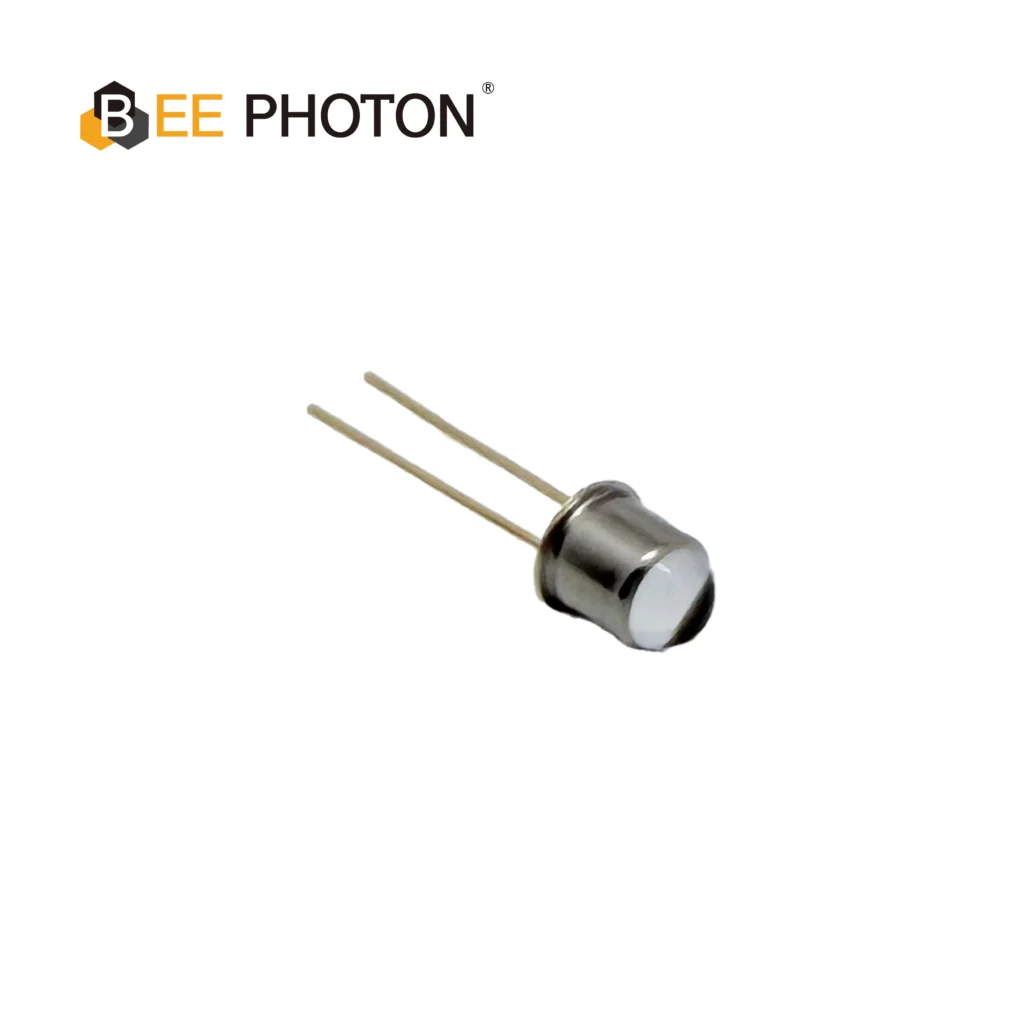
NIR-LED E850-180-201L4
Die E850-180-201L4 ist eine leistungsstarke 850nm NIR-LED für die industrielle Präzisionsmessung entwickelt. Hergestellt von Bienen-Photon, Dieser Infrarot-Strahler ist auf hohe Leuchtkraft und außergewöhnliche Stabilität ausgelegt und damit die ideale Lichtquelle für anspruchsvolle Automatisierungsumgebungen.
Punktlichtquelle vs. Oberflächenemitter: Warum die 855-nm-NIR-LED bei Präzisions-Optiksensoren gewinnt
Das wichtigste Unterscheidungsmerkmal zwischen einer generischen 850-nm-LED und einer Präzisions- 855nm NIR-LED ist oft die interne Struktur des Chips selbst.
Standard 850nm LEDs are typically “surface emitters.” The entire top surface of the semiconductor die glows, but this glow is interrupted by the wire bond pad in the middle of the chip. This creates a messy emission profile with a dark spot right where your optical system expects the brightest light. For security illumination, this does not matter. For a sub-micron optical encoder, it is a problem.
Hier kommt die spezialisierte 855nm NIR-LED Punktlichtquelle ins Spiel.
Bei einem Standard-Oberflächenemitter (typisch 850 nm) wird ein Drahtbondpad direkt in der Mitte des aktiven Emissionsbereichs platziert, was zu einem deutlichen dunklen Fleck in der Mitte des Ausgangsstrahls führt und ein diffuses Lichtmuster erzeugt.
Bei einem Punktlichtquellen-Emitter (typisch 855 nm) wird eine Maskierungsschicht über der Halbleiterstruktur aufgebracht, die eine Mikroapertur aufweist, welche die Lichtemission auf ein winziges, gleichmäßiges kreisförmiges Fenster beschränkt (z. B. 50 bis 150 Mikrometer). Der Drahtbond ist mit der Maskierungsschicht außerhalb der Apertur verbunden, sodass kein Drahtschatten entsteht und der Strahl unglaublich gleichmäßig ist.
Eliminierung des Halbschatteneffekts in Drehgebern
Wenn Sie einen hochauflösenden rotatorischen oder linearen optischen Encoder entwerfen, muss Ihr Emitter den Schatten eines beweglichen Gitters auf ein Photodioden-Array projizieren. Wenn Ihre Lichtquelle eine große Emissionsfläche hat, entsteht ein unscharfer Schattenrand, der als Halbschatten (Penumbra) bezeichnet wird.
The width of this fuzzy edge (P) is determined by the emitter’s aperture diameter (d), the distance from the emitter to the grating (g), and the distance from the grating to the detector (D):
P = d * (D / g)
If you use a standard 850nm surface emitter with an effective chip diameter of 300 micrometers, your penumbra will be relatively wide, causing phase errors and limiting your encoder’s resolution.
Wenn Sie diese gegen eine 855nm NIR-LED Punktquelle mit einer Apertur von 50 Mikrometern austauschen, verringert sich der Halbschatten um den Faktor sechs! Die resultierenden Schatten sind messerscharf, sodass Sie wesentlich feinere Gitterteilungen ohne Signalverschlechterung auslesen können.
Management von Temperaturverschiebungen bei einer 855-nm-NIR-LED
Beim Betrieb eines Sensors in einer industriellen Umgebung ist die Temperatur Ihr ständiger Feind. Alle Infrarot-Emitter auf AlGaAs-Basis leiden unter einem physikalischen Phänomen, das als thermische Rotverschiebung bekannt ist: Mit steigender Sperrschichttemperatur verringert sich die Bandlücke, und die Peak-Emissionswellenlänge verschiebt sich zu einer längeren Wellenlänge.
Für die meisten Nahinfrarot-Dioden ist dieser Temperaturkoeffizient (alpha_T) relativ konstant:
alpha_T ≈ 0,25 nm/°C bis 0,30 nm/°C
Die mathematischen Hintergründe der temperaturbedingten Rotverschiebung
Let’s look at how this thermal shift affects an 855nm NIR-LED unter typischen Betriebsbedingungen. Wir können die Peak-Wellenlänge im Betrieb mit dieser linearen Näherung berechnen:
lambda(T) = lambda_0 + alpha_T * (T_junction – T_0)
Wo:
- lambda(T) ist die Peak-Wellenlänge bei Betriebstemperatur.
- lambda_0 ist die Peak-Wellenlänge bei Raumtemperatur (üblicherweise 855 nm bei 25 °C).
- alpha_T ist der thermische Verschiebungskoeffizient (wir verwenden 0,26 nm/°C).
- T_junction ist die tatsächliche Temperatur des Halbleiterübergangs (Sperrschichttemperatur).
- T_0 ist die Referenztemperatur (25 °C).
Um die Sperrschichttemperatur (T_junction) zu bestimmen, müssen wir den durch den Betriebsstrom verursachten thermischen Anstieg berechnen:
T_junction = T_ambient + (Verlustleistung * R_thermal)
Let’s plug in some realistic numbers for a high-quality 855nm NIR-LED verpackt in einem TO-46-Metallgehäuse:
- Umgebungstemperatur (T_ambient) = 55 °C (innerhalb eines abgedichteten industriellen Sensorgehäuses).
- Durchlassstrom (If) = 80 mA.
- Typische Vorwärtsspannung (Vf) = 1,6 V.
- Thermischer Gehäusewiderstand (R_thermal) = 150 °C/W.
Berechnen Sie zunächst die Verlustleistung:
Verlustleistung = Vf * If
Power_dissipated = 1,6 V * 0,08 A = 0,128 W
Berechnen Sie nun die Sperrschichttemperatur:
T_junction = 55 °C + (0,128 W * 150 °C/W)
T_junction = 55 °C + 19,2 °C = 74,2 °C
Berechnen Sie abschließend die verschobene Peak-Wellenlänge:
lambda(T) = 855 nm + 0.26 nm/°C * (74.2°C – 25°C)
lambda(T) = 855 nm + 0,26 nm/°C * (49,2 °C)
lambda(T) = 855 nm + 12,8 nm ≈ 867,8 nm
Bei einer internen Betriebstemperatur von 74,2 °C erreicht unser 855nm NIR-LED tatsächlich einen Spitzenwert von fast 868 nm!
Warum dies für schmale Bandpassfilter wichtig ist
In many outdoor or high-ambient-light industrial environments, your sensor’s receiver needs to ignore sunlight and overhead factory lighting. To do this, engineers place an optical bandpass filter in front of the photodiode.
Wenn Sie Ihren Empfänger mit einem sehr engen Bandpassfilter entwerfen, der exakt auf 850 nm zentriert ist und eine Bandbreite von 10 nm aufweist (was bedeutet, dass er nur Licht von 845 nm bis 855 nm durchlässt), wird eine standardmäßige 850-nm-LED bei hoher Betriebstemperatur schnell aus dem Durchlassbereich driften.
For instance, at room temperature, a standard 850nm LED fits perfectly within the 845nm to 855nm transmission window. However, when operating in high ambient heat, the peak wavelength of that standard emitter redshifts to 861nm, which falls entirely outside the filter’s passband, causing a massive loss of optical signal.
Durch das Verständnis dieser Drift können Sie eine fundierte Entscheidung treffen. Einige Ingenieure verwenden gezielt eine 855nm NIR-LED paired with an 860nm or 865nm bandpass filter. This ensures that as the system warms up to its stable operating temperature, the emitter’s peak wavelength drifts directly into the sweet spot of the filter’s transmission curve, rather than drifting out of it.
Schmalstrahlende IR-Diode: Lässt sich die 855-nm-NIR-LED leicht kollimieren?
Ja, eine schmalstrahlende IR-Diode basierend auf einer 855nm NIR-LED lässt sich wesentlich einfacher kollimieren als Standard-Weitwinkel-Emitter. Da das Punktquellen-Design die Lichtemission auf einen winzigen physischen Bereich konzentriert, kann eine Kollimatorlinse sehr nah am Chip platziert werden.
Dies ermöglicht die Projektion eines engen, parallelen Strahls über weite Entfernungen mit minimaler Strahlendivergenz (oft unter 5 Grad Halbwinkel). Wenn Sie optische Lichtvorhänge, Kantenerkennungssensoren oder Reflexionsscanner bauen, verhindert dieser schmale Strahl optisches Übersprechen und stellt sicher, dass nur das Zielobjekt den Lichtweg unterbricht.

NIR-LED E850-25-001-L20
Der E850-25-001-L20 ist ein Hochleistungs 855nm NIR-LED entwickelt für anspruchsvolle industrielle Anwendungen. Hergestellt von Bee Photon, ist dieses Infrarotstrahler hat einen engen Abstrahlwinkel von 20 Grad und liefert eine hohe Strahlungsintensität von 25 mW/sr, die für Präzisionsmessungen geeignet ist. Das robuste Design sorgt für hohe Zuverlässigkeit und gleichbleibende Leistung über einen weiten Betriebstemperaturbereich.
Direkter Vergleich: 850 nm Standard-LED vs. 855 nm NIR-LED
To simplify your selection process, let’s look at how a standard, mass-produced 850nm surface-emitting LED stacks up against a precision-grade 855nm NIR-LED Punktquelle unter typischen technischen Randbedingungen.
| Technischer Parameter | 850 nm Standard-Oberflächen-LED | 855 nm NIR-LED-Punktquelle |
|---|---|---|
| Typische Emitterfläche | Großes Quadrat (ca. 300 x 300 µm) | Mikroskopischer Kreis (50 bis 150 µm Durchmesser) |
| Gleichmäßigkeit des Strahlprofils | Mäßig (beschattet durch mittige Drahtkontaktierung) | Ausgezeichnet (gleichmäßig, keine Drahtschatten) |
| Optische Brutto-Ausgangsleistung | Sehr hoch (aufgrund der großen aktiven Fläche) | Mäßig (begrenzt durch Mikroapertur) |
| Einfachheit der Kollimation | Schwierig (führt zu großer Divergenz / unscharfen Kanten) | Sehr einfach (ermöglicht kompakte, schmalstrahlende IR-Diode) |
| Spektrale Breite (FWHM) | Breit (typisch 30 nm bis 50 nm) | Schmal (typisch 15 nm bis 25 nm) |
| Typische Gehäuseformen | Kunststoff-SMD oder formgepresstes Radial-Epoxid | Hermetische TO-18 / TO-46 Metallgehäuse, Keramik-SMD |
| Primäre B2B-Anwendungsfälle | Sicherheitskameras, allgemeine IR-Beleuchtung | Drehgeber, optische Scanner, Kantensensoren |
| Relative Stückkosten | Niedrig (Preise für den Massenmarkt) | Mittel bis hoch (spezialisiert, geringe Toleranz) |
Praxisnahe Engineering-Szenarien: Wann eine 855-nm-NIR-LED eingesetzt werden sollte
Let’s look at a couple of anonymous, real-world case studies based on actual industrial designs to see how choosing an 855nm NIR-LED löste kritische Feldprobleme.
Fallstudie 1: Behebung von Phasenjitter in Roboter-Gelenk-Drehgebern
Ein Unternehmen für Industrieautomatisierung entwickelte einen hochauflösenden absoluten Drehgeber für einen mehrachsigen Roboterarm. Der Prototyp verwendete eine standardmäßige oberflächenemittierende 850-nm-SMD-LED, um Licht durch eine Chrom-auf-Glas-Encoderscheibe zu projizieren.
Während der Temperaturwechseltests bemerkte das Ingenieurteam bei Temperaturen über 50 °C erheblichen Phasenjitter und Winkelfehler.
Bei genauerer Betrachtung stellten sie fest, dass das breite Emissionsprofil und der Schatten des zentralen Bonddrahtes der 850-nm-LED dazu führten, dass sich das Lichtmuster bei thermischer Ausdehnung der LED leicht verzerrte. Diese strukturelle Verformung führte direkt zu Lesefehlern am Detektor-Array.
Die Ingenieure ersetzten den Oberflächenemitter durch eine 855nm NIR-LED Punktlichtquelle mit einer Emissionsöffnung von 100 Mikrometern. Da die Punktlichtquelle keinen Schatten durch einen zentralen Bonddraht aufweist und über einen hochsymmetrischen Strahl verfügt, erzeugte sie extrem scharfe Schattenübergänge am Fotodiodenempfänger.
Der Phasenjitter wurde vollständig eliminiert, und der Drehgeber behielt seine Genauigkeit im Sub-Bogensekundenbereich über den gesamten Betriebsbereich von -40 °C bis 85 °C bei.
Fallstudie 2: Entwurf einer optischen Lichtschranke für den Außenbereich
Ein Sicherheitsunternehmen für den Außenbereich entwickelte eine aktive Infrarot-Lichtschranke zum Schutz von Hochsicherheitsperimetern. Das System verwendete einen Sender und einen Empfänger im Abstand von 50 Metern.
Um Fehlalarme durch Sonnenlicht zu verhindern, verwendete der Empfänger einen sehr schmalen optischen 850-nm-Bandpassfilter mit einer Bandbreite von 8 nm.
In frühen Feldversuchen funktionierte das System morgens einwandfrei, verlor jedoch in der Hitze des Nachmittags häufig die Verbindung.
The problem was thermal redshift. Under direct midday sunlight, the transmitter’s internal temperature reached 65°C, causing the standard 850nm LED to drift to 861nm—completely outside the 846nm to 854nm passband of the filter.
Um dies zu beheben, wechselte das Entwicklungsteam zu einem speziellen 855nm NIR-LED gekoppelt mit einem 860-nm-Bandpassfilter.
Weil die 855nm NIR-LED beginnt naturgemäß bei einer etwas längeren Wellenlänge; seine Rotverschiebung am Nachmittag (mit Spitzenwerten um 864 nm) war auf die breiteren thermischen Toleranzen des neuen 860-nm-Filter-Setups abgestimmt. Diese geringfügige Anpassung stellte die Signalreserve wieder her und hielt die Lichtschranke selbst unter der sengenden Mittagssonne betriebsbereit.
Die Wahl des richtigen Begleiters: Fotodioden und Lichtquellen
Die Auswahl Ihres 855nm NIR-LED ist nur die halbe Miete; Sie müssen sie zudem mit einem Empfänger kombinieren, der ihren optischen Eigenschaften entspricht. Standard-Silizium-Fotodioden und PIN-Fotodetektoren weisen eine maximale spektrale Empfindlichkeit zwischen 800 nm und 950 nm auf, wodurch sie von Natur aus sowohl mit 850-nm- als auch mit 855-nm-Wellenlängen kompatibel sind.
Für optisches Scannen mit hoher Geschwindigkeit oder Präzision sollten Sie jedoch nach Fotodetektoren suchen, die integrierte Tageslichtsperrfilter oder kundenspezifische Antireflexbeschichtungen (AR) bieten, die für das 850-860-nm-Fenster optimiert sind. Wenn Ihr Sensor in Hochfrequenzumgebungen betrieben wird (z. B. optische Kommunikation im Gigahertz-Bereich oder Time-of-Flight-Entfernungsmessung), stellt die Sicherstellung, dass sowohl Ihr 855nm NIR-LED als auch Ihr Fotodetektor physikalisch aufeinander abgestimmt sind, sicher, dass Signaldämpfung verhindert wird und die Anstiegs-/Abfallzeiten extrem präzise bleiben.
Wenn Sie Komponenten beschaffen, empfehlen wir die Untersuchung von Hochleistungs- Infrarot-Lichtquellen um Emitter mit präzise gesteuerten Strahlformen und minimaler räumlicher Verzerrung zu finden.

Si-PIN-Photodioden-Array PDCA02-602
Die Bee Photon PDCA-Serie wurde speziell für den Einsatz in Hintergrundunterdrückung Photodiode zur Lösung komplexer Detektionsaufgaben in industriellen Umgebungen. Durch die Verwendung einer hochpräzisen Zwei-Segment-Architektur (PD A und PD B) ermöglicht dieses Gerät eine differenzielle Signalverarbeitung und filtert Hintergrundstörungen effektiv aus. Es ist die erste Wahl für Hersteller, die zuverlässige optische Schalter und Näherungssensoren mit Hintergrundausblendung entwickeln.
FAQ: Schnelle Antworten für Ingenieure im optischen Design
Ist eine 855-nm-NIR-LED für das menschliche Auge sichtbar?
Not for practical illumination purposes, but yes, you can see a very faint red glow if you look directly at the emitter in a completely dark room. This occurs because the wide tail of the LED’s spectral emission curve slightly bleeds into the extreme edge of human vision (which ends around 780nm). An 855nm NIR-LED wird ein etwas weniger sichtbares rotes Leuchten aufweisen als eine Standard-850-nm-LED, ist jedoch nicht vollständig unsichtbar wie ein 940-nm-Emitter.
Kann ich eine 850-nm-LED direkt durch eine 855-nm-NIR-LED ersetzen?
In den meisten Fällen ja, die elektrischen Parameter sind nahezu identisch. Die Durchlassspannung eines 855nm NIR-LED is typically around 1.5V to 1.7V, which matches standard 850nm drivers. However, if your system uses a very narrow optical filter, you must verify that the 5nm shift does not push your emitter’s output outside the filter’s transmission band.
Was unterscheidet eine 855-nm-NIR-LED von einer Laserdiode?
Eine Laserdiode emittiert kohärentes, hochgradig monochromatisches Licht mit einer spektralen Breite (FWHM) von weniger als 1 nm. Eine 855nm NIR-LED emittiert inkohärentes Licht über eine breitere spektrale Breite (typischerweise 15 nm bis 30 nm). LEDs sind weitaus unempfindlicher gegenüber elektrostatischer Entladung (ESD), haben eine längere Lebensdauer, erfordern keine komplexen Sicherheitszertifizierungen und sind für industrielle B2B-Sensoren deutlich kosteneffizienter.
Wo kann ich eine hochwertige 855-nm-NIR-LED kaufen?
Wenn Sie ein 855nm NIR-LED für ein industrielles Präzisionsprodukt beziehen, sollten Sie mit einem spezialisierten Optoelektronik-Hersteller zusammenarbeiten. Standard-Katalogdistributoren führen oft generische Beleuchtungs-LEDs, aber hochpräzise Punktlichtquellen erfordern ein spezialisiertes Binning und Testverfahren.
Eine breite Palette zuverlässiger Lichtquellen in Industriequalität und darauf abgestimmter Fotodetektoren finden Sie direkt über BeePhoton.
Ihr optisches Design auf Anhieb richtig gestalten
Bei der Wahl zwischen 850 nm und 855 nm geht es nicht nur um die Auswahl einer Zahl in einem Datenblatt. Es geht darum zu verstehen, wie Ihr System mit thermischer Drift, optischem Rauschen und Lichtkollimation umgeht. Wenn Sie eine einfache Sicherheitskamera bauen, ist die Standardwellenlänge von 850 nm oft ausreichend. Wenn Sie jedoch einen Encoder, ein Ausrichtungssystem für Laser-Entfernungsmesser oder einen hochpräzisen medizinischen Sensor bauen, wird Ihnen der Einsatz einer 855nm NIR-LED Punktquelle später unzählige Stunden bei der Fehlersuche ersparen.
Unter BeePhoton, unterstützen wir F&E-Teams beim Design, dem Prototyping und der Fertigung kundenspezifischer optischer Sensorkonfigurationen. Ganz gleich, ob Sie Hilfe bei der Auswahl eines Schmalstrahlemitters, der Abstimmung einer Fotodiode auf Ihre spezifische Wellenlänge oder der Beschaffung hochzuverlässiger Infrarot-Lichtquellen, unser Ingenieurteam hilft Ihnen gerne weiter.
Haben Sie ein anspruchsvolles optisches Design auf Ihrem Tisch?
Kontaktieren Sie uns direkt über unser Kontaktseite oder senden Sie eine E-Mail an unsere Technikabteilung unter info@photo-detector.com mit Ihren Projektspezifikationen. Wir unterstützen Sie bei kundenspezifischen Gehäuselösungen, spezialisiertem Wellenlängen-Binning und schnellem Prototyping, damit Sie Ihren Sensor souverän auf den Markt bringen können.


