Let’s be honest for a minute. If you are managing a fleet of cranes or designing the safety systems for heavy machinery, the “nightmare scenario” isn’t a blown hydraulic seal or a delayed parts shipment.
It’s gravity winning.
It’s a boom swinging into a pylon because the operator was fighting glare. It’s a crawler crane tipping over because the load moment calculation was based on a guess rather than hard data. We talk about safety protocols until we are blue in the face, but protocols don’t stop physics. When a load swings too far, or a blind spot hides a structural beam, you need more than a guy with a walkie-talkie and a vest on the ground.
You need crane safety sensors that react faster than a human brain ever could.
I’ve spent a long time digging into the optoelectronics side of industrial automation safety, specifically looking at how we turn light into data. And I’m going to tell you something that might annoy some old-school mechanical engineers: if you aren’t using advanced optical sensing—specifically high-response Si-PIN-Fotodioden—you are essentially operating in the dark.
In this deep dive, we are going to break down how optical sensors are changing the game for crane stability and obstacle detection. No fluff, just the engineering reality of why light beats mechanical switches every time.
The Problem: When “Gut Feeling” Fails
Here is the dirty truth about heavy machinery operations: they are unforgiving.
According to data that keeps popping up from labor bureaus globally, crane-related accidents are stubbornly persistent. A massive chunk of these are “struck by object” or “transportation incidents” (tipping). Why? It’s rarely because the steel snapped. It’s usually because the machine was pushed beyond its stability limits, or it hit something nobody saw.
The Human Limitation
Old-school operators are artists. They rely on “seat-of-the-pants” feelings to judge stability. They watch the boom deflection. They squint to gauge the distance to a building.
But you can’t guess with 50 tons of steel in the air. A human eye has a refresh rate of roughly 60Hz (ish) and terrible depth perception beyond 20 meters. A high-speed optical sensor? It measures reality in nanoseconds.
To truly solve this, we need to measure three things with absolute precision:
- Distance to obstacles (Precision needs to be under 1cm).
- Boom deflection angle (down to fractions of a degree).
- Load sway velocity.
You can’t do that with a limit switch. You need light.
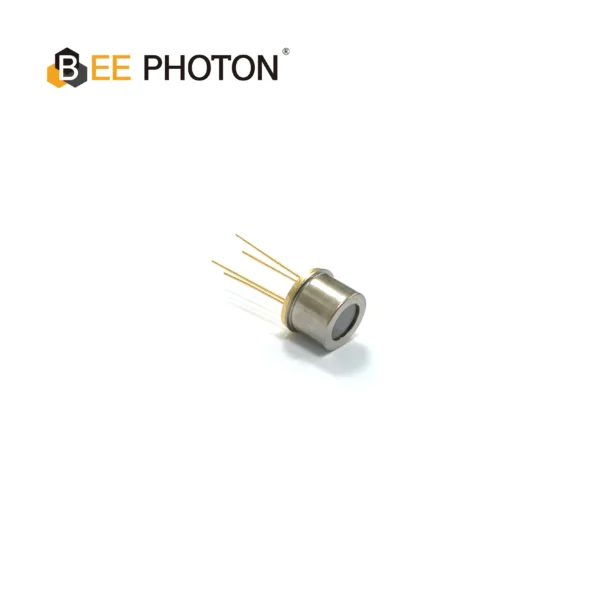
Si-PIN-Photodioden-Array Doppel-PD PDCA02-201
Die PDCA02-201 ist eine hochpräzise Photodioden-Array für analytische Instrumente, mit einem robusten TO5-Gehäuse und zwei Sensorelementen. Dieser Si-PIN-Detektor wurde für überragende Empfindlichkeit und geringes Rauschen entwickelt und bietet außergewöhnliche Genauigkeit für Spektroskopie, medizinische Diagnostik und wissenschaftliche Forschungsanwendungen.
How Optical Sensors Actually Work (Without the Confusing Math)
Okay, let’s get under the hood. When we talk about optical sensors in cranes, we are mostly talking about LiDAR (Light Detection and Ranging) and laser distance meters.
At the heart of these systems—the component that actually catches the light and turns it into a digital signal—is the photodiode. Specifically, Si-PIN-Fotodioden.
Why do we use Si PIN (Silicon PIN) technology instead of just a standard light sensor? Because they are fast. We are talking about response times that are measured in nanoseconds. In safety, speed is everything.
The Time-of-Flight (ToF) Principle
Most obstacle detection photodiodes work on the Time-of-Flight principle. The system shoots a laser pulse at an object (like a building or another crane), the pulse bounces back, and the sensor catches it.
The sensor needs to calculate the distance based on how long that trip took. Since we can’t use complex LaTeX code here, let’s look at the formula in a way that makes sense for your programming team:
The Distance Formula
Distance = (Speed of Light × Time) / 2
- Speed of Light: Roughly 300,000,000 meters per second.
- Time: The gap between sending the pulse and receiving the echo.
- Division by 2: Because the light has to travel there and back.
This looks simple, right? But here is the catch.
If an obstacle is 10 meters away, the time difference is roughly 66 nanoseconds.
66 nanoseconds. That is incredibly short.
If your photodiode is “sluggish” (has a slow rise time) or “noisy” (high dark current), you screw up the calculation. You might think the wall is 11 meters away when it’s actually 10. That 1-meter difference is the difference between a safe stop and a $500,000 accident.
Unter BeePhoton, we see engineers trying to cut costs with generic photodiodes all the time. They save $5 on a component and end up with a sensor that has a 5% margin of error. That isn’t engineering; that’s gambling.
Crane Stability: Managing the “Overturning Moment”
Stability isn’t just about not hitting things; it’s about not falling over. Modern cranes use Load Moment Indicators (LMIs) to stop the operator from lifting a load that will tip the crane.
Optical sensors play a huge role here by measuring boom deflection. As the load increases, the boom bends. By placing optical targets or laser scanners along the boom, we can measure the exact curvature.
The physics of tipping relies on the “Moment.”
The Stability Formula
Moment = Load Weight × Horizontal Distance
The “Horizontal Distance” is the tricky part. It’s the distance from the crane’s center of rotation to the load’s center of gravity.
If the boom bends, that distance increases. If your sensors aren’t reading that deflection accurately because of vibration or sun glare, your LMI calculates the wrong moment. The computer thinks you are safe, but gravity disagrees.
High-quality optical sensors use distinct wavelengths (often near-infrared, around 905nm) and optical filtration to ignore the sun and focus only on the laser return signal. This ensures that the distance variable in your formula is accurate to the millimeter.
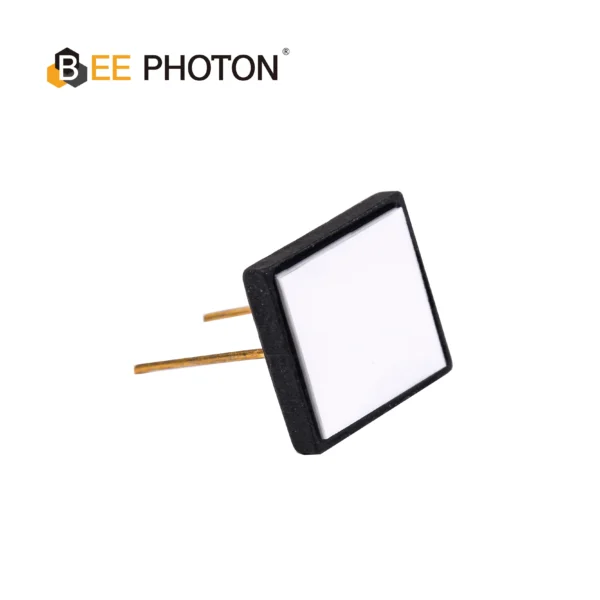
Si-PIN-Photodiode mit Szintillantor PDCD34-102
Die Si-PIN-Photodioden mit Szintillator von Bee Photon bieten eine hervorragende Röntgen- und Gammastrahlendetektion: Unsere GOS-Szintillator-Photodiode gewährleistet eine hohe Lichtleistung und ein minimales Nachleuchten für eine präzise Bildgebung.
Obstacle Detection: Why Optical Beats Radar (Sometimes)
I get into arguments about this a lot at trade shows. Engineers ask, “Why not just use radar? It sees through fog better.”
Sure, radar is great for big, chunky detection. But radar has poor angular resolution. If you are operating a crane in a dense city construction site, radar might tell you “something is there.”
Optical sensors with high-quality photodiodes tell you: “There is a rebar sticking out 30 degrees to the left at 15.4 meters.”
Here is a quick breakdown of why we lean towards optical for precision tasks:
Comparison: Optical vs. Other Sensors
| Merkmal | Optical Sensors (LiDAR) | Ultrasonic Sensors | Radar (mmWave) |
|---|---|---|---|
| Bereich | Long (up to 100m+) | Short (< 10m) | Medium/Long |
| Precision | Very High (mm) | Low (cm) | Medium (cm) |
| Reaktionsgeschwindigkeit | Fast (Nanoseconds) | Slow (Milliseconds) | Fast |
| Target Resolution | High (Small objects) | Low (Big objects only) | Mittel |
| Weakness | Heavy Dust/Thick Fog | Wind & Noise | Metal Reflections |
Für crane safety sensors, a hybrid approach is often best. But for the precision maneuvers—positioning a shipping container on a truck bed or avoiding a specific structural beam—optical is king.
The “Secret Sauce”: Signal-to-Noise Ratio
This is the part most blog posts skip because it gets technical, but if you are buying components, you need to know this.
The biggest challenge for an optical sensor on a crane is the sun. The sun is a giant nuclear explosion emitting massive amounts of light across all spectrums. Your little photodiode is trying to see a tiny laser reflection while staring into the sun.
This is where the quality of the Si-PIN-Fotodiode matters.
You need a diode with a low Dunkler Strom. Dark current is the electric current that flows through the sensor even when there is no light. It’s “noise.”
- High Dark Current: The sensor is noisy. It can’t distinguish the weak laser echo from its own internal static. It fails in bright sunlight.
- Low Dark Current (What we do): The sensor is quiet. It can detect the faintest returning signal even on a sunny day.
If you are sourcing components, ask the supplier about their “NEP” (Noise Equivalent Power). If they can’t answer, run away.

Si-PIN-Photodiode mit erhöhter UV-Empfindlichkeit (190-1100nm) PDCD100-F01
Unsere Si-PIN-Photodiode gewährleistet eine hohe Empfindlichkeit und Zuverlässigkeit für analytische Instrumente. Diese ultraviolette (UV) empfindliche Photodiode mit Quarzfenster bietet präzise Messungen von 190nm bis 1100nm.
Real Talk: A “Project Harbor” Case Study
I want to share a story (names changed to protect the client, obviously) about a port operator in Southeast Asia. Let’s call them “Port X.”
Port X was running older rubber-tired gantry cranes (RTGs). They relied on operators to visually judge the distance between the spreader (the thing that grabs the box) and the container stack.
They had a “minor” collision about once a month. Scratched paint, dented containers. Management treated it as the “cost of doing business.”
Then they had a bad one. Night shift, heavy tropical rain. The operator misjudged the height of a stack by two meters. The spreader slammed into a container filled with high-end consumer electronics. The damage was over $200,000.
They called us asking about sensor upgrades. They didn’t need a whole new crane; they just needed better eyes.
Die Lösung:
We helped them spec out a LiDAR solution using high-sensitivity Si-PIN-Fotodioden capable of handling low-light signal returns. We chose a sensor package that operated at 905nm with a narrow bandpass filter to cut through the rain interference.
Das Ergebnis:
They retrofitted 12 cranes.
- Cost of retrofit: Roughly $15,000 per crane.
- Collisions in the next 12 months: Zero.
- Unexpected Bonus: The operators actually moved containers faster. Why? Because they stopped second-guessing their depth perception. The screen gave them the exact distance, so they could drop the spreader confidently.
Installation & Retrofitting: Don’t Mess It Up
If you are convinced that you need optical sensors, here is some practical advice on installing them. I’ve seen great sensors fail because of bad installation.
1. Vibration is the Enemy
Cranes shake. A lot. If you mount a laser sensor on a flimsy bracket, the laser dot will dance around at 50 meters like a cat toy.
- Tip: Use rigid, machined mounts. Use rubber isolation dampers if the frequency is high.
2. Keep the Lens Clean (Automatically)
Optical sensors need to see. Dust, grease, and bird droppings are inevitable.
- Tip: Design your housing with a positive air pressure purge. A small stream of compressed air blowing over the lens keeps dust from settling. It’s a cheap fix that saves hours of maintenance.
3. Cable Management
Cranes extend and retract. Your sensor cables need to survive this.
- Tip: Use high-flex “robotic” grade cables. Standard PVC cables will crack after a few thousand cycles of the boom extending.
A Controversial Opinion: Stop Blaming Operators for “Human Error”
It’s easy to blame the guy or gal in the cab when things go wrong. “Operator error” is the favorite phrase of insurance adjusters.
But I have a different take. If you give an operator a machine with massive blind spots and ask them to work 10-hour shifts, you are setting them up to fail. Relying solely on human vision in 2026 is irresponsible engineering.
The human brain gets tired. A photodiode does not.
If your machine doesn’t have an active industrial automation safety layer that can override a human mistake, your design is flawed. Period. We have the technology to prevent these accidents. Not using it is a choice.
Integrating BeePhoton Into Your Safety Loop
So, where do we fit in?
BeePhoton specializes in the component level. We don’t build the crane; we build the “retina” of the crane’s eye.
If you are a manufacturer of Load Moment Indicators (LMI) or Crane Anti-Collision Systems, you need a photodetector source that understands the stakes. Our Si-PIN-Fotodioden are batch-tested for consistency. We don’t send you a bag of parts and wish you luck.
We work with your engineering team to ensure the signal-to-noise ratio is high enough to detect a concrete block through a dust storm. We can help you choose the right active area size—balancing speed (capacitance) with sensitivity.
Common Applications for Our Sensors:
- Boom Angle Monitoring: High-precision optical encoders.
- Anti-Two-Block Systems: Preventing the hook block from hitting the boom tip.
- Lidar Mapping: Scanning the job site for dynamic obstacles (people, trucks).
- Spreader Positioning: Helping port cranes lock onto containers instantly.
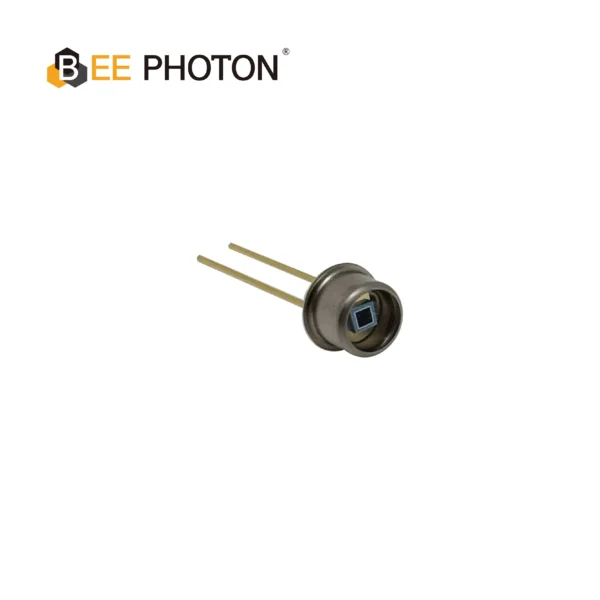
Si-PIN-Photodiode mit erhöhter UV-Empfindlichkeit (190-1100nm) PDCT01-F01
Erleben Sie präzise UV-Detektion mit unserer Quarzfenster-Si-PIN-Photodiode. Sie ist ideal für die Spektroskopie und bietet eine hohe Empfindlichkeit und ein geringes Rauschen im Bereich von 190-1100nm. Diese zuverlässige Si-PIN-Photodiode gewährleistet genaue Analyseergebnisse.
FAQ: Questions We Get Asked by Engineers
Q1: Can optical sensors really work in heavy dust or fog?
A: Yes, but it depends on the technology. While visible light gets blocked, modern “multi-echo” technology allows the sensor to ignore the first return (the fog/dust) and read the second return (the hard object). Also, using high-power infrared diodes (like those available at BeePhoton) helps punch through particulate matter much better than standard visual cameras.
Q2: How often do these sensors need calibration?
A: In a high-vibration environment like a crane, mechanical alignment should be checked during routine maintenance (every 3-6 months). However, the Si PIN photodiode itself—the solid-state component—does not degrade significantly over time. It’s usually the mounting bracket that shifts, not the electronics that fail.
Q3: Is LiDAR better than cameras for crane safety?
A: For distance measurement? Absolutely. Cameras provide a 2D image and rely on software to “guess” depth (stereovision). This requires massive processing power and can be fooled by shadows or low contrast. LiDAR gives you exact XYZ coordinates instantly. A laser pulse cannot be fooled by a shadow. For ultimate safety, the best systems fuse both: cameras for the operator to see, and LiDAR for the machine to measure.
Q4: What is the lifespan of a typical Si PIN photodiode in industrial use?
A: These are solid-state devices with no moving parts. Unless they are subjected to voltage spikes or temperatures outside their rating (usually -40°C to +85°C), they can last for decades. They are the most reliable part of the entire sensor system.
Time to Upgrade Your Vision
You wouldn’t drive a car with a muddy windshield. You wouldn’t fly a plane without an altimeter. So why run a crane with blind sensors?
Whether you are building the next generation of automated port machinery or retrofitting a fleet of construction cranes, the quality of your optical components dictates the safety of your site.
Crane safety sensors are not just an accessory; they are the difference between a productive day and a catastrophic one.
Ready to discuss your specific requirements? Do you need a custom photodiode array or advice on integration?
Contact BeePhoton today. Or shoot us an email at info@photo-detector.com. Let’s make sure your machinery sees everything coming.