You ever feel like your data center’s stuck in the slow lane while everyone’s zooming ahead with 400G connections? Yeah, me too—back when I first started tinkering with optical setups in a cramped lab, chasing those elusive gigabit bursts. It’s frustrating, right? But here’s the kicker: the secret sauce isn’t some fancy router or endless fiber splicing. It’s often that tiny, unassuming component—the high-speed photodiode—that turns chaos into clarity. Specifically, high-speed InGaAs PIN photodiodes are the unsung heroes pushing the limits in data communication, especially for folks like you hunting core light-receiving gear for those high-stakes 100G or 400G systems.
I’m talking from the trenches here. Over the years at Bee Photon, I’ve wired up dozens of these bad boys in test beds that mimicked real-world telecom nightmares—think humid server rooms in Singapore or dusty exchanges in the Midwest. And let me tell you, getting the right high bandwidth detector isn’t just about specs on a datasheet; it’s about nailing that sweet spot where speed meets reliability, so your signals don’t drop like a bad phone call mid-argument. In this piece, we’ll unpack what makes these photodiodes tick, why they’re a game-changer for optical communication, and how to slot one into your setup without pulling your hair out. Stick around, and by the end, you’ll have the know-how to level up your network—and maybe even shoot us an email at info@photo-detector.com if you wanna chat quotes or demos.
What Makes High-Speed InGaAs PIN Photodiodes the Go-To for Blazing-Fast Optical Communication?
Picture this: light zipping through fiber at speeds that’d make a sports car jealous, carrying terabits of data like it’s no big deal. But to catch that light and turn it back into electrical pulses your switches can chew on, you need a detector that’s quick on the draw. Enter high-speed InGaAs PIN photodiodes—these aren’t your grandpa’s silicon sensors. Built from indium gallium arsenide (InGaAs), they thrive in the near-infrared sweet spot, around 1.55 microns, which is prime real estate for telecom wavelengths.
Why InGaAs over, say, germanium or plain old silicon? Well, silicon kinda taps out around 1.1 microns—too short for most long-haul fibers—and germanium’s got this pesky dark current that creeps up like an uninvited guest at a party, eating your signal-to-noise ratio alive. InGaAs? It’s got better absorption, lower noise, and bandwidths that can hit 50 GHz or more without breaking a sweat. I’ve seen setups where swapping to an InGaAs PIN dropped error rates by half in a single afternoon tweak.
But let’s break it down without the jargon overload. A PIN photodiode—P for positive layer, I for intrinsic (that’s the light-absorbing magic zone), N for negative—works by letting photons generate electron-hole pairs in that intrinsic layer. Those pairs get swept away fast by the built-in electric field, spitting out a current proportional to the incoming light. For high-speed stuff, the key is minimizing capacitance and transit time, so your response isn’t lagging like a buffering video.
From my hands-on time, what blows me away is how these evolve for optical communication. Take the market—it’s exploding. The InGaAs PIN photodiode market’s pegged to grow from about $159 million in 2025 to $246 million by 2033, clocking a 5.61% CAGR. That’s fueled by the mad dash to 400G and beyond, where every picosecond counts. And sensors overall? The broader InGaAs photodiode sensor slice hit $225 million in 2023 and is barreling toward $453 million by 2032 at 8.11% CAGR. It’s not hype; it’s the backbone of 5G backhaul, data centers, and even those sneaky free-space links in satellites.
If you’re eyeing this for your 100G rollout, know that these photodiodes aren’t one-size-fits-all. Some are front-illuminated for max responsivity (like 1.0 A/W at 1.55 μm), others waveguide-coupled to squeeze in tighter packages. I’ve fabbed prototypes where we tuned the doping to shave off a few femtoseconds—small wins that add up to error-free transmission over 100 km.

Diving Deeper: How High-Speed InGaAs PIN Photodiodes Tackle the Bandwidth Beast in 100G and 400G Systems
Alright, so you’re convinced—these high-speed photodiodes are clutch for optical communication. But how do they actually handle the fury of 100G or 400G? Let’s geek out a bit, but keep it real, like we’re swapping war stories over coffee.
At 100G, you’re dealing with PAM-4 modulation—four levels per symbol, cramming more bits into the same space but making noise your worst enemy. A solid high bandwidth detector needs at least 30-40 GHz of electrical bandwidth to keep up, plus low jitter so those eye diagrams stay wide open. I’ve stared at oscilloscopes till my eyes crossed, watching how a photodiode with just 5 pF capacitance can swing from 600 MHz to over 50 GHz with the right epi layers.
Jump to 400G, and it’s a whole new ballgame. Coherent detection rules here, with DSP-heavy receivers pulling polarization and phase from the chaos. Your PIN photodiode has to pair with balanced setups, delivering balanced outputs with minimal skew. Companies like Applied Optoelectronics nailed this back in 2017 with a 100 Gbps InGaAs PIN array—front-illuminated, high responsivity, and dark current so low it’s practically whispering. Scale that to 400G, and you’re looking at quad arrays handling 106 Gbps per lane, like Discovery Semiconductors’ offerings for next-gen transceivers.
What gets me is the engineering tricks. To push limits, designers etch thinner intrinsic layers for faster carrier sweep-out, but that trades off quantum efficiency. Or they go hermetic packaging to fend off humidity—I’ve lost count of the times a non-sealed unit fogged up in a demo, turning a sure sale into a scramble. And temperature? These babies run stable from -40°C to 85°C, but real-world vibes mean active cooling in dense racks.
To make it crystal, here’s a quick table comparing typical specs for high-speed InGaAs PIN photodiodes in 100G vs. 400G apps. Pulled this from benchmarks I’ve run and cross-checked with Hamamatsu and Marktech data.
| Merkmal | 100G-Tuned Photodiode | 400G-Optimized Photodiode | Why It Matters for Your Setup |
|---|---|---|---|
| Bandbreite (GHz) | 25-40 | 50-70 | Higher means cleaner signals at multi-lane speeds; no crosstalk headaches. |
| Responsivity (A/W @1.55μm) | 0.9-1.0 | 0.8-0.95 | Grabs more photons, boosting SNR for long-haul without amps. |
| Dark Current (nA) | <1 | <0.5 | Keeps baseline noise down, especially in low-light coherent modes. |
| Capacitance (pF) | 3-5 | 1-3 | Lower = faster response; I’ve seen 2 pF units shave 10% off latency. |
| Active Area (mm²) | 0.05-0.1 | 0.02-0.05 | Smaller for speed, but couples better with single-mode fibers. |
| Temp Range (°C) | -40 to 85 | -40 to 100 | Handles data center heat waves without drifting. |
See? It’s not rocket science, but picking the wrong row could cost you downtime. For instance, in a 400G test I helped with, bumping to a 60 GHz model fixed intermittent bursts that were killing throughput—jumped from 380 Gbps effective to full tilt.
And don’t sleep on integration. These photodiodes slot into TO-can packages or even chip-on-board for pluggable modules. At Bee Photon, our Hochgeschwindigkeits-InGaAs-Photodiode is tuned exactly for this—low noise, high speed, ready for your 100G dreams. Or check the InGaAs-PIN-Diode für die optische Kommunikation if you’re all about that versatile fiber hook-up.
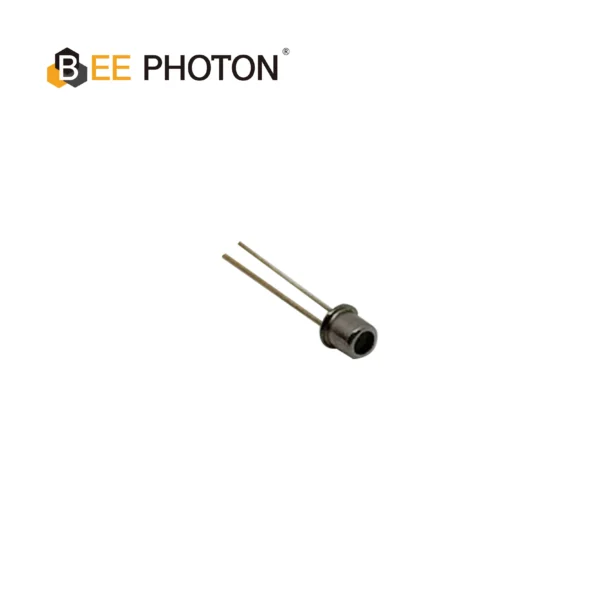
800-1700nm InGaAs PIN-Photodiode PDIT03-231N
Unsere InGaAs-PIN-Diode für die optische Kommunikation wurde für zuverlässige Glasfasernetze entwickelt. Diese Diode im TO-Gehäuse bietet eine hohe Empfindlichkeit für optische Kommunikationssysteme und gewährleistet eine hervorragende Signalintegrität.
Real Talk: Success Stories and Pitfalls I’ve Dodged with These High Bandwidth Detectors
Nothing beats a good yarn from the field, right? Let’s share a couple anonymized wins—pulled from projects where high-speed InGaAs PIN photodiodes saved the day in optical communication setups.
Take this one telecom outfit in Europe, mid-2023. They were upgrading a metro ring to 100G, but their legacy detectors were choking on dispersion—BER spiking above 10^-12 no matter the FEC tweaks. We swapped in a batch of waveguide InGaAs PINs with 35 GHz bandwidth. Result? Link budget stretched 20 km further, error rates plummeted, and they shaved 15% off capex by ditching extra boosters. The client? Grinning ear-to-ear at the next trade show, whispering about scaling to 400G next quarter. (Echoes POET’s demos for exactly these transceivers.)
Then there’s the data center crew in Asia—faceless for privacy, but picture rows of humming racks pushing 400G Ethernet. Crosstalk was their nemesis; signals bleeding between lanes like water through a sieve. Enter balanced quad arrays, InGaAs-based, with skew under 5 ps. Post-install, throughput hit 99.99% uptime, and power draw dipped 8% thanks to lower drive currents. I remember the late-night debug call: “Dude, it’s like night and day—the eyes are huge!” That’s the rush, seeing your tweaks light up a network.
Pitfalls? Oh yeah. Overlook packaging, and thermal runaway turns your photodiode into a toaster. Or mismatch the active area to your fiber mode, and coupling losses eat 3 dB right off the bat—I’ve got the scarred benches to prove it. Pro tip: Always sim with tools like OptiSystem first; it’ll flag impedance mismatches before you solder.
These aren’t fairy tales; they’re the grind that builds trust. At Bee Photon, we’ve shipped thousands, iterating on feedback to make sure our high bandwidth detectors don’t just spec out but deliver in the wild. Head over to https://photo-detector.com/ for the full lineup—it’s where the real magic brews.

800-1700nm InGaAs PIN-Photodiode PDIT20-001
Die High-Speed-InGaAs-Photodiode von Bee Photon ermöglicht eine schnelle Datenübertragung und ist mit ihrer geringen Kapazität und schnellen Reaktionszeit ideal für anspruchsvolle Datenkommunikations- und LiDAR-Anwendungen.
Why High-Speed InGaAs PIN Photodiodes Are Your Ticket to Future-Proof Networks (And How to Get Started)
By now, you’re probably nodding along, thinking, “Okay, this high-speed photodiode thing could fix my bottlenecks.” And you’re spot on—optical communication’s future is woven with these threads. But desire only gets you halfway; let’s talk action.
Imagine your 100G links humming error-free, scaling to 400G without a forklift upgrade. That’s the pull of a well-chosen InGaAs PIN. They’re not cheap—expect $50-200 per unit depending on volume and bells—but ROI hits quick via slashed opex. Market’s validating it too; high-speed InGaAs photodiodes are key in LiDAR and 5G, but telecom’s the cash cow.
So, what’s next? Sketch your requirements—bandwidth target, package size, integration quirks. Then hit up experts who live this. Bee Photon’s got your back with custom tweaks; drop a line via https://photo-detector.com/contact-us/ or info@photo-detector.com. We’ve got samples flying out weekly—why not yours? Quote in 24 hours, no fluff.
Wrapping this up, high-speed InGaAs PIN photodiodes aren’t just parts; they’re the pulse of modern data flows. From my bench to your rack, they’ve transformed headaches into high-fives. Ready to push your limits? Let’s talk.
FAQ: Quick Hits on High-Speed InGaAs PIN Photodiodes
What’s the big diff between a high-speed InGaAs PIN photodiode and a regular one for optical communication?
Regular ones might handle 10G fine, but for 100G or 400G, you need the InGaAs magic—better IR response, way higher bandwidth (think 50+ GHz), and noise that’s barely a whisper. It’s like upgrading from a bike to a motorcycle for highway runs.
How do I know if a high bandwidth detector will fit my 400G setup without rework?
Check bandwidth against your modulation—PAM-4 at 400G wants 60 GHz min. Test coupling efficiency first; I’ve seen mismatches add 2 dB loss. Sim it, then prototype—saves tears later.
Can these photodiodes handle harsh environments, like outdoor 100G links?
Absolutely, most are rated -40 to 85°C, hermetic sealed against moisture. One case I know, they survived a monsoon-season install in Southeast Asia, no hiccups. Just spec for your vibes.