So you’re stuck on a circuit design. You’ve got a board on your bench, you’re trying to pull a tiny optical signal out of the noise floor, and it’s just not working. The scope trace looks like a fuzzy caterpillar.
I’ll just say it: if you are still relying on a legacy BPW34S for modern low light detection, you are shooting yourself in the foot.
Yeah, I know. It’s a controversial opinion. People love the BPW34S. It’s been around forever, it’s cheap, and it’s in every textbook. But it’s kinda like using a flip phone in 2026. It works for basic stuff, but when you actually need precision, it falls apart. A lot of engineers over look this and just keep dropping the same old part into new schematics out of pure habit.
If you want to fix your signal-to-noise ratio (SNR) problems, you need a serious BPW34S upgrade. Specifically, you need a high sensitivity photodiode that was actually built for today’s crazy-low tolerances. Let’s break down why swapping to the PDCP08-502 high sensitivity photodiode from BeePhoton changes everything for your next low light detection project.
The dirty secret about legacy sensors in low light detection
Look, the BPW34S was great for its time. But when you are dealing with low light detection—think medical fluorescence, weak scatter measurements, or precision optical switching—the rules change.
In low light detection, your signal is tiny. We’re talking nano-amps or even pico-amps of photocurrent. When your signal is that small, the background noise of the sensor itself becomes the loudest thing in the room. You can’t just fix this by throwing a bigger amplifier at it. If you amplify a noisy signal, you just get a bigger noisy signal.
This is exactly why you need a high sensitivity photodiode. A true high sensitivity photodiode doesn’t just produce more current per photon; it produces less noise.
Most engineers think “sensitivity” just means responsivity (Amps per Watt). But in the real world of precision engineering, a high sensitivity photodiode is all about the noise floor. You need an incredibly low dark current and a massive shunt resistance. If your current sensor doesn’t have that, you definetly need a BPW34S upgrade.
Let’s do the noise math real quick
I know, nobody likes doing the math, but we gotta look at why a high sensitivity photodiode matters.
When you use a high sensitivity photodiode at zero bias (photovoltaic mode) or very low reverse bias (like 10mV) to minimize dark current, the dominant noise source is Johnson-Nyquist thermal noise from the photodiode’s internal shunt resistance.
Here is the formula for thermal noise current in plain text:I_thermal = sqrt( 4 * k * T * B / R_sh )
Wo:
kis Boltzmann’s constantTis absolute temperatureBis your circuit’s bandwidthR_shis the shunt resistance of your high sensitivity photodiode
Notice where R_sh is? It’s in the denominator. That means the higher your shunt resistance, the lower your thermal noise.
A standard BPW34S typically has a shunt resistance around 40 MΩ to 50 MΩ. Not great.
Now look at the PDCP08-502 high sensitivity photodiode. It has a typical shunt resistance of 2 GΩ (Giga-ohms!).
Do the math: sqrt( 2,000,000,000 / 40,000,000 ) = sqrt(50) = ~7.07.
By just performing this BPW34S upgrade and dropping in this specific high sensitivity photodiode, you cut your thermal noise floor by a factor of 7. That is massive. That’s the difference between seeing your signal and seeing nothing but static.
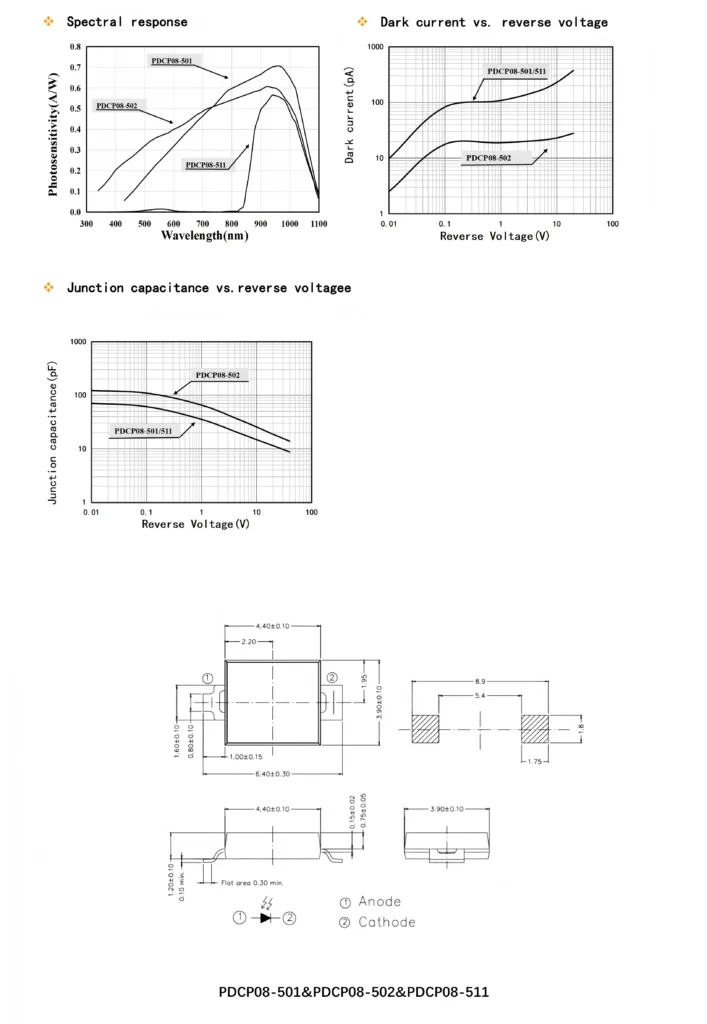
Spec throwdown: BPW34S vs PDCP08-502 High Sensitivity Photodiode
Let’s look at the actual numbers. If you are going to pitch a BPW34S upgrade to your boss or your design team, you need hard data. Here is how a legacy sensor compares to a modern high sensitivity photodiode like the PDCP08-502.
| Specification | Legacy BPW34S (Typical) | PDCP08-502 High Sensitivity Photodiode | Why It Matters for Low Light Detection |
|---|---|---|---|
| Aktiver Bereich | 2.73 × 2.73 mm | 2.9 × 2.8 mm | Nearly identical size makes the BPW34S upgrade mechanically easy. |
| Spektralbereich | 400 – 1100 nm | 340 – 1100 nm | The high sensitivity photodiode reaches deeper into the UV range (340nm). |
| Peak-Wellenlänge | 900 nm | 920 nm | Better matched for modern near-IR LED and laser emitters. |
| Dunkler Strom | ~2 nA (at 10V) | 5 pA typ, 100 pA max (at 10mV) | 5pA is insanely low. This high sensitivity photodiode eliminates DC baseline drift. |
| Shunt Resistance | ~40 – 50 MΩ | 0.1 GΩ min, 2 GΩ typ | A 2 GΩ Rsh means this high sensitivity photodiode has drastically lower thermal noise. |
| Übergangskapazität | ~70 pF (at 0V) | 125 pF typ (at 0V) | You accomodate the slightly higher capacitance easily in your TIA design. |
Data based on standard industry datasheets and BeePhoton’s PDCP08 Series specs.
Look at that dark current. 5 pico-amps! When you use a high sensitivity photodiode with a 5pA dark current, you don’t have to worry about temperature drifts ruining your calibration. As temperature goes up, dark current doubles roughly every 10°C. If you start at 2nA with a legacy part, a warm room pushes you into the tens of nano-amps. Your whole baseline shifts. But if you start at 5pA with this high sensitivity photodiode, even at elevated temps, your noise floor stays practically invisible.
Real-world talk: Where this high sensitivity photodiode saves the day
I don’t just want to throw theory at you. Let’s look at how actual engineering teams are using this exact high sensitivity photodiode for their BPW34S upgrade.
Case 1: Medical Diagnostics and Fluorescence
A few months ago, a team was building an in-vitro diagnostic device. They were measuring fluorescence from a reagent. The light levels were incredibly low. They originally used a BPW34S because, well, it was in their component library.
The problem? The machine would pass calibration in the morning, but by the afternoon, as the internal chassis warmed up, the baseline would drift. Their low light detection was completely ruined by the temperature coefficient of the dark current.
They did a BPW34S upgrade and swapped it for the PDCP08-502 high sensitivity photodiode. Because the active area is practically the same (2.9×2.8mm), they didn’t even have to redesign their optical path.
The result? The 2 GΩ shunt resistance of the high sensitivity photodiode dropped the thermal noise, and the 5pA dark current meant the baseline drift practically disappeared. The high sensitivity photodiode locked down their SNR. They went to production three weeks later.
Case 2: High-Speed Industrial Optical Switches
Another common issue is optical switching in industrial environments. You have a lot of ambient light pollution, and you need a high sensitivity photodiode that can react fast but not get swamped by background noise.
The PDCP08-502 high sensitivity photodiode has a rise time of 0.27 μs. Combine that with its tight directivity (±65 degrees) and its epoxy resin packaging, and you get a very robust sensor. For an optical switch, you need to know exactly when a beam is broken or reflected. A high sensitivity photodiode with a flat, stable response across 340-1100nm gives you the flexibility to use weird wavelengths, like 365nm UV or 940nm IR, to seperate your signal from factory floor lighting.
Let’s talk about NEP (Noise Equivalent Power)
If you are a hardcore optics nerd, you probably only care about one number: NEP.
Noise Equivalent Power tells you the minimum optical power your high sensitivity photodiode can detect.
Here is how you calculate it:NEP = I_noise / Responsivity
The PDCP08-502 high sensitivity photodiode has an NEP of 5.9 × 10^-15 W/Hz^(1/2).
Let me spell that out: 5.9 femto-watts.
When your high sensitivity photodiode can resolve down to the femto-watt level, your low light detection capabilities are basically limited only by your PCB layout and your op-amp. You simply cannot get this kind of performance out of an old BPW34S. This is why a BPW34S upgrade isn’t just a “nice to have”, it is a hard requirement for modern sensing.
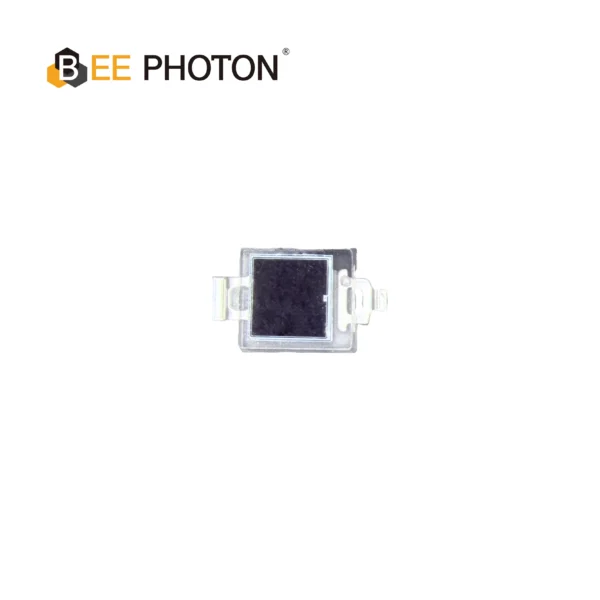
Si-PIN-Fotodiode Serie PDCP08 PDCP08-502
Die PDCP08-502 ist eine 2,9×2,8 mm große Silizium-PIN-Photodiode mit hohem Ansprechverhalten, die für fotoelektrische Präzisionsanwendungen entwickelt wurde. Mit niedriger Sperrschichtkapazität, niedrigem Dunkelstrom und einem breiten Spektralbereich (340-1100 nm) ist sie das ideale Bauteil für optische Schalter und kompakte Sensormodule, die eine stabile und schnelle Signalausgabe erfordern.
Wiring up your new high sensitivity photodiode (TIA tips)
Okay, so you bought the high sensitivity photodiode. Now you gotta build the circuit. You can’t just slap a high sensitivity photodiode into a sloppy breadboard and expect femto-watt performance.
You will be using a Transimpedance Amplifier (TIA). The TIA converts the tiny photocurrent from your high sensitivity photodiode into a usable voltage.
The basic math is V_out = I_photo * R_f, where R_f is your feedback resistor.
Because this high sensitivity photodiode gives you such a low noise floor, you can afford to use a massive feedback resistor to crank up the gain. I’m talking 1 MΩ, 10 MΩ, or even 100 MΩ.
Dealing with capacitance
One thing you might notice from the spec table: this high sensitivity photodiode has a junction capacitance (C_j) of about 125 pF typical at 0V. That is slightly higher than the BPW34S.
Is this a problem? No, but you need to design for it.
In a TIA, the capacitance of your high sensitivity photodiode combines with the input capacitance of your op-amp to create a pole in your feedback loop. If you ignore it, your circuit will ring or outright oscillate.
To keep your high sensitivity photodiode stable, you need a feedback capacitor (C_f) in parallel with your feedback resistor.
The rule of thumb formula to find the right feedback cap for your high sensitivity photodiode is:C_f = sqrt( C_total / ( 2 * pi * R_f * GBWP ) )
Wo C_total is the high sensitivity photodiode capacitance plus the op-amp input capacitance, and GBWP is the gain-bandwidth product of your op-amp. Match this up, and your high sensitivity photodiode will give you a beautiful, crisp, flat response.
Why BeePhoton’s PDCP08-502 is the Ultimate BPW34S Upgrade
Honestly, there are alot of sensors out there, but finding a high sensitivity photodiode that hits the sweet spot of price, availability, and pure performance is tough.BeePhoton designed the PDCP08-502 specifically to be the ultimate high sensitivity photodiode for these scenarios.
- It covers a massive spectral response range (340nm to 1100nm).
- It has that incredibly low dark current (5pA).
- It utilizes a robust epoxy resin package that handles harsh environments.
Plus, BeePhoton doesn’t just treat you like a number. If you need a high sensitivity photodiode with a custom window material, or a specific pin configuration to make your BPW34S upgrade completely seamless, they actually customize the photosensitive area size, window material, and pin numbers. You just reach out to them.
When you use a BeePhoton high sensitivity photodiode, you aren’t just buying a piece of silicon; you are buying out of the headache of low light detection noise.

Si-PIN-Fotodiode Serie PDCP08 PDCP08-511
Die PDCP08-511 ist eine leistungsstarke Schwarze Epoxid-PIN-Fotodiode entwickelt für Präzisions-Infrarotanwendungen. Dieser Sensor ist in ein spezielles schwarzes Epoxidharz gehüllt und wirkt wie ein Tageslichtfilter, der Störungen durch sichtbares Licht blockiert und gleichzeitig die Empfindlichkeit bei 940 nm maximiert. Mit einer großen aktiven Fläche von 2,9×2,9 mm und niedrigem Dunkelstrom gewährleistet er eine zuverlässige Signalerfassung für optische Schalter und Fernsteuerungssysteme, selbst in Umgebungen mit starkem Umgebungslicht.
FAQs about High Sensitivity Photodiode Upgrades
1. Is the PDCP08-502 high sensitivity photodiode a direct drop-in replacement for the BPW34S?
Mechanically, it is incredibly close. The active area is 2.9×2.8mm (compared to 2.73×2.73mm for the BPW34S), and it uses a standard 2-pin layout. In 95% of PCB designs, this high sensitivity photodiode is a direct drop-in BPW34S upgrade. You might just need to tweak your TIA feedback capacitor to account for the slightly different junction capacitance.
2. Why is the dark current of this high sensitivity photodiode so important if I operate at 0V?
Even if you operate your high sensitivity photodiode at 0V (photovoltaic mode) where dark current is technically zero, the physics that create a low dark current (like high material purity and low defect density) are the exact same physics that give you a massive shunt resistance (2 GΩ). A high sensitivity photodiode with low dark current essentially guarantees low thermal noise, making your low light detection flawless.
3. What kind of op-amp should I pair with this high sensitivity photodiode?
Since this is a high sensitivity photodiode with extremely low noise, do not ruin it with a cheap, noisy op-amp! Look for a precision CMOS or JFET input op-amp. You want something with incredibly low input bias current (fA range) and low input voltage noise. Parts like the OPA or ADA series are great companions for this high sensitivity photodiode.
Ready to fix your signal noise?
Stop fighting with legacy components that were never designed for modern low light detection. Every day you spend trying to filter out the noise from an outdated sensor is a day you lose in your development cycle.
A simple BPW34S upgrade can solve your baseline drift and thermal noise issues overnight. If you want to see what a true high sensitivity photodiode can do for your circuit, you need to get your hands on the PDCP08-502.
Don’t let bad signal-to-noise ratios hold your project back.
Contact the experts today. Send an email to info@photo-detector.com or visit the BeePhoton Contact Us page to request samples, get a custom quote, and finally get the high sensitivity photodiode your design deserves.