Listen up hardware engineers. You spend weeks designing what you think is a flawless optical front-end circuit. You calculate the gain, you pick a fancy low-noise op-amp, and you power up the board. And what do you see on the oscilloscope? A massive, fuzzy band of noise completely burying your tiny optical signal.
Most guys immediately blame the transimpedance amplifier (TIA) or maybe EMI from a switching regulator nearby. But honestly, nine times out of ten, the problem is sitting right at the front of your circuit. You didn’t use a low dark current photodiode.
I’m going to share some hard truths about designing a precision light sensor. We’re going to dive deep into why grabbing a generic silicon detector off the shelf is destroying your signal-to-noise ratio, and why a specific 5pA low dark current photodiode is the only real way to achive a clean signal.
The Responsivity Myth
Here is a somewhat controversial opinion that always gets me in trouble with old-school optical engineers: chasing ultra-high responsivity without fixing your dark current is just plain stupid.
Everyone looks at a datasheet and goes straight for the A/W (Amps per Watt) number. Yes, having 0.6 A/W is great. But what good is a massive signal if your noise floor is bouncing around like crazy? Some people love to over-engineer their systems with Avalanche Photodiodes (APDs) or Photomultiplier Tubes (PMTs) just to get that signal boost. But APDs require wierd high-voltage biases (sometimes 100V or 200V) and they introduce their own excess noise factor.
I’ll say it loud: most of you don’t need an APD. You just need a better PIN diode. Specifically, you need a high SNR photodiode that doesn’t leak current when it’s sitting in the dark. By dropping your noise floor using a low dark current photodiode, your effective sensitivity goes through the roof without needing a 200V power supply.
What Exactly is Dark Current and Why Does 5pA Matter?
When a photodiode is reverse biased (or even at zero bias with a tiny offset voltage from your op-amp), a small amount of current flows through the device even when there is absolutely zero light hitting it. This is your dark current (Id).
This leakage happens because of thermal generation of electron-hole pairs in the depletion region of the silicon. It’s a physical property of the material and the manufacturing process. A standard, cheap detector might have a dark current of 1nA (1000 pA) or even 10nA.
Now, why does 5pA make such a massive difference? It comes down to physics. Dark current generates shot noise, which is completely random and impossible to filter out without killing your bandwidth. Let’s look at the actual math. Don’t worry, I won’t use complicated LaTeX formatting, you can just copy these formulas straight into your notes.
The formula for Shot Noise current is:
Inoise = √(2 * q * Id * Δf)
Wo:
- q is the charge of an electron (roughly 1.6 x 10^-19 Coulombs)
- Id is your dark current in Amps
- Δf is your measurement bandwidth in Hz
Let’s say you have a 10kHz bandwidth.
If you use a standard 1nA (1000pA) diode, your shot noise current is:
√(2 * 1.6e-19 * 1e-9 * 10000) = 5.65 x 10^-14 Amps RMS.
Now, swap that out for a 5pA low dark current photodiode.
√(2 * 1.6e-19 * 5e-12 * 10000) = 4.0 x 10^-15 Amps RMS.
You just dropped your inherent sensor noise by more than an order of magnitude just by changing the component. This is why a low dark current photodiode is fundamentally a high SNR photodiode. You can’t cheat physics. Lower leakage equals lower noise.
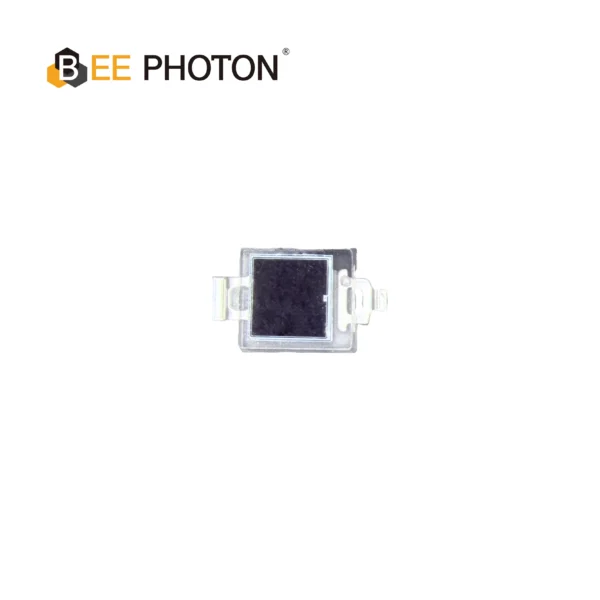
Si-PIN-Fotodiode Serie PDCP08 PDCP08-502
Die PDCP08-502 ist eine 2,9×2,8 mm große Silizium-PIN-Photodiode mit hohem Ansprechverhalten, die für fotoelektrische Präzisionsanwendungen entwickelt wurde. Mit niedriger Sperrschichtkapazität, niedrigem Dunkelstrom und einem breiten Spektralbereich (340-1100 nm) ist sie das ideale Bauteil für optische Schalter und kompakte Sensormodule, die eine stabile und schnelle Signalausgabe erfordern.
Deep Dive into Shunt Resistance (Rsh)
There is another massive factor that makes a low dark current photodiode so critical for a precision light sensor: Shunt Resistance.
If you operate your diode in photovoltaic mode (0V bias), the dark current specs technically translate into shunt resistance. They are two sides of the same coin. A low dark current photodiode inherently has a massive shunt resistance.
Thermal noise (Johnson noise) from the sensor is dictated by this shunt resistance.
The text formula is:
I_thermal = √(4 * k * T * Δf / Rsh)
Wo:
- k is Boltzmann’s constant (1.38 x 10^-23 J/K)
- T is temperature in Kelvin (let’s say 298K for room temp)
- Rsh is your shunt resistance
- Δf is bandwidth
If you look at the datasheet for the PDCP08-502 low dark current photodiode manufactured by BeePhoton, you’ll see the shunt resistance (Rsh) is a staggering 2 GΩ typical (minimum 0.1 GΩ) at VR=10mV.
Plugging 2 Giga-ohms into that thermal noise formula means your thermal noise current is practically nonexistent. If you use a cheap diode with an Rsh of 10 MΩ, your thermal noise shoots up, totally wrecking your high SNR photodiode goals.
The Temperature Trap (Why 5pA saves you at 85°C)
Here is a scenario I’ve seen play out allot. An engineer tests their prototype on the lab bench at 22°C air-conditioned comfort. Everything works great. Then the product goes out into the field, sits inside a metal enclosure in the sun, hits 60°C, and the signal completely disappears into a wall of noise.
Why? Because dark current is wildly temperature dependent.
Looking closely at the BeePhoton PDCP08-502 specs, the temperature coefficient of the dark current (TCID) is 1.135 times/℃. This means that for every single degree Celsius the temperature rises, the dark current multiplies by 1.135.
If you start with a generic diode that has 1nA of dark current at 25°C, by the time your device hits 60°C, your dark current has exploded to over 80nA. Your noise floor just went through the roof, and your op-amp might even saturate from the DC leakage offset.
But if you start with a 5pA low dark current photodiode, that same temperature rise pushes your dark current to roughly 400pA. It’s higher, sure, but it’s still lower than the starting point of the cheap diode! Starting at a baseline of 5pA gives you a massive thermal headroom. If your enviroment gets hot, a low dark current photodiode isn’t just a luxury, it’s a mandatory requirement for survival.
Real World Application: Medical Fluorescence Detection
I worked with a team a while back designing a handheld fluorescence detector for medical diagnostics. The optical signal they were trying to catch was ridiculously small—we’re talking pico-watts of light hitting the active area.
They were initially using a 5x5mm generic silicon detector. The noise was terrible. They tried adding digital filtering, moving averages, lock-in amplification… everything. It was a software nightmare trying to fix a hardware problem.
We swapped their sensor for a low dark current photodiode. Because the signal was so weak, we needed something with exceptional NEP (Noise Equivalent Power). The BeePhoton PDCP08-502 low dark current photodiode has an NEP of 5.9 x 10^-15 W/Hz^(1/2).
Once we put this low dark current photodiode onto the board and paired it with an ADA4530-1 electrometer-grade op-amp, the noise floor dropped to almost a flat line. The engineers were blown away. The high SNR photodiode allowed them to completely strip out the complex DSP software they were trying to write. The raw analog signal was clean enough to just read with a standard 16-bit ADC.
Specs Breakdown: BeePhoton PDCP08-502
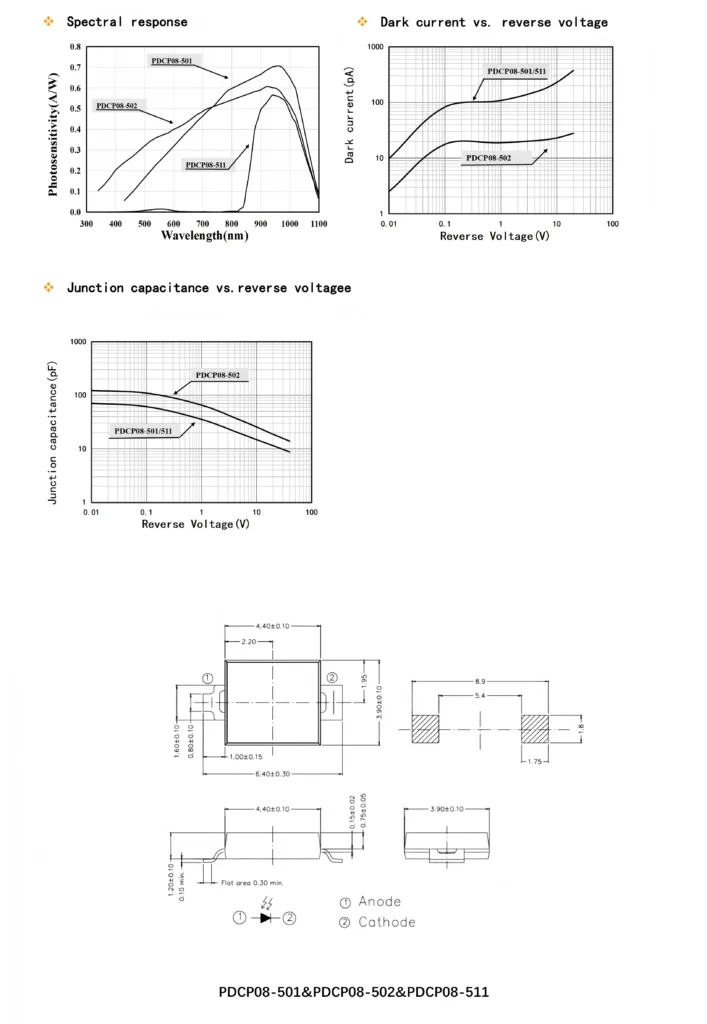
To give you a clear picture of what a true low dark current photodiode looks like on paper, I’ve summarized the critical specs of the PDCP08-502. When you evaluate a low dark current photodiode for your precision light sensor, these are the numbers you need to compare.
| Parameter | Value | Why it matters for your circuit |
|---|---|---|
| Photosensitive Area | 2.9 x 2.8 mm | Large enough to easily align your optics or fiber, but small enough to keep capacitance down. |
| Dunkler Strom (Id) | 5 pA (Typ) / 100 pA (Max) | The magic number. Keeps shot noise microscopic and prevents TIA DC offset drift. |
| Shunt Resistance (Rsh) | 2 GΩ (Typ) | Massive resistance means thermal (Johnson) noise is practically zero. |
| Junction Capacitance (Cj) | 125 pF (Typ) at VR=0V | A 125pF cap is totally manageable for stability in a TIA up to a few hundred kHz. |
| Spitzenempfindlichkeit Wellenlänge | 920 nm | Ideal for NIR precision light sensor applications, blood analysis, or YAG laser monitoring. |
| Responsivity | 0.6 A/W @ 920nm | Excellent conversion of photons to electrons. |
| NEP | 5.9 x 10^-15 W/Hz^(1/2) | Directly proves this is a high SNR photodiode. The minimum detectable power is incredibly low. |
You can see the full spec sheet and get more details on this low dark current photodiode on their product page:PDCP08-502 2.9×2.8mm Silicon PIN Photodiode.
PCB Layout: Don’t Ruin Your Low Dark Current Photodiode
Buying a 5pA low dark current photodiode is only step one. I see guys buy a premium high SNR photodiode and then totally ruin the performance with garbage PCB layout.
If your diode has 5pA of leakage, but your FR4 circuit board has 500pA of leakage between the power rail and the TIA input trace, you just threw your money away. You are no longer building a precision light sensor; you are building an expensive humidity detector.
Here are my personal, hard-learned rules for implementing a low dark current photodiode:
- Use Guard Rings: This is non-negotiable. You must route a guard ring around the anode and cathode pads of the low dark current photodiode and the input pin of your TIA. Drive this ring to the same voltage as the TIA input (usually ground or a virtual ground reference). If there is zero voltage difference between the sensitive trace and the guard ring, no leakage current can flow across the board surface.
- Wash Your Boards: Solder flux is slightly conductive. If you leave no-clean flux residue near the pins of your low dark current photodiode, it will act like a parallel resistor. I’ve seen flux add 50pA of noise. Get some high-purity isopropyl alcohol, scrub the board, and bake it dry.
- Keep the Traces Short: The trace between your low dark current photodiode and the op-amp inverting input should be as short as physically possible. Every millimeter of trace acts as an antenna picking up 60Hz mains hum and adds stray capacitance that can make your op-amp oscillate.
- Choose the Right Op-Amp: You can’t pair a 5pA low dark current photodiode with a bipolar op-amp that has 1uA of input bias current. You need a CMOS or JFET input op-amp with bias currents in the fempto-amp (fA) or low pico-amp (pA) range. Otherwise, the op-amp noise completely overshadows the low dark current photodiode.
Applications That Demand a Low Dark Current Photodiode
You don’t need a high SNR photodiode to detect if a room light is on or off. But there are specific applications where a low dark current photodiode is the only way to build a functional precision light sensor.
- Optische Schalter: The PDCP08-502 is highly recomended for optical switches. In telecommunications or industrial fiber switching, you need to detect the presence or absence of a signal with absolute certainty, often at high speeds and low light levels. A low dark current photodiode ensures no false triggers from noise.
- Spectrometry: When you are splitting light through a prism or grating, the amount of light hitting individual pixels is microscopic. A low dark current photodiode array or single swept sensor ensures you can detect trace chemicals without the baseline wandering.
- Lidar and Ranging: When waiting for a single photon to bounce back from a target 100 meters away, a high SNR photodiode is critical. While APDs are common here, many short-range precision light sensor modules are moving to low dark current PIN diodes to save cost and power.
- Medical Wearables: Pulse oximeters and blood glucose monitors measure tiny changes in light absorption. A low dark current photodiode ensures the patient’s heartbeat signal isn’t lost in the sensor’s own internal noise.
The Bottom Line
Designing a precision light sensor is hard enough without fighting your own components. Stop trying to filter out bad data in software. Stop buying $50 op-amps to compensate for a $0.50 noisy detector.
Start at the source. By upgrading your design to a true low dark current photodiode like the BeePhoton PDCP08-502, you eliminate the root cause of shot noise, you minimize thermal drift, and you drastically simplify your downstream amplification. A high SNR photodiode isn’t just a component upgrade; it’s a completely different way to approach optical design. It makes your life as an engineer easier, and it makes your final product infinitely more reliable.

Si-PIN-Fotodiode Serie PDCP08 PDCP08-511
Die PDCP08-511 ist eine leistungsstarke Schwarze Epoxid-PIN-Fotodiode entwickelt für Präzisions-Infrarotanwendungen. Dieser Sensor ist in ein spezielles schwarzes Epoxidharz gehüllt und wirkt wie ein Tageslichtfilter, der Störungen durch sichtbares Licht blockiert und gleichzeitig die Empfindlichkeit bei 940 nm maximiert. Mit einer großen aktiven Fläche von 2,9×2,9 mm und niedrigem Dunkelstrom gewährleistet er eine zuverlässige Signalerfassung für optische Schalter und Fernsteuerungssysteme, selbst in Umgebungen mit starkem Umgebungslicht.
FAQ
Q: Can I use a low dark current photodiode in an environment with high temperature fluctuations?
Absolutely. In fact, that’s exactly when you should use one. Because dark current multiplies exponentially with temperature, starting with a baseline of 5pA with a low dark current photodiode ensures that even at 85°C, your leakage remains manageable. If you started with a standard diode, the heat would push the dark current into the micro-amp range, ruining your precision light sensor.
Q: How does a low dark current photodiode improve my signal-to-noise ratio (SNR)?
A high SNR photodiode relies on minimizing the noise floor. Since Shot Noise is mathematically derived directly from the dark current (Inoise = √(2qId*Δf)), lowering the dark current to 5pA mathematically reduces the inherent noise of the sensor. This allows you to detect much weaker light signals clearly.
Q: Do I need special PCB assembly processes when using a 5pA low dark current photodiode?
Yes, definitly. To maintain the ultra-low leakage of the BeePhoton PDCP08-502 low dark current photodiode, you must clean all solder flux off the PCB using isopropyl alcohol. You should also implement guard rings around the sensor pads in your layout to prevent surface leakage currents from contaminating the high SNR photodiode signal.
Q: Is the BeePhoton PDCP08-502 only good for visible light?
No, this low dark current photodiode has a very wide spectral response range from 340nm (UV) all the way up to 1100nm (NIR), with a peak sensitivity at 920nm. This makes it an incredibly versatile precision light sensor for everything from fluorescence to near-infrared optical switches.
Ready to fix your signal noise for good?
Are you tired of watching your optical signals drown in thermal and shot noise? It’s time to stop fighting bad components and upgrade your front-end. The BeePhoton PDCP08-502 low dark current photodiode delivers the 5pA stability and 2 GΩ shunt resistance you need to finally build a clean, reliable precision light sensor.
Don’t let noise ruin your next project. Imagine turning on your prototype and seeing a dead-flat noise floor and a crystal-clear signal.
We can make that happen. For custom specs, volume pricing, or technical help integrating our high SNR photodiode into your specific circuit, reach out to us today.
Shoot us an email directly at info@photo-detector.com oder besuchen Sie unser Contact Us page to get a quote and samples. Let’s get your optical design working the way it’s supposed to.