Ever wondered how machines know exactly where a motor shaft is spinning or how fast it’s going? That’s where optical encoders come in. These clever devices turn light into signals that tell controllers all about position and speed. And the star of the show? Photodiodes. They’re the bits that catch the light and spit out electrical pulses.
I’ve worked with these in various setups over the years, from tweaking robotic arms to fine-tuning conveyor systems. It’s pretty fascinating once you get past the tech jargon. Let’s break it down step by step, like we’re chatting over coffee.
What Exactly Is an Optical Encoder?
An optical encoder is basically a sensor that tracks movement – either rotary (spinning) or linear (straight line). It uses light to detect changes in position. The core idea: a light source shines through (or reflects off) a patterned disk or scale, and a detector picks up the on-off patterns as things move.
Most common ones are rotary optical encoders, attached to motor shafts for things like motor control. They help with precise position sensing, which is crucial in robotics or automation.
There are two main flavors: incremental and absolute.
Incremental vs. Absolute Optical Encoders
Here’s a quick comparison to clear things up:
| Merkmal | Incremental Optical Encoder | Absolute Optical Encoder |
|---|---|---|
| How it tracks position | Counts pulses from a starting point (needs homing) | Gives unique position code right away, no homing needed |
| Power loss effect | Loses absolute position; must reset | Keeps position info even if power cuts out |
| Typical resolution | Up to 10,000 pulses per revolution (PPR), higher with interpolation | Varies, often high but depends on code patterns |
| Common uses | Speed and direction in motor control | Precise positioning in robotics |
| Cost and complexity | Simpler, cheaper | More complex, pricier |
Incremental ones are great for ongoing speed checks, while absolute shine when you can’t afford to lose track.
Real data shows optical encoders can hit resolutions like 81 million counts per rev in high-end setups, but everyday ones often run 1,000 to 10,000 PPR.

Foto-IC Serie PDTC
Unser Foto-IC mit zweistufigem Verstärkungsschalter bietet eine präzise optische Erkennung für die industrielle Automatisierung. Dieser fortschrittliche Foto-IC verfügt über einen einstellbaren Verstärkungsschalter, der eine zuverlässige Leistung gewährleistet
The Role of Photodiodes in Optical Encoders
Photodiodes are the heroes here. They work on the photoelectric effect – light hits the semiconductor material (usually silicon), knocking electrons loose and creating current.
In a typical setup:
- An LED shines light.
- It passes through slots in a code disk (those alternating opaque and transparent lines).
- When light hits the photodiode, it generates a pulse.
- No light? No pulse.
For better accuracy, encoders use quadrature – two photodiodes offset by 90 degrees. This gives A and B channels, letting the system figure out direction too (clockwise or counterclockwise).
Speed comes from how fast pulses arrive, position from counting them.
In one project I recall, we used photodiodes in a custom encoder for a conveyor belt. The switch from basic detectors to high-sensitivity ones cut noise and boosted reliability in a dusty environment.
At Bee Photon, we specialize in photo detectors like our two-level gain switch photo IC, which handles varying light levels perfectly for encoder apps.
How Optical Encoders Measure Position and Speed
Measuring Position
Position sensing happens by counting those light interruptions. More lines on the disk = finer resolution.
For example:
- A disk with 1,000 lines gives 1,000 pulses per turn.
- With quadrature (x4 counting), that’s 4,000 counts per rev.
Linear versions use a scale strip instead of a disk.
Absolute ones use unique patterns, like Gray code, so each spot has its own signature.
Measuring Speed
Speed’s simpler: time the pulses. Faster rotation = quicker pulses.
Controllers calculate RPM from pulse frequency.
In motor control, this feedback loops back to adjust power, keeping things steady.
We’ve seen cases where tight encoder feedback held motor speeds within 0.1% accuracy – handy in precision manufacturing.
Key Components Breakdown
Let’s list the main parts:
- LED light source: Usually infrared for reliability.
- Code disk or scale: Glass or plastic with precise patterns.
- Photodiode array: Detects light, often in quadrature setup.
- Mask: Sharpens the light edges for cleaner signals.
- Electronics: Amplifies and shapes pulses into square waves.
High-quality photodiodes make all the difference – low noise, fast response.
Types of Optical Encoders
Beyond incremental/absolute:
- Transmissive: Light passes through the disk (common, accurate).
- Reflective: Light bounces back (compact, good for small spaces).
- Rotary vs. Linear: For spinning or straight motion.
Resolutions can go crazy high – some hit arc-seconds level.

Real-World Applications and Examples
Optical encoders pop up everywhere needing precise motor control or position sensing.
- Robotics: Tracking joint angles. In one anonymous factory setup, encoders on robotic arms improved pick-and-place accuracy, cutting errors by over 50%.
- CNC Machines: Exact tool positioning.
- Conveyors and Automation: Speed control on belts.
- Medizinische Geräte: Precise movements in scanners or pumps.
The market’s growing fast – reports peg it around $3 billion in recent years, with double-digit growth thanks to automation.
In motor control, they provide feedback for closed-loop systems, making servos super responsive.
Advantages and a Few Drawbacks
Why go optical?
- High accuracy and resolution.
- Non-contact, so low wear.
- Fast response for real-time control.
Downsides: Dust or dirt can block light, though modern filtering optics help a lot.
Compared to magnetic encoders, optical often wins on precision but might need cleaner environments.
Tips for Choosing and Using Optical Encoders
Think about:
- Resolution needed.
- Environment (dust, vibration?).
- Incremental or absolute?
- Integration with your controller.
At Bee Photon, we’ve helped folks pick the right photo detectors for their encoders. If you’re building something, drop us a line.
FAQ
How do photodiodes help measure speed in optical encoders?
Photodiodes detect light pulses as the disk spins. The rate of pulses directly ties to speed – more pulses per second means faster rotation. Controllers count and time them for exact RPM.
What’s the difference between position sensing in incremental and absolute optical encoders?
Incremental counts changes from a reference point (needs a home reset). Absolute gives a unique code for every position, so it knows exactly where it is anytime, even after power off.
Can optical encoders work in motor control for robotics?
Yeah, absolutely. They’re perfect for feedback on motor position and speed, helping robots move precisely without drifting.
If this sparked ideas for your project, check out more at Bienen-Photon. Need specifics or a quote? Head to our Kontaktseite oder E-Mail info@photo-detector.com. We’d love to chat about how our photo detectors can fit your optical encoder needs.
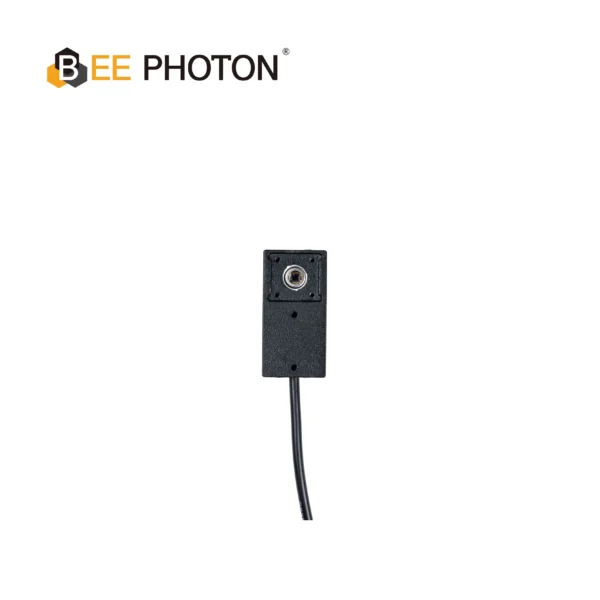
Fotodioden-Modul(Analoger Ausgang)PDTM-A
Bee Photon ist ein führender Anbieter von OEM-Fotodiodenmodulen für kundenspezifische Anforderungen. Vertrauen Sie einem erfahrenen OEM-Fotodiodenmodul-Lieferanten für Ihre optischen Präzisionsinstrumente.