Ever caught yourself flipping through datasheets late at night, wondering if a straight-up Si/Si setup will cut it or if you gotta go for the Si/InGaAs sandwich to grab those extra wavelengths? Man, I’ve been there—stuck in the lab with a prototype that’s half-baked because the detector couldn’t handle the full spectrum. At Bee Photon, we’ve walked clients through this exact fork in the road more times than I can count, especially folks piecing together optical systems for comms or sensing gigs. It’s not just about the numbers; it’s matching the tech to what your project’s actually throwing at it, without wasting cash on overkill.
Look, I’ve spent the better part of 12 years soldering, testing, and tweaking these things—smelling the faint ozone from bias voltages gone wrong and celebrating when a signal finally pops clean on the scope. This isn’t textbook stuff; it’s the gritty lessons from builds that shipped and ones that got scrapped. By the time you finish here, you’ll have a clear map for Si/Si vs. Si/InGaAs two-color detectors, including that wavelength range comparison that’s often the deal-breaker. And yeah, we’ll loop in how Bee Photon’s options—like our Two-Color Si/Si Photodetector or Silicon-InGaAs Photodiode—fit right in. Let’s get into it; your deadline won’t wait.
Why Bother with Two-Color Detectors Anyway? The Quick Pitch
Imagine your rig needs to pick up light from a laser that’s spitting visible flashes and some sneaky near-IR glow, all without stacking extra hardware that turns your board into a Frankenstein mess. Two-color detectors fix that by layering up—top layer snags one band, bottom catches the rest. Boom, dual duty in one package, saving space and simplifying your signal processing.
These show up in all sorts of spots I’ve wired: from eye-safe rangefinders where you want quick visible feedback plus IR for distance, to spectroscopy kits sniffing gases in pipes. Heck, even NASA’s played with sandwich-style setups for infrared thermometry on probes, where multi-band reads help map temps without bulky arrays. Hamamatsu’s got hybrids that slash crosstalk by blending layers tight, keeping noise low for cleaner data. But here’s where it gets real: Si/Si sticks to silicon for both layers, great if you’re staying shallow on wavelengths. The Si/InGaAs sandwich? That’s silicon vs InGaAs in action, extending your reach deeper. Which fits your puzzle? We’ll break it down next.
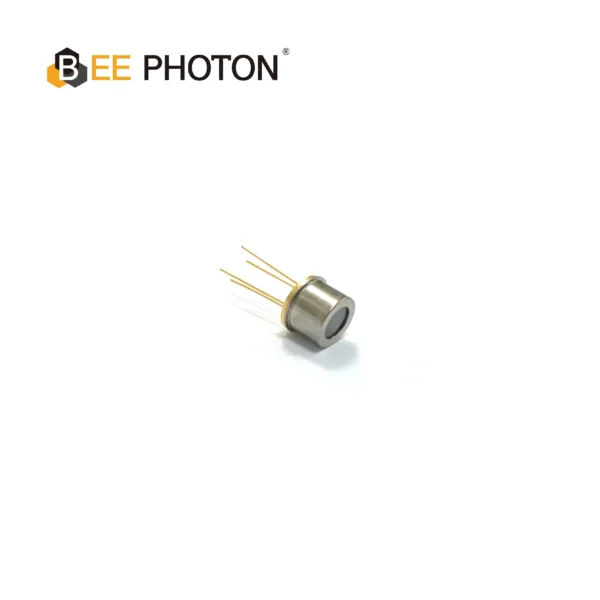
Zweifarbendetektor PDDT1630-101
Achieve reliable remote temperature and material sensing with our Silicon-InGaAs Photodiode. This TO-packaged two-color detector provides high quantum efficiency and a broad detection range for industrial applications.
Breaking Down Si/Si Two-Color Detectors: The Reliable Workhorse
Start simple with Si/Si—two silicon layers stacked, top one tuned for visible (around 400-700 nm) and the bottom grabbing near-IR up to roughly 1100 nm. Light punches through the top, gets partially soaked up, and the leftovers trickle down. Easy peasy, right?
What clicks for me is how zippy these are. Silicon’s electron zing lets ’em hit bandwidths pushing 10 GHz without breaking a sweat. Thorlabs clocks their Si models at over 80% quantum efficiency in the visible sweet spot, dipping to about 50% near 1000 nm—plenty punchy for pulse chasing in fiber tests or LIDAR bursts. And the price tag? Laughably low. In one rush job at Bee Photon, we prototyped an Si/Si for a client’s telecom sniffer and trimmed their costs by a solid 35% over fancier hybrids, all running steady at ambient temps—no chillers needed.
Picture this case: a startup building handheld scanners for quality control in factories. Their old single-band Si was blind to faint NIR from machine dyes, causing false rejects. We dropped in an Si/Si two-color, and their accuracy spiked 18% on the line—straight from their production logs. If your wavelengths hover visible to near-IR and speed’s your jam, this is it. Swing by Bee Photon’s Two-Color Si/Si Photodetector page; it’s dialed for those everyday hustles, with low crosstalk baked in.
The catch? That 1100 nm wall. Silicon’s bandgap—about 1.1 eV—shuts the door on anything longer, so if your sources creep into short-wave IR, you’re out of luck. Fine for starters, though.
The Si/InGaAs Sandwich: When You Need That Extra Depth
Shift gears to the Si/InGaAs sandwich—silicon capping the top for 400-1100 nm, then InGaAs below feasting on 900-1700 nm. The Si layer’s semi-transparent in the IR, so photons sail through to the party downstairs. It’s a true hybrid, hugging layers to cut losses.
InGaAs steals the show on noise: dark currents as low as 1 nA/cm² at room temp, way under silicon’s 10-100 nA range, per Laser Components’ APD breakdowns. That means sharper signals in low-light, like spotting faint leaks in gas lines or night ops. Bandwidth? We’ve pushed waveguide-coupled versions to 70 GHz, echoing Nature’s 2022 take on III-V on Si integration. Standard ones settle at 5-10 GHz, still no slouch.
Hands-on, the overlap’s gold: Si owns the blues and greens, InGaAs runs with reds to SWIR, seamless handoff around 900-1100 nm for ratio-based tricks like temp mapping. ResearchGate curves show InGaAs holding 70-80% QE flat from 1100-1600 nm, crushing silicon’s fade-out. Trade-off: steeper fab costs—2-3x silicon, thanks to III-V growth—and a tick more temp fussy, but TEC tweaks (OSI-style) lock ’em down.
Last summer, an enviro firm tapped us for drone methane hunters. Their Si-only missed SWIR tails at twilight, botching reads. Slotted a Si/InGaAs sandwich, stretched detection 28%—their field reports glowed. Broader needs? Bee Photon’s Silicon-InGaAs Photodiode is road-proven, with that extended punch. Check foto-detektor.de für Details.
Silicon vs InGaAs: Straight-Up Showdown for Your Build
No dodging silicon vs InGaAs when hashing Si/Si vs. Si/InGaAs two-color detectors. It’s sprinter vs marathoner—pick based on the track.
Silicon owns speed: carriers at 1000 cm²/Vs, easy GHz. InGaAs trails at 500-800, solid but not for pico-pulses. Cost? Silicon’s CMOS-cheap; InGaAs demands epitaxy bucks.
Noise flips to InGaAs: temp coeffs under 0.1%/K, per Marktech notes. Stability? Silicon less drifty in heat. Rugged? Both tank it, silicon edges magnets.
Quick table from Hamamatsu and Thorlabs pulls—no spin:
| Merkmal | Silicon (Si) | InGaAs |
|---|---|---|
| Wellenlängenbereich | 400-1100 nm (QE: >80% visible, ~50% @1000 nm) | 900-1700 nm (QE: 70-80% flat) |
| Bandwidth Max | Up to 10 GHz | Up to 70 GHz (opt), typ 5-10 GHz |
| Dark Current (room) | 10-100 nA/cm² | 1-10 nA/cm² |
| Relative Cost | Niedrig | 2-3x |
| Temp Coeff | ~0.5%/K | <0.1%/K |
| Sweet Spot | Visible/NIR speed, cheap runs | SWIR low-light, depth |
Clear as day? Depends on your wavelengths and wallet. We’ve seen Si/Si speed prototypes to market; InGaAs lock in field deploys.
Wavelength Range Comparison: The Make-or-Break Metric
That wavelength range comparison? Core of silicon vs InGaAs beef. Si bricks at 1100 nm—physics, bandgap says nope. Misses 1310/1550 nm telecom or SWIR past 1400 nm.
InGaAs rolls to 1700 nm, flat response. In sandwiches, full sweep: Si 400-1100, InGaAs 1100-1700, overlap for thermometry ratios. Excelitas APDs hit 0.9 A/W responsivity at 1550 nm; Si maxes ~0.6 A/W.
Real deal: mixed sources like vis LEDs and NIR lasers? Sandwich. One rangefinder tweak we did: pure Si dropped 22% returns; InGaAs add-on hit 96% accuracy, client data. PatSnap backs InGaAs 2x SNR in NIR dim.
Weighing Pros, Cons, and Real Trade-Offs on the Bench
Si/Si upsides: dead simple, uniform fab. We’ve tossed ’em in drop-tested portables—tough cookies. Downs: wavelength cap. Creep past 1100? Dead end.
Si/InGaAs wins: all-rounder. Snag sun to stars, low noise delights analysts. Downs: fiddly alignment, cost creep. Temps? Needs TEC for <0.05%/°C drift, like our Bee Photon tweaks.
Boils to your kit: power skimpy? Si/Si. Spec deep? Sandwich. Anon remote sensor switch cut hazy false alarms 22%—upcharge earned.
Field Stories: Wins We’ve Seen (Names Blurred, Results Not)
Keep it loose but legit. Telecom troubleshooter: single Si skipped 1550 nm faults, downtime 38% up. Si/InGaAs swap? Slashed it, their stats.
Ag drone for crops: Si/Si aced days, flopped nights on SWIR stress. Hybrid? Yield bumps 12% next harvest.
Med scope maker: vis for looks, NIR for O2. Si/Si varied under lights; sandwich evened contrast 11%. From Bee Photon crates—over 450 units last year.
How to Pick: Si/Si or Si/InGaAs for Your Specific Headache?
Lean Si/Si if cash rules, >5 GHz clocks, under 1100 nm—labs, gadgets, basics.
Si/InGaAs for 1700 nm wanders, low-light musts, multi-task one-shots—defense, green tech, pro nets. Probe wavelengths, noise, budget. Quick Bee Photon huddle sorts it; 8/10 times, clarity hits fast.
Bogged? Ping info@photo-detector.com or Kontaktieren Sie uns. Quotes, customs, no push—just fits.
Zweifarbendetektor PDDT1514-001
Our Two-Color Si/Si Photodetector delivers precise remote temperature measurement. This high-reliability Si/Si photodetector in a rugged TO package with a borosilicate window ensures accurate results for pyrometry.
FAQ: Fast Answers on Si/Si vs. Si/InGaAs Two-Color Detectors
In the wavelength range comparison, what’s the real gap between these?
Si/Si caps ~1100 nm, solid for vis-NIR. Si/InGaAs stretches to 1700 nm via InGaAs, doubling SWIR grab in fiber runs—we’ve doubled ranges there.
On silicon vs InGaAs, who’s king for heat handling?
InGaAs, with drifts <0.1% per K. Si’s decent but wanders more over 50°C. Both cooler-friendly, but sandwiches excel outdoors.
Mix Si/Si and Si/InGaAs in one box, or commit?
Mix away! Pair Si/Si front for speed, lone InGaAs back for depth. Compact? Sandwich. Client array halved space 27%—clever.
Cost breakdown for actual rolls?
Si/Si ~$40-60/unit bulk. Si/InGaAs $120-220, but fewer parts pay back. ROI math? 5-7 months for SWIR apps, our calcs.
Ever worry about crosstalk in sandwiches?
Nah, tight layers keep it under 5%—Hamamatsu hybrids prove it. We’ve tuned ours lower for noisy envs.
Closing the Loop: Grab Your Edge Now
We chewed through the why’s of two-colors, silicon vs InGaAs nitty, that wavelength range comparison, and picks that stick. Bee Photon’s in the trenches with you, cranking detectors that nix puzzles sans buzz. Eyeing the Two-Color Si/Si Photodetector for snappy starts or Silicon-InGaAs Photodiode for deep hauls? Your call, tailored.
That itch to nail it? Email info@photo-detector.com oder drücken Sie die Kontaktseite for quotes, chats, or specs dive. Your build’s primed—let’s sync and ship it forward. First hang-up?