If you’re building or upgrading optical sorting machines for food processing, you know the pressure is on. Lines run faster every year, customers demand zero defects, and one tiny foreign object or spoiled piece can cause big problems downstream. That’s where high-speed photodiodes come in—they’re the quiet heroes catching those issues at blistering speeds.
We’ve been in this game at Fotón abeja for years, helping food processing machinery manufacturers get sensors that actually keep up with modern belts flying at 3-5 m/s or more. In this post, I’ll walk you through why high-speed photodiodes matter so much for food sorting, what to look for, real-world examples (without naming names), and how they tie into inspección de seguridad alimentaria y sensores de clasificación por colores.
Why Speed Matters in Food Optical Sorting Today
Food sorting isn’t what it used to be. Back in the day, machines might handle a few tons per hour. Now? Top systems process millions of items hourly. According to recent industry reports, the global food sorting machine market sits around USD 2.6-3.4 billion in 2025 and is heading toward 4-5.5 billion by early 2030s, growing at 4-9% CAGR depending who you ask (sources like Future Market Insights and Mordor Intelligence). Optical sorters grab the biggest chunk—often 40-57% market share—because they nail color, shape, and defect detection without touching the product.
The bottleneck? The detector. If your photodiode can’t respond fast enough, you miss defects. A slow sensor means blurred signals at high belt speeds, leading to false rejects (wasted good product) or worse—false accepts (quality complaints or recalls).
High-speed Si PIN photodiodes solve this with rise times down to the nanosecond range. Some models hit 500 MHz bandwidth or better. That translates to clear detection even when products zip by at conveyor speeds up to 3 m/s or higher in advanced setups.

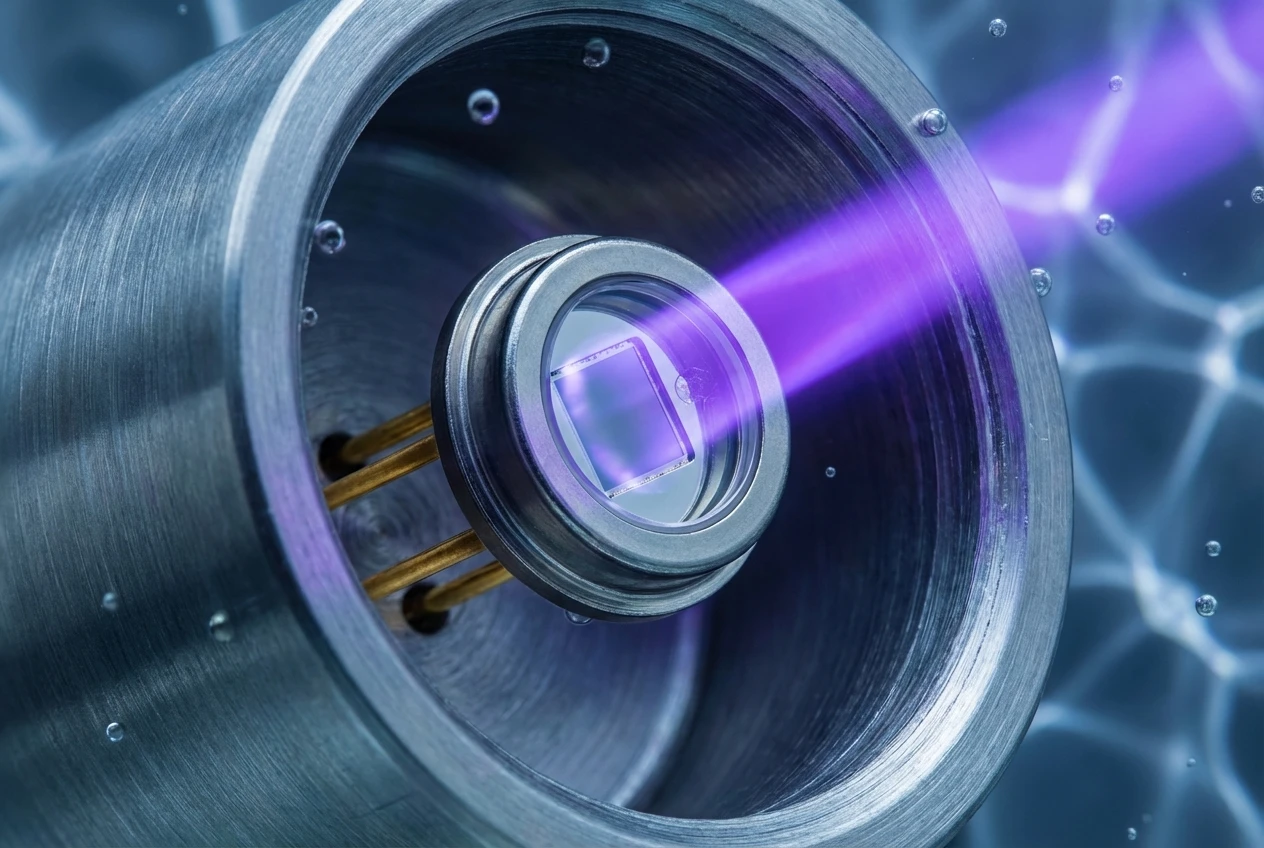
Fotodiodo PIN de Si con sensibilidad UV mejorada (190-1100 nm) PDCD100-F01
Experimente una detección UV superior con el fotodiodo sensible al ultravioleta (UV) de Bee Photon.Nuestro fotodiodo PIN de Si garantiza una alta sensibilidad y fiabilidad para instrumentos analíticos.Este fotodiodo sensible al ultravioleta (UV) con ventana de cuarzo ofrece mediciones precisas de 190nm a 1100nm.
Key Benefits of High-Speed Photodiodes in Food Processing
Let’s get practical. Here’s why manufacturers keep coming back to fast photodiodes:
- Super-fast response — Rise times as low as 1-3 ns let you catch tiny defects on fast-moving belts without motion blur.
- Alta sensibilidad — Good responsivity (around 0.5-0.6 A/W in visible/NIR) picks up subtle color differences or foreign material.
- Low noise & capacitance — Means cleaner signals, fewer false triggers, especially in dusty or humid food plants.
- Reliability in tough environments — Hermetic packages handle washdowns, temperature swings, vibrations.
- Cost-effective upgrade — Swap old detectors for high-speed ones and suddenly your machine sorts 20-50% faster without redesigning everything.
In real terms, this helps hit food safety standards (think FDA, EU regs) by reducing contamination risks. One bad batch of nuts with mold or plastic bits can cost tens of thousands.
How High-Speed Photodiodes Work in Optical Sorting Machines
Most optical sorters use light sources (LEDs, lasers) shining on the product stream. Reflected or transmitted light hits the sensor array. The photodiode converts that light to electrical signal → processed by software → ejectors kick out bad pieces.
The magic happens in the detection stage. High-speed photodiodes (especially Si PIN types) excel here because:
- They handle visible light (400-700 nm) for sensores de clasificación por colores
- Extend into NIR (up to 1000-1100 nm) for detecting moisture, bruises, or foreign materials invisible to the eye
- Work in arrays or line-scan setups for full product coverage
For example, in a typical belt sorter for vegetables or grains, the system might scan at thousands of lines per second. Only photodiodes with bandwidth >100-500 MHz keep up without losing detail.
Choosing the Right High-Speed Photodiode for Your Application
Not all photodiodes are equal for food sorting. Here’s a quick comparison table of typical specs you might see (based on real models from industry leaders like Hamamatsu, OSI, Excelitas):
| Parámetro | Standard Si PIN | High-Speed Si PIN (Recommended) | Why It Matters for Food Sorting |
|---|---|---|---|
| Tiempo de subida | 10-50 ns | 1-5 ns | Critical for high belt speeds (>2 m/s) |
| Ancho de banda | <100 MHz | 300-1500 MHz | Handles fast scanning without signal loss |
| Active Area | 1-5 mm² | 0.2-4 mm (array compatible) | Balance between sensitivity & speed |
| Responsivity (800 nm) | 0,4-0,5 A/W | 0.55-0.65 A/W | Better detection of subtle color/foreign material |
| Capacitance | 10-50 pF | <1-8 pF | Lower noise, better SNR in high-speed circuits |
| Corriente oscura | 1-10 nA | <25-100 pA | Reduces false triggers in low-light conditions |
For most food applications, we recommend starting with models offering at least 300 MHz bandwidth and low capacitance. At Fotón abeja, our Fotodiodos PIN de Si collection includes options tuned exactly for these needs—check them out here: https://photo-detector.com/product-category/si-pin-photodiodes/.

Fotodiodo PIN de Si con sensibilidad UV mejorada (190-1100 nm) PDCT25-F01
Nuestro diodo PIN de Si con amplio rango dinámico garantiza una medición precisa de intensidades de luz variables. Ideal para medidores de potencia, ofrece una excelente linealidad en todo el espectro de 190-1100 nm. Un diodo PIN de Si fiable para un rendimiento constante.
Real-World Application Scenarios We’ve Seen
Can’t share client names, but here’s what we’ve helped with:
One manufacturer making sorters for nuts and seeds was struggling with plastic fragments slipping through at 4 tons/hour. They upgraded to faster photodiodes with 1 ns rise time. Reject accuracy jumped, waste dropped 35%, and they avoided a major recall after a supplier contamination issue.
Another case: Vegetable processor using color sorting for potatoes. Bruises and green spots were hard to catch on wet product. Switching to high-speed detectors with strong NIR response improved detection by catching moisture-related defects better. Yield went up noticeably.
These aren’t miracles—just better sensors matching the machine’s speed.
PREGUNTAS FRECUENTES
Q: What’s the difference between standard and high-speed photodiodes for optical sorting machines?
A: Standard ones work fine for slow lines, but high-speed versions (with rise times under 5 ns) handle modern fast conveyors without losing detail. They reduce false rejects and catch more defects.
Q: Do high-speed photodiodes improve food safety inspection?
A: Yes, big time. Faster, more accurate detection means fewer foreign objects or spoiled items make it through, helping meet strict inspección de seguridad alimentaria standards and reducing recall risks.
Q: How do I know if my current sensors are too slow?
A: If you’re seeing blurry signals, high false reject rates, or can’t push belt speed higher without quality drops—your photodiodes are likely the bottleneck. Test with faster models and watch the difference.

Fotodiodo PIN de Si con sensibilidad UV mejorada (320-1060nm) PDCC100-701
Nuestro fotodiodo PIN de Si de alta respuesta ofrece una señal superior para aplicaciones exigentes. Destaca en la detección de UV con poca luz de 320-1060 nm.
Ready to Upgrade Your Optical Sorting Machines?
Look, food processing lines don’t slow down for bad sensors. If you’re a food processing machinery manufacturer needing reliable high-speed photodiodes that actually deliver on speed, sensitivity, and durability for sensores de clasificación por colores y inspección de seguridad alimentaria, we’ve got your back at Fotón abeja.
Visite nuestro Si PIN photodiodes page to see options. Got questions or want a quote? Drop us a line at info@photo-detector.com or hit up our contact page: https://photo-detector.com/contact-us/. We’d love to chat about your project and see how we can help make your machines faster and more accurate.
Don’t let slow detection hold your line back—let’s get those defects out before they become problems. Talk soon! 🚀