If you’re an engineer staring at a blank schematic early in a project, wondering whether to go with an NPN phototransistor or a PNP one, you’re not alone. I’ve been there plenty of times – scratching my head over polarity because picking the wrong one can mean extra headaches later, like flipping the whole logic or dealing with harder sourcing. Phototransistors are awesome for detecting light in all sorts of setups, from remote controls to industrial sensors, but the choice between NPN and PNP boils down to how your circuit handles grounding, switching, and part availability.
Let’s break this down in a straightforward way, no fluff. We’ll look at how they work, the real differences, when each shines (pun intended), and some practical tips from projects I’ve seen or worked on. By the end, you’ll have a clearer idea of which phototransistor type fits your needs.
What Even Is a Phototransistor Anyway?
Quick refresher: a phototransistor is basically a transistor that reacts to light instead of a base current from a pin. Light hits the base-collector junction, generates electron-hole pairs, and boom – it amplifies that into a usable current. Most are built around bipolar junctions, so you get two main phototransistor types: NPN and PNP.
NPN phototransistors are by far the most common. Why? They fit perfectly with negative ground systems, which is how pretty much everything is wired these days. PNP versions exist, but honestly, they’re rarer – some folks in forums call them “scarce as hen’s teeth.” That alone often pushes people toward NPN.
Both turn on when light hits them (conducting state), and off when it’s dark. No big inversion there like you might think with regular transistors.
How NPN and PNP Phototransistors Differ in Circuits
The big difference shows up in how you wire them.
- NPN phototransistor: Usually low-side switching. Emitter goes to ground, collector pulls up to Vcc through a load. When light hits, it sinks current to ground – perfect for turning something on by pulling a signal low.
- PNP phototransistor: More for high-side switching. Emitter to Vcc, collector to load then ground. Light makes it source current from the positive rail.
In real designs, NPN is easier for most microcontroller interfaces because sinking current is straightforward and matches logic levels better. PNP might simplify things if you’re switching the positive side, like in some automotive or safety setups.
Here’s a simple comparison table to make it clearer:
| Aspecto | Fototransistor NPN | PNP Phototransistor |
|---|---|---|
| Common Configuration | Low-side switch (sinking current) | High-side switch (sourcing current) |
| Availability | Very common, wide selection | Less common, harder to source |
| Response Speed | Generally faster due to electron mobility | Slightly slower |
| Typical Bias | Collector positive to emitter | Emitter positive to collector |
| Niveles de ruido | Lower compared to photodiodes, good gain | Similar, but overall performance edges to NPN |
| Lo mejor para | Ground-referenced systems, encoders, IR receivers | Positive rail switching, complementary designs |
This isn’t pulled out of thin air – NPN dominates because electron mobility is higher than holes, giving them a slight edge in speed and efficiency, as noted in lots of electronics resources.

Fototransistor de Si Serie PTCP PTCP001-202
Mejore sus soluciones de conmutación con este fototransistor NPN de 800-1100 nm. Perfecto para interruptores fotoeléctricos, ofrece una alta disipación de potencia de hasta 90 mW. Este fototransistor de silicio ofrece un rendimiento constante en entornos adversos de -40°C a +85°C.
Pros and Cons of Each Type
Let’s get real about the trade-offs.
NPN Phototransistor Advantages:
- Way more options on the market. If you need something specific like 800-1100nm wavelength for IR applications, you’ll find plenty.
- Fits negative ground designs without extra tricks.
- Often higher gain and faster response – rise/fall times around 10μs for common parts like the SFH 310.
- Easier integration with logic gates or MCUs.
Downsides? If your design screams for high-side switching, you’ll need to invert signals or add components.
PNP Phototransistor Advantages:
- Natural for sourcing current, which can clean up some circuits.
- Sometimes useful in push-pull or complementary setups.
But the cons are bigger: harder to find, potentially poorer performance (about 10% worse in conduction params in some BJTs, though not drastic here), and you might end up approximating with an NPN anyway by swapping collector/emitter (though not ideal).
In practice, I’ve seen teams default to NPN 9 times out of 10 just to avoid supply chain issues.
Real-World Scenarios: When to Pick Which
Okay, let’s talk actual projects – anonymized, of course.
One setup I recall was an optical encoder for a motor control system. They went NPN because it was low-side, tied directly to ground, and needed quick response for counting pulses. Worked like a charm, no noise problems.
Another was a reflective proximity sensor in a consumer gadget. Again, NPN – common parts like the QRE1113 are NPN, and sinking to ground matched the MCU input perfectly.
There was this one industrial sensor project where high-side switching made sense for safety reasons (isolating the load from ground). They hunted for a PNP phototransistor but ended up using an NPN with some logic inversion because stock was better. Lesson learned: availability wins.
Phototransistors pop up everywhere – remote controls (mostly IR, NPN), automatic lighting, smoke detectors, even some automotive headlight controls. In all those, NPN rules because of standard negative grounding.
If you’re designing something battery-powered or portable, NPN often edges out for efficiency too.
At Bee Photon, we focus on high-quality options like our Fototransistor NPN tuned for 800-1100nm – great for IR detection with solid sensitivity and low noise.
Key Factors in Selecting Between NPN and PNP Phototransistors
Early in circuit design, ask yourself these:
- Is your system negative ground? (Almost always yes → NPN)
- Low-side or high-side switch? Low-side is simpler → NPN
- Speed critical? NPN usually wins
- Part availability? Check Digi-Key or Mouser – NPN floods the results
- Wavelength needs? For near-IR, tons of NPN choices
Also, think about noise – phototransistors beat photodiodes here because of built-in gain, but still add a pull-up resistor (1k to 10k typical) and maybe filtering.
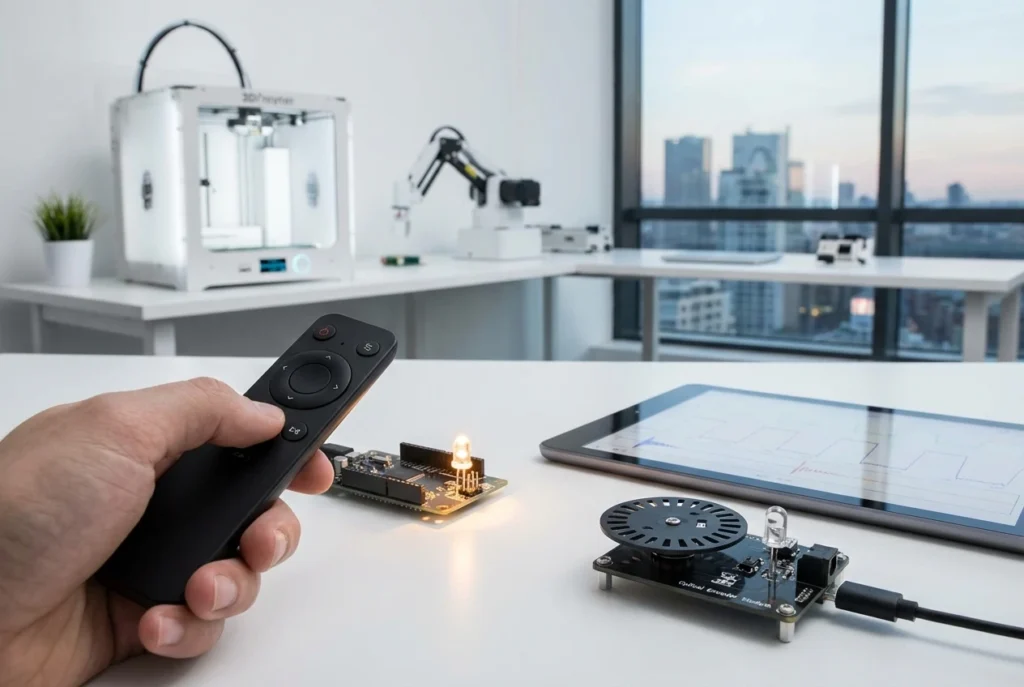
One tip from experience: always prototype with a breadboard. Shine a flashlight or IR remote at it and measure the output. You’ll spot if the polarity fits quick.
Common Circuit Examples
Most folks use common emitter for switching.
For NPN: Collector to Vcc via resistor, emitter to GND, output from collector.
Light on → transistor conducts → output low.
For PNP: Flip the voltages.
Darlington versions give extra gain if light is weak, but slower.
Why Most Engineers End Up with NPN
Bottom line: unless you have a specific reason for high-side, go NPN phototransistor. It’s the path of least resistance – better parts, faster, more reliable supply.
That said, if your design calls for PNP, don’t force it – it’ll work, just plan for sourcing.
Need help picking the right one for your project? We’ve got solid NPN options at Bee Photon that have worked great in tons of applications. Check out our site at https://photo-detector.com/ or drop us a line.
PREGUNTAS FRECUENTES
What’s the main difference between NPN and PNP phototransistors?
Both react the same to light (conduct when illuminated), but NPN is for sinking current (low-side), PNP for sourcing (high-side). NPN is much more common and often performs a bit better.
Can I use a PNP phototransistor if I only find NPN ones?
Sometimes you can approximate by swapping collector and emitter on an NPN, but it’s not perfect. Better to stick with proper NPN for most cases.
Are PNP phototransistors completely unavailable?
No, they exist, but selection is limited compared to NPN phototransistor types. Many manufacturers focus on NPN because of demand.
Which is better for IR remote control applications?
Definitely NPN phototransistor – that’s what you’ll find in most receivers, paired with 940nm or similar IR LEDs.
If you’ve got more questions or want a quote on parts, hit us up at info@photo-detector.com o a través de nuestro página de contacto. We’d love to chat about your setup and help narrow it down.