If you’ve ever had to choose a photodiode for a project and stared at datasheets until your eyes hurt, you’re not alone. The big question usually boils down to: “Do I go with silicon or germanium?” Both work great, but they’re totally different beasts depending on what light you’re trying to catch. Let’s break it down in plain English—no PhD required.
Why Even Compare Silicon and Germanium?
Silicon photodiodes are everywhere. Your phone camera? Silicon. Most fiber-optic receivers? Silicon. Cheap, tough, super sensitive from about 400 nm to 1100 nm. Germanium, on the other hand, feels a bit more “special ops.” It sees way deeper into the infrared—up to around 1800 nm—so it’s the go-to when you’re working with 1310 nm or 1550 nm telecom wavelengths or doing some night-vision kind of stuff.
Quick look at the wavelength range thing:
| Material | Main Sensitivity Range | Peak Responsivity Usually Around | Goes Out To (usable) |
|---|---|---|---|
| Silicon (Si) | 400–1100 nm | 900–980 nm | ~1100 nm |
| Germanium (Ge) | 800–1800 nm | 1450–1550 nm | ~1850 nm |
Yeah, germanium basically laughs at anything past 1100 nm and says “I got you.”
Sensitivity and Quantum Efficiency – Who Wins Where?
Silicon wins hands-down in the visible and near-IR up to 1000 nm. Typical quantum efficiency (QE) for a good Si PIN photodiode is 85–95% around 900 nm. We have some Si PIN Photodiodes at Bee Photon that hit 0.65 A/W at 850 nm without breaking a sweat.
Germanium’s QE peaks lower—usually 70–90% in the 1300–1550 nm region—but that’s still really good for something that can actually see that far. The catch? Germanium has higher dark current (leakage when no light is hitting it), sometimes 10–100× more than silicon at room temperature. That means more noise if you’re doing low-light work without cooling.
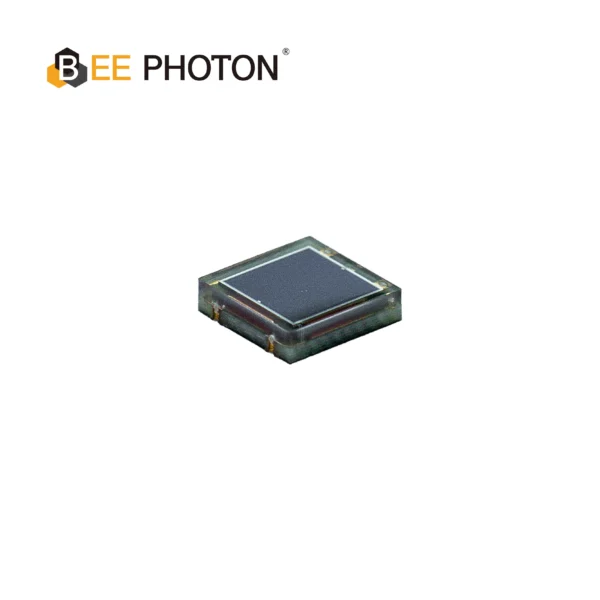
Fotodiodo PIN de Si con baja corriente oscura (350-1060nm) PDCC34-001
Bee Photon ofrece un fotodiodo PIN de Si COB compacto con una amplia respuesta espectral (350-1060 nm). Este fotodiodo Chip-on-Board presenta una baja corriente oscura, ideal para aplicaciones integradas y con limitaciones de espacio.
Noise and Temperature – The Not-So-Fun Part
Here’s something I learned the hard way on a customer project: germanium dark current doubles roughly every 8–10 °C. Silicon? More like every 15–18 °C. If your detector is going to sit in a box that gets warm, silicon usually behaves better without a thermoelectric cooler.
Real numbers from Hamamatsu and other reputable datasheets (public domain):
| Temperature | Typical Si Dark Current (nA) | Typical Ge Dark Current (nA) |
|---|---|---|
| 25 °C | 0.1 – 2 | 50 – 500 |
| 40 °C | ~1 – 10 | 500 – 5000 |
That’s why a lot of outdoor or industrial applications stick with silicon unless they absolutely need the longer wavelength.
Speed – How Fast Can They React?
Both can be made fast, but silicon PIN structures are easier to make with low capacitance. A 1 mm² Si PIN photodiode can easily give you <1 ns rise time. Germanium is a little slower because the material itself has higher carrier lifetime and capacitance tends to be bigger for the same active area. Typical Ge PIN rise times are 2–10 ns—still blazing fast for most telecom or LIDAR uses, just not quite silicon territory.
Cost Reality Check (2025 prices, roughly)
| Tipo | Typical Price (1–99 pcs) | Price per mm² active area |
|---|---|---|
| Standard Si PIN (InGaAs no) | $2 – $15 | ~$3–8 |
| Germanium PIN photodiode | $25 – $120 | ~$30–100 |
| Cooled InGaAs (if you go even longer) | $200+ | Sky’s the limit |
Germanium is genuinely 5–20× more expensive than silicon for similar size. If your boss asks “can we use silicon instead?” and you’re only working at 850 nm or 980 nm—the answer is almost always yes, and you’ll save a bundle.
When We Actually Recommend Germanium (Yes, It Happens)
Last year we had a customer doing OCT (optical coherence tomography) at 1300 nm. Silicon was completely blind there. We swapped in a germanium photodiode, noise was higher than they liked, so we added a tiny TEC and a transimpedance amp we designed in-house. End result: 5× better signal-to-noise than their previous silicon attempt. They were grinning ear to ear.
Another fun one: a research lab measuring water vapor absorption lines around 1650 nm. Silicon? Nope. Germanium nailed it on the first try.
Quick Decision Cheat Sheet
Pick Silicon if:
- Your light is 400–1050 nm
- You want low noise without cooling
- Budget matters
- You need super-fast response (<1 ns)
Pick Germanium if:
- You’re working 1200–1800 nm
- You can tolerate (or cool away) higher dark current
- Speed around 2–10 ns is fine
- Money is less of an issue than actually seeing the light
Still unsure? Drop us a line at info@photo-detector.com — we literally do this for a living.
Let’s Put It in a Table One More Time (Because Tables Rule)
| Característica | Fotodiodos de silicio | Germanium Photodiodes | Winner for Most People |
|---|---|---|---|
| Wavelength range | 400–1100 nm | 800–1800 nm | Depends on your λ |
| Peak responsivity | ~0.6–0.7 A/W @ 900 nm | ~0.9–1.1 A/W @ 1550 nm | Tie |
| Dark current (25 °C) | Super low | Noticeably higher | Silicon |
| Temperature stability | Excelente | Needs cooling above ~35 °C | Silicon |
| Velocidad | Faster (sub-ns possible) | A bit slower | Silicon |
| Coste | Cheap | Ouch | Silicon |
| Availability | Everywhere | Fewer suppliers | Silicon |
Real Talk: Is Germanium Ever “Better”?
Better is the wrong word. It’s different. Think of it like camera lenses: a 50 mm prime is cheap and sharp, but if you need to shoot birds 300 m away, you grab the 600 mm telephoto even though it costs ten times more and weighs a ton.
FAQ – Stuff People Actually Ask Us
Q: Can I just use a silicon photodiode with an optical filter to block visible light and pretend it works at 1550 nm?
A: Haha no. Silicon’s bandgap is ~1.1 eV, so photons at 1550 nm (0.8 eV) simply don’t create electron-hole pairs. You’ll measure exactly zero photocurrent. Filters don’t magically change physics.
Q: Is germanium toxic or radioactive or something?
A: Nope. Pure germanium is about as dangerous as silicon. The old rumor comes from germanium tetrachloride (used in fiber production), which is nasty if you breathe it, but the crystal itself is totally safe.
Q: Why do some high-end SWIR cameras use InGaAs instead of germanium now?
A: InGaAs has lower noise, works great from 900–1700 nm (or even 2600 nm), and dark current is way lower than germanium. But it costs a small fortune. Germanium is still the budget king if you only need up to ~1800 nm and can cool it a bit.
Still have questions? Want a quote on a custom Si or Ge detector? Hit us up on our página de contacto or just reply to this article. We’re Bee Photon — we build these things every day and love talking shop.
Now go forth and pick the right photodiode without losing your mind staring at datasheets!
— The team at Fotón abeja

Fotodiodo PIN de Si con sensibilidad UV mejorada (320-1060nm) PDCT16-601
Our Borosilicate Window Photodiode ensures superior UV to NIR detection. This photodiode with a durable borosilicate window excels in spectroscopy & medical analysis.