
If you’re building or upgrading industrial CT scanners, picking the right scintillator material makes a huge difference—especially when dealing with high-energy X-rays that need to punch through thick metal parts or dense objects. I’ve spent years working with these setups, testing detectors in real-world non-destructive testing lines, and helping manufacturers tweak their industrial CT components for better resolution and faster scans.
Today, let’s break down the two big players: CWO scintillator (cadmium tungstate, CdWO4) and CsI (usually CsI:Tl, cesium iodide doped with thallium). Both get used a lot in X-ray detection, but they shine (or don’t) in different spots. I’ll walk you through the comparison so you can decide which fits your high-energy needs better.
Why Scintillator Choice Matters in Industrial CT
Industrial CT isn’t like medical scanners—here we’re often blasting high-energy X-rays (hundreds of keV up to MeV range sometimes) to inspect turbine blades, castings, or welded assemblies. The scintillator converts those X-rays into visible light, which then hits a photodiode or Si PIN photodiode array to make the image.
Key things manufacturers care about:
- High stopping power (density + high Z) to absorb tough high-energy rays without too much thickness.
- Low afterglow so images don’t blur from leftover glow messing up the next projection.
- Decent light yield for good signal-to-noise.
- Radiation hardness—high flux over long runs shouldn’t degrade it fast.
- Compatibility with photodetectors like our Si PIN photodiodes.
CsI:Tl has been around forever and works great for lower-energy or medical stuff, but high-energy industrial? That’s where CWO scintillator often pulls ahead.
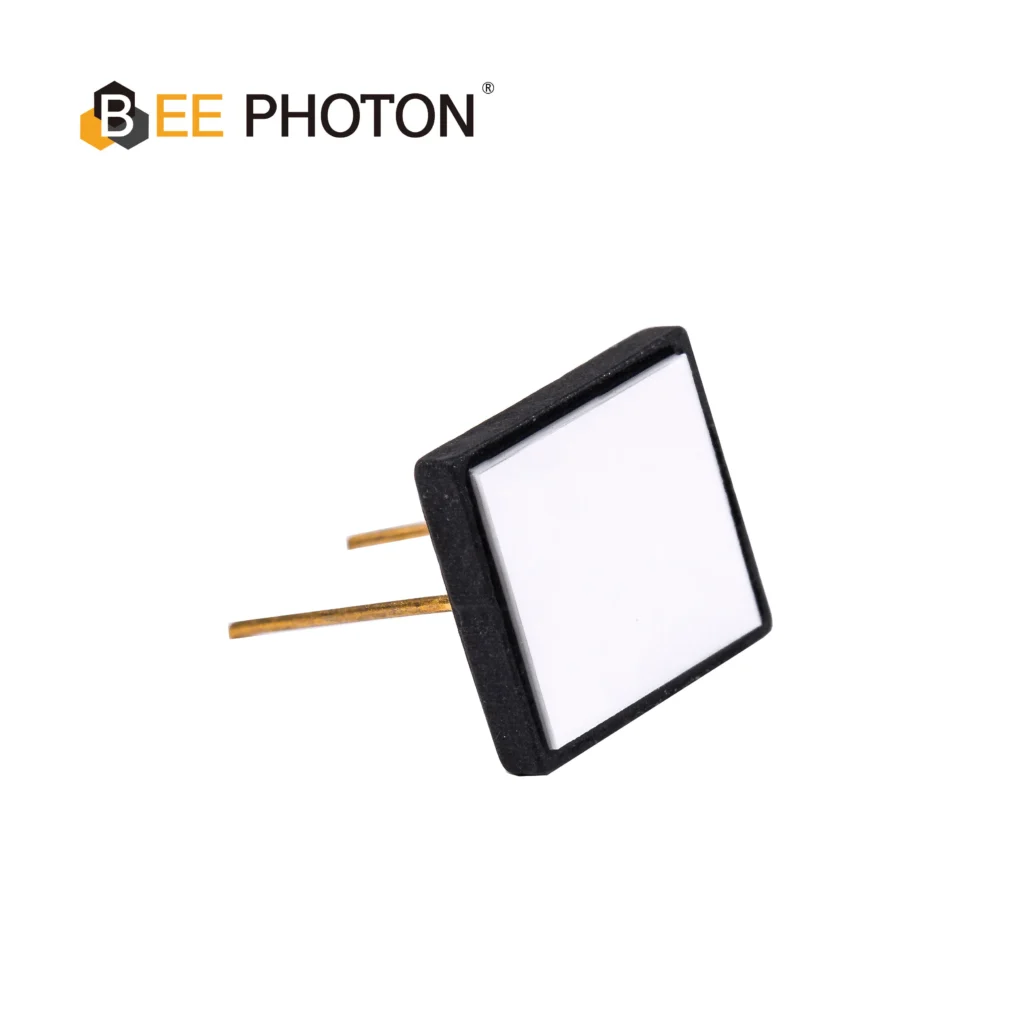
Si PIN Photodiode with scintillantor PDCD34-102
Bee Photon’s Si PIN photodiodes with scintillator deliver superior X-ray and gamma-ray detection.Our GOS scintillator photodiode ensures high light output and minimal afterglow for precise imaging.
Key Properties Side-by-Side
Let’s put numbers on the table—pulled from real studies and manufacturer data (like Luxium Solutions for CsI and various papers on CWO). These aren’t made up; they’re from sources like Optica publications and scintillator spec sheets.
| Property | CWO (CdWO4) | CsI:Tl | Winner for High-Energy Industrial CT? |
|---|---|---|---|
| Density (g/cm³) | 7.9 | 4.51 | CWO – way better stopping power |
| Light Yield (ph/MeV) | ~28,000 – 30,000 | ~54,000 – 66,000 | CsI – brighter |
| Peak Emission (nm) | ~495 | ~550 | Similar, both match Si photodiodes |
| Primary Decay Time (ns) | ~5,000 (5 µs) | ~1,000 (1 µs) | CsI – faster initial decay |
| Afterglow (after 3 ms) | <0.05% – 0.1% | ~0.3% or higher | CWO – much lower! |
| Radiation Hardness | Excellent | Good, but degrades more | CWO |
| Hygroscopic? | No | Slightly | CWO – easier handling |
From synchrotron tests (like in Optica 2021 paper), CWO and similar high-density materials handle high-flux better without saturation issues in thick setups. CsI wins on raw brightness, but in high-energy where absorption rules, CWO’s density means you stop more photons in less material.
When CWO Scintillator Wins Big
For high-energy industrial CT—think 450 kV+ systems scanning dense alloys—CWO often outperforms.
- Superior absorption — With density almost double CsI’s, CWO stops high-energy X-rays way better. Less thickness needed for same efficiency, meaning slimmer detectors and better geometry in tight setups.
- Low afterglow — Studies show CWO afterglow drops to tiny levels fast (0.05% after 3 ms in some refs). In fast CT rotations, CsI’s higher afterglow can ghost images, especially in dynamic scans or high-flux.
- Radiation resistance — Long runs under intense beams? CWO holds up better, less damage over time.
- Temperature stability — CWO has lower temp coefficient, less drift in hot factory floors.
I’ve seen cases where switching to CWO cut scan times by allowing higher flux without blur, and improved contrast on thick steel parts. One anonymous client (big aerospace supplier) swapped CsI panels for CWO-based ones in their high-energy line—defect detection jumped noticeably because fewer artifacts from afterglow.
Where CsI Still Holds Its Own
Don’t get me wrong—CsI:Tl isn’t trash. It’s brighter, so in lower-flux or micro-CT setups (lower keV), you get snappier signals and better SNR. Structured CsI columns also give killer spatial resolution in thin layers.
For industrial high-energy though? The density drop means thicker CsI needed, more scatter, and that afterglow bites harder when you’re cranking throughput.
Real-World Application Scenarios
In baggage or cargo CT (high-energy too), CWO gets picked for low-afterglow needs. Same for NDT on engine blocks—high penetration without ghosting.
We at Bee Photon supply both, but for your high-energy industrial CT components, we lean toward CWO when specs demand it. Pair it with our Si PIN photodiodes (check ’em here: https://photo-detector.com/product-category/si-pin-photodiodes/) and you get solid light collection without hassle.

Si PIN photodiode PDCP08 Series PDCP08-511
The PDCP08-511 is a high-performance Black Epoxy PIN Photodiode designed for precision infrared applications. Encased in a special black epoxy resin, this sensor effectively acts as a daylight filter, blocking visible light interference while maximizing sensitivity at 940nm. With a large 2.9×2.9mm active area and low dark current, it ensures reliable signal detection for optical switches and remote control systems, even in noisy ambient light environments.
Pros and Cons Quick Hit
CWO Scintillator Pros:
- Top-tier high-energy absorption
- Super low afterglow
- Tough against radiation
- Non-hygroscopic—stores easy
Cons:
- Lower light yield (but still plenty for most setups)
- Slightly slower decay (but afterglow matters more)
CsI Pros:
- Bright output
- Fast initial decay
- Proven in many systems
Cons:
- More afterglow
- Lower density needs thicker crystal
- Slight moisture sensitivity
Making the Choice for Your System
If your industrial CT runs high-energy X-rays on dense parts, go CWO scintillator. You’ll get cleaner images, faster reliable scans, and longer detector life. For mixed or lower-energy work, CsI might save cost or boost signal.
Want to chat specifics? Drop us a line at info@photo-detector.com or hit the contact page: https://photo-detector.com/contact-us/. Happy to run numbers on your setup or send sample quotes.
FAQ
Q: Is CWO scintillator always better than CsI for industrial CT?
A: Not always—depends on energy. For high-energy (>200-300 kV), yeah, CWO usually wins on absorption and low afterglow. Lower energies? CsI’s brightness shines.
Q: How does afterglow really affect my scans?
A: In fast CT, leftover glow from previous projections adds noise or ghosts. CWO’s tiny afterglow keeps things crisp, especially at high throughput.
Q: Can I pair CWO with Si PIN photodiodes?
A: Absolutely—emission around 495 nm matches Si response great. We’ve built plenty of detectors that way for industrial clients.
Q: What’s the cost difference?
A: CWO tends a bit pricier due to material, but pays off in performance for demanding apps. Reach out for a quote—we’ll tailor it.


