
If you are designing the next generation of smartwatches or haptic gaming gloves, you don’t have space. You just don’t. Marketing wants the device to be thinner than a credit card, battery guys want half the housing for the cell, and here you are, trying to fit complex optics into a space the size of a grain of rice.
It’s a nightmare. I’ve been there.
That’s where the miniature photodiode comes in. It’s not just a smaller version of the big guys; it is a fundamental shift in how we approach PPG sensor components and optical sensing in tight spaces.
At BeePhoton, we’ve seen projects go from “impossible” to “market-ready” just by swapping out a bulky detector for the right silicon die. Today, I’m going to walk you through how these tiny sensors work, why they are critical for your BOM (Bill of Materials), and how to integrate them without tearing your hair out.
The “Space Race” on the Wrist
Consumers are picky. They want a health tracker that monitors heart rate, SpO2, stress levels, and maybe even blood glucose, but they don’t want to wear a brick.
When we talk about wearable sensors, the constraint isn’t usually the processor; it’s the physical interface with the human body. You need a light source (LED) and a detector (miniature photodiode). These two need to be spaced apart correctly to catch the light reflecting from the blood vessels, not the surface of the skin.
If your photodiode is too big, you push the LEDs further out, increasing the total package size. If it’s too small, you lose signal quality. It’s a balancing act.
Why “Off-the-Shelf” Often Fails
I remember consulting for a company (let’s call them fit-tech start-up X) trying to build a smart ring. They used a standard photodiode because it was cheap and available. The result? The ring looked like a lug nut. It was huge. By switching to a custom miniature photodiode, they shaved 4mm off the width. That is a lifetime in wearable design.
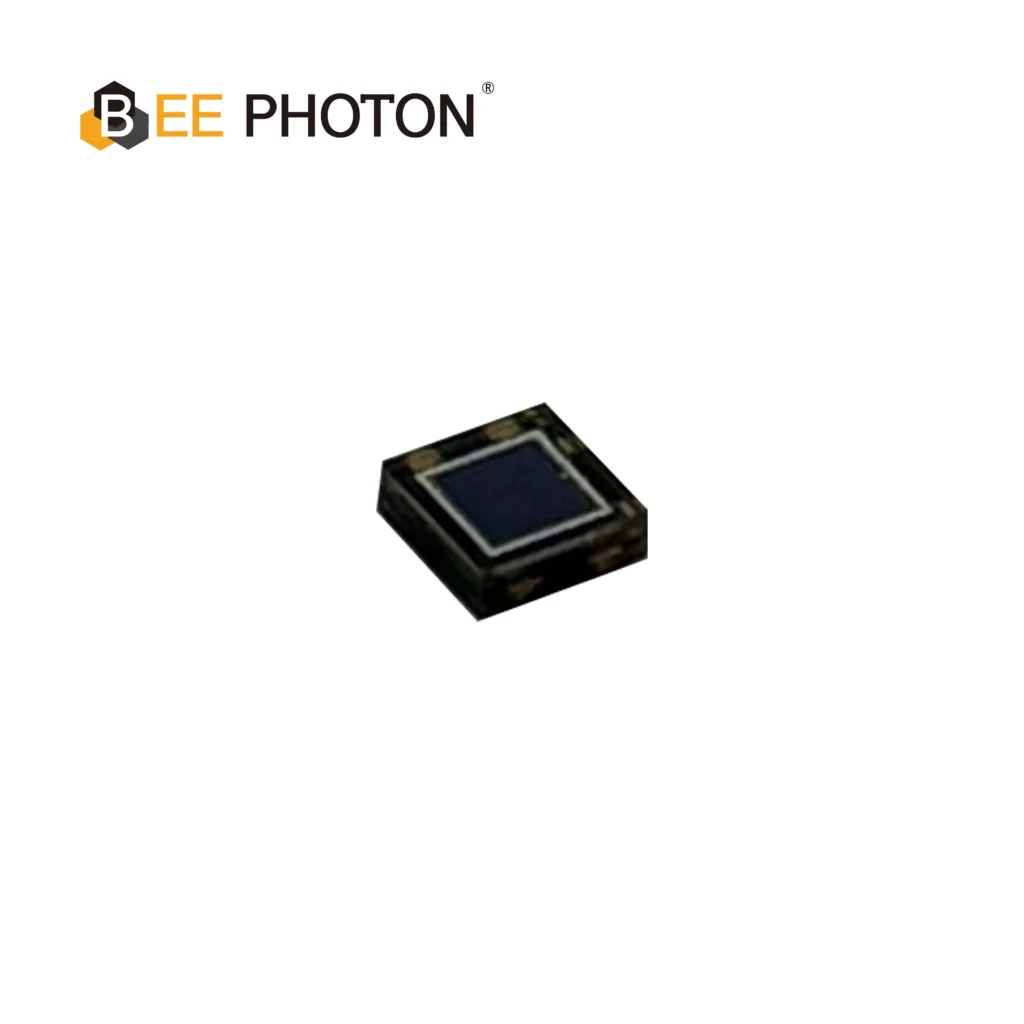
Si PIN Photodiode with low dark current (350-1060nm) PDCC07-003
Enhance your industrial automation systems with our low dark current Si PIN photodiode. This industrial automation photodiode (350-1060nm) offers superior precision and reliability.
The Science: How PPG Works (The Non-Boring Version)
To understand why the miniature photodiode specs matter, we have to look at Photoplethysmography (PPG).
Basically, you shine light into the skin. Most of it gets absorbed by tissue, bone, and melanin. A tiny fraction hits the pulsing blood in the arteries and bounces back. Your photodiode’s job is to catch that tiny bounce.
The intensity of light detected ($I$) follows the Beer-Lambert law principles, roughly expressed as:
I = I_0 * exp(-ε * c * d)
Where:
- I: Transmitted/Reflected light intensity
- I_0: Initial light intensity (from your LED)
- ε: Molar extinction coefficient (how much blood absorbs light)
- c: Concentration of the absorber (hemoglobin)
- d: Path length (depth in tissue)
In a miniature photodiode, the active area ($A$) is smaller. This means the total photocurrent ($I_ph$) generated is lower compared to a giant sensor.
I_ph = R_λ * P_opt
Where:
- I_ph: Photocurrent (Amps)
- R_λ: Responsivity at a specific wavelength (A/W)
- P_opt: Optical power hitting the sensor (Watts)
Here is the controversial take: Most engineers obsess over Responsivity ($R_λ$). They think higher is always better. But in wearables using a miniature photodiode, Dark Current is actually the killer.
If your tiny sensor has high dark current (noise), it doesn’t matter how responsive it is; your signal gets buried. You need a high Signal-to-Noise Ratio (SNR).
SNR = I_signal / sqrt(I_shot^2 + I_thermal^2 + I_dark^2)
In miniature devices, minimizing that $I_dark$ (Dark Current) is how BeePhoton wins against generic suppliers. We focus on purity in the silicon to keep that noise floor low, even when the chip is tiny.
Critical Specs for Miniature Photodiodes in Wearables
When you are browsing through our Si PIN photodiodes, don’t just look at the price. Look at these:
| Feature | Why it Matters for Wearables | Target Spec (Approx.) |
|---|---|---|
| Package Size | Fits in rings, earbuds, slim bands. | < 2mm x 2mm (SMD) |
| Spectral Range | Needs to match Green (HR) and Red/IR (SpO2). | 400nm – 1100nm |
| Capacitance | Lower capacitance = faster response (crucial for gaming). | < 10pF |
| Dark Current | Less noise = better battery life (less LED power needed). | < 1nA @ Vr=5V |
| Field of View | Wider is usually better for skin contact variability. | ~120 degrees |
Gaming Devices: The Next Frontier
It’s not just about heart rate. The gaming industry is moving toward “invisible” controllers. We are talking smart gloves and wristbands that track finger movement.
In this setup, a miniature photodiode is often paired with an IR emitter to create a break-beam or reflective proximity sensor. When you curl your finger, the reflection changes.
Latency is the Enemy
In health monitoring, if the heart rate creates a data point 100ms late, nobody cares. In gaming? 100ms is lag. It’s the difference between a headshot and a “Game Over.”
This is where the junction capacitance ($C_j$) of the miniature photodiode comes into play. A smaller active area naturally lowers capacitance, which increases speed.
t_r = 2.2 * R_load * C_j
If you use a big, sluggish sensor, your rise time ($t_r$) goes up. By using a high-speed miniature photodiode, we keep $C_j$ low, ensuring that the gesture is registered instantly.

Si PIN Photodiode with low dark current (350-1060nm) PDCC07-101
Optimize your optical communication systems with the PDCC07-101, a high-performance Si PIN for Data Transmission engineered for precision and reliability. This COB-packaged photodiode features a large Φ3.0mm photosensitive area and a peak sensitivity at 800nm, delivering a fast rise time of 0.18µs and an ultra-low dark current of 2.5pA. Designed to cover a broad spectral range from 350nm to 1060nm, the PDCC07-101 is the ideal Si PIN for Data Transmission solution for ensuring stable, high-speed signal processing in demanding industrial environments.
Designing for Manufacture (DFM): Don’t Ignore Assembly
I’ve seen designs that work perfectly on a breadboard fail miserably on the assembly line.
When you are dealing with miniature photodiode chips (some as small as 0402 footprints), manual soldering is out. You need precise SMT (Surface Mount Technology) processes.
Common Pitfall: The “Optical Cross-talk” disaster.
Because the sensor is so small, engineers pack the LED right next to it. Light leaks directly from the LED to the photodiode through the glass or PCB, bypassing the skin entirely. This saturates the miniature photodiode and gives you a flatline signal.
The Fix:
- Optical Barriers: Use physical light blocking between the emitter and the miniature photodiode.
- Underfill: Use black epoxy around the sensor.
- Lens Integration: Some of our Si PIN photodiodes come with integrated lenses to narrow the viewing angle and reject stray light.
Case Study: The “Insomnia” Tracker
Disclaimer: Client name withheld for privacy.
A client approached us building a sleep tracking mask. They needed PPG sensor components to track REM sleep via heart rate variability (HRV) from the forehead.
The Problem: The forehead is a terrible place for PPG. The bone is right there, and signal is weak. Their original sensor was a standard 5mm photodiode. It was too thick, pressing into the user’s skull and causing pain. Not great for a sleep product.
The Solution: We implemented a custom BeePhoton miniature photodiode with a customized spectral filter blocking ambient light (since bedrooms aren’t always pitch black).
The Result:
- Comfort: Profile reduced by 60%.
- Signal: The smaller active area actually improved SNR because we could place the sensor closer to the supraorbital artery without bulk.
- Battery: Because the miniature photodiode was more sensitive to the specific wavelength of the LED used, they lowered LED brightness by 20%, extending battery life by 3 hours.
Why Silicon (Si) PIN?
You might hear about InGaAs or APDs (Avalanche Photodiodes). Forget them for mass-market wearables.
- Cost: Si PIN is affordable at scale.
- Voltage: APDs need high bias voltage (often 100V+). You can’t put that on a smartwatch battery. A Si PIN miniature photodiode works great at 3.3V or even 0V (photovoltaic mode).
- Spectrum: Silicon peaks right where we need it—visible to near-infrared (VIS-NIR).

Si PIN Photodiode with low dark current (350-1060nm) PDCC34-001
Bee Photon offers a compact COB Si PIN Photodiode with wide spectral response (350-1060nm). This Chip-on-Board photodiode features low dark current, ideal for integrated and space-constrained applications.
FAQ: Questions We Get All the Time
Q1: Can I use a miniature photodiode for both Heart Rate and SpO2?
A: Absolutely. In fact, you should. A broadband miniature photodiode (covering roughly 400nm to 1000nm) can detect green light (for heart rate) and red/IR light (for SpO2) sequentially. You just time-multiplex the LEDs.
Q2: Is a smaller active area always worse for signal strength?
A: Theoretically, yes, you catch fewer photons. However, in practice, a miniature photodiode allows for tighter optical coupling with the skin. If you can get the sensor 1mm closer to the blood vessels because the package is smaller, that gain often outweighs the loss of active area.
Q3: How do I handle sweat and motion artifacts with such small sensors?
A: This is 90% mechanics and software, but the sensor plays a role. A miniature photodiode with a fast response time allows you to sample at a higher frequency. This gives your software algorithms more data points to filter out the noise caused by jogging or typing.
Ready to Shrink Your Tech?
Look, the market isn’t getting any friendlier to bulky devices. If your wearable looks like a medical clamp from the 1980s, you are done.
You need sensors that fit your vision, not the other way around. At BeePhoton, we specialize in the high-performance miniature photodiode solutions that B2B buyers actually need—reliable, consistent, and tiny.
Whether you are building the next e-sports glove or a clinical-grade health patch, we have the PPG sensor components to make it work.
Don’t let physics bully your design.
- Check out our products: Browse Si PIN Photodiodes
- Need custom specs? Contact our engineering team
- Email us directly: info@photo-detector.com
Let’s build something small, powerful, and profitable.


