
If you are an engineer designing the next generation of Computed Tomography (CT) equipment, you are probably losing sleep over one specific trade-off: Image Quality vs. Radiation Dose.
It’s the eternal struggle. Doctors want crystal clear images to spot micro-fractures or early-stage tumors. Patients (and regulators) want to stop glowing in the dark after a scan. And you? You’re stuck in the middle, staring at datasheets for CT scanner detectors.
I’ve been in the optics game for a long time, and I’ve seen some “revolutionary” detectors that were basically just expensive sand. But when we talk about Si PIN photodiodes for CT scanners, we are talking about the actual workhorse of modern medical imaging.
Today, I’m going to skip the marketing fluff. We’re going to dive deep into the physics of sensitivity, the need for speed (rise time), and why off-the-shelf components might be killing your system’s performance.
Why Your Old Detectors Are Probably Obsolete
Here’s a controversial take: if you are still using standard front-illuminated photodiodes for high-slice count CTs, you’re doing it wrong.
The gantry rotation speeds on modern scanners are insane. We are talking about 0.2 seconds per rotation or faster. If your medical photodiodes are lagging, you get motion artifacts. If they aren’t sensitive enough, you have to crank up the X-ray tube current, and boom—you just increased the patient dose.
To fix this, we need to look at Si PIN photodiodes for CT scanners not just as “light sensors,” but as the bridge between the analog world of photons and the digital world of diagnostic data.
The Sensitivity Equation: Cutting Dose Without Losing Data
Sensitivity isn’t just a number on a spec sheet; it’s the difference between a clean scan and a noisy mess. When we talk about X-ray scintillator coupling, we are usually dealing with materials like Gadolinium Oxysulfide (GOS) or Cesium Iodide (CsI). These emit light in the visible spectrum (usually green or yellow) when hit by X-rays.
Your photodiode needs to eat that specific wavelength of light for breakfast.
Spectral Matching is Key
If your scintillator peaks at 550nm but your photodiode peaks at 800nm, you are losing signal. It’s simple physics, but you’d be surprised how many designs ignore this.
For Si PIN photodiodes for CT scanners, we define Responsivity (R) roughly like this:
R = I_p / P_opt
Where:
- R is Responsivity (Amps/Watt)
- I_p is the photocurrent generated
- P_opt is the optical power incident on the chip
In high-performance silicon, typically, you want to see a Quantum Efficiency (QE) close to 100% at the peak wavelength of your scintillator.
For a silicon photodiode, the theoretical maximum responsivity at a given wavelength (lambda) follows this logic:
R_max = (lambda / 1.24)
So, if you are coupling with a scintillator emitting at 540nm (green), your Si PIN photodiodes for CT scanners should theoretically aim for:
R = 0.54 / 1.24 = ~0.435 A/W
If your vendor is selling you a diode with 0.2 A/W at that wavelength, throw it in the trash. You are losing half your signal before it even hits the amplifier. At BeePhoton, we obsess over this spectral matching. You can check out our optimized arrays here: Si PIN photodiodes.
Engineer’s Note: Don’t forget about the “dead space” between pixels. In a multi-slice CT, the fill factor is crucial. If the gap between active areas is too large, those photons are wasted. High-quality Si PIN photodiodes for CT scanners use precision dicing or tiling to minimize this gap.
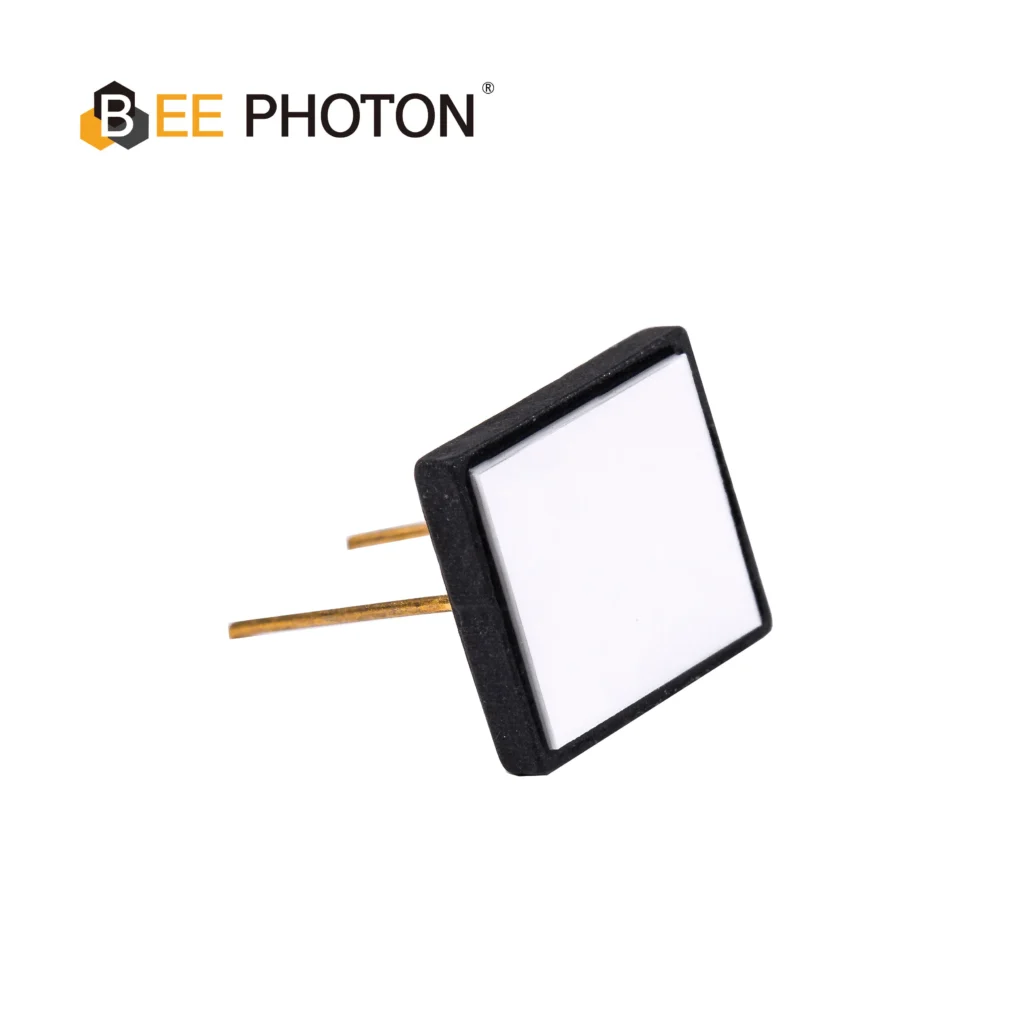
Si PIN Photodiode with scintillantor PDCD34-102
Bee Photon’s Si PIN photodiodes with scintillator deliver superior X-ray and gamma-ray detection.Our GOS scintillator photodiode ensures high light output and minimal afterglow for precise imaging.
Speed Kills (Artifacts): Rise Time and Capacitance
Sensitivity is great, but speed is what allows you to freeze a beating heart in an image.
When the CT gantry spins, the detector is sampling thousands of views per second. If the Si PIN photodiodes for CT scanners have a slow response time, the signal from “View 1” bleeds into “View 2.” This is called “afterglow” or “lag,” and it ruins spatial resolution.
The speed of the photodiode is largely dictated by its junction capacitance (C_j).
The Math Behind the Speed
The rise time (t_r) is roughly related to the bandwidth (f_c):
t_r = 0.35 / f_c
And bandwidth is limited by the RC time constant:
f_c = 1 / (2 * pi * R_load * C_j)
So, to get a faster detector, you need to lower the Capacitance (C_j).
C_j = (epsilon * A) / W
Where:
- epsilon is the permittivity of silicon
- A is the active area
- W is the depletion width
Here is the catch: To get high sensitivity (stopping more photons), you often want a thicker depletion layer (larger W), which actually helps lower capacitance (since W is in the denominator). However, if the chip is too large (Area A increases), capacitance shoots up, and speed goes down.
It’s a balancing act. This is why Si PIN photodiodes for CT scanners are often segmented into smaller arrays rather than huge single chips.
Data Comparison: Standard vs. Optimized
I put together a quick table to show you the difference between generic photodiodes and the ones we specifically tune for medical imaging at BeePhoton.
| Feature | Generic Photodiode | BeePhoton Medical Grade Si PIN | Impact on CT Scan |
|---|---|---|---|
| Dark Current (Id) | > 5 nA | < 0.5 nA | Less noise in low-dose scans |
| Capacitance (Cj) | > 100 pF | < 20 pF | Faster sampling, no motion blur |
| Peak Responsivity | 850 nm (IR) | Tuned to 540-560 nm (Visible) | Max signal from X-ray scintillator coupling |
| Shunt Resistance | 100 MOhm | > 1 GOhm | Better Signal-to-Noise Ratio (SNR) |
Real-World Scenario: The “Project Cobalt” Turnaround
I can’t name the client (NDA life, you know?), but let’s call them “Project Cobalt.” They were building a portable CT scanner for ambulances. Cool concept, right?
They were using generic industrial photodiodes to save cost. The problem? The images were grainy unless they cranked the X-ray power, which drained the ambulance battery in two scans. Not practical.
They reached out to us at info@photo-detector.com.
We swapped their detectors for specialized Si PIN photodiodes for CT scanners with a back-illuminated structure. This reduced the junction capacitance by 60%.
The result?
- Signal strength increased by 40% (due to better scintillator matching).
- They lowered the X-ray dose, extending battery life by 3x.
- The “ghosting” artifacts disappeared because the rise time dropped from 5 microseconds to 50 nanoseconds.
Sometimes, the hardware really is the bottleneck.

Si PIN Photodiode with UV sensitivity enchanced (190-1100nm) PDCT25-F01
Our Si PIN Diode with Wide Dynamic Range ensures precise measurement of varying light intensities. Ideal for power meters, it offers excellent linearity across the 190-1100nm spectrum. A reliable Si PIN diode for consistent performance.
Technical Specs You Should Actually Care About
When you are browsing through Si PIN photodiodes for CT scanners, ignore the shiny marketing headers and look at these two numbers:
1. Shunt Resistance (R_sh)
This determines the thermal noise current (Johnson noise).
Noise_current = Square_root( (4 * k * T * B) / R_sh )
If R_sh is low, your noise is high. For medical imaging, where we are counting individual photons sometimes, you want R_sh to be in the Giga-Ohm range. Si PIN photodiodes for CT scanners with low shunt resistance are basically useless for low-dose imaging.
2. Temperature Stability
CT scanners get hot. The gantry spins, the tube generates heat. If your photodiode’s performance drifts with temperature, your calibration goes out the window. We test our Si PIN photodiodes to ensure the temperature coefficient of responsivity is minimal.
Why BeePhoton?
Look, there are plenty of massive corporations selling detectors. But try getting their lead engineer on the phone to discuss custom array geometry for a 64-slice prototype. Good luck with that.
At BeePhoton, we specialize in this niche. We understand that Si PIN photodiodes for CT scanners aren’t just components; they are the eyes of the machine. We customize the active area, the pitch, and the ceramic carrier to fit your mechanics.
We don’t just sell parts; we help you solve the physics.
FAQ: Questions We Get All The Time
Q1: Can I use standard IR photodiodes for CT applications?
Honestly? No. Standard photodiodes peak in sensitivity around 900nm (Infrared). CT scintillators usually emit in the visible range (green/yellow). Using an IR diode means you throw away about 60% of your signal. You specifically need Si PIN photodiodes for CT scanners that are spectrally matched to your scintillator.
Q2: How does reverse bias affect the performance of Si PIN photodiodes for CT scanners?
Applying a reverse bias increases the depletion width. This reduces capacitance (making the detector faster) but can slightly increase dark current. For CT, we usually recommend a specific bias voltage that finds the “sweet spot” between speed and noise.
Q3: What is the lifespan of these photodiodes under X-ray exposure?
Silicon is pretty robust, but direct X-rays can damage the crystal lattice over time. However, in a CT setup, the photodiode is protected by the scintillator layer. The scintillator absorbs the X-rays and converts them to light. If designed correctly, the Si PIN photodiodes for CT scanners should last the lifetime of the scanner.
Q4: Do you provide the scintillator material too?
We focus on the semiconductor side—the Si PIN photodiodes. However, we work closely with scintillator partners and can advise on the best adhesives for X-ray scintillator coupling to minimize refractive index mismatch.
So, What’s the Bottom Line?
designing a CT scanner is hard enough without worrying if your detectors are lying to you. You need high speed to handle fast rotations and high sensitivity to keep radiation doses safe.
Si PIN photodiodes for CT scanners are the critical link in that chain. Don’t cheap out on them.
If you are stuck on a design or just want to bounce some specs off a human who actually understands the physics, give us a shout.
You can check out our full range of sensors here: https://photo-detector.com/product-category/si-pin-photodiodes/
Or, if you have a custom array in mind, drop us a line at info@photo-detector.com. We usually reply pretty fast—unless we’re in the lab testing a new batch.
Ready to upgrade your imaging chain? Contact BeePhoton Today and let’s build something safer and faster.


