
I see this happen way too often in hardware development. A team drops thousands of dollars on the absolute latest edge AI computing hardware. They are running incredibly complex multimodal models locally—stuff that was strictly locked in the cloud just a year ago, mimicking the massive capabilities of Gemini 3.1. They expect miracles right out of the box. But when they actually deploy the hardware in the real world to do something like high-speed optical sorting, LiDAR processing, or predictive maintenance, the accuracy completely tanks.
They usually blame the algorithm. They spend weeks collecting more data, tweaking parameters, and retraining. But nothing really fixes it.
Here is a controversial opinion for you: People obsess over GPU TOPS or NPU benchmark scores, but they completely ignore the frontend sensor noise. Most cheap off-the-shelf OP-amps totally ruin your optical signal before it even hits the Analog-to-Digital Converter (ADC). You can have the smartest neural network in the world, powered by next-gen silicon, but if your analog front-end is garbage, your multi-thousand-dollar AI chip is just doing really expensive guesswork.
If you are feeding a noisy, distorted optical signal into your processor, you are dead in the water. That is exactly why Low-Noise Photodiode Modules have become completely non-negotiable for serious edge AI computing hardware.
Let’s break down what is actually happening at the edge, why signal-to-noise ratio (SNR) is destroying your inference accuracy, and how dropping in ready-made Low-Noise Photodiode Modules is basically a cheat code to get your hardware to market faster.
The Edge AI Market is Exploding (And So Are The Hardware Bottlenecks)
We are living in a wild time for AI. In late 2025 and early 2026, Google pushed the boundaries of hardware computing power to crazy new heights with their custom Trillium TPUs (v6e) to run models like Gemini 3.1 Pro. That cloud-level power shifted the entire industry’s expectations. Now, B2B buyers don’t just want basic edge AI—they want real-time, multimodal reasoning directly on the device.
The money backs this up. The global edge AI market was valued around USD 35.81 billion in 2025 and is projected to cross $47.59 billion in 2026, scaling rapidly toward hundreds of billions over the next decade. Every industrial sector is trying to pack more AI onto the edge.
But here is the physical reality that software engineers hate to hear: AI models running on edge computing hardware need physical data. They need to “see” the world, often through optical sensors.
When your edge device is sitting in a pristine lab, your optical sensors work fine. But put that same hardware in a factory enviornment next to a massive conveyor belt motor, and suddenly your signal is buried in Electromagnetic Interference (EMI) and thermal noise. Your ADC can’t accomodate the messy voltage spikes, so it digitizes noise. The AI then confidently identifies a shadow as a critical defect.
This is why hardware designers are desperately moving away from raw, discrete photodiode setups and moving toward fully integrated Low-Noise Photodiode Modules.
Why Frontend Analog Signals Make or Break Your Edge AI
Let’s talk about Signal-to-Noise Ratio (SNR). In the context of edge AI computing hardware, SNR is basically the measure of truth.
When photons hit your photodiode, they generate a tiny photocurrent. And I mean tiny—often in the nano-ampere or even pico-ampere range. To make this signal useful for your edge AI processor, you have to convert that tiny current into a readable voltage using a Transimpedance Amplifier (TIA).
If your SNR is high, the AI processor gets a clear, crisp digital wave after the ADC. It knows exactly what it is looking at.
If your SNR is low, the signal looks like a fuzzy, chaotic mess.
When the edge AI tries to process a low-SNR signal, it wastes precious computing cycles. Instead of just running inference, the hardware has to run aggressive digital filtering algorithms just to seperate the signal from the noise. This burns power, creates latency, and totally defeats the purpose of having fast edge computing hardware in the first place. You definetly don’t want to waste compute on noise filtering when you could just fix the hardware frontend.
Using high-quality Low-Noise Photodiode Modules solves the SNR problem before it ever reaches the digital domain.
Understanding the Noise Math (Without Getting a Headache)
I promise I won’t use unreadable LaTeX formulas here, but we need to look at the basic math to understand why DIY sensor boards usually fail in edge AI applications.
The basic formula for converting your photocurrent to voltage in a TIA is:V_out = I_pd * R_f
Where V_out is your output voltage, I_pd is the photocurrent generated by the sensor, and R_f is the feedback resistor in your amplifier.
Simple, right? Just crank up the feedback resistor to get a bigger signal! But here is the catch: when you increase the gain, you also amplify the noise, and you kill your bandwidth.
Let’s look at the three main villains ruining your optical data:
1. Shot Noise
This happens because light isn’t a continuous stream; it’s made of individual discrete photons. The formula looks like this:I_shot = sqrt( 2 * q * (I_pd + I_dark) * BW )
Here, q is the charge of an electron, I_dark is the dark current (the current that flows even when there is zero light), and BW is your bandwidth. Notice that dark current is directly adding to your noise. If you buy a cheap sensor with high dark current, your edge AI is doomed from the start.
2. Thermal Noise (Johnson-Nyquist Noise)
Everything that has resistance generates thermal noise just by existing above absolute zero.I_thermal = sqrt( (4 * k * T * BW) / R_f )
k is Boltzmann’s constant, T is temperature in Kelvin. In hot industrial settings, thermal noise spikes hard.
3. Amplifier Noise
Your OP-amp itself introduces voltage and current noise. If the input capacitance of your raw photodiode isn’t perfectly matched to the OP-amp, your circuit will actually ring like a bell.
The total noise you have to deal with is the root sum square of all these:Total Noise = sqrt( I_shot^2 + I_thermal^2 + I_amplifier^2 )
If you are trying to wire a discrete photodiode to an amplifier on a custom PCB, the parasitic capacitance on your copper traces will absolutely wreck your phase margin. This is exactly why custom-engineering your analog frontend takes months of frustrating trial and error.
By contrast, Low-Noise Photodiode Modules have the sensor and the TIA co-located inside a tiny, shielded package. The trace length is basically zero. The capacitance is perfectly matched at the factory. The noise math is optimized for you before you even open the box.

Si PIN Photodiode Array PDCA02-602
The Bee Photon PDCA Series is engineered specifically as a Background Suppression Photodiode to solve complex detection challenges in industrial environments. By utilizing a high-precision two-segment architecture (PD A and PD B), this device allows for differential signal processing, effectively filtering out background interference. It is the premier choice for manufacturers designing reliable background suppression optical switches and proximity sensors.
The Trap of DIY Circuits vs. Ready-Made Modules
I’ve sat in on so many hardware design reviews where a junior engineer says, “Why would we buy Low-Noise Photodiode Modules? I can just buy a $2 Si PIN photodiode and a $3 OP-amp and build it myself.”
Sure you can. And then you will spend the next four months wondering why your edge AI computing hardware hallucinates data every time someone turns on the air conditioning in the building.
When you build a discrete circuit, exposed PCB traces act like microscopic antennas. They pick up 60Hz hum from the power lines, RF noise from Wi-Fi routers, and EMI from nearby motors.
Professional Low-Noise Photodiode Modules encapsulate the photodiode and the amplifier inside a hermetically sealed, metal-shielded can. They are designed specifically to reject external noise.
Here is a quick breakdown of why modules win every single time in commercial edge AI hardware:
| Feature | Discrete DIY Photodiode Design | BeePhoton Low-Noise Photodiode Modules |
|---|---|---|
| Signal-to-Noise Ratio (SNR) | Usually poor unless perfectly routed by a senior analog engineer. | Extremely high, pre-optimized and factory calibrated. |
| Time to Market | Months of debugging, layout tweaks, and board respins. | Drop-in ready. Takes days to implement into your edge device. |
| EMI Susceptibility | High. Exposed PCB traces act like antennas for factory noise. | Very low. Internally shielded components block interference. |
| Engineering Cost | Very high. Requires dedicated analog engineering hours. | Low. Plug-and-play architecture saves massive labor costs. |
| AI Inference Accuracy | Inconsistent. Varies based on environmental noise. | Rock solid. Clean data feeds directly to your edge AI processor. |
If your company’s core value is building cutting-edge AI software and integrating it into digital hardware, you should not be wasting engineering sprints tuning analog feedback loops. Just buy the module.
Deep Dive: The Si PIN Photodiodes Inside the Modules
If you open up top-tier Low-Noise Photodiode Modules, what is actually doing the work? In many edge AI applications, especially those dealing with visible to near-infrared light, you will find Si PIN photodiodes.
You can browse a great selection of these specific components here:Si PIN photodiodes.
Why PIN? A standard PN photodiode is okay for basic light detection, but it is too slow and has too much capacitance for high-speed edge AI computing hardware.
A PIN photodiode inserts an “Intrinsic” (I) semiconductor layer between the P-type and N-type layers. This seemingly minor change does two massive things:
First, it widens the depletion region, which means photons have a much larger target area to hit and convert into current. This gives you fantastic quantum efficiency.
Second, widening the gap between the P and N layers drastically lowers the capacitance of the junction. Lower capacitance means higher bandwidth and faster response times.
When edge AI hardware is processing optical data at hundreds of frames per second, or analyzing high-speed LiDAR pulses, you need that speed. You cannot afford sluggish sensor response times. Integrating high-speed Si PIN sensors inside Low-Noise Photodiode Modules gives you the perfect balance of massive bandwidth and whisper-quiet noise floors.
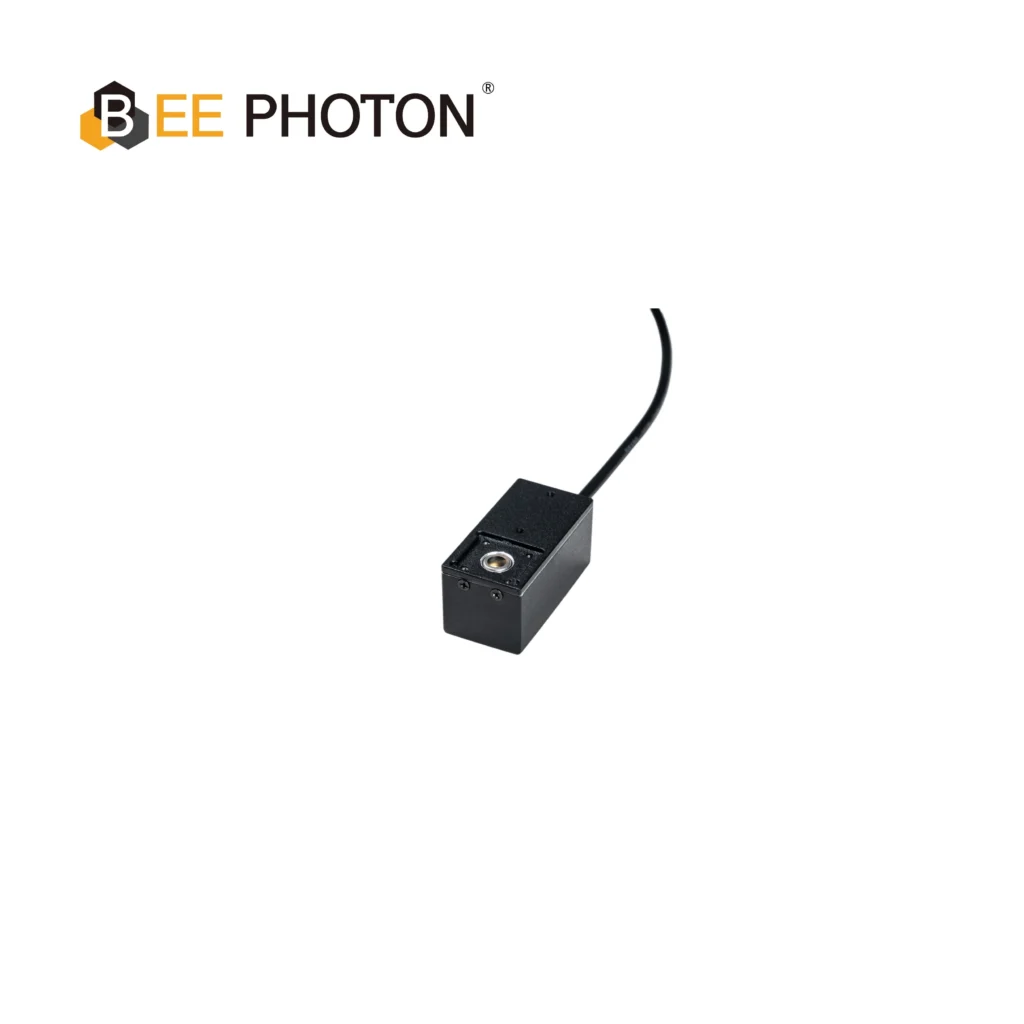
Photodiode Module(Digital signal output)PDMM
Our Low Noise Photodetector Module ensures high sensitivity for precision tasks. Use this low noise photodetector module for superior spectroscopy results.
Real-World Anonymous Case Study: Fixing Optical Sorting Inference
Let me share a story from a consulting gig I did last year. I was working with a smart manufacturing company that built edge AI hardware for agricultural sorting. They used optical sensors to detect the ripeness and detect subtle bruising on fruit flying down a high-speed conveyor belt.
The edge computing hardware they selected was an absolute beast—capable of running advanced local models easily. But their real-world inference was wildly inconsistent.
The software team was pulling their hair out. They thought their model was underfitting, so they spent weeks collecting thousands of new images, tweaking hyperparameters, and retraining the neural network. Absolutely nothing worked.
They finally let me look at their hardware stack. They were using a cheap, unshielded photodiode wired into a generic op-amp on a massive custom PCB. The factory enviornment was loud—both acoustically and electrically. The EMI from the massive conveyor motors was coupling directly into their analog traces.
When they tried to read the optical signal, the noise floor was so erratic that the AI literally couldn’t tell the difference between a dark bruise on an apple and a random voltage spike caused by the motor spinning up. The AI was basically guessing.
We threw out their custom sensor board and swapped in a pair of industrial-grade Low-Noise Photodiode Modules from BeePhoton. Because the TIA and the sensor were perfectly matched and shielded inside a single unit, the EMI issue disappeared overnight.
Instantly, the SNR improved by a massive factor. The crazy part? The software team didn’t even need to retrain their AI model. The original algorithm was completely fine; it just needed clean analog data. By switching to Low-Noise Photodiode Modules, they saved months of wasted software engineering and finally shipped the product.
How to Choose the Right Low-Noise Photodiode Modules for Your AI Device
Okay, so you realize you need one. How do you actually spec it out for your edge AI hardware? You can’t just pick the first one you see. You need to look at three main specs:
1. Responsivity (A/W)
This tells you how much current the module generates for a given amount of optical power at a specific wavelength. If your AI hardware uses an 850nm infrared laser, you need Low-Noise Photodiode Modules that peak exactly at 850nm.
2. Bandwidth vs. Gain
As we discussed with the math earlier, you can’t have infinite gain and infinite bandwidth. If your edge AI is looking at slow-changing environmental light, you want massive gain and low bandwidth. If you are building a high-speed optical data receiver or LiDAR, you need high bandwidth, and you’ll have to sacrifice some gain. The beauty of buying pre-made Low-Noise Photodiode Modules is that the manufacturer provides a clean datasheet showing exactly what bandwidth you get at what gain. No guessing required.
3. Active Area
A bigger sensor area makes it easier to align your optics and capture more light. But a bigger active area also means higher capacitance, which increases noise and slows down the sensor. You have to find the sweet spot.
If you aren’t sure how to balance these tradeoffs, that is exactly what the engineers at BeePhoton are for. You can check out their main site at BeePhoton to see how they handle these exact edge AI hardware challenges.

Photodiode module(Analog output)PDTM-A
Bee Photon is a top OEM Photodiode Module Supplier for custom needs. Trust an experienced OEM photodiode module supplier for your precision optical instruments.
Frequently Asked Questions (FAQ)
What exactly are Low-Noise Photodiode Modules?
They are fully integrated, plug-and-play optical sensing units. Instead of giving you a raw photodiode, these modules contain the sensor, a precision Transimpedance Amplifier (TIA), and heavy electromagnetic shielding all in one package. They output a clean, amplified voltage signal directly to your edge AI’s ADC.
Why can’t I just use a standard photodiode and my own amplifier for edge AI?
You can, but you will likely fail the first few times. Wiring a discrete photodiode on a PCB introduces parasitic capacitance on the traces, which causes amplifier instability and amplifies thermal and EMI noise. Low-Noise Photodiode Modules eliminate trace length by co-locating the sensor and amplifier, guaranteeing a high SNR out of the box.
How does dark current impact my edge AI hardware’s performance?
Dark current is the tiny amount of electricity that flows through a photodiode even when in total darkness. Because it fluctuates randomly, it adds directly to your shot noise floor. If your dark current is too high, your AI will recieve false positive signals, degrading its ability to accurately classify optical data. High-end Low-Noise Photodiode Modules are engineered specifically to minimize this dark current leakage.
Will upgrading my optical module really improve my AI accuracy?
Absolutely. AI algorithms operate on the principle of “garbage in, garbage out.” If your optical frontend is feeding noisy, jittery voltage to your edge computing hardware, the neural network will struggle to find patterns. Providing clean, high-SNR data allows the AI to function exactly as trained.
Wrap Up and Next Steps
The edge AI landscape is moving ridiculously fast. With hardware architectures inspired by the Gemini 3.1 era becoming the new normal, your edge devices are expected to perform flawless, real-time multimodal reasoning.
But all that digital computing power is completely useless if your analog frontend is feeding it garbage data.
Stop wasting your engineers’ time debugging analog feedback loops. Head over to the experts at BeePhoton to explore our ready-to-use Si PIN photodiodes. If you have a highly specific edge AI application, reach out to us directly via our contact page or email us at info@photo-detector.com so we can spec the exact custom module your hardware needs to succeed.


