
If you design infrared systems for a living, you’ve probably cursed at ambient light more times than you care to count. Sunlight flooding a factory floor, LED shop lights flickering at 120 Hz, or just plain old daylight turning your clean IR signal into noise. That’s exactly where the choice between a black epoxy photodiode and a clear epoxy photodiode makes or breaks your project.
I’ve helped plenty of engineers sort this out over the years, and the difference isn’t subtle. A black epoxy photodiode literally builds a daylight filter right into the package. Clear ones? They let everything in and leave you fighting saturation with extra circuitry or software hacks. Let’s break it down so you can pick the right one and get your system running rock-solid.
Why the Epoxy Encapsulation Matters More Than You Think
Photodiodes turn light into current, plain and simple. Silicon PIN types do it especially well across 340–1100 nm. But the package—the epoxy or lens on top—decides what wavelengths actually reach the silicon chip.
Clear epoxy photodiodes act like a window. They pass visible light (400–700 nm) plus near-IR with almost no loss. Great if you’re in a dark lab measuring precise optical power. Terrible if your sensor sits anywhere near real-world lighting.
Black epoxy photodiodes flip the script. The resin is loaded with special pigments that block nearly all light below 700 nm while staying almost transparent from 700–1100 nm. Peak response often lands right around 940 nm—perfect for the 850 nm or 940 nm IR LEDs and lasers most industrial systems use.
It’s not magic. It’s a physical filter built into the encapsulation. No extra glass, no extra cost for external filters, and zero chance of the filter falling off during vibration or thermal cycling.
Clear Epoxy Photodiodes: When They Work (and When They Fail Hard)
Clear epoxy versions shine in controlled environments. Low dark current, fast response, and flat spectral response across visible and IR. You get decent responsivity—typically 0.5–0.6 A/W at peak—and they’re cheap.
But take them outdoors or into a bright factory and they saturate fast. Background current can hit 1 mA under direct sunlight. Your transimpedance amp clips, your signal-to-noise ratio tanks, and you start chasing false triggers. I’ve seen prototypes that worked perfectly on the bench fail the moment someone turned on the overhead LEDs.
Engineers often try to fix it with AC coupling, servo loops, or heavy DSP filtering. That adds parts, board space, power draw, and debug time. Not ideal when you’re trying to hit cost and reliability targets.

Si PIN photodiode PDCP08 Series PDCP08-511
The PDCP08-511 is a high-performance Black Epoxy PIN Photodiode designed for precision infrared applications. Encased in a special black epoxy resin, this sensor effectively acts as a daylight filter, blocking visible light interference while maximizing sensitivity at 940nm. With a large 2.9×2.9mm active area and low dark current, it ensures reliable signal detection for optical switches and remote control systems, even in noisy ambient light environments.
Black Epoxy Photodiode: Built-In Daylight Filter That Actually Works
Here’s where the black epoxy photodiode earns its keep. It knocks visible light interference down by orders of magnitude before the light even hits the junction. In one stamping plant test I know of, switching to black epoxy dropped oscilloscope noise by 98% and eliminated the need for months of DSP tweaking. The sensor locked onto a 940 nm IR laser with zero jitter even when LED reflections were bouncing everywhere.
The black epoxy photodiode blocks below 700 nm so effectively that background current under 100,000 lux sunlight drops from around 1 mA (clear) to roughly 50 µA. That keeps your TIA happy and your signal clean.
Response time stays fast because junction capacitance stays low—usually single-digit pF under 5–10 V reverse bias. Dark current stays in the low nanoamp range. You get high responsivity right where you need it (900–940 nm) and almost nothing in the visible band.
Head-to-Head: Black Epoxy Photodiode vs Clear Epoxy Photodiodes
Here’s a no-nonsense comparison table based on real field performance and manufacturer data:
| Feature | Clear Epoxy Photodiode | Black Epoxy Photodiode | Why It Matters for IR Systems |
|---|---|---|---|
| Visible Light Immunity | Terrible – saturates easily | Excellent – blocks <700 nm | Prevents false triggers in sunlight/LEDs |
| Best Use Case | Dark labs, controlled benches | Factories, outdoors, loading docks | Matches real industrial environments |
| TIA Circuit Complexity | High – needs AC coupling & servo loops | Low – minimal DC offset | Cuts BOM cost and PCB real estate |
| Outdoor SNR | Extremely poor | Very high | Reliable detection without heavy filtering |
| Component Cost | Slightly cheaper | Marginally higher | System-level savings far outweigh difference |
| Peak Sensitivity | Broad visible + IR | Sharp rise >800 nm, peaks ~940 nm | Optimized for common 850/940 nm IR sources |
| Noise Floor in Bright Light | High background current | Dramatically reduced | Cleaner signal, faster response |
You can see why more B2B designers are moving to the black epoxy photodiode for anything that leaves the lab.
How Black Epoxy Actually Filters Visible Light (Technical Details You Can Use)
The epoxy resin itself does the heavy lifting. It scatters and absorbs photons below 700 nm while letting 700–1100 nm pass with minimal attenuation. Silicon’s own cutoff sits around 1100 nm anyway, so the black epoxy photodiode pairs perfectly with it.
Responsivity (in A/W) is still calculated the same way: photocurrent divided by incident optical power. But now your photocurrent comes almost entirely from the IR you care about.
Quantum efficiency stays high in the NIR—often 70–90% at 940 nm—because the filter doesn’t eat your signal. Noise equivalent power (NEP) improves because the noise current drops with lower background light. Simple formula: NEP equals noise current divided by responsivity (in W/√Hz).
In practice, you get a flatter noise floor even when the factory lights are blazing. Pair it with 10 kHz modulation and a simple bandpass filter and ambient light basically disappears.

Si phototransistor PTCP Series PTCP001-202
Enhance your switching solutions with this 800-1100nm NPN Phototransistor. Perfect for photoelectric switches, it offers high power dissipation up to 90mW. This silicon phototransistor delivers consistent performance in harsh environments from -40°C to +85°C.
Real Applications Where Black Epoxy Photodiode Wins
Industrial position sensing for AGVs and CNC machines. Optical curtains and light barriers. Long-range IR remote controls in noisy factories. Edge detection on high-speed production lines.
One aerospace supplier I worked with swapped to black epoxy photodiodes and cut false positives by over 90% in direct sunlight tests. Another factory making automotive parts used them in safety light curtains—zero downtime from ambient interference after the change.
These aren’t lab toys. They’re field-proven in environments where clear epoxy photodiodes would have engineers pulling their hair out.
Key Specs to Check Before You Buy a Black Epoxy Photodiode
Active area (2.9 × 2.9 mm is common and plenty for most jobs).
Dark current (keep it under a few nA).
Junction capacitance (lower is faster).
Rise/fall time (microseconds matter for high-speed barriers).
Package (through-hole or SMD—pick what fits your board).
BeePhoton’s PDCP08-511 is a solid example: black epoxy Si PIN, low dark current, high responsivity at 940 nm, and built for exactly these noisy industrial jobs.
How to Pick and Integrate the Right Black Epoxy Photodiode
Start with your wavelength—940 nm is usually the sweet spot because it’s eye-safe and cheap to source. Check reverse bias voltage your circuit can supply (5–10 V is typical). Make sure the active area matches your optical budget.
Mount it so the black epoxy faces the source—no extra lenses needed unless you want to narrow the field of view. Keep leads short to minimize capacitance. And test it in the actual environment, not just on the bench. That one step saves more headaches than anything else.
If you’re still on the fence, grab a few samples of our Si PIN photodiodes and run a side-by-side test. The difference shows up in minutes.
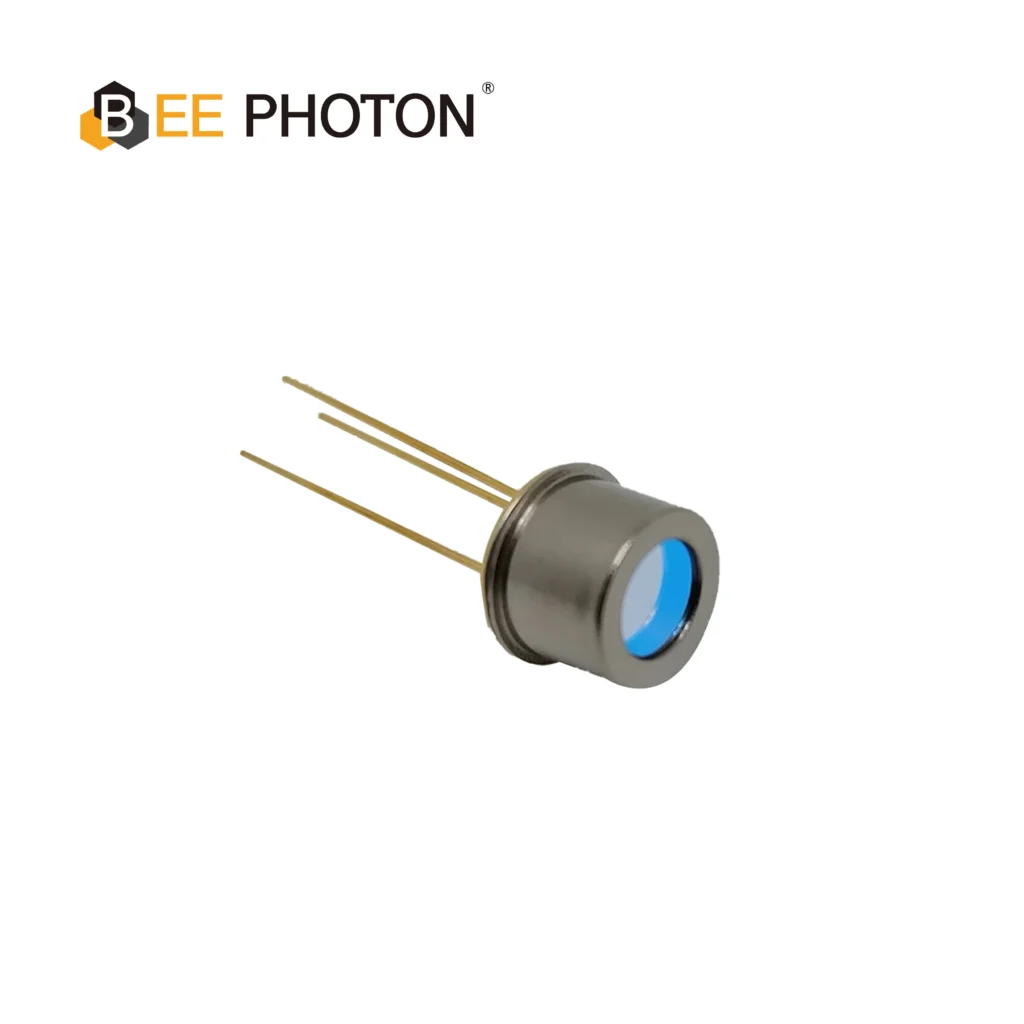
Si PIN Photodiode with low dark current (350-1060nm) PDCT07-001
Achieve high-precision results with our wide spectral range Si PIN photodiode, ideal for spectrometry and analytical instruments. Its ultra-low dark current and high linearity ensure accurate light detection. This photodiode offers a wide spectral response for diverse applications.
FAQ
Q1: Can I just add an external filter instead of using a black epoxy photodiode?
Sure, but it adds cost, alignment hassle, and potential failure points. The black epoxy photodiode builds the filter into the package so it’s vibration-proof and thermally stable. Most engineers who try external filters end up switching anyway.
Q2: Does the black epoxy photodiode reduce my IR sensitivity?
Not at all. It actually improves effective sensitivity in real conditions because there’s way less background noise competing with your signal. Responsivity at 940 nm stays right where you want it.
Q3: Will a black epoxy photodiode work with visible light sources?
No—and that’s the point. If your system needs visible detection, stick with clear epoxy. For pure IR, black epoxy photodiode is the smarter move.
Q4: How much more expensive is a black epoxy photodiode?
Component price is only pennies higher at volume. The real savings come from simpler circuitry, less engineering time, and higher reliability. The ROI is usually obvious after the first field test.
Ready to Make the Switch?
If ambient light is killing your IR performance, a black epoxy photodiode is the straightforward fix. Cleaner signals, simpler boards, happier customers.
Head over to our full range of Si PIN photodiodes and see the black epoxy options for yourself. Or reach out to our team and tell us about your application—we’ll help you spec the right part and even send samples. Drop us a line at info@photo-detector.com if you want datasheets or a quick quote.
You’ve got enough on your plate without fighting visible light interference. Let the black epoxy photodiode handle that part so you can focus on the rest of the design. Talk soon.


