
So, you’re dealing with industrial inspection, right? You’ve got a pipeline, a casting, or maybe some high-tech luggage scanner, and you need to see inside it without breaking it open. That’s the magic of NDT. But here’s the thing—your image is only as good as your detector.
I’ve spent years messing around with different detection setups, from old-school film (yeah, remember that?) to bulky PMTs. But lately, the real game-changer in the lab and on the factory floor has been the combo of Non-Destructive Testing (NDT) with Si PIN Photodiodes and Scintillators.
If you are trying to detect X-rays or Gamma rays with high precision and you aren’t using this setup, you might be making your life harder than it needs to be. Let’s break down why this tech works, how to use it, and share some real-world stuff from the trenches at Bee Photon.
Why the Old Ways Are Failing You
Back in the day, Photomultiplier Tubes (PMTs) were the kings. They are sensitive, sure. But they are also fragile glass bulbs that hate magnetic fields and require high voltage that can zap you if you aren’t careful.
In modern industrial NDT, we need something rugged. We need compactness. And we need a large area photodiode that can capture a decent amount of signal without taking up the space of a shoebox.
When you pair a silicon (Si) PIN photodiode with the right scintillator, you get a solid-state solution that is basically bulletproof compared to the old tech.
The Basics: How It Actually Works
I won’t bore you with a physics lecture, but you gotta understand the mechanism to pick the right parts.
- The Radiation Source: You shoot X-rays or Gamma rays at your target object.
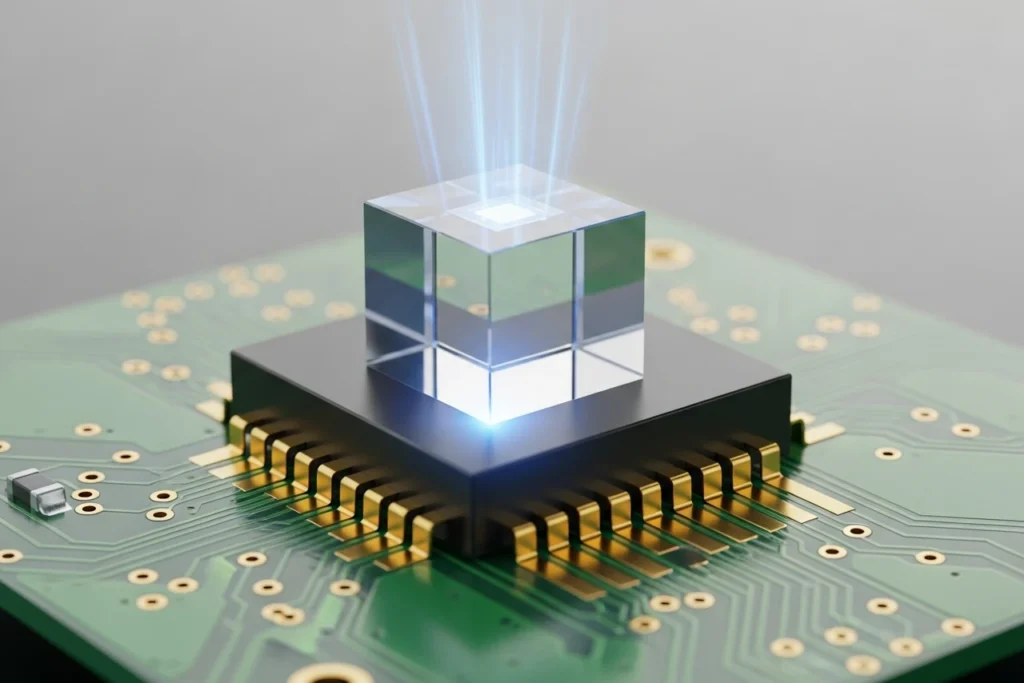
- The Scintillator: This is a crystal (like CsI or GOS) that sits right on top of the sensor. When the X-ray hits it, it glows. It converts high-energy radiation detection events into visible light.
- The Photodiode: The Si PIN diode sees that flash of visible light and turns it into an electrical current.
Simple, right? But the devil is in the details. If your photodiode isn’t matched to the emission wavelength of your scintillator, you’re losing signal. If your photodiode area is too small, you’re missing data.
The “Large Area” Advantage
This is where I see a lot of engineers mess up. They buy a tiny, cheap photodiode intended for fiber optics and try to use it for X-ray detection. It doesn’t end well.
For industrial detection and scientific research, you usually have a diffuse light source coming out of that scintillator. A small active area means you capture maybe 10% of the light. You get a noisy image, and you have to crank up your X-ray source power to compensate (which costs more money and safety shielding).
Using a large area photodiode is like using a bucket to catch rain instead of a thimble. You gather more photons, which gives you a better Signal-to-Noise Ratio (SNR).
At Bee Photon, we see this all the time. Customers switch to a larger active area, and suddenly their “ghostly” images become sharp and defined. If you need a component that can handle this kind of flux without saturation, you should definitely look at our Si PIN Diode with Wide Dynamic Range. It’s designed specifically to handle the varying intensities you find in NDT.
Choosing the Right Scintillator
You can have the best diode in the world, but if your scintillator is garbage, your system fails. Its a partnership.
Here is a quick rundown of what we usually see in the field:
- CsI(Tl) (Cesium Iodide): The workhorse. It puts out a LOT of light (high light yield). It emits green light, which matches silicon photodiodes perfectly. The downside? It’s hygroscopic (absorbs water), so it needs to be sealed tight.
- GOS (Gadolinium Oxysulfide): Great for higher energy X-rays. It’s ceramic-like, very dense, and stops X-rays dead in their tracks. Fast decay time, good for scanners that move quickly.
- CdWO4 (Cadmium Tungstate): Heavy, dense, no afterglow. We use this when we need really clean signals without the “ghosting” from previous frames.
A Quick Comparison Table
To make this easier to digest, here’s how the Si PIN + Scintillator combo stacks up against other tech.
| Feature | Si PIN + Scintillator | PMT (Photomultiplier) | Direct Conversion (CdTe) |
|---|---|---|---|
| Ruggedness | High (Solid state) | Low (Glass vacuum tube) | Medium (Brittle crystals) |
| Magnetic Immunity | Yes (immune) | No (affected heavily) | Yes |
| Cost | Low to Medium | High | Very High |
| Size | Compact / Flat | Bulky | Compact |
| Bias Voltage | Low (<50V usually) | High (1000V+) | Medium/High |
| Best Use | General NDT, Baggage, CT | Low light counting | High-res spectroscopy |
Real World Application: A Success Story
I want to share a story (anonymized, of course) about a client we helped recently. Let’s call them “Company X.”
Company X manufactures heavy-duty steel pipes for the oil and gas industry. They were using an old image intensifier system to check for weld defects. The system was huge, heavy, and the images were getting grainy because the vacuum tube was aging. Plus, every time they moved the magnetic clamps for the welding rig, the image on the detector would warp.
They came to us asking for a solution.
The Fix:
We suggested replacing the intensifier with a linear array of our large area Si PIN photodiodes coupled with CsI(Tl) scintillators.
The Result:
- Zero Magnetic Interference: Because Si PINs don’t care about magnets, the welding clamps didn’t distort the image anymore.
- Better Contrast: The Si PIN Diode with Wide Dynamic Range allowed them to see through the thick steel walls (low signal) while not getting blinded by the raw X-ray beam passing around the pipe (high signal).
- Compactness: They shrunk the detector head size by about 70%.
Company X was pretty happy. They saved money on maintenance and improved their defect detection rate by like 15%.
Technical Nuances: What to Watch Out For
Okay, moving away from the sales pitch—let’s talk engineering headaches. If you are building these systems, here are the traps:
1. Optical Coupling is Key
You can’t just tape the scintillator to the diode. You need optical grease or a specific optical epoxy. If there is an air gap, the light reflects back into the crystal and never hits the diode. You lose signal. We’ve seen setups lose 50% of their efficiency just because of a bad glue job.
2. Dark Current
Every photodiode has “dark current”—electricity that flows even when there’s no light. In radiation detection, if your signal is weak, high dark current will drown it out. Temperature makes this worse. If your industrial environment is hot (like near a furnace), you might need a diode with exceptionally low leakage current or consider cooling it.
3. Response Speed
If you are scanning luggage on a fast conveyor belt, your detector needs to be fast. Si PINs are generally fast enough, but some scintillators (like CsI) have an “afterglow.” They keep glowing for milliseconds after the X-ray stops. This causes motion blur. Make sure your scintillator speed matches your conveyor speed.
Why Bee Photon?
Look, there are plenty of places to buy diodes. But at Bee Photon, we focus specifically on the intersection of light and physics. We understand that you aren’t just buying a chip; you’re trying to solve a detection problem.
We specialize in customizing the active area shape and size to match your specific scintillator crystals. Whether you need a single element for a spot check or a 1D array for a scanner, we can handle it.
If you are unsure about which diode matches your specific X-ray energy source, just ask us. We love geeking out over this stuff. You can check out our full range of detectors at https://photo-detector.com/.

Si PIN Photodiode with UV sensitivity enchanced (190-1100nm) PDCT25-F01
Our Si PIN Diode with Wide Dynamic Range ensures precise measurement of varying light intensities. Ideal for power meters, it offers excellent linearity across the 190-1100nm spectrum. A reliable Si PIN diode for consistent performance.
FAQ: Common Questions We Get
Q: Can I use a standard photodiode for X-ray detection without a scintillator?
A: Generally, no. Silicon is almost transparent to high-energy X-rays. They pass right through without generating a signal. You need the scintillator to convert the X-ray to visible light, which the silicon can then absorb. There are direct detection methods, but for standard industrial NDT, you need the scintillator.
Q: How long do these detectors last?
A: The Si PIN diode itself is solid-state and can last practically forever if not over-volted. However, scintillators can degrade over time with massive radiation exposure (radiation damage), leading to “yellowing” which reduces light output. But in most industrial NDT applications, they last for many years.
Q: Why should I use a Si PIN instead of an Avalanche Photodiode (APD)?
A: APDs provide internal gain, which is great for very low light. But they are temperature sensitive, require high voltage (100V-200V), and are noisier. For most X-ray NDT applications, the light from the scintillator is bright enough that a standard Si PIN is more stable, cheaper, and easier to use.
Ready to Upgrade Your Detection System?
If you are tired of grainy images, bulky equipment, or just want to modernize your radiation detection setup, it’s time to look at Non-Destructive Testing (NDT) with Si PIN Photodiodes and Scintillators.
Don’t let poor detection quality bottleneck your production line or research project.
Let’s talk.
We can help you calculate the exact active area you need and recommend the perfect scintillator pairing.
- Visit us: https://photo-detector.com/
- Drop us a line: info@photo-detector.com
- Contact Page: https://photo-detector.com/contact-us/
Reach out today for a quote or just to bounce some technical ideas off us. We’re here to help you see the unseen.
Technical Deep Dive: Understanding the “Wide Dynamic Range”
I want to circle back to one specific point before I wrap up. The term “Dynamic Range.”
In NDT, you often have an object with thick parts and thin parts. Imagine scanning a car engine block. The thick metal stops almost all X-rays (low signal). The air around the engine lets all X-rays through (huge signal).
Your detector needs to see the tiny signal through the metal without getting saturated by the massive signal through the air. This is where the Si PIN Diode with Wide Dynamic Range becomes critical.
If the diode saturates (maxes out), it goes blind. It takes time to recover. That messes up your image. Our diodes are engineered to have a linear response over a huge range of light intensities. This ensures that whether you are looking at a hairline crack in dense lead or a plastic washer, you get accurate data.
A Note on Implementation
Implementing these sensors requires a decent pre-amplifier circuit. Since photodiodes output current (not voltage), you need a Transimpedance Amplifier (TIA).
- Keep leads short: Long wires pick up noise.
- Shielding: Even though the diode is immune to magnets, your amplifier circuit isn’t immune to RF noise from industrial machinery. Shield your electronics!
- Bias Voltage: Applying a reverse bias voltage to the Si PIN reduces its capacitance, making it faster. But it also increases dark current slightly. It’s a balancing act.

Si PIN Photodiode with NIR sensitivity enchanced (350-1100nm) PDCC100-501
Achieve uniform results with our High Consistency Si PIN Diode for medical devices. This COB photodiode provides dependable NIR sensitivity for health monitoring. Trust our High Consistency Si PIN Diode.
The Bee Photon Difference
We aren’t just a catalog company. We are engineers who happen to sell parts. When you work with Bee Photon, you get:
- Expertise: We know NDT.
- Quality: High-grade silicon wafers.
- Support: We answer emails fast (usually).
If you are building a CT scanner, a baggage screener, or a food inspection system, you need reliable eyes inside the machine. That’s what we provide.
So, don’t settle for fuzzy data. Upgrade to a large area Si PIN solution and see what you’ve been missing.
Contact us today: https://photo-detector.com/contact-us/
Let’s get your project moving.
Disclaimer: While we try to be as accurate as possible, always test components in your specific environment. Physics can be tricky!


