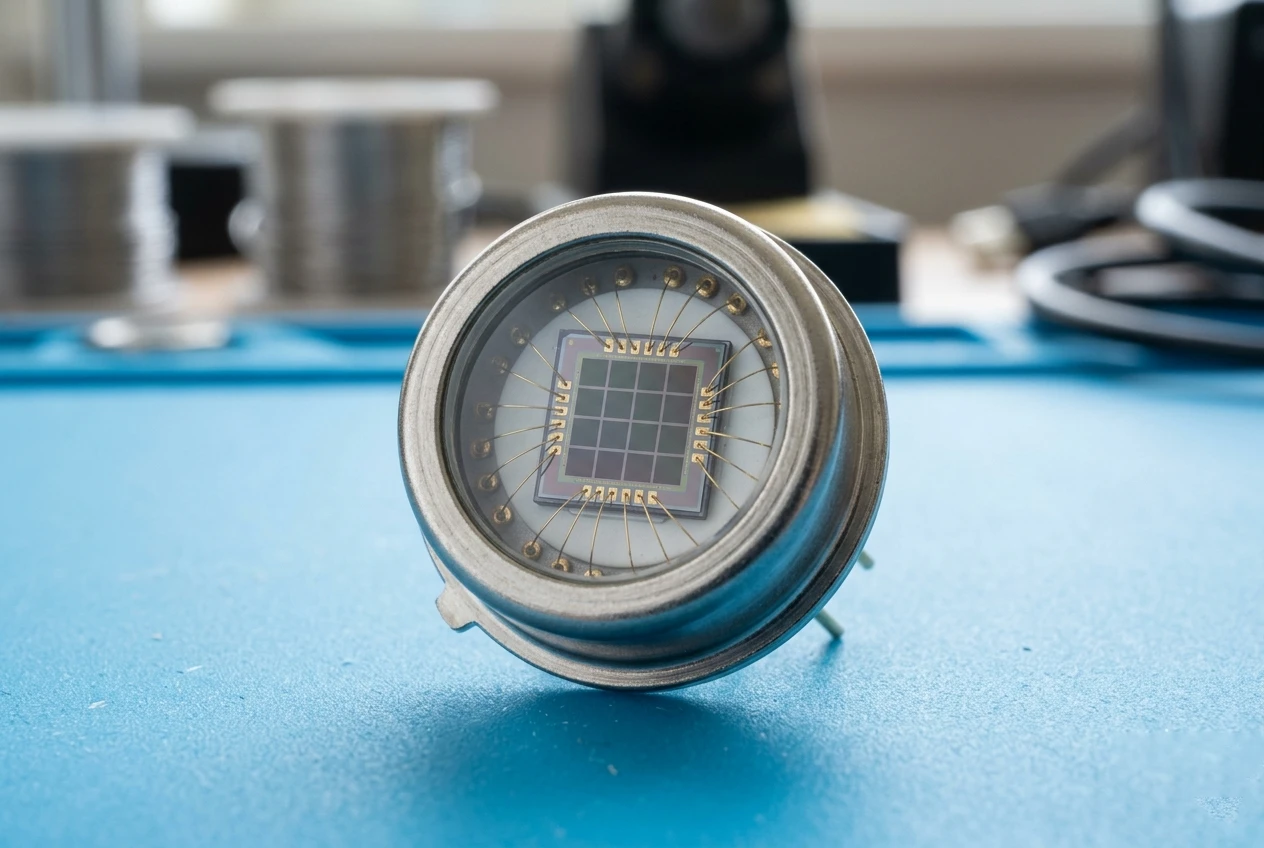
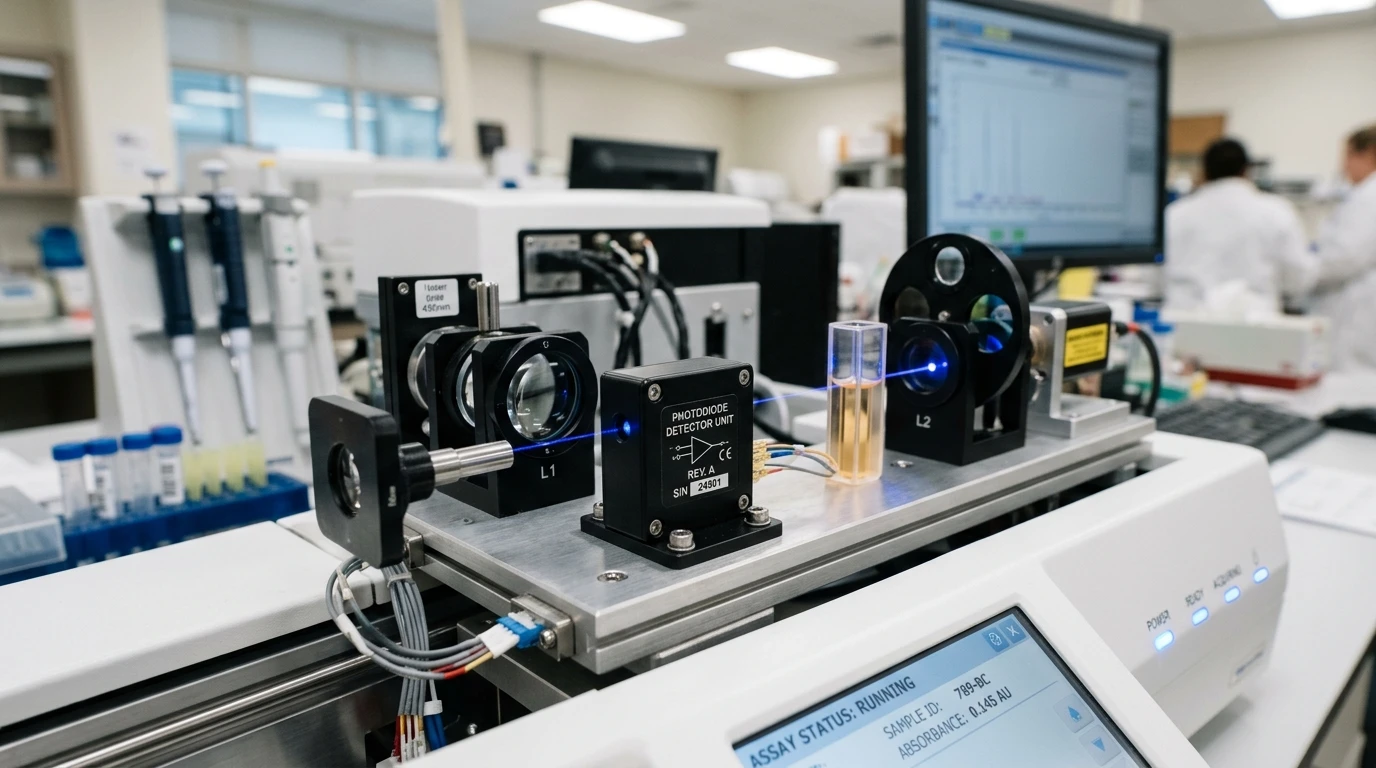
I’ll just say it out loud because somebody has to. If you are speccing a standard clear-lens optical sensor for equipment that will ever be used near a window, an open bay door, or under bright factory LEDs, you are basically throwing your engineering budget in the trash.
I see this all the time. Design teams spend months perfecting their circuit boards, tweaking their op-amps, and writing massive amounts of software code to filter out optical noise. And for what? Just to accomodate a cheap, clear-lens sensor that shouldn’t have been used in that enviroment in the first place.
If you want an optical system that actually survives the real world, you need to rely on a black epoxy photodiode.
This isn’t just me being a cynical hardware guy. The physics and the economics both prove that optical filtering at the hardware level beats software filtering every single day of the week. Let’s break down exactly why a black epoxy photodiode is the only sane choice for a heavy-duty position sensing detector, and why your next industrial sensor design defnitely needs one.
The Absolute Nightmare of Ambient Light
Let’s paint a picture. You are building an industrial sensor. Maybe it’s a position sensing detector for an automated guided vehicle (AGV), or maybe it’s an edge-detection sensor for a massive CNC router.
In your lab, the lights are nice and steady. You fire up your 850nm or 940nm infrared (IR) laser, it hits your clear photodiode, and your oscilloscope shows a beautifully crisp square wave. You pat yourself on the back, box up the prototype, and send it to the client.
Then summer hits.
The client rolls your machine out onto a loading dock. Direct sunlight hits the sensor. Boom. Your system completely fails. The AGV drives into a wall, or the CNC machine triggers an emergency stop.
Why did this happen? Direct summer sunlight can hit 100,000 lux. That sunlight contains a massive amount of energy across the entire visible spectrum (400nm to 700nm) and beyond. A standard clear silicon photodiode sees all of it. The DC background current from the sun is so incredibly loud that it completely drowns out your tiny little IR laser signal.
Even indoors, you aren’t safe. Modern factories use high-intensity LED bay lights or older fluorescent tubes. These lights don’t just produce a steady glare; they flicker at 100Hz or 120Hz. If your position sensing detector picks up that visible AC flicker, your microcontroller is going to interpret it as false data.
You can try to write complex DSP code to filter this out, but once your analog front end is saturated, the data is gone. You can’t fix a clipped signal in software. This is exactly where the black epoxy photodiode comes in to save the day.

Si PIN photodiode PDCP08 Series PDCP08-511
The PDCP08-511 is a high-performance Black Epoxy PIN Photodiode designed for precision infrared applications. Encased in a special black epoxy resin, this sensor effectively acts as a daylight filter, blocking visible light interference while maximizing sensitivity at 940nm. With a large 2.9×2.9mm active area and low dark current, it ensures reliable signal detection for optical switches and remote control systems, even in noisy ambient light environments.
What Exactly is a Black Epoxy Photodiode?
A black epoxy photodiode is exactly what it sounds like, but the magic is in the chemistry.
Instead of packaging the silicon chip inside a clear plastic or glass lens, the manufacturer encapsulates it in a specialized, visibly opaque epoxy resin. To the human eye, the black epoxy photodiode looks completely pitch black. You might wonder how a light sensor works if it’s painted black.
The secret is that the epoxy is designed to be a daylight-blocking filter. It blocks nearly all light below 700nm (which covers blue, green, yellow, and red visible light). However, it is almost entirely transparent to near-infrared light (700nm to 1100nm).
When you use a black epoxy photodiode, you are physically building a brick wall against factory glare, flashlight beams, and a massive chunk of the sun’s energy. Your 940nm IR laser passes right through the black plastic like it’s clear glass, but the blinding visible light from the warehouse LEDs bounces right off.
By simply swapping a standard sensor for a black epoxy photodiode, you drop your background noise floor by orders of magnitude before the signal even touches a wire.
Optical Filtering vs. Electronic Filtering (The TIA Problem)
Let’s get into the engineering weeds for a second because this is where the black epoxy photodiode really pays for itself.
When you build an industrial sensor, you usually connect the photodiode to a Transimpedance Amplifier (TIA). The TIA’s job is to take the tiny current from the diode and turn it into a readable voltage. The basic formula is:
V_out = I_photocurrent * R_feedback
If you use a clear lens photodiode outdoors, the sunlight generates a massive DC background current. Let’s say your background current is 1mA, but your actual IR signal is only 10 microamps (uA).
If you set your R_feedback high enough to read that tiny 10uA signal, that 1mA of sunlight noise is going to be multiplied by the same resistor. Your TIA will instantly hit its voltage rail. It completely saturates. Your sensor goes entirely blind.
To fix this with a clear sensor, you have to build annoying DC servo loops, use massive coupling capacitors, or use multiple op-amp stages to subtract the background current. It adds cost, uses up precious PCB real estate, and ruins your profit margins.
Now, let’s run the same scenario with a black epoxy photodiode.
Because the black epoxy photodiode physically blocks the visible spectrum, that 1mA of sunlight background current drops down to maybe 50uA of just the ambient IR leakage. Your TIA doesn’t saturate. Your circuit remains incredibly simple. You use fewer components, your industrial sensor is vastly more reliable, and your bill of materials (BOM) shrinks.
Real-World Case Study: Blinded in a Stamping Plant
A few years back, I worked with a team building a laser-based position sensing detector for a heavy metal stamping plant. The plant had brand new, ultra-bright LED bay lights.
Their original design used a standard clear silicon detector. Every time the press stamped a sheet of polished steel, the LED lights reflected off the metal and blinded the sensor. Their software team spent three exhausting months writing custom filtering algorithms to seperate the real laser pulse from the LED reflections. It was a complete disaster.
I walked in and told the lead engineer to drop in a black epoxy photodiode instead. He honestly thought I was joking. He couldn’t believe a cheap plastic component change would fix a deep architectural problem.
We grabbed a soldering iron, swapped out their clear diode for a black epoxy photodiode, and fired up the machine. The visible LED reflections were instantly blocked by the black resin. The background noise on the oscilloscope dropped by roughly 98%. The position sensing detector locked onto their IR laser with zero jitter.
They fired their expensive DSP consultant the next day and standardized the black epoxy photodiode across all their product lines.
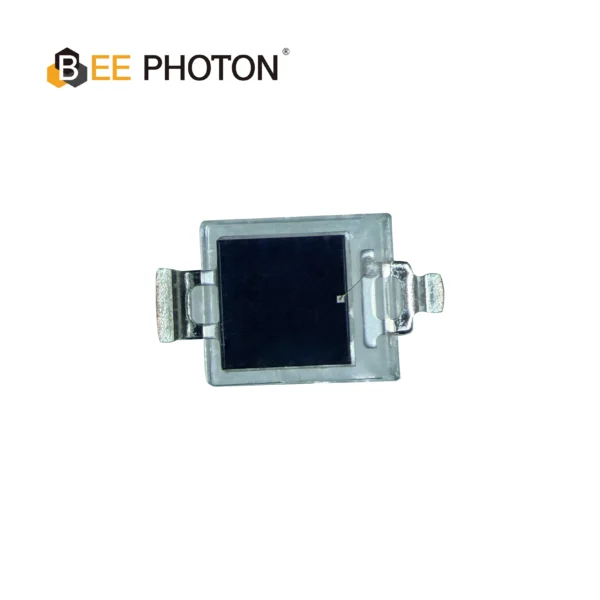
Si PIN photodiode PDCP08 Series PDCP08-501
High-Performance Detection: The PDCP08-501 is a high-speed Silicon PIN Photodiode with a transparent window.
Key Specs: Featuring a 2.9×2.9mm active area, this PIN photodiode offers low dark current and high responsivity, making it an ideal sensor for general optical switches and light detection systems.
Key Specs to Look For in a Black Epoxy Photodiode
Not every black epoxy photodiode is created equal. If you are speccing one for a serious industrial sensor, you need to look at the datasheet closely. Here is what actually matters:
1. Spectral Response (The Cut-off Wavelength)
You want to see a graph where the sensitivity is basically zero from 400nm to about 700nm. The responsivity should sharply spike up around 800nm and peak right at 900nm or 940nm. If the black epoxy photodiode lets in light at 600nm, it’s a bad mix and will let in factory glare.
2. Dark Current (I_d)
Even in pitch black, a photodiode leaks a tiny bit of current when reverse-biased. This is called dark current. Lower is better. For a high-precision position sensing detector, you want a black epoxy photodiode with a dark current in the low nanoamp (nA) range. High dark current creates thermal noise, which ruins your accuracy at long distances.
3. Junction Capacitance (C_j)
If you are building a high-speed industrial sensor—like an optical curtain that needs to trigger in microseconds—you need a fast response time. The response time is heavily dictated by the junction capacitance. A good black epoxy photodiode will have a low capacitance (often measured in pF) when you apply a reverse bias voltage (like 5V or 10V).
4. Active Area
The physical size of the silicon chip inside the black epoxy photodiode matters. A larger active area captures more of your IR laser, making alignment easier. But a larger area also means higher capacitance. You have to balance the two depending on your specific position sensing detector needs.
Clear vs. Black Epoxy Photodiode: Feature Breakdown
If you are still on the fence about whether to use a black epoxy photodiode for your next project, look at this quick comparison table. It usually makes the decision pretty obvious for most hardware teams.
| Feature / Metric | Standard Clear Photodiode | Black Epoxy Photodiode |
|---|---|---|
| Visible Light Immunity | Terrible. Saturated by sunlight & LEDs. | Excellent. Physically blocks < 700nm light. |
| Best Use Case | Controlled, dark lab environments. | Harsh outdoors, bright factory floors. |
| TIA Circuit Complexity | High. Requires aggressive AC coupling. | Low. Minimal background DC offset. |
| Signal-to-Noise Ratio (Outdoors) | Extremely poor. | Very high. |
| Cost Impact | Cheaper component, but higher overall system cost. | Slightly higher component cost, massive savings on PCB & software. |
As you can see, the black epoxy photodiode wins hands down in any enviroment where you don’t control the lighting.
Getting the Most Out of Your Design
So you’ve decided to use a black epoxy photodiode. Great choice. But to build a truly bulletproof industrial sensor, you need to follow a few basic design rules.
First, match your emitter to your detector. A black epoxy photodiode typically peaks around 900nm to 940nm. Don’t use an 850nm LED if you can avoid it; you’ll lose a bit of efficiency. Pair your black epoxy photodiode with a strong 940nm infrared LED or laser diode for maximum signal transfer.
Second, modulate your light source. Don’t just turn your IR laser on and leave it on. Pulse it at a specific frequency (say, 10 kHz). Then, on the receiving end, take the signal from your black epoxy photodiode and run it through a bandpass filter tuned exactly to 10 kHz.
When you combine the physical optical blocking of a black epoxy photodiode with the electronic frequency filtering of a modulated signal, your position sensing detector becomes practically invincible. You could point a heavy-duty flashlight right at the industrial sensor, and it wouldn’t even flinch.
How BeePhoton Approaches the Black Epoxy Photodiode
We don’t just talk about theory here; we actually build the hardware that solves these exact problems.
At BeePhoton, we understand that B2B buyers and hardware engineers are tired of industrial sensor components that look good on a datasheet but fail in the field. That’s exactly why we engineered solutions like the PDCP08-511 black epoxy photodiode.
The PDCP08-511 black epoxy photodiode is an absolute workhorse. We specifically designed the epoxy compound to aggressively reject visible ambient light while providing massive sensitivity in the near-IR spectrum. It features incredibly low dark current, meaning your noise floor stays flat even when things get hot on the factory floor.
Whether you are designing a high-speed optical switch, a rugged position sensing detector, or a long-range light barrier, starting your design with a high-grade black epoxy photodiode from BeePhoton guarantees you won’t be fighting ambient light noise down the road.
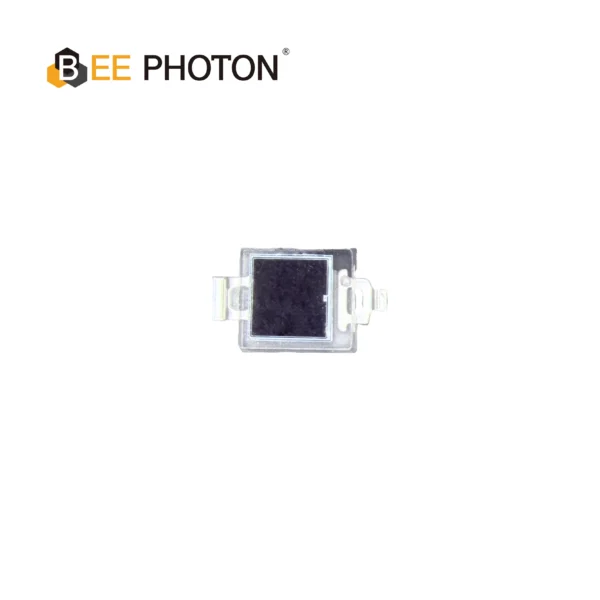
Si PIN photodiode PDCP08 Series PDCP08-502
The PDCP08-502 is a high-response 2.9×2.8mm Silicon PIN Photodiode designed for precision photoelectric applications. Featuring low junction capacitance, low dark current, and a wide spectral range (340-1100nm), it is the ideal component for optical switches and compact sensing modules requiring stable and fast signal output.
FAQ: Everything Else You Need to Know
1. Can a black epoxy photodiode work in direct, harsh sunlight?
Yes, absolutely. That is exactly what they are designed for. While standard clear sensors will quickly saturate and go blind, a black epoxy photodiode filters out the visible spectrum of sunlight. As long as your IR signal is reasonably strong and you use basic modulation, your industrial sensor will perform flawlessly even at noon in the middle of summer.
2. Does a black epoxy photodiode cost significantly more than a clear one?
Suprisingly, no. The cost difference at scale is negligible—often just pennies. However, the cost savings in your circuit design are massive. Because the black epoxy photodiode blocks optical noise, you don’t need to buy expensive, high-end op-amps or spend weeks paying software engineers to write noise-canceling code. It is the cheapest and most effective upgrade you can make to a position sensing detector.
3. Will the black epoxy photodiode block my 850nm or 940nm IR laser?
No. The epoxy resin is opaque to visible light (typically cutting off below 700nm), but it is completely transparent to near-infrared light. Your 850nm or 940nm laser will pass right through the black housing and hit the silicon chip with minimal attenuation.
Let’s Get Your Next Project Moving
Look, dealing with ambient light noise is the single most frustrating part of designing an optical industrial sensor. But you don’t have to keep fighting physics.
By upgrading your hardware to a high-quality black epoxy photodiode, you instantly eliminate the headaches of factory glare, sunlight saturation, and complex TIA circuit design. Your engineers will thank you, your field maintanence costs will drop, and your products will just work out of the box.
Don’t let a cheap clear-lens sensor ruin your system’s reliability. If you are ready to upgrade your position sensing detector or need help speccing out the perfect component for your harsh-lighting application, we are here to help.
Head over to BeePhoton to browse our full lineup of optical components. If you want to discuss custom requirements, volume pricing, or need technical datasheets for our black epoxy photodiode series, don’t hesitate to contact us or just drop us a direct line at info@photo-detector.com. Stop fighting the light, and start filtering it.