If you are reading this, you are probably in the early design phase of a new sensor circuit and staring at a datasheet trying to make a choice. We have all been there. You have your transimpedance amplifier (TIA) roughly sketched out, your IR emitter chosen, but now you hit a roadblock: should you use a clear package or a black lens photodiode?
Honestly, it seems like a small plastic difference, but picking the wrong one can absolutely ruin your signal-to-noise ratio when you take your prototype out of the lab. So let’s talk about the clear vs black package debate, dig into the optical filter effect, and figure out why you might definately want to lean towards a black lens photodiode for most industrial and B2B designs.
The Core Difference: Understanding the Optical Filter Effect
To get right to it, the difference between these two packages is all about what kind of light they let hit the silicon die inside.
Silicon naturally responds to a huge chunk of the spectrum. If you look at standard silicon physics, the cut-off wavelength is determined by the bandgap energy of the material.
You can calculate this with a simple formula:
lambda_c = 1.24 / E_g
Where:
lambda_c is the cut-off wavelength in micrometers (um)
E_g is the bandgap energy in electron-volts (eV)
For silicon, E_g is about 1.12 eV. If you do the math (1.24 / 1.12), you get roughly 1.1 um, or 1100 nm. That means a bare silicon die will pick up everything from UV light, right through the visible spectrum (380 nm to 750 nm), all the way up to the near-infrared at 1100 nm.
When you use a clear package, the epoxy is completely transparent. It lets everything through.
But when you use a black lens photodiode, the epoxy itself is doped with a specific dye that acts as a physical long-pass filter. This is what we call the optical filter effect. A high quality black lens photodiode will typically block all light below 700 nm or 750 nm. It literally eats the visible light before it can even touch the silicon, meaning your black lens photodiode will only respond to infrared light.
When Does a Clear Package Actually Make Sense?
Here is a slightly controversial take: I think clear package sensors are completely overrated for most industrial designs. Everyone thinks clear is better cause it captures everything. Spoiler: you do not want to capture everything.
But sure, there are times when you need them. If you are building an ambient light sensor for a phone screen so it dims in a dark room, you need to measure the visible light that human eyes can see. In that case, a clear package is mandatory. You need to know how bright the room is. Another area is colorimetry or specific medical sensors where you are pulsing red and green LEDs and need to read those specific visible wavelengths.
But if you are building an optical switch, a smoke detector, a remote control receiver, or a light curtain? A clear package is just going to cause you headaches. You will be fighting ambient light noise the entire time.

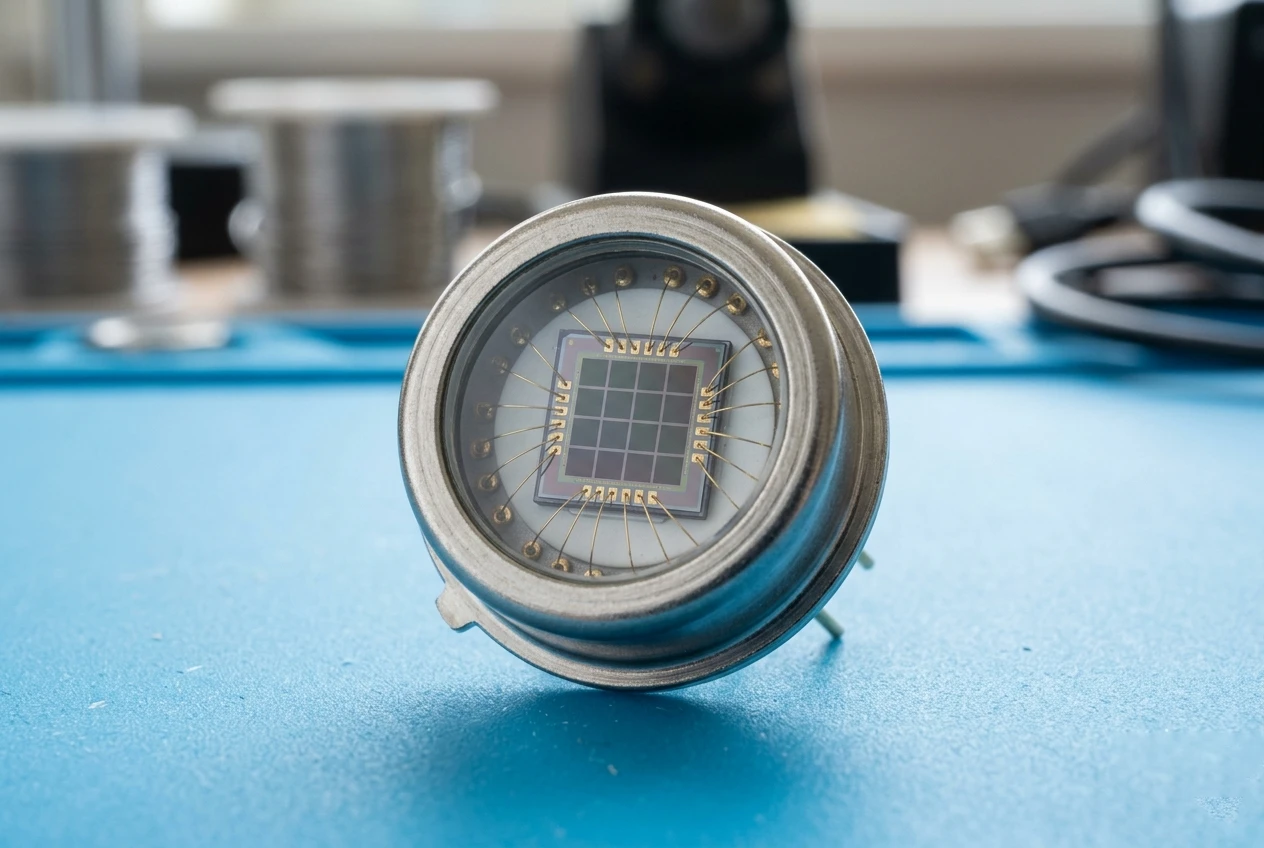
Si PIN photodiode PDCP08 Series PDCP08-511
The PDCP08-511 is a high-performance Black Epoxy PIN Photodiode designed for precision infrared applications. Encased in a special black epoxy resin, this sensor effectively acts as a daylight filter, blocking visible light interference while maximizing sensitivity at 940nm. With a large 2.9×2.9mm active area and low dark current, it ensures reliable signal detection for optical switches and remote control systems, even in noisy ambient light environments.
Why the Black Lens Photodiode is Usually the Better Choice
If you are transmitting an invisible IR signal (like 850 nm or 940 nm), you should almost always pair it with a black lens photodiode.
Why? Because the enviroment is noisy. The sun is a massive broadband emitter. The fluorescent lights in your office flicker at 50Hz or 60Hz. If you use a clear sensor to try and read a tiny 940nm IR pulse, all that visible background light creates a massive DC offset in your circuit. We call this dark current’s ugly cousin: background photocurrent.
When you swap to a black lens photodiode, the optical filter effect simply deletes the sunlight and the room lights from the equation. The black lens photodiode sits there in pitch blackness as far as it is concerned, waiting only for your 940nm IR pulse.
Let’s Look at the Math of a Black Lens Photodiode
To understand why a black lens photodiode is vastly superior for SNR (Signal to Noise Ratio), look at the responsivity formula:
R = I_p / P
Where:
R is responsivity in Amps per Watt (A/W)
I_p is the photocurrent in Amps
P is the incident optical power in Watts
If you have a clear sensor, your “P” includes the ambient sunlight. Your I_p becomes huge. This high current can literally saturate your TIA, driving the op-amp output straight to the supply rail. Once your amplifier is saturated, it is completely blind to the tiny extra current your IR LED is trying to add.
By using a black lens photodiode, you reduce “P” to only the infrared band. The visible light power never reaches the die. This keeps your I_p nice and low, so your amplifier stays in its linear region. You acheive a much higher SNR simply by letting the plastic of the black lens photodiode do the heavy lifting for you.
A Real-World Nightmare: The Sun is Your Enemy
Let me share a quick story from a few years back. I was consulting for a team designing a perimeter security beam for industrial gates. They had specced a standard clear PIN diode. During bench testing in the lab, the system was flawless. They could detect a hand breaking the beam from 10 meters away.
Then we took the prototype outside.
It was a bright Tuesday afternoon. We turned the system on, and the receiver just locked up. It constantly said the beam was broken even when it wasn’t. The midday sun was totally saturating the clear sensor. The visible daylight was so intense that the 850nm IR pulses from the transmitter couldn’t even register over the noise floor.
The engineers thought they had to redesign the whole circuit to add active AC coupling and complex DSP filtering. I told them to hold off and just solder in a black lens photodiode instead. We grabbed a standard black lens photodiode from the parts bin, swapped it in, and went back outside.
Boom. The system worked perfectly. The built-in optical filter effect of the black lens photodiode blocked almost all the visible sunlight, dropping the background noise by orders of magnitude. No software rewrite, no crazy circuit changes, just choosing the right black lens photodiode for the job.
Deep Dive: How to Read the Datasheet for a Black Lens Photodiode
When you are hunting for the right black lens photodiode, the datasheet can be a bit overwhelming. Let’s break down the specs you actually need to care about when evaluating a black lens photodiode.
1. Spectral Range of Sensitivity
A good black lens photodiode will show a range of something like 750 nm to 1100 nm. If it says 400 nm to 1100 nm, that is a clear package! Pay attention to where the black lens photodiode starts picking up light.
2. Wavelength of Peak Sensitivity (lambda_p)
You want the peak of your black lens photodiode to closely match your emitter. If you are using a 940nm LED, look for a black lens photodiode with a peak sensitivity around 940nm or 950nm.
3. Angle of Half Sensitivity
This tells you how focused the lens is. A black lens photodiode with a narrow angle (like +/- 10 degrees) will have a curved dome that focuses light from directly ahead while rejecting light from the sides. This is great for point-to-point links. If you need to catch scattered light, find a black lens photodiode with a wider angle like +/- 60 degrees.
4. Dark Current (I_d)
This is the tiny leakage current that flows through the black lens photodiode even when it is in complete darkness. Lower is better, especially if you are measuring really weak signals, because dark current contributes directly to shot noise.
Shot noise formula:
I_shot = sqrt(2 * q * I_d * Delta_f)
(Where q is the charge of an electron 1.6 x 10^-19 C, and Delta_f is your bandwidth).
A quality black lens photodiode keeps this I_d incredibly small.
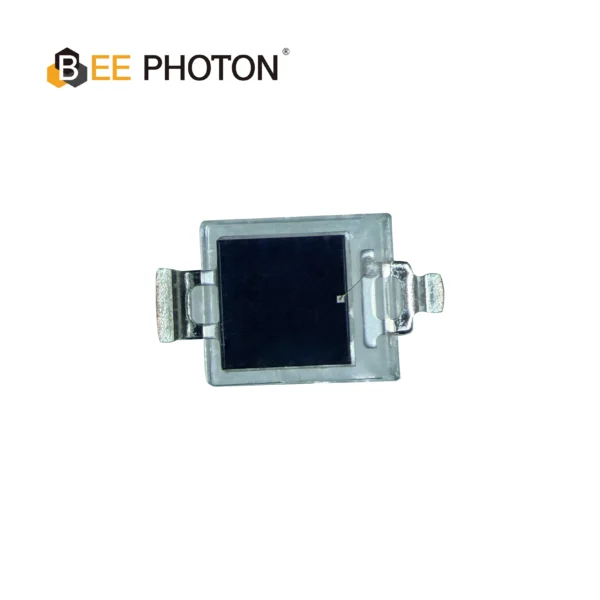
Si PIN photodiode PDCP08 Series PDCP08-501
High-Performance Detection: The PDCP08-501 is a high-speed Silicon PIN Photodiode with a transparent window.
Key Specs: Featuring a 2.9×2.9mm active area, this PIN photodiode offers low dark current and high responsivity, making it an ideal sensor for general optical switches and light detection systems.
Comparison: Clear vs Black Lens Photodiode
To make things super simple, here is a breakdown of how a clear package stacks up against a black lens photodiode.
| Feature | Clear Package Photodiode | Black Lens Photodiode |
|---|---|---|
| Spectral Range | ~400 nm to 1100 nm (Visible + IR) | ~750 nm to 1100 nm (IR only) |
| Optical Filter Effect | None. Lets everything through. | Blocks visible light (< 750nm). |
| Ambient Light Immunity | Very poor. Easily saturated by the sun. | Excellent. Ignores most room light and sunlight. |
| Best Emitters to Pair With | White LEDs, RGB LEDs, ambient light. | 850nm, 880nm, 940nm IR LEDs. |
| Typical Applications | Screen brightness control, color sensing. | Smoke detectors, optical switches, IR remotes. |
As you can see, if you don’t need to see the rainbow, just get a black lens photodiode. It makes your circuit design so much easier.
TIA Circuit Considerations for a Black Lens Photodiode
So let’s say you made the right call and picked a black lens photodiode. How do you hook it up?
Usually, you will run it in reverse bias (photoconductive mode) connected to a transimpedance amplifier. Applying a reverse voltage across the black lens photodiode does two things: it increases the speed (bandwidth) by widening the depletion region, which lowers the junction capacitance (C_j). It also makes the response more linear.
When designing the TIA for your black lens photodiode, your output voltage is simply:
V_out = I_p * R_f
Where R_f is your feedback resistor.
Because the black lens photodiode is blocking all that ambient visible light, your baseline I_p is very low. This means you can use a much larger R_f value to amplify your tiny IR signal without risking op-amp saturation. A bigger R_f gives you massive gain. If you tried that with a clear package, the ambient light would generate enough I_p to max out the V_out instantly.
This is the hidden magic of the black lens photodiode. It doesn’t just block light; it allows you to design a far more sensitive and aggressive amplifier circuit.
Meet Your Match: The BeePhoton PDCP08-511
Look, if you are tired of comparing hundreds of generic parts and just want a reliable black lens photodiode that works exactly how it should, you need to check out what we are doing at BeePhoton.
One of our absolute workhorses is the PDCP08-511. This is a top-tier black lens photodiode designed specifically for engineers who need high speed and serious ambient light rejection. It uses a high-grade black epoxy that provides a severe optical filter effect, completely cutting out the visible spectrum so your IR signals stay clean and crisp.
Whether you are designing a precise optical encoder, a safety light curtain for factory automation, or a high-speed data transmission link, this black lens photodiode delivers the tight responsivity and low dark current your TIA circuit desperately wants. We build these to handle harsh enviroments where other components just give up.
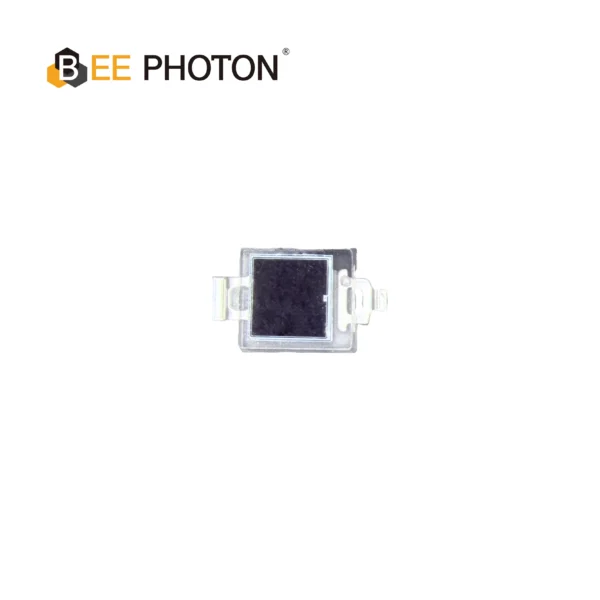
Si PIN photodiode PDCP08 Series PDCP08-502
The PDCP08-502 is a high-response 2.9×2.8mm Silicon PIN Photodiode designed for precision photoelectric applications. Featuring low junction capacitance, low dark current, and a wide spectral range (340-1100nm), it is the ideal component for optical switches and compact sensing modules requiring stable and fast signal output.
FAQ: Clear vs Black Package Photodiodes
I get alot of the same questions from junior engineers when we do design reviews. Here are a few common ones regarding the black lens photodiode.
Q1: Can a black lens photodiode detect a standard red laser pointer?
Usually, no. A standard red laser operates around 650 nm. Because of the optical filter effect, a typical black lens photodiode cuts off light below 750 nm. The red laser beam will just bounce off or be absorbed by the black plastic. If you are using a 650nm laser, you unfortunately have to use a clear package or a specific red-tinted package.
Q2: Does the black epoxy of a black lens photodiode reduce the sensitivity of the IR signal?
A tiny bit, yes. Whenever you put a physical filter in front of a sensor, there is a small insertion loss. A clear package might let 99% of the 940nm light through, while a black lens photodiode might let 95% through. But the trade-off is completely worth it because the black lens photodiode reduces the visible noise by 99%. The massive boost in Signal-to-Noise Ratio far outweighs the tiny drop in absolute IR transmission.
Q3: How do I easily test a black lens photodiode on my bench?
Grab your black lens photodiode and put your multimeter in diode test mode or measure the resistance. In a bright room, a clear diode will show a huge change in resistance when you cover it with your hand. A black lens photodiode won’t care about the room lights. To see the black lens photodiode react, you need to point a TV remote (which emits 940nm IR) at it and press a button. You will see the readings jump immediately.
Q4: Is a black lens photodiode more expensive than a clear one?
Not really. The manufacturing process is essentially identical. The factory just uses a seperate batch of epoxy resin that has the daylight blocking dye mixed in. The price difference for a black lens photodiode versus a clear one is usually fractions of a cent at volume.
Final Thoughts: Don’t Let Ambient Light Ruin Your Day
Designing sensor circuits is hard enough without letting the sun dictate your noise floor. The clear vs black package debate isn’t really a debate once you understand the physics of your enviroment. Unless your product specifically requires the detection of visible human-eye colors, the black lens photodiode is your best friend. It acts as a mechanical shield, giving your electronics a pristine, noise-free infrared signal to work with.
When you specify a black lens photodiode, you are buying yourself headroom. Headroom in your amplifier, headroom in your software filtering, and headroom in your overall system reliability.
Still not sure if the PDCP08-511 black lens photodiode is the exact right fit for your custom board? Or mabye you need a specific half-angle to accomodate a weird mechanical housing? We have been solving these exact optical problems for years.
Don’t just guess and hope it works in the field. Reach out to our engineering team at BeePhoton. You can drop us an email directly at info@photo-detector.com or head over to our site and contact us for a quote, some free samples, or just a sanity check on your design. We are here to help you get the hardware right the first time.