If you are running older SMD photodiodes on your production boards, you have probably run into the classic supply chain wall lately. For years, the legacy BPW34S was teh gold standard of silicon PIN photodiodes. It popped up in everything from rain sensors to high-speed optical switches. But let’s be completely real here: the optoelectronics market has changed. Long lead times, sudden price hikes, and the looming threat of end-of-life (EOL) announcements are forcing hardware teams to look elsewhere. Many of our legacy B2B clients are actively hunting for reliable BPW34S alternatives to avoid shutting down their assembly lines.
Upgrading a core optical sensor isn’t just about finding another part that fits on the solder pads. Engineers hate changing components mid-lifecycle because “equivalent” doesn’t always mean identical in the real world. You have to think about dark current, junction capacitance, spectral matching, and whether the new part will saturate under factory lighting.
We engineered the PDCP08 series at BeePhoton specifically to address these technical headaches. If you have been searching for BPW34S alternatives that won’t require a total PCB spin, this guide will clear up your doubts and help you select the right drop-in replacement.
Why You Need to Seriously Consider BPW34S Alternatives
When you evaluate BPW34S alternatives, you aren’t just looking to dodge supply chain issues; you are often getting a major performance boost. Legacy PIN photodiodes were designed decades ago. Since then, silicon purification and wafer manufacturing processes have gotten way more precise.
Let’s look at why B2B buyers are switching to modern BPW34S alternatives:
- Supply Chain Stability: Relying on a single legacy brand makes your production schedule vulnerable. Having qualified BPW34S alternatives in your Bill of Materials (BOM) protects your supply chain.
- Dramatic Dark Current Reduction: Modern silicon processing allows us to slash dark current by a factor of 100 or more, which drops your system’s noise floor.
- Daylight Filtering Options: Newer BPW34S alternatives offer integrated black epoxy packaging that filters out visible light, saving you the cost of external optical filters.
If you are sourcing BPW34S alternatives for industrial automation or precision medical devices, you want a component that does the exact same job—detecting light efficiently—without the massive brand-name markup.
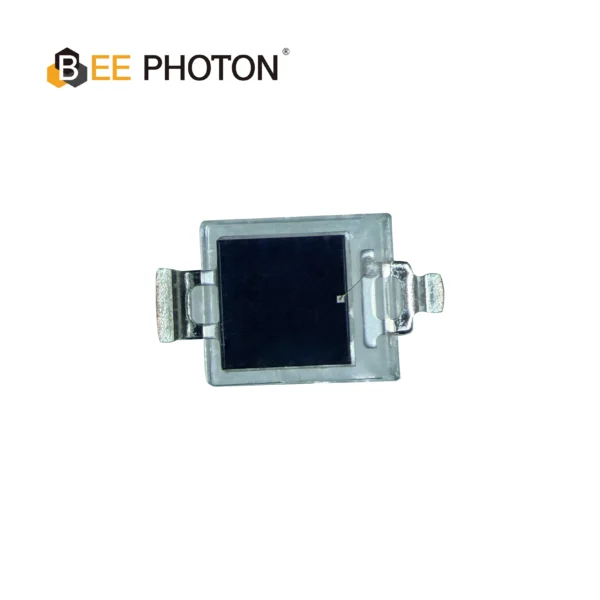
Si-PIN-Fotodiode Serie PDCP08 PDCP08-501
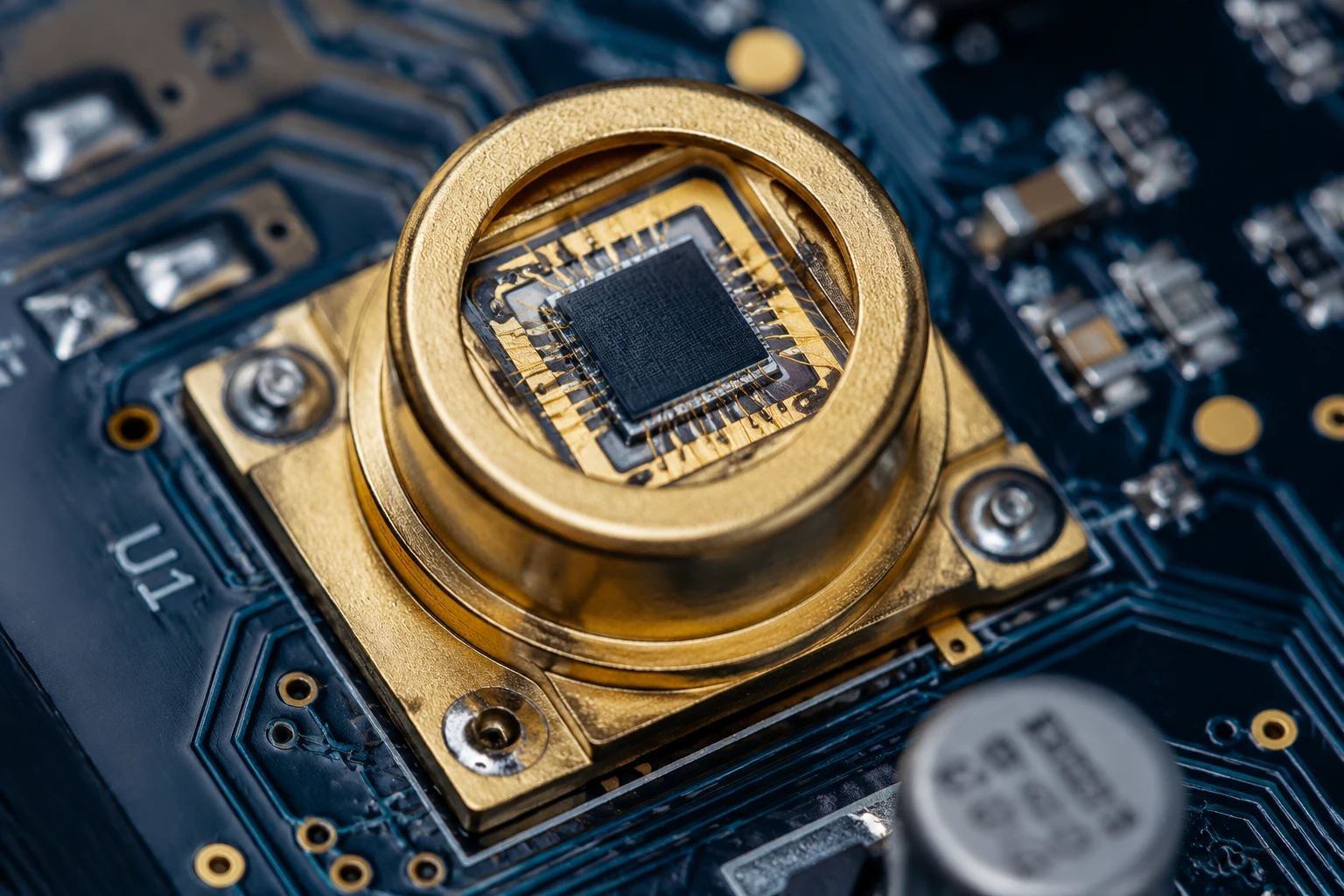
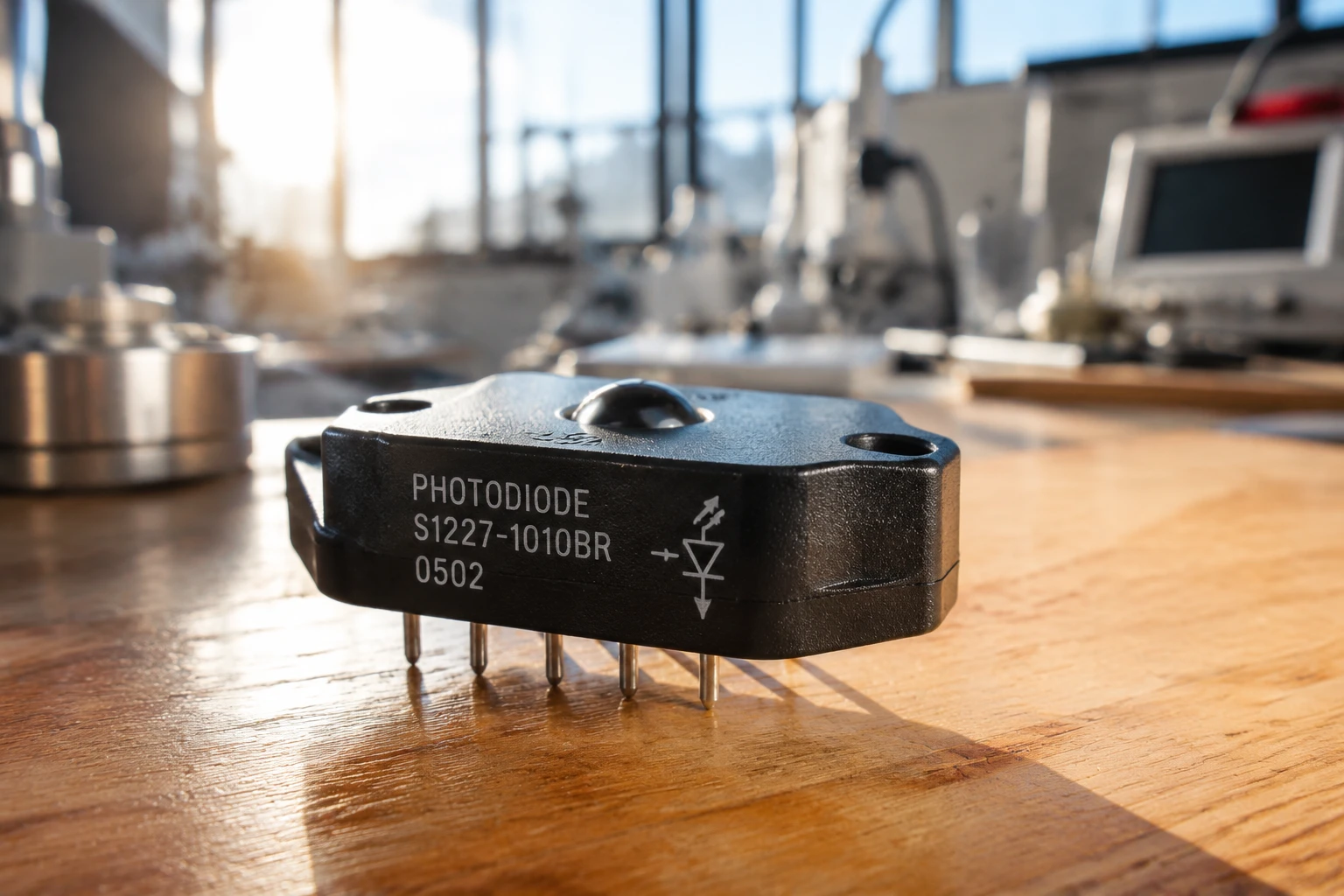
Leistungsstarke Detektion: Die PDCP08-501 ist eine Hochgeschwindigkeits-Silizium-PIN-Photodiode mit einem transparenten Fenster.
Wesentliche Merkmale: Mit einer aktiven Fläche von 2,9×2,9 mm bietet diese PIN-Fotodiode einen niedrigen Dunkelstrom und eine hohe Empfindlichkeit, was sie zu einem idealen Sensor für allgemeine optische Schalter und Lichterkennungssysteme macht.
What Actually Happens in the Silicon? (The Math)
When engineers look for BPW34S alternatives, they need to understand how the underlying physics translates to circuit performance. The core function of a PIN photodiode is converting incident photons into electric current.
The photocurrent generated by the diode is calculated using this plain-text formula:
Photocurrent (Ip) = Responsivity (R) * Optical Power (P)
Wo:
Ipis the photocurrent (measured in Amperes or microamperes).Ris the spectral responsivity of the photodiode (measured in Amperes per Watt, A/W).Pis the incident optical power falling on the active silicon area (measured in Watts).
Many high-performance BPW34S alternatives offer optimized responsivity at specific infrared wavelengths (like 940nm or 920nm). This means your circuit receives more signal for the same LED output, which is a big deal when comparing different BPW34S alternatives.
However, the signal is only half of the equation. You also have to deal with noise. The absolute limit of your sensor’s sensitivity is determined by the dark current shot noise.
We calculate this dark current noise current with the following formula:
In = SquareRoot(2 * q * Id * B)
Wo:
Unteris the noise current (Amperes).qis the electron charge (approximately 1.6 * 10^-19 Coulombs).Idis the dark current of the photodiode under reverse bias (Amperes).Bis the electrical bandwidth of your system (Hertz).
If your photodiode has a high dark current, your transmpedance amplifier (TIA) will amplify that noise, ruining your Signal-to-Noise Ratio (SNR):
SNR = Ip / In
By selecting BPW34S alternatives with significantly lower dark current (Id), you automatically reduce the noise floor. This allows your system to detect much weaker light levels without changing your amplifier circuit.
Footprint Compatibility: Drop-In Without PCB Headaches
Let’s face it: no one wants to spin a new board. A PCB redesign means paying for new tooling, updating documentation, and running compliance tests all over again. Therefore, your chosen BPW34S alternatives must align perfectly with your existing footprint.
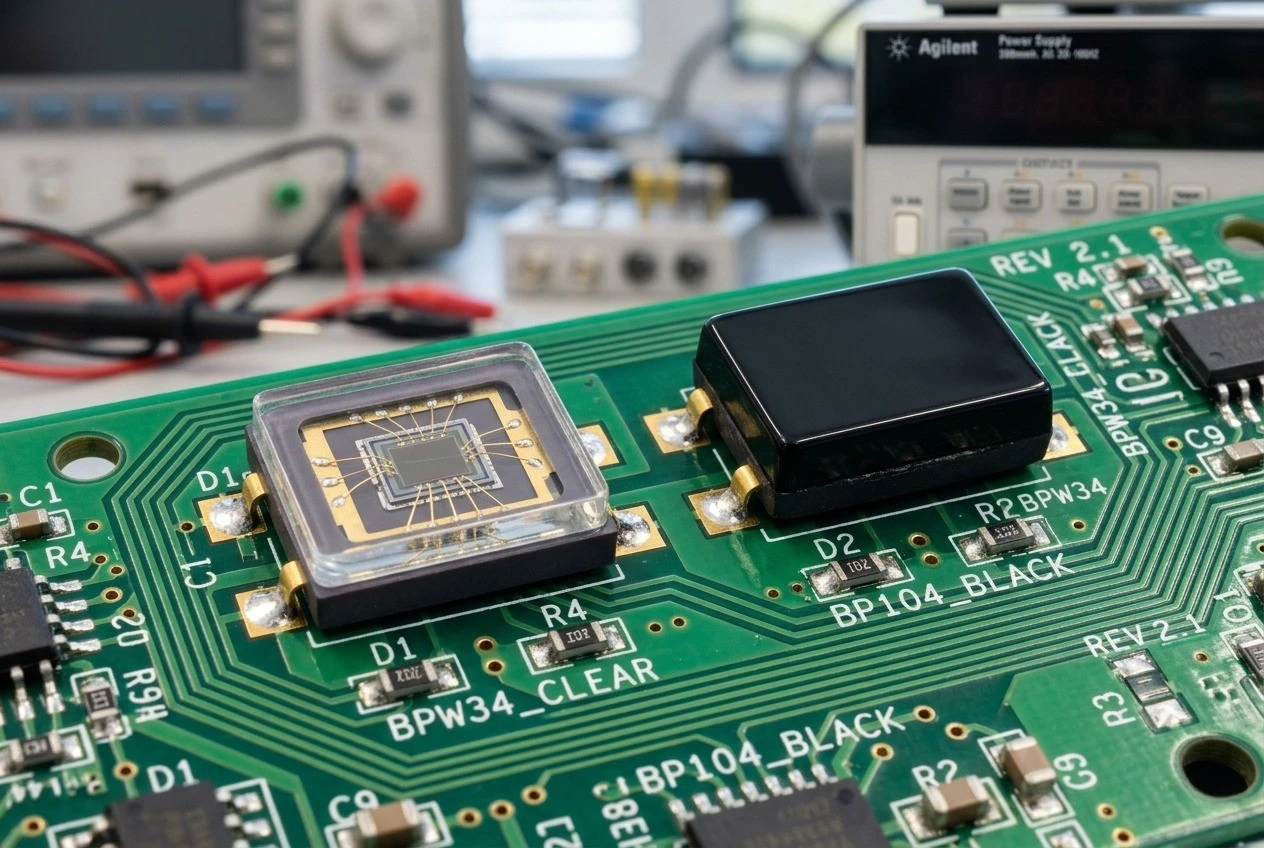
The standard BPW34S comes in a miniature, flat, top-view DIL (Dual-In-Line) SMT package with a typical dimension of 5.4 x 4.3 mm. The footprint of our PDCP08 series is designed with these exact mechanical dimensions in mind.
These direct BPW34S alternatives feature an identical layout, meaning you can load them directly onto your existing assembly pick-and-place files. There is no need to adjust stencil apertures or modify solder pads. Drop-in BPW34S alternatives let you swap parts seamlessly on the manufacturing floor.
The Technical Comparison: BPW34S vs. Modern Alternatives
To show you exactly how these modern BPW34S alternatives stack up, we have pulled together the real datasheet specs. We compared the standard BPW34S against three of our most popular BPW34S alternatives:
| Parameter | Legacy BPW34S (Standard) | PDCP08-501 (Clear Window) | PDCP08-502 (High Response) | PDCP08-511 (Daylight Filter) |
|---|---|---|---|---|
| Spektralbereich (λ0.1) | 430 bis 1100 nm | 450 bis 1100 nm | 340 bis 1100 nm | 850 bis 1100 nm |
| Spitzen-Empfindlichkeit (λp) | 900 nm | 940 nm | 920 nm | 940 nm |
| Dark Current (Typ, VR=10V) | 2000 pA (2 nA) | 20 pA | 5 pA | 20 pA |
| Lichtempfindlicher Bereich | 7,5 mm² | 2,9 × 2,9 mm | 2,9 × 2,8 mm | 2,9 × 2,9 mm |
| Rise Time (Typ, VR=5V) | 100 ns | 150 ns | 270 ns | 150 ns |
| Package Window | Clear Plastic | Clear Epoxy (CR) | Clear Epoxy (CR) | Black Epoxy (BK) |
Looking at this comparison of BPW34S alternatives, a few details stand out. The legacy BPW34S has a typical dark current of 2000 pA (or 2 nA). Compare that to the PDCP08-502, which drops to a microscopic 5 pA typical dark current under the same conditions!
These BPW34S alternatives prove that you don’t have to compromise on performance when replacing an old sensor. In fact, by replacing old parts with these modern BPW34S alternatives, you get a cleaner signal, better thermal stability, and a significantly lower noise floor.
Clear Epoxy vs. Black Epoxy: Selecting the Right Variant
When evaluating BPW34S alternatives, you need to think about your ambient environment. Standard PIN photodiodes are encapsulated in clear resin, which lets all wavelengths pass through—from visible light right up to near-infrared (NIR).
However, we offer our BPW34S alternatives in different packaging variants:
Clear Epoxy (PDCP08-501 & PDCP08-502)
These BPW34S alternatives act like a wide-open window. They pass visible light plus near-IR with almost no loss. Clear epoxy is ideal if your system operates inside a dark, sealed enclosure, or if you are measuring precise optical power across a broad spectrum.
Black Epoxy (PDCP08-511)
If your sensor is exposed to real-world ambient lighting, clear photodiodes can saturate fast. Background light from standard room LEDs or daylight can swamp your sensor, clipping your amplifier.
This is where black-epoxy BPW34S alternatives save the day. The black resin is loaded with special pigments that block nearly all visible light (below 700nm) while remaining highly transparent to infrared (700nm to 1100nm).

Si-PIN-Fotodiode Serie PDCP08 PDCP08-511
Die PDCP08-511 ist eine leistungsstarke Schwarze Epoxid-PIN-Fotodiode entwickelt für Präzisions-Infrarotanwendungen. Dieser Sensor ist in ein spezielles schwarzes Epoxidharz gehüllt und wirkt wie ein Tageslichtfilter, der Störungen durch sichtbares Licht blockiert und gleichzeitig die Empfindlichkeit bei 940 nm maximiert. Mit einer großen aktiven Fläche von 2,9×2,9 mm und niedrigem Dunkelstrom gewährleistet er eine zuverlässige Signalerfassung für optische Schalter und Fernsteuerungssysteme, selbst in Umgebungen mit starkem Umgebungslicht.
Choosing between these BPW34S alternatives depends on your application:
- If you need high sensitivity across both visible and IR spectra, go with the PDCP08-501 oder PDCP08-502.
- If you are building an infrared light barrier, optical switch, or safety curtain that must work in bright environments, choose the PDCP08-511.
Anonymized Real-World Success Stories
We have helped many B2B customers transition to these modern BPW34S alternatives. Here are two common scenarios where the upgrade solved serious production issues:
Case Study 1: The Saturated Light Curtain
A European manufacturer of industrial safety light curtains was using standard BPW34S sensors. They kept getting complaints from field engineers about false triggers. Whenever their safety curtains were installed in bright, modern factories with overhead LED lighting, the sensors saturated.
They were desperate for BPW34S alternatives that could handle ambient noise without a massive mechanical redesign. We recommended they drop in the PDCP08-511 (our black epoxy daylight filter model). Because it filters out visible light, it completely eliminated the LED interference. The client saved their existing board layout and secured a more stable supply chain in the process.
Case Study 2: Upgrading a Medical Diagnostic Tool
Another B2B client built high-precision medical instruments that relied on detecting tiny changes in light transmission. They were looking for BPW34S alternatives because of supply chain delays, but they were also struggling with their instrument’s detection limit.
They evaluated several BPW34S alternatives and selected the PDCP08-502. Thanks to its ultra-low 5 pA dark current (compared to the 2 nA of their old sensor), their noise floor plummeted. The change allowed them to detect much weaker optical signals, upgrading their instrument’s overall accuracy without requiring them to redesign their low-noise transimpedance amplifiers.
Transitioning to BPW34S Alternatives: Assembly and Handling
Engineers are naturally conservative, and and we get it. Nobody wants to sign off on a BOM change that fails in the field. When you transition to modern BPW34S alternatives, there are a few practical handling and assembly points to keep in mind:
ESD Sensitivity
Like most high-sensitivity silicon PIN photodiodes, these BPW34S alternatives are sensitive to electrostatic discharge (ESD). Always handle them in ESD-safe environments with grounded wrist straps and conductive work surfaces.
Reflow Profile
These modern BPW34S alternatives are rated for lead-free reflow soldering. They can easily withstand peak reflow temperatures of up to 260C for a duration of 3 seconds, which matches standard assembly lines.
Bench Testing
We always suggest testing new BPW34S alternatives on the bench before rolling them out to full production. When qualifying the parts, make sure to measure:
- Dunkler Strom: Verify that the noise floor meets your system’s requirements under your operating temperature range.
- Spectral Matching: Ensure your light source (e.g., a 940nm LED) matches the peak sensitivity of your chosen photodiode.
To make testing these BPW34S alternatives easy, we provide engineering samples so your hardware team can run their own validation tests.
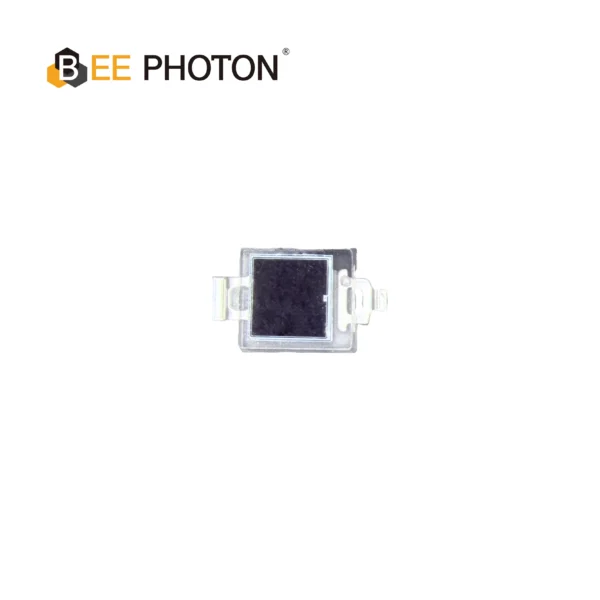
Si-PIN-Fotodiode Serie PDCP08 PDCP08-502
Die PDCP08-502 ist eine 2,9×2,8 mm große Silizium-PIN-Photodiode mit hohem Ansprechverhalten, die für fotoelektrische Präzisionsanwendungen entwickelt wurde. Mit niedriger Sperrschichtkapazität, niedrigem Dunkelstrom und einem breiten Spektralbereich (340-1100 nm) ist sie das ideale Bauteil für optische Schalter und kompakte Sensormodule, die eine stabile und schnelle Signalausgabe erfordern.
Frequently Asked Questions About BPW34S Alternatives
Q1: Are these BPW34S alternatives 100% pin-compatible?
Yes. Our PDCP08 series photodiodes are direct physical replacements. They feature the exact same top-view DIL SMD 2-pin package style. This means they will align perfectly on your existing PCB solder pads with zero modifications to your pick-and-place setup.
Q2: What is the main electrical advantage of upgrading from BPW34S?
The massive advantage is dark current. The typical dark current for standard BPW34S is around 2000 pA (2 nA). Our modern BPW34S alternatives (like the PDCP08-502) drop that typical dark current down to 5 pA. This dramatically lowers your noise floor, providing a cleaner signal-to-noise ratio in low-light applications.
Q3: How do these BPW34S alternatives handle thermal drift?
Modern silicon fabrication techniques provide excellent thermal stability. The temperature coefficient of dark current in our PDCP08 series is highly predictable. Since the initial dark current starts so low (5 pA to 20 pA), even when things get hot on a busy factory floor, the elevated dark current remains well below the baseline of older, legacy sensors.
Q4: Can we request custom modifications for these BPW34S alternatives?
Absolutely. Unlike giant, rigid distributors, we are a direct manufacturer. If your design requires a custom photosensitive area, a specific window material, or customized pin configurations, our engineering team can tailor these BPW34S alternatives to fit your exact project requirements.
Ready to Secure Your Optical Sensor Supply Chain?
If you are tired of long lead times, rising costs, and supply chain delays on legacy parts, it is time to make the switch to high-quality BPW34S alternatives.The PDCP08 series from BeePhoton offers exact drop-in footprint compatibility, vastly superior dark current performance, and reliable B2B lead times.Take the stress out of your manufacturing schedule. Head over to our Kontaktieren Sie uns page today or shoot us an email directly at info@photo-detector.com to request your free engineering samples and get a custom bulk quote!