Why Your Drone Crashes Indoors (And How to Fix It)
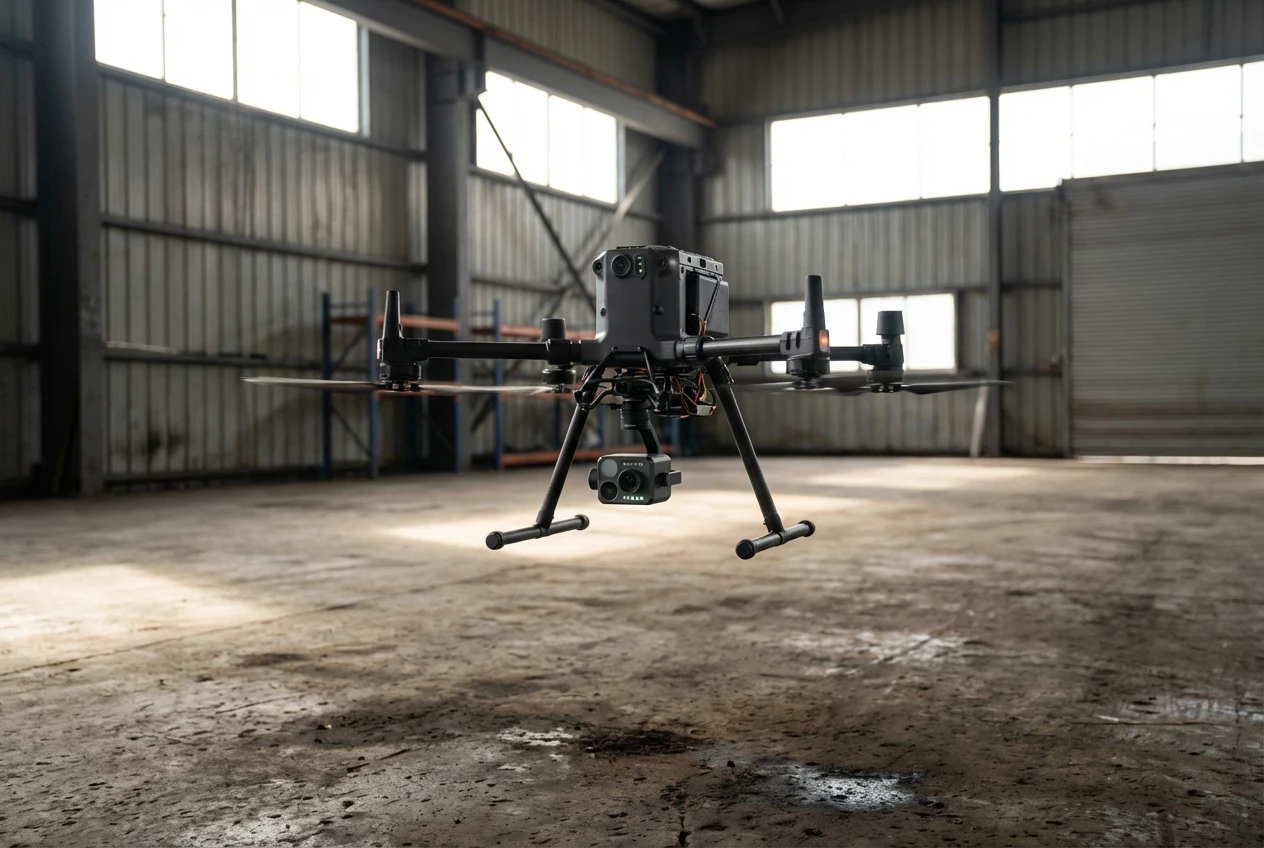
You spend weeks calibrating a new heavy-lift quadcopter. The GPS lock looks solid outside. You bring it into the warehouse for a demo, and suddenly—panic. The drone starts drifting like a drunk sailor. It hits a rack. Game over.
Why does this happen? Because GPS is useless inside a metal box.
This is where the magic of the drone optical flow sensor comes in. If you are building commercial UAVs and you aren’t obsessing over optical flow and Si PIN photodiodes yet, you are basically flying blind.
I’ve spent years messing around with flight controllers, and frankly, relying solely on GPS or barometers for position holding is a rookie mistake for industrial applications. Today, I want to dig deep into the tech stack that keeps drones stable when the satellites go dark. We’re talking about optical flow, the math behind it, and the hardware that makes it possible.
The “Mouse Sensor” of the Sky
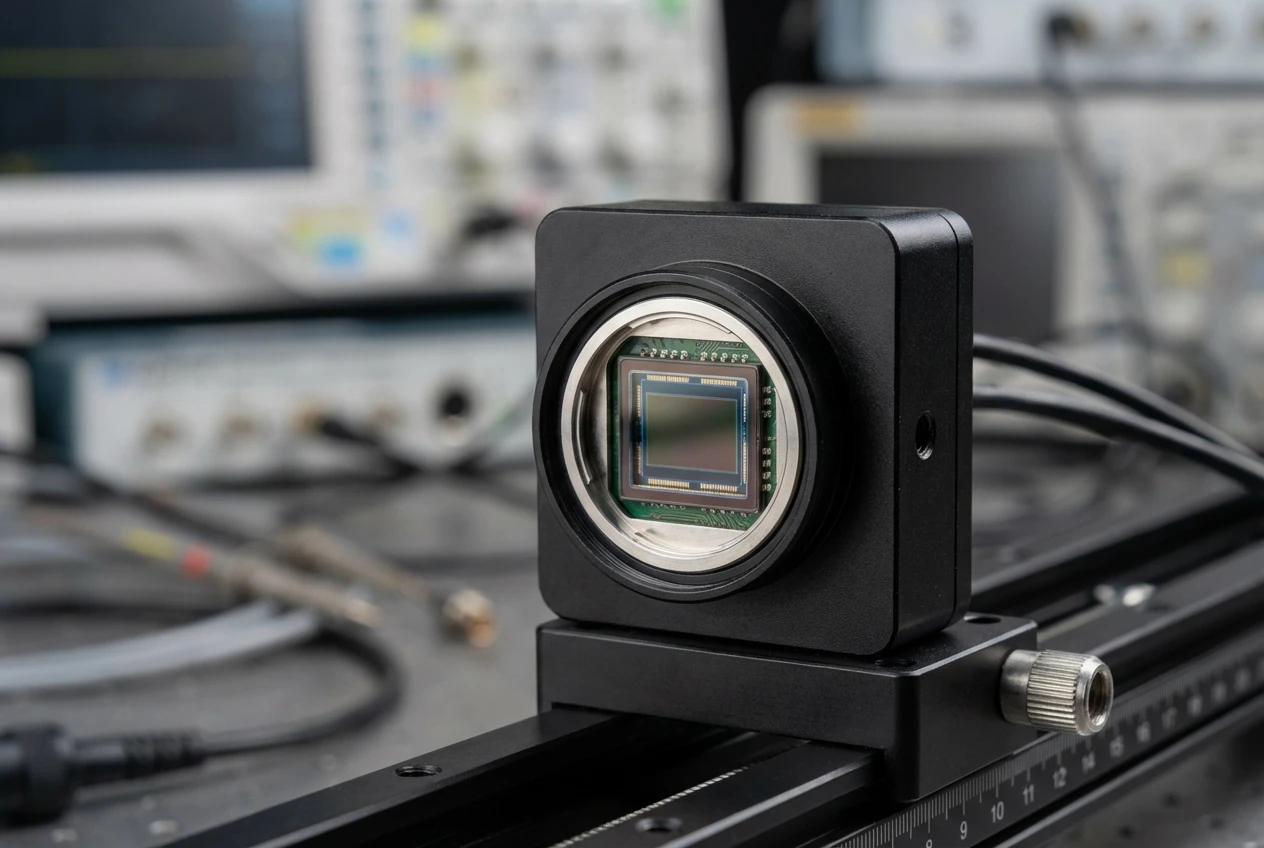
Let’s keep this simple. You know how your computer mouse works? It takes thousands of tiny pictures of your desk surface every second. It compares image A to image B, sees that the texture moved to the left, and tells the computer, “Hey, the mouse moved right.”
A drone optical flow sensor is literally just that, but flipped upside down and strapped to the belly of a UAV.
It tracks the texture of the ground. When the drone drifts, the sensor sees the ground move. It calculates the velocity of that movement and screams at the flight controller to compensate. The result? A rock-solid hover without a single GPS satellite in sight.
But here is the kicker: It is not as simple as slapping a camera on a PCB. The hardware choices you make—specifically the photodiodes—can make or break the system.
The Math: How a Drone Optical Flow Sensor Actually Works
I know, math is boring. But if you are engineering a flight stack, you need to know why the sensor spits out the data it does. We usually use the brightness constancy assumption.
Basically, we assume the brightness of a point on the ground doesn’t change as the drone moves.
The core formula looks something like this in plain text:
I(x, y, t) = I(x + dx, y + dy, t + dt)
Here:
- I is the image intensity (brightness).
- x, y are the spatial coordinates.
- t is time.
- dx, dy, dt are the changes in position and time.
When you expand this using a Taylor Series (I won’t bore you with the full derivation), you end up with the Optical Flow Constraint Equation:
Ix * u + Iy * v + It = 0
Where:
- Ix and Iy are the spatial gradients (how fast brightness changes across the image).
- It is the temporal gradient (how fast brightness changes over time).
- u and v are the optical flow velocities (this is what we want!).
So, your drone optical flow sensor is constantly solving for u and v.
The Altitude Problem
There is a catch. The sensor measures angular velocity, not linear velocity. If you are flying at 1 meter, the ground rushes by fast. If you are at 100 meters, it looks slow.
To get the true speed, you need to scale by altitude (h).
Velocity_x = (Flow_x * h) / Focal_Length
This is why a drone optical flow sensor is almost always paired with a distance sensor (like LiDAR or Ultrasonic) for height sensing drone applications. If your height data is trash, your flow data is trash. Period.
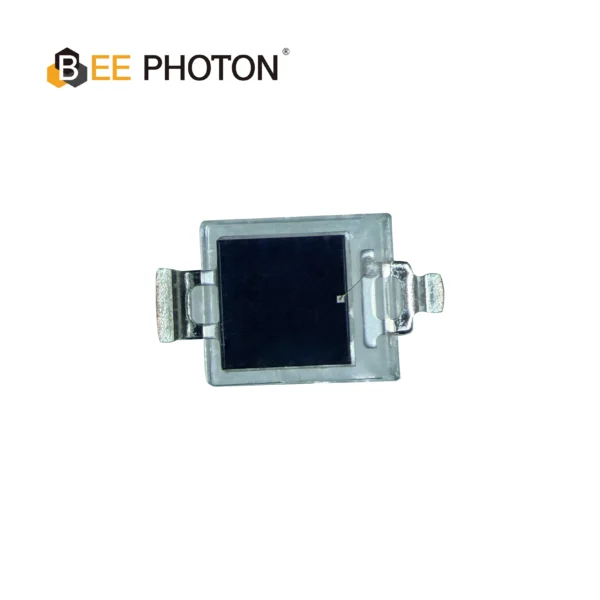
Si PIN photodiode PDCP08 Series PDCP08-501
High-Performance Detection: The PDCP08-501 is a high-speed Silicon PIN Photodiode with a transparent window.
Key Specs: Featuring a 2.9×2.9mm active area, this PIN photodiode offers low dark current and high responsivity, making it an ideal sensor for general optical switches and light detection systems.
Hardware Matters: Why We Use Si PIN Photodiodes
Okay, let’s talk hardware. You can have the best algorithm in the world, but if your sensor reads noise, you crash.
For high-speed UAV obstacle avoidance and optical flow, standard CMOS cameras are often too slow or suffer from “rolling shutter” jelly effects. This is where BeePhoton steps in. We find that for precise light detection in these systems, specifically for the laser-based parts of the flow modules (like in P-Flow designs), using high-speed Si PIN photodiodes is crucial.
Why Si PIN?
A Silicon PIN photodiode has an intrinsic layer between the P and N regions. This does two things:
- Low Capacitance: This means it can switch on and off incredibly fast. We are talking nanoseconds.
- High Sensitivity: It picks up light signals very efficiently.
When you are designing a drone optical flow sensor module, especially those that use laser speckle tracking or need to sync with active illumination (to see in the dark), the response time of the detector is everything.
If your photodiode lags, your flow calculation lags. If the calculation lags, the drone over-corrects. That’s how you get that wobble effect (PI oscillation) right before the drone flips over.
Obstacle Avoidance: The Other Half of the Equation
A drone optical flow sensor looks down. But what about what’s in front?
UAV obstacle avoidance uses similar principles but often relies closer on Time-of-Flight (ToF) or structured light. However, the data processing pipeline is surprisingly similar.
I remember consulting for a warehouse logistics company last year. They were trying to build an inventory drone. They used a cheap ultrasonic sensor for the front. It was a disaster. The ultrasonic waves bounced off the smooth metal racks at weird angles, and the drone kept thinking the path was clear when it wasn’t.
We switched them to a system utilizing optical arrays and high-speed Si PIN photodiodes for the receiver. The difference was night and day. The optical system didn’t get confused by the angled metal.
Integrating Height Sensing
For a height sensing drone, you need to fuse data. The drone optical flow sensor provides the X and Y movement. The height sensor (Z-axis) scales that movement.
If you are a manufacturer, ensure your sensor fusion filter (usually an Extended Kalman Filter – EKF) trusts the drone optical flow sensor more when the GPS variance increases.
Comparison: Optical Flow vs. GPS vs. Lidar
I put together this table to help you decide when to rely on a drone optical flow sensor.
| Feature | GPS | Lidar (SLAM) | Drone Optical Flow Sensor |
|---|---|---|---|
| Environment | Outdoors Only | Indoor/Outdoor | Indoor/Outdoor (Low altitude) |
| Cost | Low | High | Medium |
| Drift | Meters (without RTK) | Centimeters | Centimeters |
| Light Dependency | None | None | High (needs light) |
| Texture Dependency | None | Medium | High (needs texture) |
| Update Rate | 5-10 Hz | 10-100 Hz | >100 Hz |
You can see that the drone optical flow sensor fills a specific gap: low-cost, high-precision holding in GPS-denied environments.
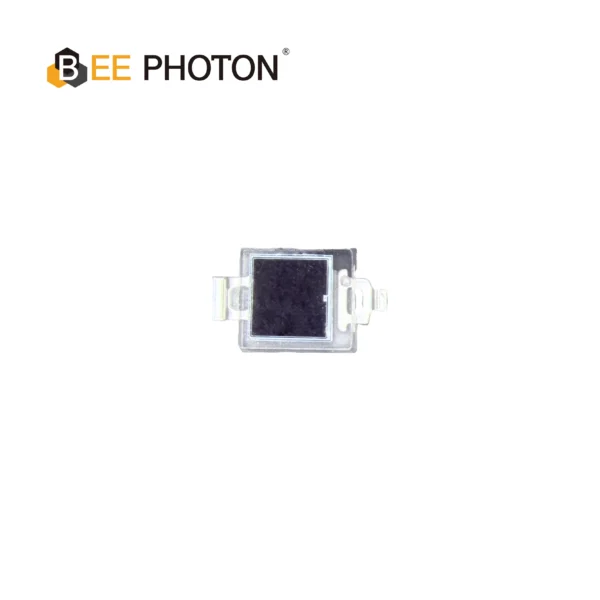
Si PIN photodiode PDCP08 Series PDCP08-502
The PDCP08-502 is a high-response 2.9×2.8mm Silicon PIN Photodiode designed for precision photoelectric applications. Featuring low junction capacitance, low dark current, and a wide spectral range (340-1100nm), it is the ideal component for optical switches and compact sensing modules requiring stable and fast signal output.
Real-World Case Study: The “Dark” Warehouse
Let me share a quick story (names changed to protect the innocent).
A client, “Firm X,” was building a security drone to patrol a server farm. Server farms are weird places—long corridors, blinking lights, and polished concrete floors.
The Problem: The polished floor was the enemy. It reflected the ceiling lights. The standard camera-based drone optical flow sensor was locking onto the reflection of the lights, not the floor. As the drone moved forward, the reflection moved with it. The drone thought it was stationary, so it sped up. Crash.
The Solution: We had to get creative. We couldn’t change the floor. We upgraded the drone optical flow sensor module to one that used active IR illumination and better Si PIN photodiodes that cut through the visible glare.
By projecting a texture pattern (IR speckles) onto the floor, the sensor finally had something to “grip” onto. The Si PIN photodiodes at BeePhoton are excellent for this type of IR application because of their spectral sensitivity curve peaking around 800-900nm.
Challenges You Will Face (And How to Beat Them)
Implementing a drone optical flow sensor isn’t plug-and-play. Here are the headaches you’ll run into:
1. Vibration
This is the silent killer. If your motors are unbalanced, the frame vibrates. The drone optical flow sensor is a camera. Vibration = Motion Blur. Motion Blur = Bad Data.
- Fix: Soft mount your sensor. Use dampening foam.
2. Low Light
As mentioned, standard flow sensors need light. Pitch black? No data.
- Fix: Use active LED illumination or switch to IR-sensitive Si PIN photodiodes.
3. The “Textureless” Void
Snow, water, and polished concrete are terrible for optical flow.
- Fix: Sensor fusion. When flow confidence drops, fallback to IMU integration (though this drifts fast).
Future Trends: AI on the Edge
We are starting to see “Smart” flow sensors. Instead of just raw pixel math, they run tiny neural networks to recognize “floor” vs “obstacle.”
But even with AI, the physics doesn’t change. Garbage in, garbage out. You still need high-quality photons hitting high-quality silicon. That is why we at BeePhoton focus so heavily on the raw material quality of our detectors. Whether you are building a height sensing drone or a racing quad, the sensor speed defines your control loop.
How to Source the Right Components
If you are a B2B buyer for a drone manufacturer, don’t just look at the resolution of the camera. Look at the latency of the photodiode in the obstacle avoidance array.
Check out our full range of sensors at https://photo-detector.com/. We have helped dozens of manufacturers fine-tune their UAV obstacle avoidance rigs.
For specific datasheets on the high-speed diodes I mentioned, go straight to our Si PIN photodiodes category.

Si PIN photodiode PDCP08 Series PDCP08-511
The PDCP08-511 is a high-performance Black Epoxy PIN Photodiode designed for precision infrared applications. Encased in a special black epoxy resin, this sensor effectively acts as a daylight filter, blocking visible light interference while maximizing sensitivity at 940nm. With a large 2.9×2.9mm active area and low dark current, it ensures reliable signal detection for optical switches and remote control systems, even in noisy ambient light environments.
Conclusion
The drone optical flow sensor is no longer a luxury; it is a requirement for commercial autonomy. It bridges the gap between the clumsy GPS reliance of the past and the fully autonomous future. By understanding the math (dx/dt!), mitigating vibration, and choosing the right Si PIN photodiodes, you can build a drone that hovers as if it’s nailed to the air.
Don’t let your drones drift into obscurity. Or a wall.
Ready to upgrade your sensor array?
We love talking tech. If you are unsure which photodiode matches your specific flow algorithm or emitter wavelength, reach out.
- Visit us: BeePhoton
- Email: info@photo-detector.com
- Contact Page: https://photo-detector.com/contact-us/
Let’s make your UAVs see better.
FAQ
1. Can a drone optical flow sensor work in total darkness?
Standard optical flow sensors using visible light cameras cannot work in darkness. However, if the drone optical flow sensor is equipped with active infrared (IR) illumination and sensitive Si PIN photodiodes, it can create its own “texture” on the ground and work perfectly in low light or dark conditions.
2. What is the difference between a drone optical flow sensor and a LiDAR sensor?
A LiDAR sensor measures the distance to an object by timing a laser pulse. A drone optical flow sensor measures the speed of the drone relative to the ground by watching texture move. While LiDAR creates a 3D map, optical flow is primarily used for stabilizing the drone’s position (preventing drift) without GPS. Most high-end drones use both.
3. Why is my drone optical flow sensor drifting over water?
Water is tricky. It has a moving texture (waves) and high reflectivity. A drone optical flow sensor tracks the moving waves, tricking the drone into thinking it is moving when it isn’t. Alternatively, the reflection creates false depth. For flying over water, it is best to disable optical flow and rely on GPS or stay at a higher altitude where the water’s motion is less apparent to the sensor.
4. How does altitude affect the accuracy of a drone optical flow sensor?
Greatly. The flow sensor measures angular change. The higher you are, the slower the ground seems to move. To get accurate velocity data, the flight controller must know the exact height (using a barometer or rangefinder) to scale the optical flow data. Most drone optical flow sensor units have an effective range of 0.3 meters to about 10-20 meters. Above that, the pixel shift is often too small to detect accurately.