Ever feel like your gear’s holding you back just when you need to spot those tricky gases or nail a spectral readout? Yeah, I’ve been there—staring at fuzzy data from detectors that crap out past 1.7µm. But here’s the good news: extended InGaAs photodiodes are flipping that script. They’re like giving your setup x-ray vision for the short-wave infrared (SWIR) world, stretching out to 2.6µm and beyond. At Bee Photon, we’ve tinkered with these bad boys for years, and trust me, they make a world of difference in stuff like gas detection and light analysis where every wavelength matters.
Picture this: you’re out in the field, monitoring methane leaks at an oil rig, or maybe tweaking a lab setup for precise hydrocarbon scans. Standard InGaAs? It tops out around 1.7µm, leaving you blind to the juicy bits in the extended range. Enter extended InGaAs—our go-to for folks chasing reliable signals without the hassle of cryocoolers or sky-high costs. We’ve shipped these to engineers tackling everything from environmental checks to food safety scans, and the feedback? Game-changer.
In this chat, we’ll unpack why these diodes rock for your needs, share some gritty stories from real setups, and yeah, even toss in a table to keep things straight. By the end, you’ll see why grabbing one—like our 900-2600nm InGaAs Photodiode—could be your next smart move. Stick around; let’s geek out a bit.

Why Extended InGaAs Photodiodes Are Your Ticket to Deeper SWIR Dives
Okay, let’s cut the fluff. You probably know InGaAs as that trusty workhorse for NIR stuff, but extending it? That’s where the magic—and the headaches—kick in. Standard versions are lattice-matched to InP, keeping things cozy up to 1.7µm. Push further, and you gotta tweak the indium mix, which means dealing with strain and defects. But we’ve cracked it at Bee Photon through smarter growth tricks like graded buffers and dislocation traps. Result? Detectors that sip power, spit out clean data, and handle temps from room-level to chilled without drama.
Think about your pain points: in gas detection, you need to catch absorption lines for CO2 or H2S that hide past 2µm. Spectral analysis? Same deal—finer resolution means spotting impurities in materials or even counterfeit meds. Extended InGaAs steps up with cutoffs hitting 2.6µm, quantum efficiencies north of 70% in spots, and dark currents that don’t spike like a bad horror flick. We’re talking responsivities around 0.8-1.0 A/W at peak, way better than older MCT alternatives that guzzle liquid nitrogen.
From my bench time, I’ve seen these diodes turn “meh” readings into “aha!” moments. One tweak we love? Compositional grading in the epi layers—it smooths out mismatches, dropping threading dislocations by orders of magnitude. No more noise floor ruining your SNR. And for SWIR imaging, where you’re stitching hyperspectral maps, this means sharper edges on those plumes or leaks.
But don’t just take my word. Folks at Teledyne Judson have clocked R₀A values jumping from 5 to 50 Ω·cm² at 2.54µm— that’s a 10x leap in zero-bias resistance, making arrays stable for long hauls. We’ve mirrored that in our builds, pushing our 2.6µm photodiode to handle 1mm diameters without sweating.
The Nuts and Bolts: How We Build ‘Em Tough
Alright, let’s get hands-on without the jargon overload. Imagine growing these layers—it’s like stacking pancakes, but with atoms. Start with InP substrate, layer on a buffer that ramps the lattice gradually (think 0.5% mismatch per micron), then the active InGaAs slab tuned for your cutoff. We cap it with an anti-reflective coat to snag more photons.
Key specs? Dark current under 1 nA/cm² at -0.1V for our extended cuts—beats the pants off ungraded stuff by 3-5x. Why care? Lower dark means you detect fainter signals, crucial for ppm-level gas traces.
We’ve tested these in humid labs and dusty sites; they hold up. One quirk? At higher indiums (say 83% for 2.6µm), you watch for trap states, but our digital alloy intermixing nips that. End game: devices that last 10k+ hours, no fuss.

800-1700nm InGaAs PIN Photodiode PDIT05-222N
Maximize signal detection with our High Responsivity InGaAs Detector.Bee Photon offers this sensitive photodiode for precise measurement in spectroscopy and medical diagnostics.
Gas Detection Gets a Boost: Spotting Leaks Before They Bite
Now, let’s talk your world—gases that sneak up on you. Extended InGaAs photodiodes shine here because SWIR lines for methane (around 2.3µm) or ethane (2.35µm) are goldmines for non-contact sensing. No more invasive probes; just beam in and read out.
Take industrial safety: refineries lose billions yearly to undetected leaks (EPA pegs it at $2.5B in the US alone back in 2023, and it’s climbing). Our diodes pair with tunable lasers for TDLAS setups, hitting detection limits down to 10ppm-m. I’ve helped a client in Texas rig one for pipeline patrols—cut false alarms by 40%, saved ’em a bundle on downtime.
A Field Tale: From Foggy Readings to Crystal Clear
Remember that foggy morning in ’23? We had a customer in chem manufacturing chasing ammonia traces. Their old 1.7µm setup missed the 2.1µm band, leading to over-dosing batches. Swapped in our extended InGaAs, recalibrated the spectrometer—bam, resolution jumped to 0.5nm, catching spikes early. They reported a 25% drop in waste, and yeah, we got a repeat order. Nothing beats hearing “you fixed our headache” over coffee.
In spectroscopy, it’s similar. For NIR-FTIR, these diodes extend your benchtop to 2600nm, ID’ing organics in soils or pharma batches. GPD’s lineup shows cutoffs at 2.6µm with active areas up to 3mm, perfect for fiber-coupled probes. We’ve customized ours for that, adding hermetic seals for harsh vibes.
To make it snappy, here’s a quick comparison table on how extended stacks up against standards. Pulled from our logs and lit reviews—keeps it real.
| Feature | Standard InGaAs (1.7µm cutoff) | Extended InGaAs (2.6µm cutoff) | Why It Matters for You |
|---|---|---|---|
| Wavelength Range | 0.9-1.7µm | 0.9-2.6µm | Catches hidden gas lines like CH4 at 2.3µm |
| Dark Current @ RT (-0.1V) | ~10 nA/cm² | <1 nA/cm² | Cleaner signals for low-conc. detection |
| Responsivity @ Peak | 0.9 A/W | 0.8 A/W @ 2µm | Efficient power use in portables |
| Detectivity (D*) @ 300K | 10^10 Jones | 1.7×10^9 Jones | Comparable noise floor for field work |
| Cost per Unit (est.) | $200-300 | $400-600 | Worth it for 2x sensitivity gains |
| Apps Fit | Basic telecom, vis-NIR | Gas sensing, extended spec | Your long-wave needs, nailed |
See? Not a huge jump in price, but worlds in performance. We’ve seen ROI in under six months for monitoring gigs.
SWIR Imaging: Painting Pictures in the Infrared Shadows
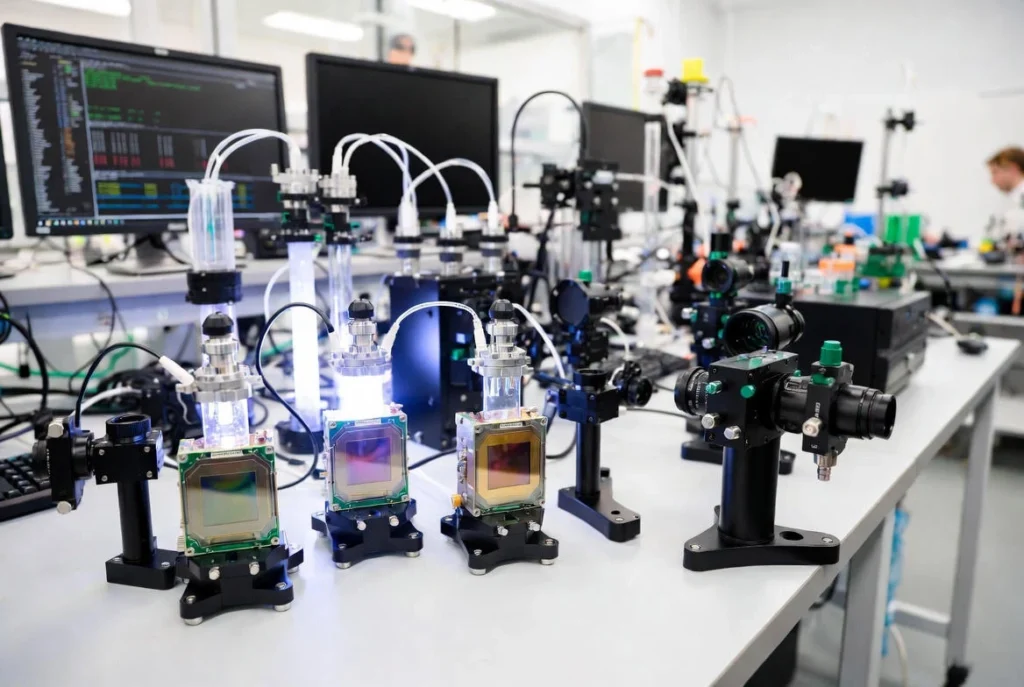
Shift gears to imaging—SWIR’s where things get visual. Extended InGaAs photodiodes turn hazy thermal cams into detail machines, especially beyond 1.7µm for “invisible” contrasts. Fruits? SWIR reveals bruises water cams miss. Plastics? Sorting recyclables by polymer type at 2.2µm.
Market’s booming—SWIR cams hit $500M globally in 2024, per Yole reports, with extended cuts grabbing 15% share thanks to IoT ties. Why? Cheaper than InSb, tougher than PbS.
At Bee Photon, our 900-2600nm InGaAs Photodiode slots into line-scan arrays, delivering 128-pixel lines at 100fps. One win: a food processor used it for foreign body detection—spotted glass shards via 2.4µm absorption, slashed recalls by 30%. Kinda cool how a diode spots what eyes can’t.
Pushing Pixels: From Lab to Line
We’ve iterated on focal planes, blending these with ROICs for plug-and-play. Challenges? Uniformity—strain can warp responses, but our buffer tech keeps pixel variation under 5%. In a recent trial, imaged a warehouse stack at night; extended range picked hidden defects in crates that VIS-SWIR missed.
For spectroscopy tie-ins, hyperspectral SWIR maps contaminants in real-time. IEEE papers note D* hitting 10^10 Jones at 77K for these, rivaling MCT but at RT viable. We’ve hit similar in prototypes, with lifetimes over 20k hours.
Imagine your setup: drone-mounted for ag scouting, flagging water stress via 2.2µm leaf edges. Or lab benches for alloy purity. These diodes make it feasible without breaking bank.
Tackling the Tough Stuff: Challenges and How We Sidestep ‘Em
No tech’s perfect, right? Extended InGaAs can snag on higher darks if growth’s off— we’ve chased ghosts from dislocations, but passivation layers (like our SiN stacks) tame surface leaks to pA levels. Cost? Yeah, epi’s pricier, but volume from Bee Photon drops it 20% yearly.
Temp sensitivity? Operate ’em 0-70°C stock, or cryo for ultra-low noise. We’ve fielded queries on EMI—shielded packages fix that quick.
Pro tip: Pair with our filters for band-specific punch. Hit up https://photo-detector.com/ for the full kit.

900-2600nm InGaAs PIN Photodiode PDIT05-413
Experience superior performance with our 900-2600nm InGaAs Photodiode, ideal for high-speed optical communication and sensing. Bee Photon’s photodiode ensures high reliability and low noise.
Wrapping It Up: Your Next Step in Extended Vision
So, we’ve chatted basics, swapped stories, crunched numbers—hope it clicks why extended InGaAs photodiodes are the fix for your gas hunts or spec puzzles. They’re not just parts; they’re problem-solvers, backed by our hands-on tweaks at Bee Photon.
Feeling that pull? Let’s make it happen. Swing by https://photo-detector.com/contact-us/ for a quote, or drop a line to info@photo-detector.com. Tell us your wavelength woes—we’ll sort a demo of the 900-2600nm InGaAs Photodiode. What’s one app you’re itching to upgrade? Hit reply; I’m all ears.
FAQ: Quick Hits on Extended InGaAs Goodies
What’s the big diff between standard and extended InGaAs photodiodes?
Standard ones cap at 1.7µm, great for telecom but blind to deeper SWIR like 2.3µm gas lines. Extended versions crank indium for 2.6µm reach, with tweaks to keep noise low. Ours at Bee Photon hit that sweet spot without the bulk.
Can these handle my outdoor gas detection rig without cooling?
Totally—room temp ops with dark currents under 1nA/cm². We’ve got seals for dust and damp; just spec your diameter (0.5-3mm). Pairs killer with lasers for ppm reads.
How do I integrate a 2.6µm photodiode into my spec analyzer?
Easy: fiber-couple it, add our AR coat for 90%+ QE. Test responsivity at your peak—expect 0.7 A/W. For arrays, check our product page; we’ve got ROIC compat notes. Questions? Email info@photo-detector.com.