If you are designing the optical bench for a next-gen DNA sequencer or a qPCR machine, you aren’t sleeping much. The biology is getting faster, the sample volumes are getting smaller, and the demand for accuracy? It’s through the roof.
The pressure is on to detect fewer photons in less time.
I’ve spent years working with engineers in bio-instrumentation, and the bottleneck usually isn’t the chemistry anymore; it’s the physics of light detection. Specifically, catching those faint emission signals from fluorophores without drowning in electronic noise.
Today, we are diving deep into the engine room of DNA analysis: fluorescence detection photodiodes. We aren’t just listing specs. We are going to look at how to actually engineer a solution that works when you’re dealing with picowatts of signal power.
The “Needle in a Haystack” Problem: DNA Analyzer Sensors
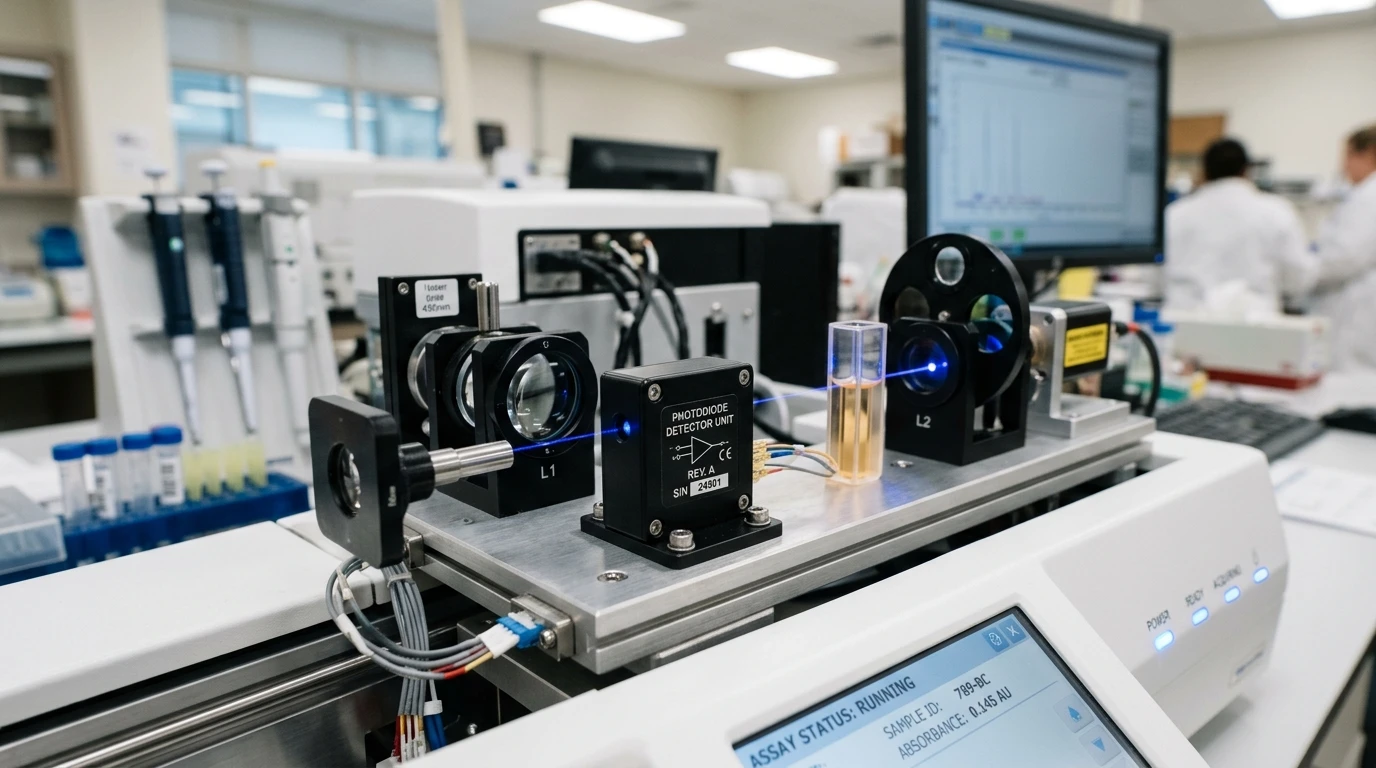
When we talk about DNA analyzer sensors, we are essentially talking about counting photons. In Sanger sequencing or Next-Gen Sequencing (NGS), the fluorescent tags (like FAM, VIC, ROX, or CY5) emit light when excited by a laser or LED.
But here’s the kicker: the Stokes shift means the emitted light is weak. Like, incredibly weak.
If your photodetector isn’t tuned perfectly, you get “dark noise” that looks like data. False positives in gene sequencing aren’t just annoying; they are a diagnostic liability.
Why Standard Sensors Fail
I’ve seen plenty of prototypes fail because the engineering team picked a generic off-the-shelf sensor. Standard sensors often suffer from:
- High Dark Current: The noise generated just by the sensor existing at room temperature.
- Poor Blue/UV Response: Many standard silicon chips die off below 450nm.
- Slow Rise Times: If you are doing high-throughput flow cytometry, a slow sensor blurs the data.
To fix this, we need to look at specific fluorescence detection photodiodes designed for the life sciences.
The Physics of Sensitivity (Without the Headache)
You need to optimize the Signal-to-Noise Ratio (SNR). That is the holy grail.
If you are using a visual editor, you probably hate complex LaTeX, so let’s keep the math readable. The SNR for a photodiode in a DNA analyzer roughly looks like this:
SNR = Ip / sqrt(2 * q * (Ip + Id) * B + (4 * k * T * B) / Rf)
Where:
- Ip = Photocurrent (Signal)
- Id = Dark Current (The enemy)
- q = Electron charge
- B = Bandwidth
- k = Boltzmann constant
- T = Temperature
- Rf = Feedback resistance of your amplifier
What does this tell us?
To get a better signal, you can’t always increase the laser power (you’ll bleach the sample). You have to lower the Id (Dark Current) or optimize the Rf (Gain). This is where high-quality Si PIN photodiodes come into play.
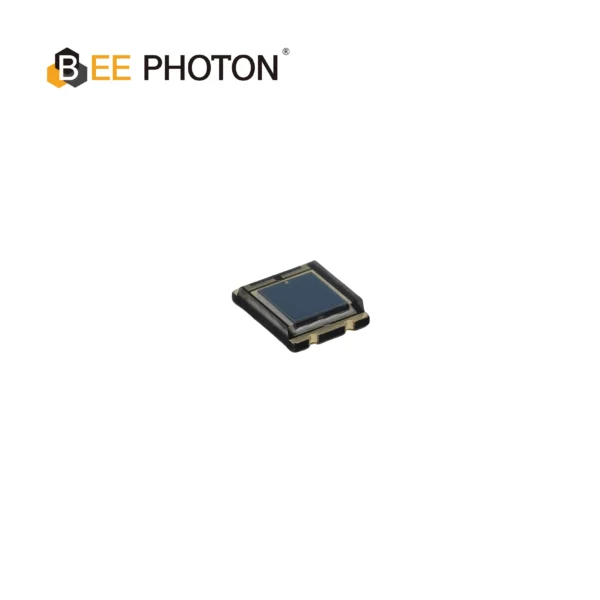
Si PIN Photodiode with NIR sensitivity enchanced (430-1100nm) PDCP08-201
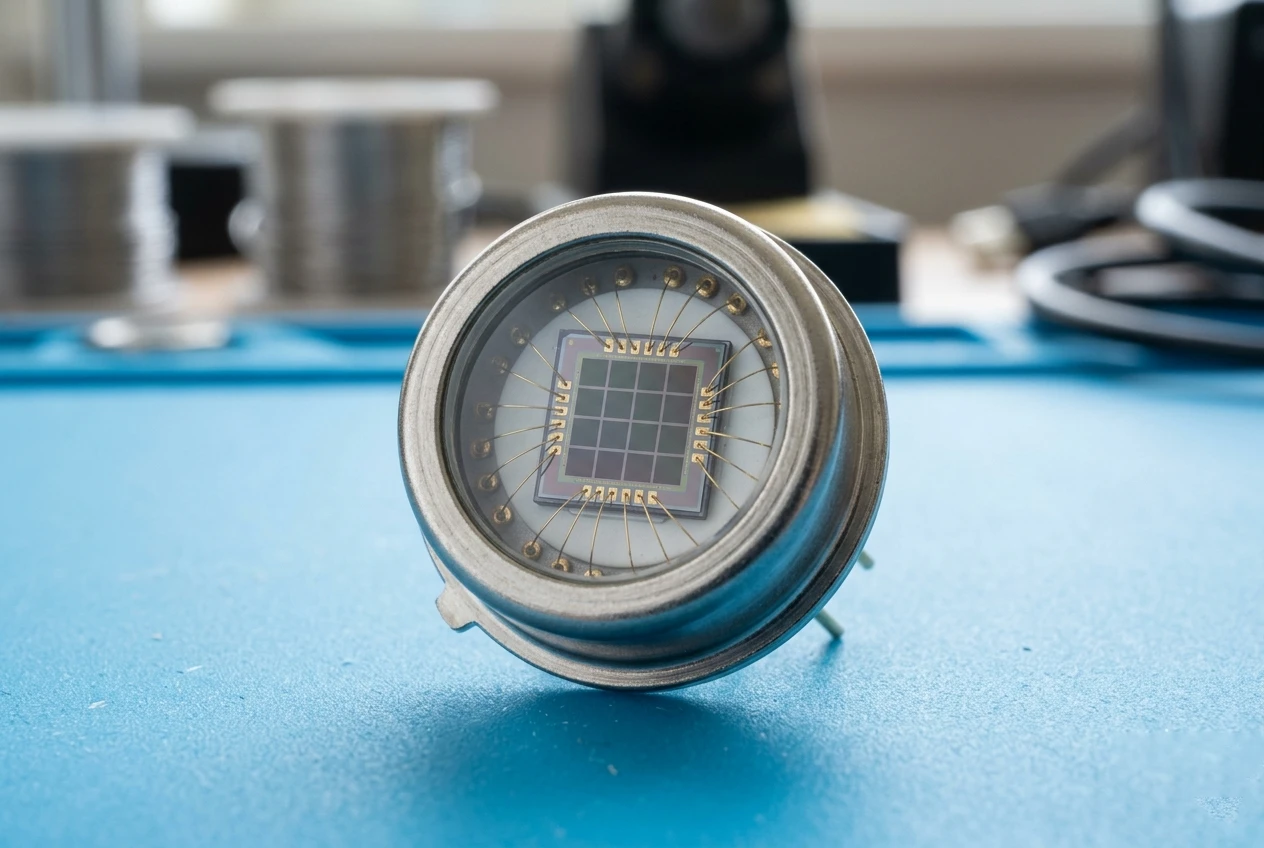
The PDCP08-201 is a high-performance SMD Si PIN Photodiode designed for precision optical communication and medical sensing.[1] Featuring a large 2.9×2.9 mm active area with enhanced NIR sensitivity (0.70 A/W) and ultra-low dark current (20 pA), this SMD Si PIN Photodiode ensures superior signal detection and reliability in a compact surface-mount package.
Comparing the Contenders: PMT vs. APD vs. Si PIN
Back in the day, the Photomultiplier Tube (PMT) was the king of low light. But things have changed. PMTs are bulky, fragile, and require high voltage (scary stuff in a compact benchtop device).
Here is a breakdown of why modern bio-instrumentation is shifting toward Silicon PIN diodes.
| Feature | Photomultiplier Tube (PMT) | Avalanche Photodiode (APD) | Si PIN Photodiodes |
|---|---|---|---|
| Sensitivity | Extremely High | High (with internal gain) | Moderate to High (needs good electronics) |
| Cost | $$$ (Expensive) | $$ | $ (Cost-effective) |
| Durability | Fragile (Glass) | Robust | Robust (Solid State) |
| Voltage | High (>1000V) | High (~100V) | Low (<15V) |
| Linearity | Good | Fair | Excellent |
| Size | Bulky | Compact | Miniature |
For many portable or point-of-care (POC) DNA analyzers, the fluorescence detection photodiodes based on Si PIN technology are the winner. They are stable, don’t require massive power supplies, and their linearity ensures that if the fluorescence doubles, your signal actually doubles.
A Real-World Scenario: The “Project Genesis” Retrofit
I want to share a story (names changed to protect the NDA, obviously). We worked with a mid-sized biotech firm, let’s call them “GenTech.” They were building a 4-channel qPCR machine.
The Problem:
They were using generic photodiodes. Their “Cycle Threshold” (Ct) values were inconsistent because the sensors drifted as the machine heated up during the PCR cycles. The thermal noise was burying the fluorescence signal of the late-cycle amplification.
The Fix:
We swapped their generic sensors for high-shunt resistance Si PIN photodiodes.
- Matched Wavelengths: We utilized sensors with enhanced sensitivity in the 500nm–700nm range to match their FAM and ROX dyes.
- Lower Capacitance: We chose smaller active areas to reduce junction capacitance, allowing for faster readout without noise.
- Shielding: We grounded the case to the PCB ground plane.
The Result:
Their SNR improved by 40%. They didn’t change the optics. They didn’t change the chemistry. They just put the right eyes in the machine. If you are struggling with thermal drift, check out our Si PIN photodiodes. Sometimes the silicon makes all the difference.
Technical Deep Dive: The Transimpedance Amplifier (TIA)
You can have the best fluorescence detection photodiodes in the world, but if your TIA circuit is garbage, your data will be too.
The photodiode produces current. Your ADC (Analog to Digital Converter) reads voltage. The TIA bridges that gap.
The “Gotchas” of TIA Design
When designing for DNA analyzer sensors, keep an eye on parasitic capacitance.
V_out = -I_pd * Rf
Simple, right? No. Because high gain (large Rf) limits your bandwidth. It is a trade-off.
For fluorescence, you usually deal with low frequency signals (compared to telecom), so you can afford a higher Rf (like 100MΩ or even 1GΩ) to get massive gain.
Expert Tip: Keep the trace length between the photodiode anode and the Op-Amp inverting input as short as possible. I mean millimeters. This reduces the antenna effect that picks up 60Hz hum from the lab lights.

Si PIN Photodiode with NIR sensitivity enchanced (350-1100nm) PDCC100-501
Achieve uniform results with our High Consistency Si PIN Diode for medical devices. This COB photodiode provides dependable NIR sensitivity for health monitoring. Trust our High Consistency Si PIN Diode.
Why Customization Matters in Bio-Instrumentation
Generic catalogs are fine for hobbyists. But for a medical device? You need precise geometry.
At BeePhoton, we often see requests for:
- Custom Active Areas: Shaping the sensor to match the exact spot size of the laser focus.
- Filter Integration: Bonding an optical filter directly onto the glass window of the photodiode to reject the excitation light. This saves space and money.
If the sensor doesn’t fit the mechanics, you end up using fiber optics or weird mirrors, which just loses more light. Customizing the chip package is often cheaper than redesigning the optical bench.
Why BeePhoton?
Look, there are giant sensor companies out there. We know them. But try getting an application engineer on the phone to discuss the noise floor of a specific batch of fluorescence detection photodiodes. Good luck.
BeePhoton specializes in the niche. We understand that in life sciences, “close enough” isn’t good enough.
- Low Dark Current: We bin our chips. We know which ones are quiet enough for DNA sequencing.
- Speed: fast prototyping.
- Experience: We speak the language of bio-engineers.
You can verify our specs and see our range of detectors at https://photo-detector.com/.
Industry Trends: What’s Next for DNA Analyzers?
We are seeing a shift toward “sample-to-answer” devices. These are machines that sit in a doctor’s office, take a cheek swab, and give a genetic result in 30 minutes.
This means fluorescence detection photodiodes need to get:
- Smaller: Chip-scale packaging.
- Cheaper: For disposable cartridges.
- Integrated: Sensors with on-chip amplifiers.
If you are designing for this market, you cannot rely on old-school PMTs. They won’t fit, and they use too much juice. Solid-state is the only way forward.
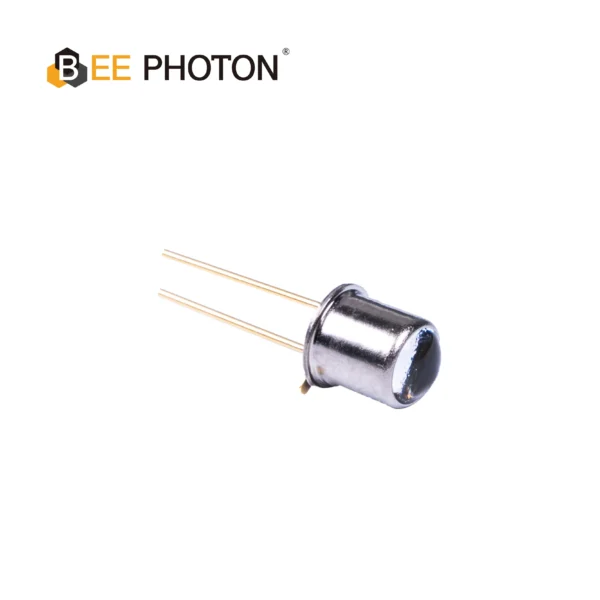
Si PIN Photodiode with low dark current (350-1060nm) PDCT01-202
Our high stability silicon PIN photodiode delivers consistent and reliable performance for analytical and optical measurement equipment. Benefit from its wide spectral range (350-1060nm) and ultra-low dark current. Trust this silicon PIN photodiode for your precision needs.
Frequently Asked Questions (FAQ)
Q1: Can I use a standard photodiode for fluorescence detection?
Technically, yes, but you will likely struggle with the Signal-to-Noise Ratio. Fluorescence signals are very weak (often pico-watts). Standard photodiodes usually have a dark current that is too high, masking your signal. You really need fluorescence detection photodiodes optimized for low-light applications.
Q2: Should I use a Si PIN diode or an Avalanche Photodiode (APD)?
It depends on your light level. If you have extremely low light (photon counting), an APD might be necessary because it amplifies the signal internally. However, APDs are temperature sensitive and require high voltage. For most standard qPCR and Sanger sequencing applications, a high-quality Si PIN photodiode paired with a good low-noise amplifier is more stable, cheaper, and easier to integrate.
Q3: How do I reduce noise in my DNA analyzer sensor circuit?
First, select a photodiode with low dark current and low capacitance. Second, shield the photodiode and the amplifier from external electromagnetic interference (EMI). Third, keep the connection between the sensor and the amplifier extremely short. Finally, ensure your power supply is clean; ripples in power can look like DNA signals!
Ready to Upgrade Your Optical Bench?
Don’t let noisy data kill your instrument’s performance. Whether you are retrofitting an old sequencer or building a new portable qPCR device, the right sensor makes all the difference.
- Need technical advice? Let’s talk about your optical budget.
- Want a sample? We can ship test units for your prototyping run.
Contact us today.
BeePhoton – Precision sensing for the life sciences.