Look, the hype around autonomous driving has been a rollercoaster. A few years ago, everyone thought we’d be sleeping in the back of our cars by 2025. Clearly, that didn’t happen. But while the mainstream media has moved on to AI chatbots, the real work in the hardware trenches has just gotten serious.
If you are an engineer or a sourcing manager at a LiDAR startup or an automotive OEM, you know the pain. You’re trying to balance range, resolution, and that pesky thing called cost. Everyone wants 1550nm FMCW performance, but nobody wants to pay the bill for it.
This is where LiDAR Photodiodes come back into the conversation. Specifically, Silicon PINs and Avalanche Photodiodes (APDs).
At BeePhoton, we’ve seen the shift firsthand. We get inquiries every day asking for the “next big thing,” but when we dig into the specs and the budget, 90% of projects end up realizing that optimized Silicon-based detectors are actually what they need. Today, I’m going to walk you through why this tech is not just “legacy” hardware—it’s the backbone of the automotive LiDAR sensors market.
The Real Bottleneck in Automotive LiDAR Sensors
The laser isn’t usually the problem. We have plenty of powerful lasers. The problem is catching those photons when they bounce back from a black tire at 200 meters in the rain.
The receiver sensitivity is everything.
In the world of autonomous driving components, the photodetector is the unsung hero. You can blast out all the power you want (within eye-safety limits, of course), but if your LiDAR Photodiodes are deaf, you’re blind.
We often see engineers obsessing over point cloud density before they’ve even solved their Signal-to-Noise Ratio (SNR). If you pick the wrong detector, you are fighting a losing battle against physics.
PIN vs. Avalanche Photodiodes: A No-Nonsense Comparison
I’ve sat in too many meetings where people conflate these two. Yes, they both turn light into electricity. No, they are not swappable.
If you are building a Flash LiDAR for short-range applications (like automated parking or AGVs), you might be looking at PIN diodes. But for highway autopilot? You need gain. You need APDs.
Here is a breakdown of how we see these stacking up in the current market:
| Feature | Silicon PIN Photodiode | Silicon Avalanche Photodiode (APD) |
|---|---|---|
| Internal Gain | 1 (No gain) | 50 to 200 (High gain) |
| Operating Voltage | Low (5V – 20V) | High (100V – 200V+) |
| Circuit Complexity | Simple | Complex (Needs temp compensation) |
| Cost | Very Low | Moderate |
| Best For | Short-range (<30m), Flash LiDAR | Long-range (>150m), ToF LiDAR |
| Noise Factor | Low dark current | Excess noise factor (F) comes into play |
When to Stick with Silicon PIN Photodiodes
Don’t let anyone tell you PINs are dead. They are bulletproof. Literally, they are robust, cheap, and they don’t drift much with temperature.
If your application is blind-spot detection or indoor robotics, using an APD is overkill. It’s like using a chainsaw to cut butter. You’re introducing high-voltage bias circuitry that you don’t need.
For many of our clients working on Si PIN photodiodes, the focus is on speed and active area size. You want a fast response time (low capacitance) to resolve those short pulses.
Pro Tip: If you are designing a budget-friendly solid-state LiDAR for industrial AGVs, stick to high-speed PINs. The ROI on moving to APDs just isn’t there for ranges under 50 meters.
Why Avalanche Photodiodes (APDs) Rule Long-Range
This is where the magic happens for LiDAR detectors.
When a photon hits an APD, it doesn’t just knock one electron loose. Because of the high reverse bias voltage, that electron accelerates, smashes into the lattice, and knocks more electrons loose. It’s an avalanche. Hence the name.
This internal gain (M) is the only reason we can see a pedestrian at 200 meters using a 905nm laser.
However, APDs are diva-ish. They are temperature sensitive. If the ambient temp goes up, your breakdown voltage shifts, and your gain drops. If you don’t have a feedback loop to adjust the bias voltage, your LiDAR Photodiodes will give you inconsistent data. We’ve seen startups fail validation testing simply because they cheaped out on the bias control circuit.

Si PIN photodiode PDCP08 Series PDCP08-511
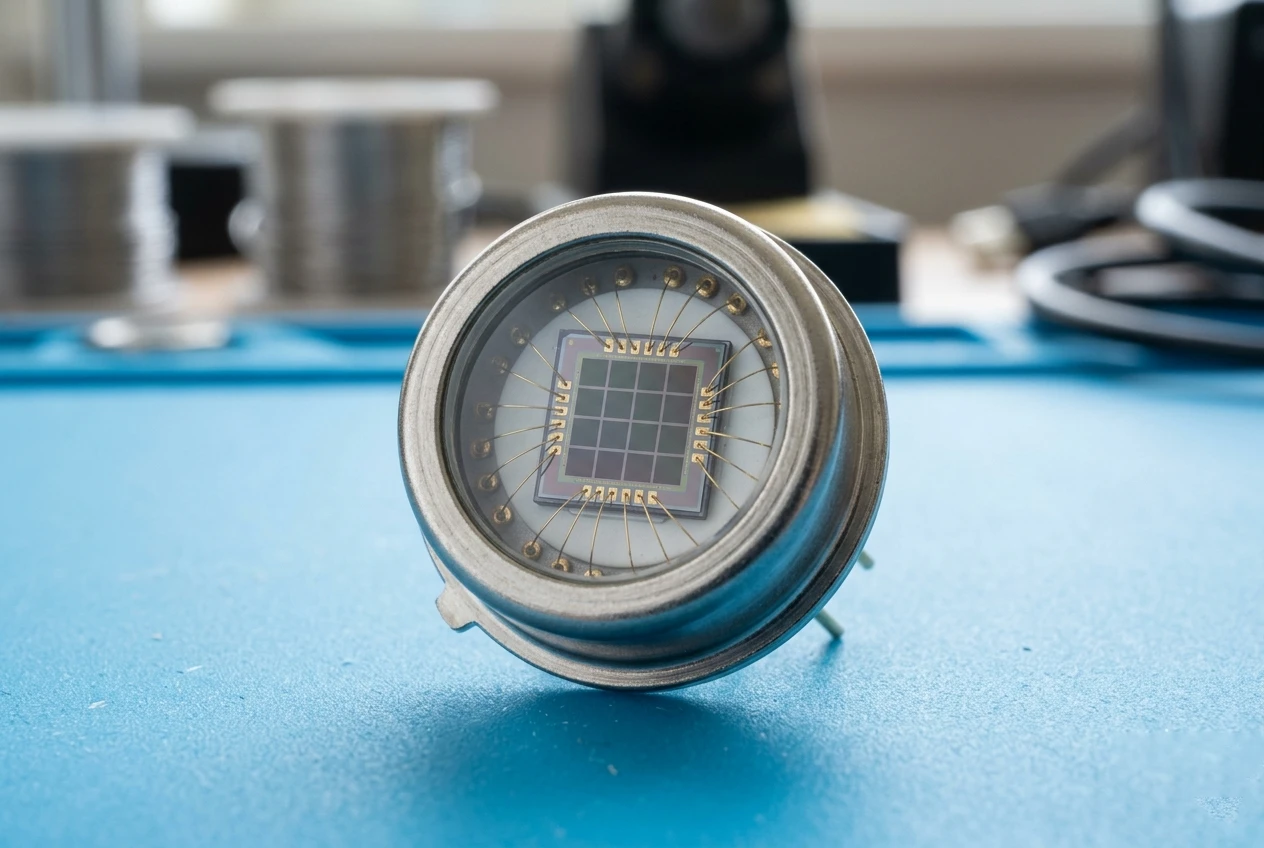
The PDCP08-511 is a high-performance Black Epoxy PIN Photodiode designed for precision infrared applications. Encased in a special black epoxy resin, this sensor effectively acts as a daylight filter, blocking visible light interference while maximizing sensitivity at 940nm. With a large 2.9×2.9mm active area and low dark current, it ensures reliable signal detection for optical switches and remote control systems, even in noisy ambient light environments.
Technical Deep Dive: The Math Behind the Detection
I promised no fancy code blocks, so let’s look at the math in plain text. This is important because understanding the “why” helps you choose the right component from BeePhoton.
The performance of your LiDAR Photodiodes essentially boils down to the Signal-to-Noise Ratio (SNR).
SNR = (Signal Current) / (Total Noise Current)
Breaking that down for an APD:
Signal Current = P_opt * R * M
(Where P_opt is optical power, R is responsivity, M is gain)
Noise Current includes three main enemies:
- Shot Noise: Random fluctuations from the signal and background light.
- Dark Current Noise: The detector firing when there is no light.
- Thermal (Johnson) Noise: Noise from the electronics/resistors.
Here is the formula written out for your notebook:
i_noise_total = Sqrt( [2 * q * (I_ph + I_dark) * M^2 * F * B] + [(4 * k * T * B) / R_load] )
- q: Electron charge
- I_ph: Photocurrent
- F: Excess Noise Factor (This is the killer in APDs!)
- B: Bandwidth
- k: Boltzmann constant
- T: Temperature
- R_load: Load resistance
Why does this matter? Because of F (Excess Noise Factor).
In LiDAR Photodiodes, specifically APDs, you can’t just crank the gain (M) up to infinity. As M goes up, F goes up. Eventually, the noise grows faster than the signal. There is a “sweet spot” for gain, usually around M=100 for Silicon APDs. If a supplier promises you stable gain at M=500 on a standard Si APD, they are lying to you.
Integrating LiDAR Detectors: Lessons from the Field
Let me share a quick story (names changed to protect the innocent).
We worked with a company—let’s call them “AutoVision”—developing a new automotive LiDAR sensor for Level 3 trucking. They were convinced they needed a massive array of 128 APDs.
They sourced some cheap, off-the-shelf APDs from a general electronics distributor, not a specialized photonics vendor.
The problem? Crosstalk.
They didn’t account for the electrical crosstalk between the channels in the array. When Channel 1 fired an “avalanche,” it induced a spike in Channel 2. Their point cloud looked like a fuzzy mess.
They came to BeePhoton panic-stricken. We helped them spec out a custom array with better isolation trenches and recommended a specific packaging that minimized parasitic capacitance.
The Lesson: A datasheet doesn’t tell you the whole story. The integration of LiDAR Photodiodes into the PCB is just as critical as the chip itself.
The Future? SiPMs vs. APDs in Autonomous Driving Components
You can’t talk about LiDAR detectors without someone bringing up SiPMs (Silicon Photomultipliers) or SPADs (Single Photon Avalanche Diodes).
“SiPMs are the future! They can detect a single photon!”
Yeah, they can. But here is the controversial opinion I hold: SiPMs are a nightmare for daylight operations.
In pitch black? Sure, SiPMs are amazing. But autonomous cars drive in the sun. The background solar radiation (sunlight) floods a SiPM. Because they are so sensitive, they get saturated instantly. You have to implement extremely aggressive filtering and coincidence detection logic just to make them usable during the day.
For 905nm ToF LiDAR, a high-quality linear mode APD is often still the more robust, cost-effective solution for autonomous driving components. It handles dynamic range better than a SiPM in bright conditions.
Don’t jump on the SiPM bandwagon just because it sounds cool. Test it in direct sunlight first.
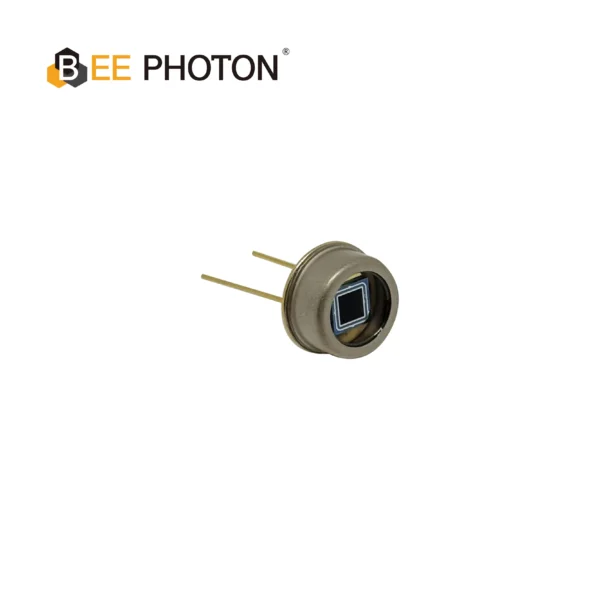
Si PIN Photodiode with UV sensitivity enchanced (190-1100nm) PDCT06-F01
Achieve rapid signal capture with our Fast Rise Time Si PIN Photodiode. Optimized for optical comms and pulse detection with low capacitance and high reliability. Get the performance of a fast Si PIN photodiode today.
Sourcing the Right Sensors for Your Stack
Supply chain security is something we don’t talk about enough in engineering.
During the chip shortage, we saw major Tier 1 automotive suppliers halting production because they couldn’t get the specific LiDAR Photodiodes they designed in.
When you choose a partner, you aren’t just buying a sensor; you are buying their fab capacity. At BeePhoton, we emphasize stability. If you design us in, we make sure those wafers are allocated.
Also, think about customization. Standard TO-cans are great for prototyping, but for mass production, you might need surface mount (SMD) packaging to reduce the height of your sensor module. We are seeing a huge demand for SMD LiDAR Photodiodes because car designers want the LiDAR to disappear into the roofline, not look like a KFC bucket spinning on top of the car.
Why 905nm Still Beats 1550nm (For Now)
There is a constant debate: 905nm (Silicon) vs. 1550nm (InGaAs).
1550nm is safer for eyes, meaning you can pump more power. That equals more range. But InGaAs (Indium Gallium Arsenide) is expensive. Like, really expensive.
Silicon (used for 905nm) is cheap. It’s the same stuff computer chips are made of.
Until the cost of InGaAs comes down significantly, LiDAR Photodiodes based on Silicon (905nm) will own the mass market. The goal is to make 905nm work better through better detectors and smarter signal processing, rather than switching to an exotic material that kills the BOM (Bill of Materials) cost.
5 Common Mistakes When Selecting LiDAR Photodiodes
- Ignoring the Bandwidth: You need high bandwidth to detect narrow pulses (ns width). If your detector is too slow, you lose distance accuracy.
- Overlooking Active Area: A smaller area is faster but harder to align optically. A larger area is easier to align but has higher capacitance (slower). It’s a trade-off.
- Forgetting Temperature Coefficients: If your APD breakdown voltage shifts by 0.5V per degree C, and you don’t compensate, your gain will fluctuate wildly.
- Underestimating Packaging Inductance: Long leads on a TO-can introduce inductance, which causes ringing in your signal.
- Buying Based on “Typical” Specs: Always design for the “Worst Case” specs in the datasheet.
Frequently Asked Questions (FAQ)
Q1: Can I use a standard PIN photodiode for highway autonomous driving LiDAR?
Honestly? No. Standard Si PIN photodiodes lack the internal gain required to detect the weak return signals from objects 100+ meters away. They are excellent for short-range (<30m) or flash LiDAR, but for highway speeds, you need the gain of an Avalanche Photodiode (APD) or a SiPM to overcome the noise floor.
Q2: What is the main advantage of Silicon APDs over InGaAs detectors for LiDAR?
It comes down to cost and maturity. Silicon LiDAR Photodiodes are significantly cheaper to manufacture than InGaAs. While InGaAs allows for higher laser power (1550nm), the sensor cost is currently prohibitive for mass-market vehicles. Silicon APDs at 905nm offer the best balance of performance and price for current automotive volumes.
Q3: How do I manage the high voltage required for APDs in a vehicle?
This is a common concern. While APDs need 100V-200V bias, the current is very low (micro-amps). You can use compact, low-noise DC-DC boost converters designed specifically for biasing photodetectors. The critical part is ensuring the voltage is clean (low ripple) and temperature-compensated to maintain stable gain.

Si PIN Photodiode with NIR sensitivity enchanced (350-1100nm) PDCC100-501
Achieve uniform results with our High Consistency Si PIN Diode for medical devices. This COB photodiode provides dependable NIR sensitivity for health monitoring. Trust our High Consistency Si PIN Diode.
Ready to Upgrade Your Detection Stack?
LiDAR is hard. We get it. You are dealing with physics, electronics, and automotive standards all at once. But you don’t have to guess when it comes to the sensors.
Whether you need a custom array of LiDAR Photodiodes or just advice on whether to go PIN or APD for your specific use case, we are here to chat. We’ve helped dozens of teams move from “noisy prototype” to “production ready.”
Don’t let thermal noise kill your product launch.
Check out our full range of detectors at photo-detector.com.
Got a specific technical challenge? Drop us an email at info@photo-detector.com or fill out our form on the Contact Us page. Let’s build something that actually sees the world clearly.