Look, if you’ve been in medical device procurement for more than a few months, you already know the massive headache I am about to talk about. You are sitting in an office in Munich or Chicago, getting pressure from the engineering team to find high-performance components, while the finance guys are breathing down your neck to cut costs. So, you look overseas. You start hunting for medical-grade photodetectors because you need to build the next generation of CT scanners, pulse oximeters, or blood analyzers.
You find a supplier in Asia. They send you a shiny PDF of their ISO 9001 certificate. The sales rep promises you the moon and stars. You think you are covered, right?
Wrong.
I’ll just say it because someone has to: relying purely on a piece of paper to verify the quality of medical-grade photodetectors is the biggest lie in overseas maufacturing. A standard ISO 9001 certificate is basically just expensive wallpaper unless you know exactly how to dig into the raw factory data behind it.
When you are buying components that literally dictate whether a doctor can see a tumor on an X-ray or accurately read a premature baby’s oxygen levels, “good enough” is going to get somebody hurt. And it might get your company slapped with an FDA recall.
Let’s talk about what actually matters when you are sourcing medical-grade photodetectors, how supply chain compliance actually works on the factory floor, and how you can avoid getting burned by bad suppliers.
The Reality of Sourcing Medical-Grade Photodetectors Overseas
Buying standard commercial sensors is easy. If a sensor goes into a cheap automatic soap dispenser and fails, someone gets slightly dirty hands. If medical-grade photodetectors fail in an intra-aortic balloon pump control system, people die.
According to data tracked from 2013 to 2022 by researchers in the Annals of Internal Medicine, cardiovascular devices are the most common device type subject to FDA Class I recalls, accounting for about a third of them. When they looked at why devices fail generally across all those recalls, process control issues accounted for 16.1% of failures, and component part design or selection caused another 7.3%.
Read that again. Over 23% of the worst kind of FDA recalls—the kind that destroy companies and careers—come down to bad process control and bad component selection.
When you source medical-grade photodetectors overseas, you are stepping into a minefield of process control variations. The supplier might have an ISO 9001 badge on their website, but does that mean they are actually controlling the epitaxial layer growth on their silicon wafers? Or does it just mean they filed their paperwork correctly last year?
Supply Chain Compliance is Usually a Mess
You ask an overseas factory about their supply chain compliance, and they usually just nod and smile. But building medical-grade photodetectors requires raw materials that are incredibly pure. Where are they getting their silicon wafers? Are they buying them from top-tier foundries, or are they buying B-grade reject wafers off the gray market to save a few bucks?
In a proper ISO 9001 enviroment for medical-grade photodetectors, every single wafer needs to be traceable. If a batch of sensors fails a year from now in a hospital in London, you need to be able to trace that exact sensor back to the specific silicon ingot it was sliced from. Most overseas suppliers realy struggle with this level of traceability. They mix batches. They lose track of lot numbers. And when things go wrong, they just shrug.
The Golden Sample Illusion
I’ve seen this trap happen so many times. You ask a new supplier for medical-grade photodetectors, specifically asking for Si PIN photodiodes. Two weeks later, a beautifully packaged box of samples arrives on your desk. Your engineers test them. The dark current is virtually zero. The responsivity is off the charts. The capacitance is perfectly stable. You approve the vendor.
Six months later, the mass production batches start arriving. Your factory starts assembling the medical devices, and suddenly the yield drops to 60%. The sensors are noisy.
What happened? The supplier hand-picked the “golden samples.” They took a wafer, found the absolute best dies right in the dead center, tested them manually, and sent those to you. But for mass production, they are using the edge dies, or worse, entirely different cheaper wafers. Their ISO 9001 quality manual might say they test products, but it probably doesn’t mandate 100% automated testing for every single unit. They probably just test 1 out of every 1000 units and assume the rest are fine. You can’t do that with medical-grade photodetectors.
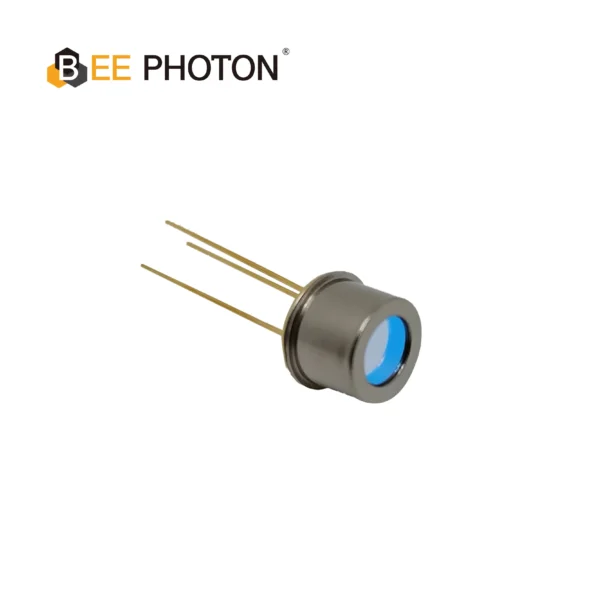
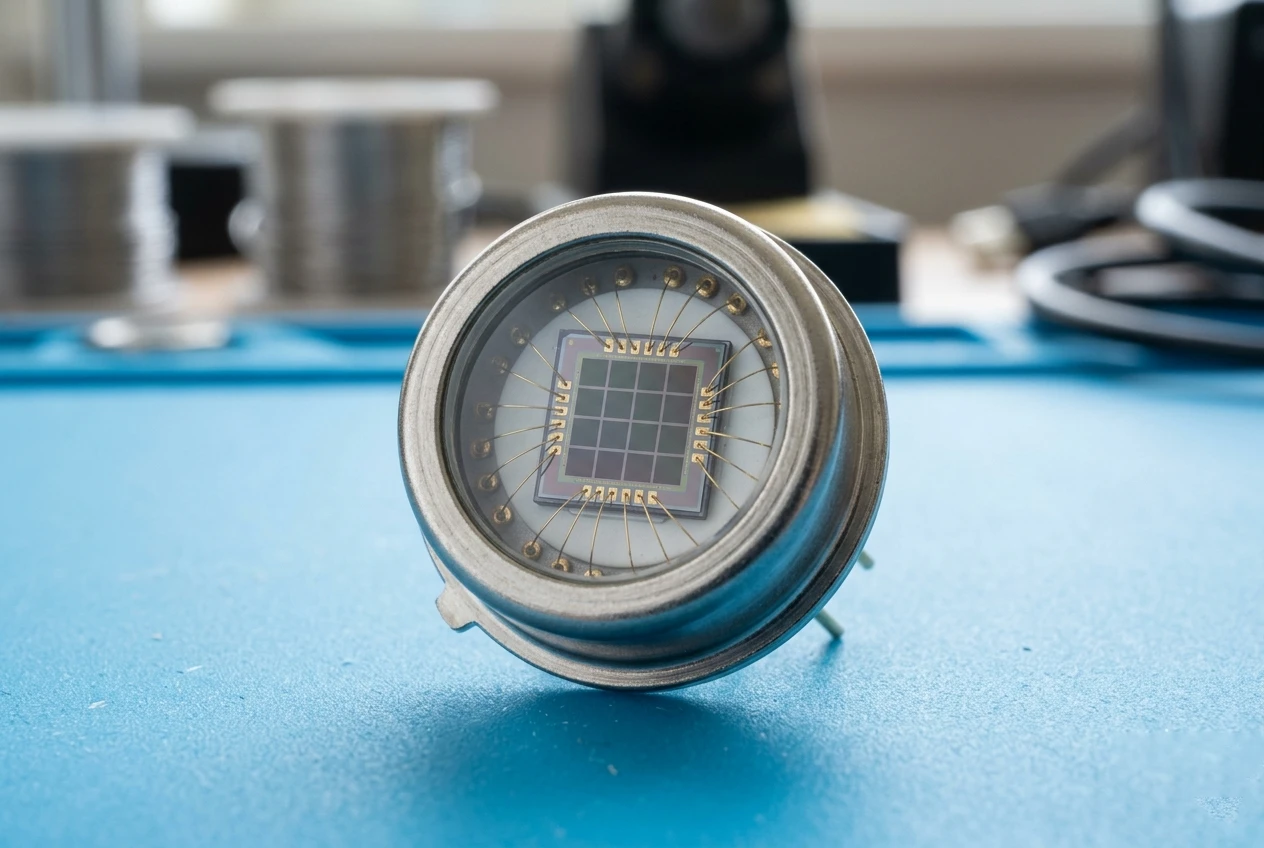
Si PIN Photodiode with low dark current (350-1060nm) PDCT07-001
Achieve high-precision results with our wide spectral range Si PIN photodiode, ideal for spectrometry and analytical instruments. Its ultra-low dark current and high linearity ensure accurate light detection. This photodiode offers a wide spectral response for diverse applications.
What You Actually Need to Audit for Medical-Grade Photodetectors
If you want to survive as a purchasing manager in the medtech industry, you have to stop acting like a paper-pusher and start acting like an auditor. When you or your team visits a factory to evaluate their medical-grade photodetectors, leave the conference room. Go to the cleanroom.
Process Control and Cleanroom Realities
You can tell a lot about a supplier’s medical-grade photodetectors just by looking at their cleanroom. I once visited a facility in Asia that claimed to produce ultra-low noise sensors. I walked up to their “Class 100” cleanroom and saw the operators wearing makeup under their masks. I saw a door propped open with a chair to let some breeze in because the AC was broken.
Makeup contains micro-particles of metals like titanium dioxide. If one of those particles lands on a silicon wafer before passivation, it creates a microscopic short circuit. This drastically increases the leakage current of the sensor. Your medical-grade photodetectors are ruined before they even get packaged.
When auditing, ask to see their environmental monitoring logs. ISO 9001 requires them to track this. If the logs look too perfect—like someone just wrote “PASS” every day for three years with the exact same pen—they are lying to you. Real data has fluctuations.
The Math Behind the Sensor
To truly understand what makes medical-grade photodetectors different, you need to look at the math that your engineers are sweating over. Don’t worry, I’ll keep it simple, but you need to know this stuff to call out bad suppliers.
First, let’s talk about Responsivity. This is the core metric of how well the sensor converts light into an electrical signal.
The formula is:
R = I_p / P_opt (A/W)
Where:
- I_p is the photocurrent generated (in Amps)
- P_opt is the optical power hitting the sensor (in Watts)
If a supplier has sloppy wafer doping processes, the thickness of the active area will vary. This means R will bounce all over the place. In a medical device like an X-ray detector, if R isn’t perfectly consistent across an array of medical-grade photodetectors, the resulting image will have dead spots or bright spots. A doctor might misread the scan.
Then you have the Noise Equivalent Power (NEP). This tells you the minimum amount of light the sensor can actually detect above its own internal noise.
NEP = I_noise / R (W / Hz^0.5)
In medical diagnostics, you are often dealing with tiny amounts of light passing through human tissue. The signal is incredibly weak. If the sensor has high internal noise (I_noise), the NEP goes up, and the sensor becomes totally blind to the medical data. This noise usually comes from high Dark Current, which is a direct result of cheap silicon or dirty manufacturing. If a supplier doesn’t understand NEP, they have no business selling you medical-grade photodetectors.
Lastly, for high-speed applications like time-of-flight scanners, you need to look at Junction Capacitance (Cj).
C_j = (ε * A) / W
Where ε is the permittivity, A is the active area, and W is the width of the depletion region. In proper Si PIN photodiodes, the “I” (Intrinsic layer) widens that W, which forces the capacitance down and makes the sensor insanely fast. If the factory’s process control is weak, W varies, capacitance spikes, and your high-speed scanner suddenly becomes sluggish and inaccurate.
Standard Sensors vs Medical-Grade Photodetectors
Sometimes suppliers try to argue that their commercial sensors are just as good. They aren’t. Here is a quick breakdown you can use the next time a sales guy tries to push standard parts on you.
| Feature / Parameter | Standard Commercial Photodetectors | True Medical-Grade Photodetectors | Why it matters for your supply chain |
|---|---|---|---|
| Dark Current (Id) | 10nA to 50nA | Typically < 1nA, sometimes pA range | High dark current drowns out low-level biological signals. |
| Testing Protocol | Batch sampling (AQL 1.0 or similar) | 100% automated parametric testing | You cannot afford a 1% failure rate in critical care devices. |
| Traceability | Date code only | Full lot, wafer, and die-level traceability | Required for FDA compliance and targeted recall isolation. |
| Encapsulation | Cheap standard epoxy | Medical-grade, low-stress, low-outgassing resins | Standard epoxy yellows over time or stresses the die under temperature changes, shifting the responsivity. |
| Process Lock | Subject to unannounced changes | Strict PCN (Product Change Notification) policy | A supplier changing a wire bond supplier without telling you can invalidate your FDA 510(k) clearance. |

Si PIN Photodiode with low dark current (350-1060nm) PDCT34-101
Discover exceptional performance with our high linearity Si PIN photodiode, designed for X-RAY and laser detection. This photodiode combines low dark current and high stability in a robust TO package. Rely on our Si PIN photodiode for critical detection tasks.
A Real Nightmare: The Temperature Leakage Story
Let me tell you a story about a company I worked with—let’s keep them anonymous, but they are a major medtech player in Germany. They were developing a high-end wearable continuous blood oxygen monitor for post-op patients.
They sourced what they thought were medical-grade photodetectors from a large, ISO 9001 certified commercial LED and sensor factory in Asia. The golden samples were great. The first production run seemed fine in the lab.
But then they started clinical field trials. The monitors worked perfectly inside the air-conditioned hospital. However, when patients went home and sat outside in the summer sun, or in a warm room, the oxygen saturation (SpO2) readings started dropping randomly. False alarms went off everywhere. Patients panicked. Doctors were furious.
The procurement manager was sweating bullets. They pulled the devices apart and found the problem. The dark current of a silicon diode roughly doubles every 8 to 10 degrees Celsius. The supplier had given them sensors with an acceptable dark current at 25°C, but they were using cheap, poorly passivated wafers. When the sensor heated up to 35°C against the patient’s skin on a hot day, the dark current multiplied so much that it completely swallowed the actual light signal from the LEDs.
The supplier’s ISO 9001 quality manual had no requirement for High-Temperature Reverse Bias (HTRB) testing. They just assumed room temperature tests were enough. That mistake cost the German company over $400,000 in scrapped inventory and delayed their product launch by nine months.
They eventually realized they couldn’t cut corners. They scrapped the bad supplier and came to us for proper medical-grade photodetectors. We ran 100% testing on the dark current at elevated temperatures to guarantee performance under real-world human conditions. Problem solved.
Integrating Si PIN Photodiodes into Your Supply Chain
So how do you avoid these disasters? You partner with a manufacturer who actually treats medical-grade photodetectors with the respect the industry demands.
At BeePhoton, we don’t play games with golden samples or fake cleanroom logs. We know that when you are buying Si PIN photodiodes for a blood analyzer or a radiation detector, you are betting your company’s reputation on our silicon.
Our ISO 9001 compliance isn’t just a binder sitting on a manager’s desk. It is built into the automated testing machines that check every single diode before it gets reeled and shipped. We track the wafers. We control the epoxy curing temperatures. We lock down the bill of materials so you never get a surprise variation that wrecks your FDA approvals.
When you audit us, we will show you the real statistical process control (SPC) data. We want you to see our Cpk values because they prove our manufacturing lines are tightly controlled. We treat supply chain compliance as an engineering discipline, not a marketing buzzword.

Si PIN Photodiode with low dark current (350-1060nm) PDCC14-001
Our Si PIN for precision photometry delivers exceptional accuracy for sensitive light measurement. With low dark current, this photodiode is ideal for analytical and scientific instruments requiring precise results.
FAQ: Buying Medical-Grade Photodetectors
I get asked alot of the same questions by frustrated purchasing managers. Here are the most common ones regarding ISO 9001 and medical-grade photodetectors.
Q: How do I verify an overseas supplier’s ISO 9001 certificate is actually meaningful?
Don’t just verify the certificate with the issuing body. Ask the supplier for their CAPA (Corrective and Preventive Action) logs for the last year. If they claim they have zero manufacturing issues and an empty CAPA log, run away. Every real factory has issues. A real ISO 9001 factory documents them and fixes them. Also, ask for raw Cpk data on critical parameters like dark current.
Q: Why are medical-grade photodetectors so much more expensive than commercial photodiodes?
It comes down to yield and testing. To guarantee the ultra-low noise required for medical devices, we have to use premium silicon wafers and strict cleanroom protocols. Plus, instead of testing 1 out of 1000 parts, we have to run 100% parametric testing. You are paying for the guarantee that the part won’t fail when a doctor is relying on it.
Q: Can a change in the supplier’s raw materials affect my medical device certification?
Absolutely. If your supplier quietly changes the epoxy resin used to encapsulate the die, the new resin might have different thermal expansion properties or a different refractive index. This shifts your optical responsivity and could invalidate your FDA 510(k) or CE mark. True medical-grade photodetectors come with a strict Product Change Notification (PCN) agreement. We don’t change anything without telling you first.
Q: What is the most critical spec to look at for SpO2 and pulse oximetry?
You want to look very closely at the signal-to-noise ratio at elevated temperatures. Since the sensor sits against the skin, you need a sensor that maintains low dark current even at 35°C to 40°C. If the baseline leakage is too high, the AC component of the blood flow signal gets lost in the noise.
Your Next Steps
You don’t want to be the procurement manager who saved 15 cents on a component only to trigger a multi-million dollar FDA recall. Sourcing medical-grade photodetectors requires working with a partner who understands the physics of the product and the brutal realities of medical supply chain compliance.
Stop rolling the dice with generic suppliers who treat your life-saving devices like cheap consumer electronics.
If you are ready to secure a reliable supply of high-performance components, or if you just want to argue with me about wafer doping specifications, shoot an email directly to info@photo-detector.com.
Or better yet, head over to our contact page and tell us exactly what kind of nightmare you are trying to solve. Send us your datasheets, your target pricing, and your compliance requirements. We will show you exactly how we build medical-grade photodetectors that actually perform in the real world. Let’s get your supply chain sorted out before your next production run.