If you are building agricultural IoT devices, you know the pressure isn’t just coming from the weather. It’s coming from the market. Farmers don’t want just “data” anymore; they want actionable insights that actually save them money on fertilizer and water. That’s where the hardware—specifically the optical sensors for agriculture—makes or breaks your product.
I’ve spent years deep in the trenches of photonics, watching the agri-tech industry shift from heavy machinery to delicate, precision electronics. And frankly, I see a lot of manufacturers getting it wrong. They grab off-the-shelf components that work great in a lab but fail miserably when covered in Iowa dust or baked in the Australian sun.
Today, we’re going to dig into the nitty-gritty of optical sensing for soil and crops. No fluff, just the engineering reality of building better systems using the right eyes.
Why Optical Sensors Are Eating the World (of Farming)
Old school farming was about intuition. Smart agriculture is about precision. The core of this transition relies heavily on optical sensors for agriculture. Unlike electrochemical sensors that corrode or capacitance sensors that get wonky with soil salinity, optical solutions offer a non-destructive way to look at and into the plant and soil.
Whether you are designing a handheld leaf spectrometer or a drone-mounted multispectral camera, the principle remains the same: light interaction.
When light hits a crop, three things happen:
- Absorption
- Transmission
- Reflection
As a device manufacturer, you are mostly interested in Reflection. The specific wavelengths that bounce back tell you everything about chlorophyll content, water stress, and even disease pressure before the human eye can see it.
The Shift to Spectral Analysis Agriculture
You’ll hear “spectral analysis agriculture” thrown around a lot in marketing decks. But from an engineering standpoint, this just means we are looking at specific bands of light.
- Visible Light (VIS): 400nm – 700nm. Good for basic plant color and size.
- Near-Infrared (NIR): 700nm – 1100nm. This is the money zone. Healthy plants reflect a ton of NIR light.
- Short-Wave Infrared (SWIR): 1100nm – 2500nm. Excellent for detecting water content (moisture stress).
If your IoT device isn’t capturing NIR effectively, you aren’t really doing smart ag. You’re just taking pictures.
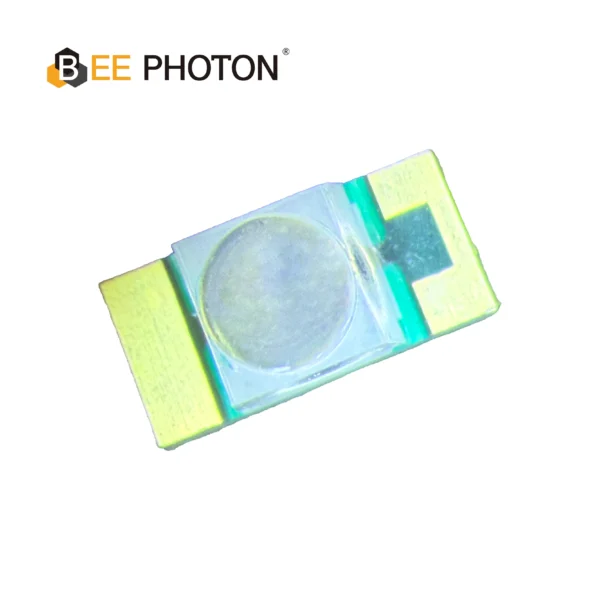
NIR LED E850-25-001-L20
The E850-25-001-L20 is a high-performance 855nm NIR LED designed for demanding industrial applications. Manufactured by Bee Photon, this infrared emitter features a narrow 20-degree emission angle, delivering high radiant intensity of 25mW/sr tailored for precision sensing. Its robust design ensures high reliability and consistent output over a wide operating temperature range.
Unpacking Crop Monitoring: The NDVI Standard
You probably already know about NDVI (Normalized Difference Vegetation Index). It’s the industry standard. But are you implementing the NDVI sensors correctly in your hardware stack?
The formula is simple enough:
NDVI = (NIR – Red) / (NIR + Red)
- NIR: Reflection in the near-infrared spectrum.
- Red: Reflection in the red range of the spectrum.
Here is the thing though. The math is easy; the hardware is hard. If your optical sensors for agriculture have a poor Signal-to-Noise Ratio (SNR), your NDVI calculation will drift. A drift of just 5% can lead a farmer to misapply nitrogen, costing thousands across a large acreage.
Common Engineering Pitfalls with NDVI Sensors
- Filter Leakage: Cheap optical filters let in light from outside the target bandwidth. If your “Red” sensor is picking up a bit of NIR, your math is busted.
- Temperature Instability: Silicon photodiodes change behavior when they get hot. A drone flying at noon acts different than one flying at 8 AM.
- Angle of Incidence: If the sun angle changes, the reflectance intensity changes. You need active calibration (usually a reference sensor facing the sky).
At BeePhoton, we often help clients tweak their photodiode arrays to maximize sensitivity specifically at the 660nm (Red) and 850nm (NIR) bands to ensure the math holds up in the field.
Soil Monitoring: Looking Beneath the Surface
While NDVI sensors look at the leaves, we are seeing a massive surge in demand for optical soil probes. This is trickier. Soil is a complex, dark, messy matrix.
Traditionally, measuring NPK (Nitrogen, Phosphorus, Potassium) required sending a dirt sample to a lab and waiting a week. Now, we use smart agriculture sensors utilizing optical reflectance to estimate these levels in real-time.
How It Works
We use specific wavelengths to detect chemical bonds.
- Nitrogen: Correlates with reflectance in the UV and visible spectrum.
- Organic Matter: Strong correlations in the NIR and SWIR bands.
Because soil doesn’t reflect light as enthusiastically as a green leaf, your detector needs high responsivity (A/W). You can’t just use a generic consumer-grade photodiode here. You need something that can pick up a whisper of a signal amidst the noise.
Here is a quick comparison of detector types for soil monitoring applications:
| Detector Type | Spectral Range | Cost | Sensitivity | Best Use Case |
|---|---|---|---|---|
| Silicon Photodiode | 190nm – 1100nm | Low | Moderate | General NPK, pH estimation, surface color |
| InGaAs Diode | 800nm – 1700nm | High | High | Moisture detection, Organic Carbon |
| SiPM (Silicon Photomultiplier) | 300nm – 900nm | Medium/High | Extreme | Low-light conditions, deep soil probes |
| PbS (Lead Sulfide) | 1000nm – 3000nm | Medium | Moderate | Wide range chemical analysis |
For most B2B manufacturers building mass-market soil probes, high-quality Silicon Photodiodes tailored for enhanced NIR sensitivity are usually the sweet spot between performance and Bill of Materials (BOM) cost.
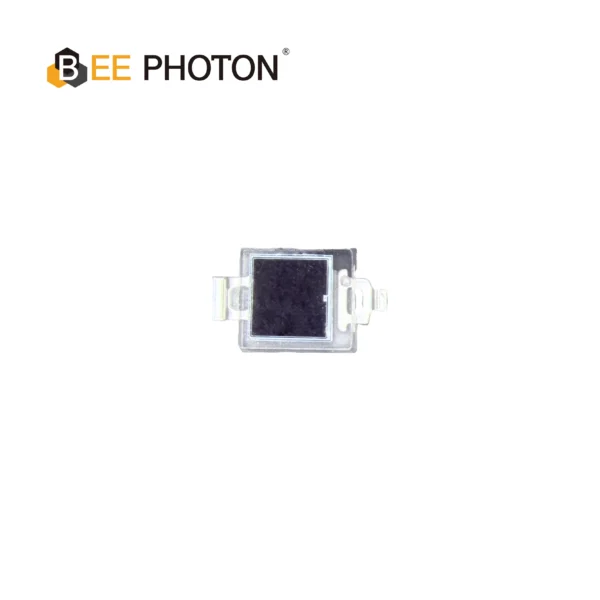
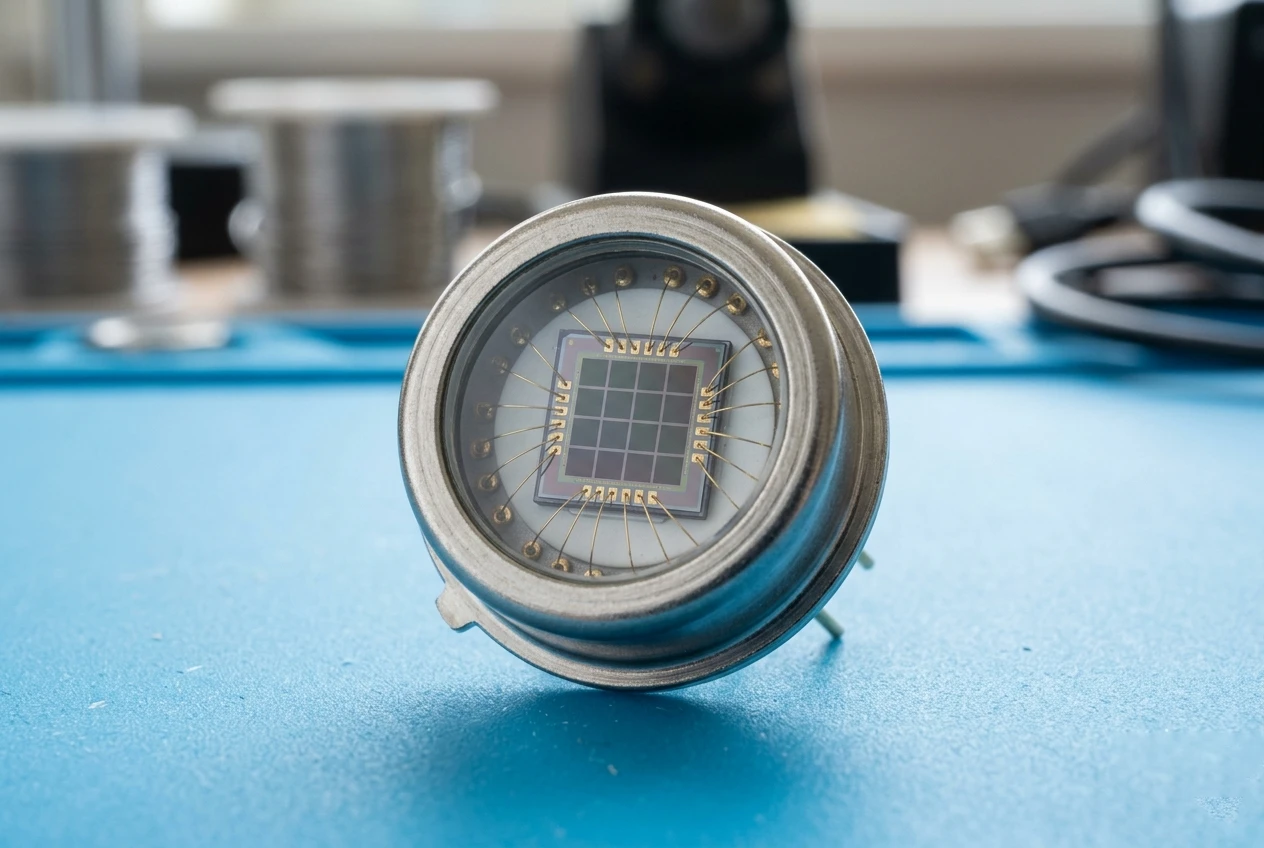
Si PIN photodiode PDCP08 Series PDCP08-502
The PDCP08-502 is a high-response 2.9×2.8mm Silicon PIN Photodiode designed for precision photoelectric applications. Featuring low junction capacitance, low dark current, and a wide spectral range (340-1100nm), it is the ideal component for optical switches and compact sensing modules requiring stable and fast signal output.
Developing Your Product: What to Ask Your Supplier
When you are sourcing optical sensors for agriculture, don’t just look at the price tag. You need to ask the tough questions. I’ve seen projects delayed by months because the engineering team realized too late that the sensor package wasn’t hermetically sealed or the dark current was too high.
Key Specifications for Ag-Tech
- Dark Current: In low light (like underground or heavy canopy), how much noise does the sensor generate? Lower is better.
- Linearity: As light intensity doubles, does the signal output exactly double? Agriculture happens in full sun and under clouds; your sensor needs to be linear across a massive dynamic range.
- Active Area: Larger active areas collect more light but are slower. For a drone flying at 40mph, speed matters. For a static soil probe, a larger area might give a more stable reading.
We discuss this a lot on our Products page. You can’t just slap a generic sensor in a ruggedized case and call it “Ag-Tech.”
Case Study: Project “SunBlock” (Anonymized)
I want to share a story about a client (let’s call them AgriDrone Co.). They were building a spectral camera for a fixed-wing drone. Their goal was high-speed spectral analysis agriculture for huge corn farms in the Midwest.
The Problem:
They were using a competitor’s standard photodiode array. In the lab, it worked perfectly. But in the field, the vibration of the drone combined with the intense midday sun caused signal saturation. Basically, the sensor was “blinded” by the sun, flattening the data. Their NDVI maps looked like gray slush.
The BeePhoton Solution:
We analyzed their optical path. It wasn’t just a sensor issue; it was a gain management issue.
- We swapped their sensor for a BeePhoton modified silicon detector with a higher saturation threshold.
- We recommended a specific optical coating to reject off-angle UV light that was creating noise.
The Result:
AgriDrone Co. reduced their noise floor by 40%. Their maps became crisp, allowing farmers to see individual rows of stress. They secured a major contract with a regional co-op three months later.
This brings up a valid point: Optical sensors for agriculture are part of a system. The sensor, the lens, the filter, and the algorithm all have to dance together.
The Future: Hyperspectral and Beyond
If NDVI sensors are the present, Hyperspectral is the future. Instead of looking at 2 or 3 bands (Red, NIR), hyperspectral looks at hundreds of narrow bands.
Imagine not just knowing a plant is “stressed,” but knowing it specifically has a magnesium deficiency because of a dip in reflectance at exactly 550nm and 2200nm.
Currently, the cost of hyperspectral optical sensors for agriculture is high, but we are seeing prices drop as manufacturing yields improve. For manufacturers looking to position themselves as premium brands, this is the R&D direction to take.
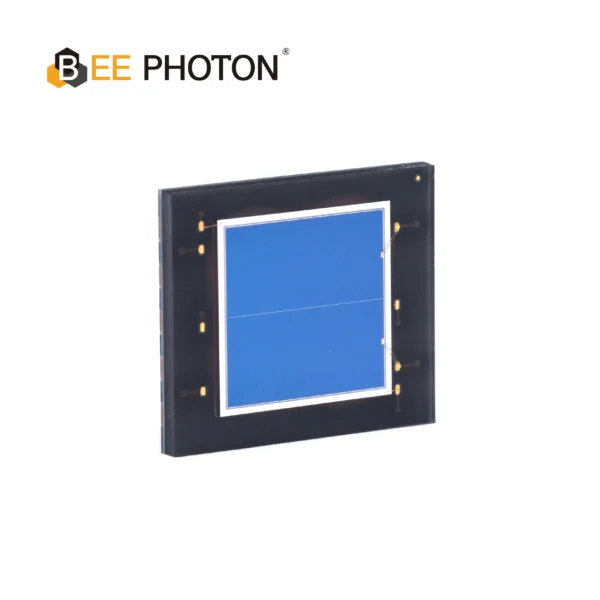
Si PIN Photodiode Array Dual PD PDCA02-103
The PDCA02-103 is a high-performance Photodiode Array for Data Transmission, featuring a robust dual-element design. With a large photosensitive area of 10×5 mm per element and a compact 16.5×14.5 mm package, this Silicon PIN photodiode ensures exceptional signal stability and alignment tolerance for advanced optical communication systems.
Integration Challenges (The Real Talk)
Look, integrating these things isn’t a walk in the park.
- Calibration: You need to calibrate these sensors. A lot. Drifting allows for bad data. We suggest including an internal white reference target in your device if possible.
- Environmental Protection: Fertilizer is corrosive. Ammonia gas in barns kills electronics. Your optical window needs to be robust (sapphire or hardened glass) and the seal needs to be IP67 or higher.
- Data Overload: High-resolution optical sensors generate a lot of data. Ensure your onboard processor can handle the throughput, or you’ll bottleneck the system.
A Controversial Opinion?
I’m going to say something that might annoy some sensor salespeople: More resolution isn’t always better.
I see companies chasing megapixels in their spectral cameras. But in smart agriculture sensors, sensitivity beats resolution almost every time. A blurry image with highly accurate spectral data is worth more to a farmer than a sharp 4K image with bad radiometric accuracy. Don’t let marketing hype drive your engineering decisions. Focus on the physics.
Conclusion
The market for optical sensors for agriculture is exploding. Whether you are building soil probes, smart irrigation systems, or crop-scouting robots, the quality of your optical components is your competitive advantage.
You can’t fake good data. If your sensor drifts, the farmer loses yield, and you lose a customer. It is that simple.
At BeePhoton, we don’t just sell diodes; we help you solve the physics problems that come with putting electronics in a cornfield. We understand the specific needs of smart agriculture sensors, from the UV to the SWIR.
Ready to upgrade your optical stack?
Don’t let subpar sensors limit your device’s potential.
- Check out our specialized solutions for agriculture here: BeePhoton Products.
- Have a specific engineering challenge? Let’s talk about it. Reach out to us at info@photo-detector.com or visit our Contact Page.
Let’s build something that actually helps things grow.

Si PIN Photodiode with NIR sensitivity enchanced (350-1100nm) PDCC100-501
Achieve uniform results with our High Consistency Si PIN Diode for medical devices. This COB photodiode provides dependable NIR sensitivity for health monitoring. Trust our High Consistency Si PIN Diode.
FAQ: Optical Sensors in Agriculture
Q1: What is the difference between multispectral and hyperspectral sensors in agriculture?
A: Think of it like a piano. A multispectral sensor plays just a few chords (usually 3 to 10 specific bands like Red, Green, NIR). It’s cheaper and great for general indices like NDVI. A hyperspectral sensor plays every single key on the piano (hundreds of continuous bands). It gives you a complete “fingerprint” of the crop, allowing for much more detailed analysis, like specific disease identification, but it’s much more expensive and generates way more data.
Q2: Can optical sensors for agriculture effectively measure soil moisture?
A: Yes, but not with standard visible light cameras. You generally need sensors that operate in the SWIR (Short-Wave Infrared) range, typically around 1450nm and 1900nm, where water absorption peaks. By measuring how much light is absorbed at these specific wavelengths, smart agriculture sensors can determine the moisture content of the soil very accurately without touching it.
Q3: How long do optical sensors last in harsh agricultural environments?
A: The sensor chip itself (the silicon or InGaAs die) can last for decades. The failure point is usually the packaging. If moisture gets inside the sensor housing, it ruins the connections. If you choose high-quality, hermetically sealed optical sensors for agriculture and design your enclosure with proper IP ratings (IP67+), your device should easily last 5-10 years in the field.
Q4: Why is my NDVI calculation drifting during the day?
A: This is a classic issue. It usually happens because the ambient light (the sun) changes color temperature and intensity throughout the day. If your system relies only on the reflection from the plant without correcting for the incoming light, your numbers will skew. High-end NDVI sensors often include a down-welling light sensor (facing the sky) to constantly calibrate the reading against the changing sunlight.