Optical switches are pretty cool little setups that let you detect stuff without any physical contact. I’ve messed around with these a ton over the years, especially when building sensors for automation gear. They’re basically a way to turn light into an on/off signal, and using Silicon Phototransistor from places like Bee Photon makes it straightforward and reliable.
If you’re diving into optical switch design, you’re probably wondering how to make one that actually works well in real scenarios. We’re talking slotted types or reflective ones – the kind used in everything from counters to position detectors. And yeah, Si PIN phototransistors (that’s silicon phototransistors with a PIN structure for better sensitivity) are solid choices here because they amp up the light signal nicely.
I’ve put together this guide based on hands-on stuff I’ve done, plus what I’ve seen work best in practical apps. We’ll cover the basics, how to build a simple photo interrupter circuit, some key design tips, and even real-world examples where these shine. Let’s jump in.
What Makes an Optical Switch Tick?
At its core, an optical switch pairs an infrared LED with a phototransistor. The LED shoots out light, and the phototransistor picks it up. When something blocks the beam – like a flag or an object sliding through a slot – the phototransistor stops conducting, and boom, you’ve got your switch flip.
Why go optical over mechanical? No moving parts means way less wear. Mechanical switches can fail after millions of cycles due to contact bounce or dust, but optical ones often last 100 million+ actuations without breaking a sweat. Plus, they’re immune to electrical noise in some setups, and response times can hit microseconds.
Si PIN phototransistors are great for this because the PIN structure gives ’em a bigger active area and faster response compared to basic ones. Typical rise/fall times are around 5-15 microseconds under normal loads – fast enough for most counting or sensing jobs.

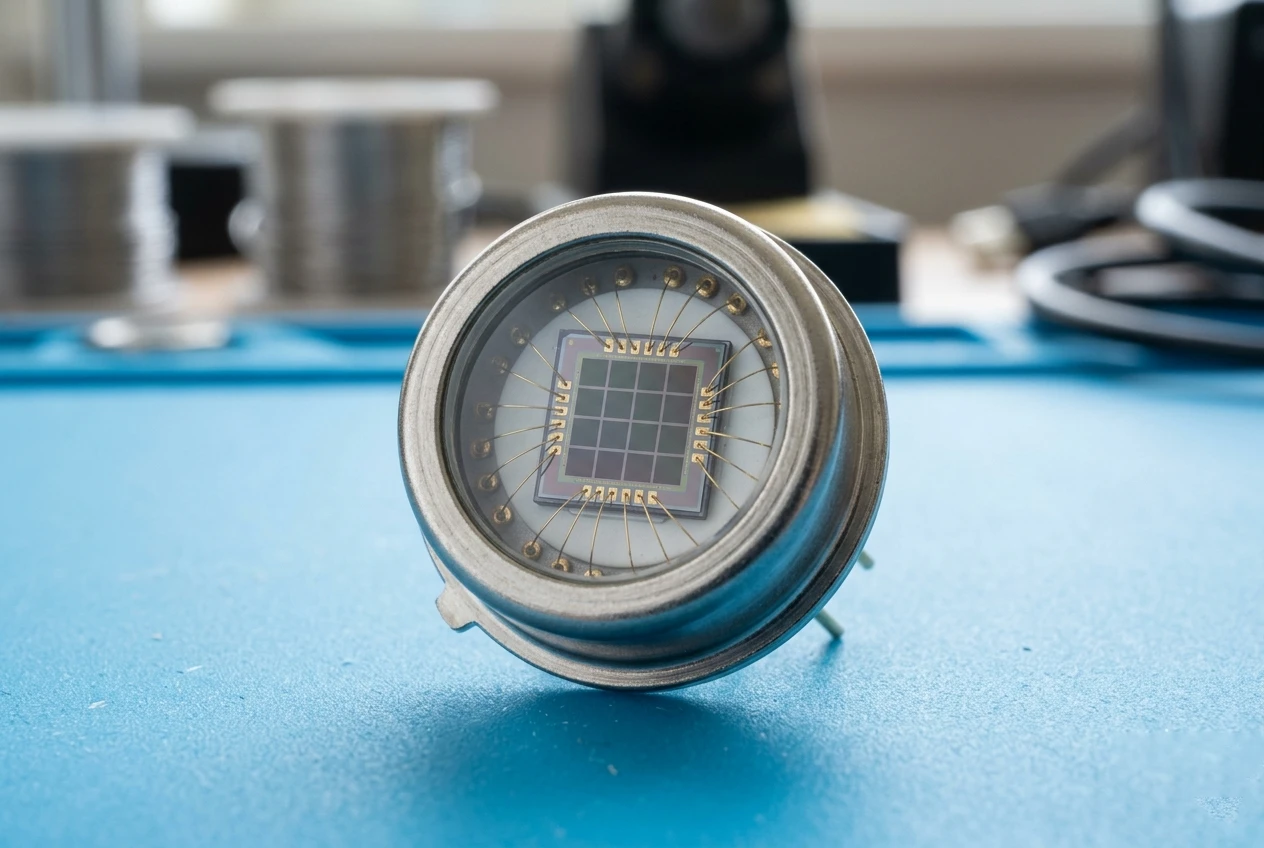
Si phototransistor PTCP Series PTCP001-102
High-sensitivity Silicon Phototransistor designed for precision detection in the 800-1100nm spectral range. This black plastic IR sensor ensures minimal noise and high reliability. Ideal for industrial applications requiring a robust silicon phototransistor with excellent response speed.
Basic Components You’ll Need
To build a simple optical switch design, grab these:
- Infrared LED (850-950nm wavelength works best with silicon detectors)
- Si phototransistor (like the ones in Bee Photon’s Silicon Phototransistor lineup)
- Resistors for current limiting
- Power supply (5V is common)
- Maybe a comparator or Schmitt trigger for clean digital output
Here’s a quick table of common values I’ve used:
| Component | Typical Value/Part | Why It Matters |
|---|---|---|
| IR LED | 5mm, 940nm, 20-50mA forward current | Matches peak sensitivity of Si phototransistors |
| Phototransistor | Si PIN type, e.g., PTCP series | High gain (100-1000), good response time |
| LED Resistor | 220-470Ω (for 5V supply) | Limits current to safe levels |
| Collector Resistor | 10k-100kΩ | Sets output swing and speed |
| Supply Voltage | 5-12V | Keeps things simple and safe |
These are ballpark – always check datasheets.
Step-by-Step: Building a Slotted Photo Interrupter Circuit
The slotted type (aka photo interrupter circuit) is the classic for optical switching applications. It’s dead simple and super reliable.
- Wire the IR LED: Anode to +V via a resistor, cathode to ground. Aim for 20-30mA – too much and it’ll burn out, too little and weak signal.
- Phototransistor side: Collector to +V via pull-up resistor (start with 47kΩ), emitter to ground. Output taken from collector.
- Alignment: In a slotted setup, LED and phototransistor face each other with a small gap (3-5mm usually). When clear, light hits the transistor, it conducts, output goes low. Block it, output goes high.
I’ve built dozens like this for object detection. One time, in a conveyor setup (keeping it anonymous), we used Si phototransistors to count parts flying by at decent speeds. Response was snappy enough – no misses even at a few hundred per minute.
To make it digital-friendly, add a Schmitt trigger (like in a 74HC14) for sharp edges. Helps with noise.
Reflective vs Transmissive
- Transmissive (slotted): Beam interrupted directly. Great for precise positioning.
- Reflective: Light bounces off object back to detector. Handy for proximity without a slot.
Both work with Si PIN phototransistors, but transmissive often gives cleaner signals.

Key Design Tips for Better Performance
From experience, here’s what trips people up:
- Ambient light rejection: Use IR only and shield if outdoors. Many Si phototransistors have daylight filters.
- Speed tweaks: Lower collector resistor for faster rise/fall, but watch for reduced sensitivity. Typical times: 10µs rise, 15µs fall.
- Gain and saturation: Phototransistors amplify – gains of 500+ are common. Avoid saturating with too much light; it slows turn-off.
- Power efficiency: LEDs pulse if you don’t need constant on – saves juice in battery stuff.
In one project detecting rotating disks for speed measurement, we pulsed the LED at 50% duty and got clean pulses up to 10kHz.

Si phototransistor PTCP Series PTCP001-202
Enhance your switching solutions with this 800-1100nm NPN Phototransistor. Perfect for photoelectric switches, it offers high power dissipation up to 90mW. This silicon phototransistor delivers consistent performance in harsh environments from -40°C to +85°C.
Real-World Optical Switching Applications
These aren’t just lab toys. In industry:
- Object counting: Conveyor lines – detect boxes or bottles passing.
- Position sensing: Printers use ’em for paper edge detection.
- Encoders: Slotted disks for motor speed/position – way more reliable than mechanical.
- Safety interlocks: Doors or gates – beam break triggers stop.
We had a client in automation (no names) switch to optical from mechanical for a high-dust environment. Downtime dropped big time – no more contact failures.
Compared to mechanical switches, optical have zero bounce, longer life, and no spark risk in explosive areas.
Advanced Tweaks and Troubleshooting
If basic isn’t cutting it:
- Add base resistor for faster turn-off (reduces stored charge).
- Use Darlington phototransistors for mega sensitivity, but slower.
- For noise, go differential or modulated light.
Common issues: Misalignment (biggest killer), wrong wavelength, or too much ambient light.
Why Choose Bee Photon Si Phototransistors?
We’ve used Bee Photon’s Silicon Phototransistor parts in several builds – consistent performance, good spectral match to common IR LEDs, and solid docs. If you’re prototyping an optical switch design, they’re a safe bet.
FAQ
What’s the main advantage of optical switches over mechanical ones?
No physical contact means longer life (often 100M+ cycles vs 50M for mech), no bounce, and better in dirty environments. Response can be faster too – microseconds vs milliseconds sometimes.
How fast are Si PIN phototransistors in optical switches?
Typical rise/fall times 5-20µs, depending on load. Good for most sensing, up to tens of kHz switching.
Can I use these for outdoor applications?
Yeah, but shield from sunlight or use modulated IR to filter ambient. Many have built-in filters.
What’s a simple way to test my photo interrupter circuit?
Hook output to an LED or multimeter. Block/unblock the beam and watch the voltage swing.
If you’ve got questions on your specific optical switching application or need parts like Si phototransistors, drop a line to info@photo-detector.com or check https://photo-detector.com/contact-us/. We can chat quotes or custom fits – happy to help get your project rolling.