Anyone who has spent more than a few years in hardware design or component purchasing knows the absolute dread of the supplier update email. You’ve got a sensor board that’s been in stable production for years. Everything is humming along, the factory is happy, and then suddenly, your distributor drops the bomb. Your go-to photodiode is on a 52-week lead time, or worse, you get an end-of-life (EOL) notice.
Now you are scrambling. The production manager is breathing down your neck, and you need to find a drop-in PD70-61B alternative before the entire assembly line grinds to a halt. Finding a reliable PD70-61B equivalent that actually fits the footprint and matches the electrical specs without requiring a costly PCB redesign is enough to make anyone want to rip their hair out.
But here is the good news: you don’t need to panic, and you don’t need to stall your manufacturing. Today, we are going to look at why the BeePhoton PDCP08-511 is the ultimate PD70-61B alternative. We will break down the raw physics, the electrical characteristics, and why switching to this Everlight replacement might actually be the smartest engineering decision you make all year.
The Sourcing Nightmare and Why You Need a PD70-61B Alternative
Let’s be completely honest about the optoelectronics supply chain right now. It is a mess. When a massive brand name part suddenly becomes scarce, buyers instinctively flood the open market trying to scoop up remaining reels, driving prices through the roof.
I’ll share a somewhat controversial hot take that usually makes conservative engineers mad: a lot of hardware teams are just lazy when it comes to their Bill of Materials (BOM). They copy and paste a reference design, specify a massive brand name, and force their purchasing team to overpay forever. But silicon is silicon. The underlying physics of a P-I-N junction don’t magically change just because a different corporate logo is printed on the shipping box.
When you start searching for a PD70-61B alternative, you shouldn’t just be looking for a brand name. You should be looking for a solid intrinsic layer process, a reliable epoxy mold, and consistent dark current specs. That’s exactly what makes finding a good PD70-61B substitute so critical. You want a component that does the exact same job—detecting infrared light efficiently—without the massive brand-name markup and the ridiculous lead times.
This is where BeePhoton steps in. As a dedicated manufacturer of high-quality photodiodes, the BeePhoton team engineered the PDCP08-511 to serve as a rock-solid Everlight replacement. If you need a PD70-61B alternative that won’t let you down in the field, this is the component you need to be looking at.
Meet the BeePhoton PDCP08-511: Your New Go-To Everlight Replacement
So what makes the PDCP08-511 the perfect PD70-61B equivalent? Let’s talk about the physical package and the primary optical properties first.
The PDCP08-511 is a Si PIN photodiode packaged in a black epoxy resin (BK). That black window isn’t just for aesthetics. If you are building an optical switch, an IR remote receiver, or a photoelectric light curtain, you are going to be blasting a 940nm infrared LED across a gap. The problem is that the sun, office lights, and factory halogen bulbs also blast out a ton of visible light.
If you use a clear epoxy photodiode, all that visible ambient light floods the semiconductor, raising your noise floor and causing false triggers. The black epoxy resin on this PD70-61B alternative acts as a physical daylight filter. It blocks out the visible spectrum and only lets the good stuff through.
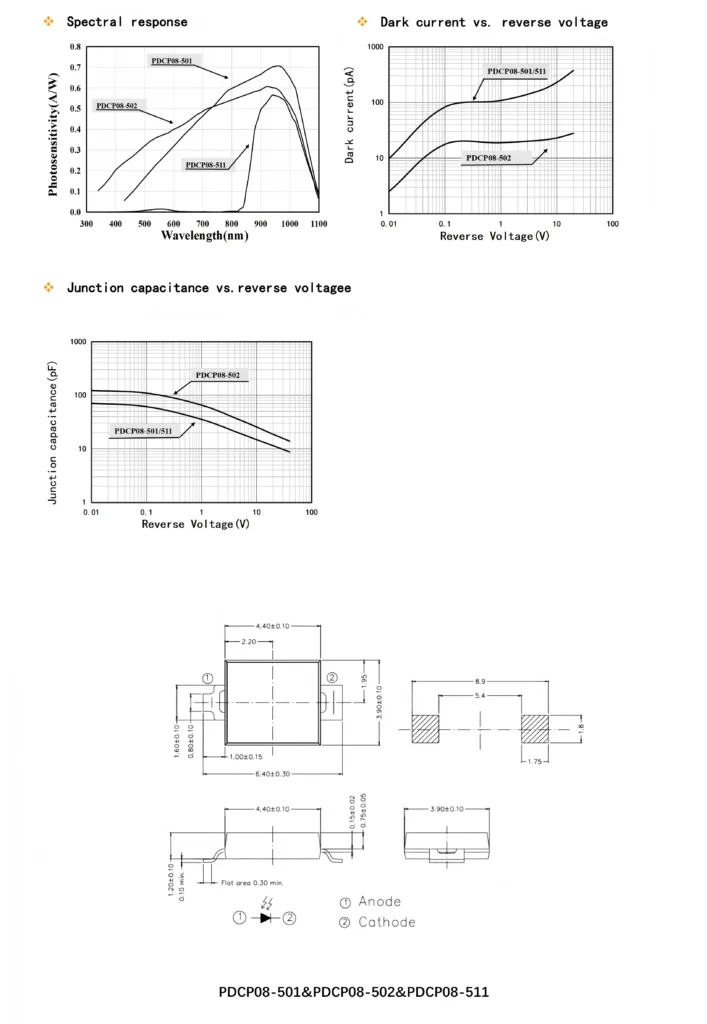
Specifically, this PD70-61B alternative has a spectral response range of 850 nm to 1100 nm, with a peak sensitivity exactly at 940 nm. This means it is custom-tailored to look at standard 940nm IR emitters while ignoring the noise. When you use this PD70-61B substitute, your transimpedance amplifier (TIA) doesn’t have to work nearly as hard to filter out the garbage.

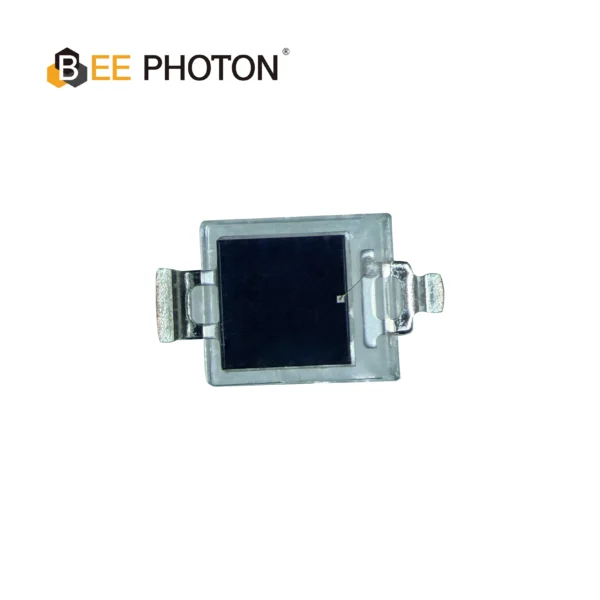
Si PIN photodiode PDCP08 Series PDCP08-511
The PDCP08-511 is a high-performance Black Epoxy PIN Photodiode designed for precision infrared applications. Encased in a special black epoxy resin, this sensor effectively acts as a daylight filter, blocking visible light interference while maximizing sensitivity at 940nm. With a large 2.9×2.9mm active area and low dark current, it ensures reliable signal detection for optical switches and remote control systems, even in noisy ambient light environments.
Breaking Down the Specs: Why This PD70-61B Equivalent Rocks
Engineers don’t buy components based on marketing fluff; they buy based on data. So let’s crack open the datasheet and look at exactly why the PDCP08-511 is the premier PD70-61B alternative.
The Dark Current Advantage
In a perfect textbook scenario, when there is zero light hitting your photodiode, it passes zero current. Sadly, we work in reality. Thermal energy inside the silicon causes a tiny amount of electron-hole pairs to generate randomly, creating what we call leakage or dark current.
The BeePhoton PDCP08-511 boasts a typical dark current (Id) of just 20 pA at VR=10mV, with a guaranteed maximum of 1000 pA. If you are designing a high-gain optical switch, this incredibly low dark current is crucial. It keeps your base noise floor in the basement. When evaluating any PD70-61B alternative, if the dark current is too high, your system will start throwing false positives the second the ambient temperature rises.
Speaking of temperature, the temp coefficient of ID for this PD70-61B alternative is 1.13 times/C. This means as the enviornment gets hotter, the dark current will scale up predictably. A coefficient of 1.13 is totally manageable and easy to account for in your analog front-end design.
Junction Capacitance and Blistering Speed
The whole point of the ‘I’ in a PIN diode is the intrinsic layer, which artificially widens the depletion region. If you remember your basic electronics, think of a capacitor: if you pull the parallel plates further apart, the capacitance drops. Lower capacitance means your diode can react to incoming light changes much faster.
This PD70-61B alternative features a typical junction capacitance (Cj) of just 70 pF (measured at VR=0V, f=100kHz). Because it isn’t bogged down by a bloated capacitance, you get a highly responsive rise time (tr) of just 0.15 microseconds (at VR=0V, RL=1kΩ). If your current system feels sluggish, or if you need to detect very fast beam-breaks in an industrial optical switch, this Everlight replacement is going to perform beautifully.
Noise Equivalent Power (NEP)
For the hardcore optics nerds out there, NEP is basically the lowest optical power you can actually detect above the intrinsic noise floor of the component. The PDCP08-511 delivers a typical NEP of 2.1 x 10^-14 W/Hz1/2. In plain English, this means this PD70-61B alternative can “see” incredibly faint infrared signals even when there is electrical noise bouncing around your PCB. This makes it an ideal PD70-61B substitute for long-range sensors.
Head-to-Head: What Makes a Good PD70-61B Substitute?
To make your life easier when pitching this to your engineering manager, here is a quick table outlining the critical parameters of the BeePhoton PDCP08-511 as a PD70-61B alternative.
| Parameter | Why It Matters for Your Optical Switch | BeePhoton PDCP08-511 Specs |
|---|---|---|
| Peak Wavelength (λp) | Matches standard IR LEDs perfectly | 940 nm |
| Spectral Range | Rejects unwanted visible daylight/room light | 850 – 1100 nm (Black Epoxy) |
| Dark Current (Id) | Determines your baseline electrical noise floor | Typ: 20 pA, Max: 1000 pA |
| Junction Capacitance (Cj) | Directly impacts your maximum switching speed | Typ: 70 pF, Max: 120 pF |
| Rise Time (tr) | Dictates how fast the switch reacts to a break | 0.15 μs (VR=0V, RL=1kΩ) |
| ESD HBM Rating | Prevents factory floor static damage | 1000 V |
| Operating Temp (Topr) | Ensures survival in harsh industrial enviornments | -40 to +100 °C |
| Directivity Angle (φ) | Allows for slight mechanical misalignment | ±65° |
As you can see, choosing a PD70-61B alternative doesn’t mean you have to compromise on performance. In many cases, you are getting a tighter, more strictly binned componant.
Anonymous Case Study: Fixing an Elevator Light Curtain
I want to share a quick story about how one company successfully integrated this PD70-61B equivalent. We will keep them anonymous, but they are a mid-sized industrial automation firm that manufactures the optical barrier switches used in cargo elevator doors. You know, the invisible light curtains that stop the door from crushing you.
Their legacy design was totally locked into the original Everlight part. Everything was great until the supply chain crashed. They were quoted a 40-week lead time out of nowhere. The purchasing manager was literally panicking, calling brokers, and facing massive line-down fees. He needed a reliable PD70-61B alternative fast.
They reached out and grabbed some samples of the BeePhoton PDCP08-511. The senior hardware engineers were highly skeptical at first—they always are. They insisted on running this new Everlight replacement through their absolute worst-case thermal chamber tests. Elevators in unheated northern warehouses get brutally cold in the winter and baking hot in the summer, so the component had to survive cycling from -40 to +100 °C without the black epoxy cracking or delaminating.
Not only did this PD70-61B alternative survive the thermal cycling flawlessly, but the wide directivity angle of ±65° actually made the elevator installation easier. Elevator tracks aren’t always perfectly plumb, so having a 130-degree total field of view meant the receivers could tolerate a bit of mechanical slop. They successfully qualified the PD70-61B substitute, updated the BOM, saved alot of money per board, and kept their factory running at full capacity.
How to Qualify Your New PD70-61B Alternative
If you are an engineer tasked with testing this PD70-61B alternative, you can’t just slap it on a board and ship it. You need to qualify it properly. Here is a quick, no-nonsense guide on how to validate this Everlight replacement.
Step 1: The Footprint and Mechanical Fit
The PDCP08-511 has a photosensitive area size of 2.9 x 2.9 mm and comes in a standard 2-pin package. Before you do anything else, grab your calipers, check your PCB footprint, and ensure the lead spacing matches your existing layout. You want this PD70-61B alternative to be a true drop-in without spinning a new board revision.
Step 2: Dark Current at High Temps
Don’t just test your new PD70-61B equivalent at comfortable room temperature (25°C). Throw the board in an oven at 85°C or 100°C and measure the dark current. Because of the 1.13 times/C temp coefficient, you need to make sure your TIA doesn’t saturate when the silicon gets hot.
Step 3: Thermal Shock and Soldering
The absolute maximum soldering temperature (Tsol) for this PD70-61B alternative is 260 °C for a maximum of 3 seconds. If your contract manufacturer is sloppy with their wave soldering or hand-soldering iron, they can easily melt the epoxy resin or damage the silicon die. Make sure they dial in their thermal profiles to match the datasheet.
Step 4: Real-World Stray Light Testing
Take your prototype out of the lab. The lab is a controlled environment. Take the board outside into direct sunlight and see if the black epoxy daylight filter on this PD70-61B alternative holds up. The 850-1100nm bandpass should reject most of the visible interference, but you definately want to prove it in the field.
Si PIN photodiode PDCP08 Series PDCP08-501
High-Performance Detection: The PDCP08-501 is a high-speed Silicon PIN Photodiode with a transparent window.
Key Specs: Featuring a 2.9×2.9mm active area, this PIN photodiode offers low dark current and high responsivity, making it an ideal sensor for general optical switches and light detection systems.
Frequently Asked Questions (FAQs) About This PD70-61B Equivalent
We get asked alot of the same questions by purchasing teams and engineers looking for a PD70-61B alternative. Here are a few quick answers to save you some time.
1. Is the BeePhoton PDCP08-511 a direct drop-in PD70-61B alternative?
Yes, for the vast majority of optical switch and IR receiver applications, the PDCP08-511 functions as a perfect PD70-61B equivalent. The 940nm peak wavelength, the black epoxy daylight filter, and the standard 2-pin configuration make it an incredibly straightforward Everlight replacement. Just verify your specific mechanical lead spacing.
2. Why should I trust a PD70-61B substitute instead of waiting for the original brand?
Waiting 40 to 52 weeks for a component is simply bad business. When you choose a high-quality PD70-61B alternative from a dedicated optoelectronics manufacturer like BeePhoton, you get identical (and sometimes superior) silicon performance without the bloated lead times. You ensure your production line never stops.
3. Will the black epoxy on this PD70-61B alternative filter out LED room lighting?
Absolutely. The entire purpose of the (BK) black resin is to block visible light (typically under 800nm). This means standard white LEDs, fluorescent tubes, and most sunlight won’t saturate the photodiode, allowing this PD70-61B alternative to clearly see your 940nm infrared emitter.
4. Can I get engineering samples of this PD70-61B equivalent for prototyping?
Yes! We know engineers need to test parts on the bench before they sign off on a BOM change. You can request samples of this PD70-61B alternative directly through our contact page to run your own qualification tests.
Stop Waiting and Start Building
Still sitting there staring at a spreadsheet, trying to figure out how to avoid a massive production delay? We know that changing a legacy component and finding the right PD70-61B alternative feels risky at first. Nobody wants to be the guy who broke the product.
But you’ve just read the specs, you understand the semiconductor physics, and you know that overpaying and waiting a year for a logo is just bad engineering. You need a reliable PD70-61B substitute that drops into your optical switch, handles the thermal stress, filters out the ambient noise, and just flat-out works. The BeePhoton PDCP08-511 is that component.
Imagine sending an email to your production manager today saying you not only found a perfect PD70-61B alternative, but you secured a faster, more reliable supply chain in the process.
Stop letting lead times dictate your manufacturing schedule. Take the next step and qualify this Everlight replacement today. Head over to our contact us page to request your test samples and secure your pricing, or just shoot us an email directly at info@photo-detector.com. Let’s get your production line back up to full speed.