There is nothing—and I mean nothing—worse than being immersed in a virtual world, turning your head quickly to spot an enemy, and watching the world “swim” to catch up with your movement. That lag? That’s what kills the experience. It’s what makes people rip the headset off and reach for a bucket.
If you are a hardware developer working on the next big thing in the metaverse, you know exactly what I’m talking about. We spend hours obsessing over refresh rates and GPU rendering times, but we often overlook the unsung hero of the hardware stack: the optical receiver. Specifically, the Photo IC sensor.
I’ve spent years digging into the guts of tracking hardware, and I’m gonna tell you why the shift from discrete photodiodes to integrated Photo IC sensor technology is not just a “nice to have”—it’s the only way we’re going to hit sub-millimeter precision with zero perceptible latency.
Why Current VR Tracking Components Are Failing Us
Look, the old way of doing things was fine for controllers that didn’t need to be precise. You grab a standard photodiode, slap a Transimpedance Amplifier (TIA) on the board next to it, maybe add a few capacitors to filter the noise, and call it a day.
But here is the problem with that “discrete” approach in modern VR tracking components.
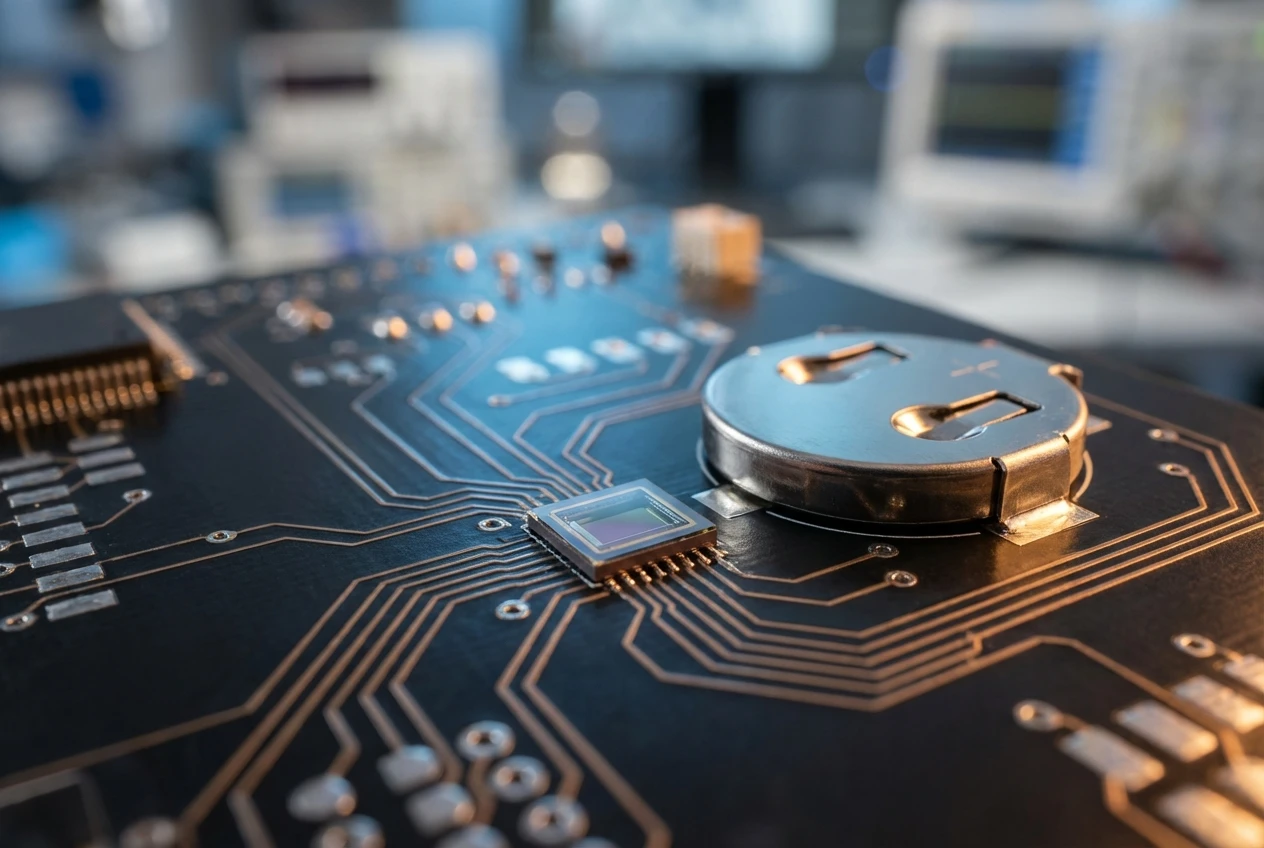
When you separate the sensor (the photodiode) from the amplifier, you create a physical distance. In the world of high-speed electronics, distance is the enemy. That trace on your PCB? It’s basically an antenna. It loves to pick up Electromagnetic Interference (EMI) from the WiFi module, the display driver, or even the user’s own body capacitance.
I remember tearing down a prototype from a startup in Shenzhen last year. They couldn’t figure out why their AR gesture control was jittery. It turned out the trace between the diode and the amp was crossing over a power rail. The noise floor was so high that the system was filtering out actual movement data just to keep the signal stable.
This is where the Photo IC sensor changes the game. By baking the photodiode, the amplifier, and the signal processing logic onto a single silicon die, you eliminate that trace. No trace, no antenna. No antenna, significantly less noise.

Photo IC PDTC series
Our Two-level Gain Switch Photo IC provides precise optical detection for industrial automation. This advanced photo IC features an adjustable gain switch, ensuring reliable performance
What the Heck is a Photo IC Sensor Anyway?
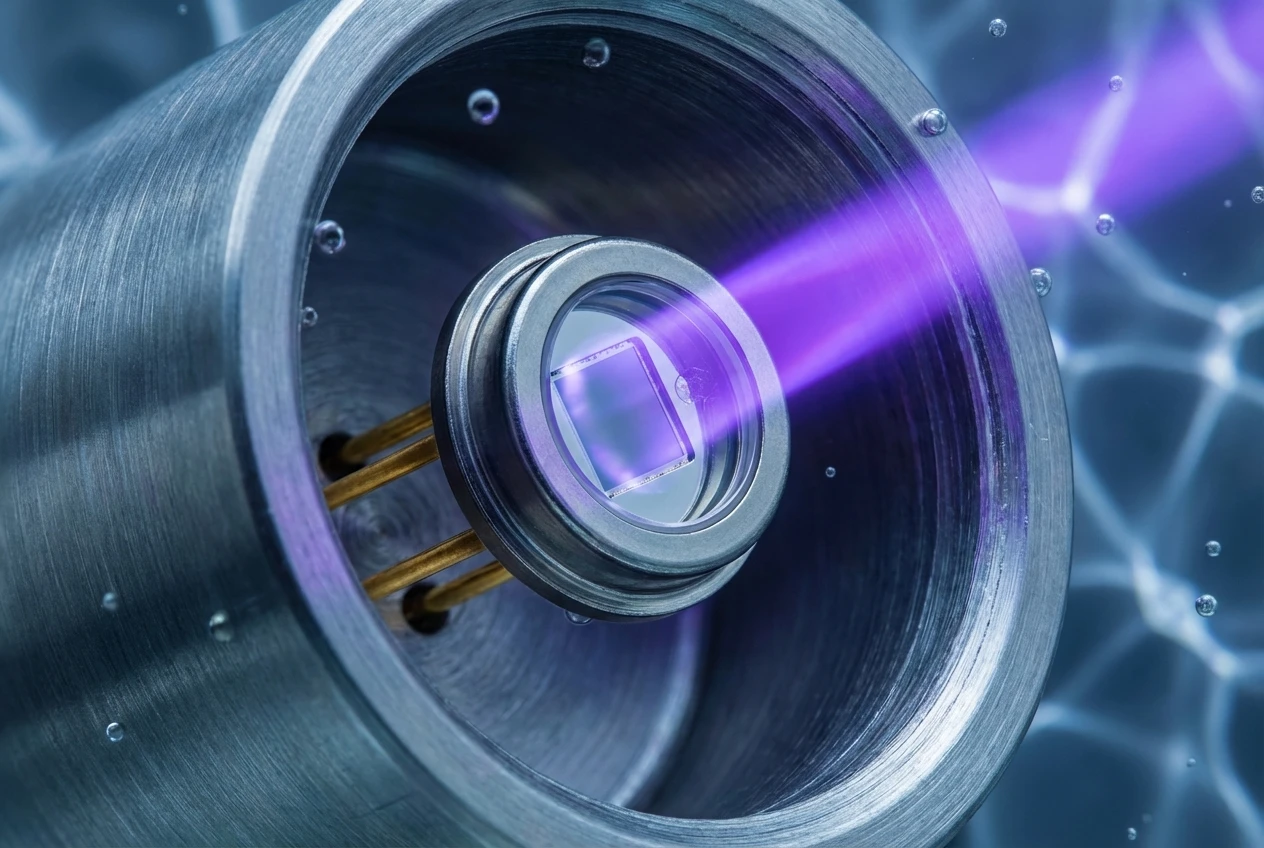
If you want to get technical (and we do), a Photo IC sensor is an optoelectronic device that integrates a photodiode with signal processing circuits. Unlike a standalone photodiode which just outputs a weak current, a Photo IC sensor outputs a usable digital or analog voltage signal that your microcontroller doesn’t have to squint to see.
For VR tracking components, this integration is critical because it lowers the capacitance at the input of the amplifier.
The Physics of Speed (Without the LaTeX)
Since I can’t use fancy code blocks here, let’s break down the math in plain text. You can copy this right into your notes.
The bandwidth (speed) of your tracking system is largely limited by the RC time constant of your input circuit.
Bandwidth (BW) = 1 / (2 * Pi * R * C)
- R is your feedback resistance.
- C is the total capacitance (photodiode capacitance + input stray capacitance).
In a discrete system, C is high because of PCB traces and component packaging. In a Photo IC sensor, C is tiny.
When C drops, Bandwidth goes up.
Also, consider the output voltage. A standard photodiode gives you a photocurrent (I_ph).
I_ph = P * S
(Where P is optical power and S is sensitivity).
But a Photo IC sensor handles the gain internally.
V_out = I_ph * R_f
(Where R_f is the internal feedback resistor).
Because this happens inside the chip, shielded from the outside world, we can push R_f much higher to get a huge gain without drowning in noise. This is how we detect those faint laser sweeps from a lighthouse base station across the room.
Photo IC vs. Discrete Photodiodes: The Showdown
I’ve had arguments with engineers who say, “But discrete parts are cheaper!” Sure, if you only look at the Bill of Materials (BOM) for those two parts. But once you factor in the shielding, the extra PCB space, and the engineering time spent debugging noise issues, the Photo IC sensor wins every time.
Here is a breakdown of why I prefer the integrated route for VR tracking components:
| Feature | Discrete Photodiode + Amp | Photo IC Sensor |
|---|---|---|
| Footprint | Large (Requires multiple parts) | Tiny (Single chip solution) |
| Noise Immunity | Poor (Susceptible to EMI) | Excellent (Internal shielding) |
| Response Speed | Moderate (Limited by stray capacitance) | Very High (Low internal capacitance) |
| Cost | Low (Component wise) | Moderate (But saves on PCB/Shielding) |
| Implementation | Complex (Needs careful layout) | Plug-and-Play |
If you are building a headset that needs to look sleek and weigh nothing, you don’t have the real estate for a discrete layout. You need a Photo IC sensor like the ones we engineer at BeePhoton.
Implementing Photo IC Sensors in AR Gesture Control
Augmented Reality (AR) is a different beast compared to VR. In VR, you have a controlled environment (usually). In AR, you’re out in the wild. You have sunlight, fluorescent lights, and shadows.
AR gesture control relies heavily on detecting hand movements, often using IR LEDs or VCSELs reflecting off the user’s skin.
The challenge here is “Ambient Light.” Sunlight is basically a giant noise blaster in the IR spectrum. A standard sensor gets blinded by the sun and can’t see the weak reflection from your hand.
A high-quality Photo IC sensor often includes circuitry for DC light subtraction. Essentially, it looks at the constant background light (the sun) and ignores it, only reacting to the modulated pulses from your tracking LEDs.
I’ve seen designs where the AR gesture control failed simply because the user walked near a window. It’s embarrassing. Using a Photo IC sensor with high dynamic range allows the system to function whether you are in a dark basement or a bright office.
Photo IC PDTC series
Our Two-level Gain Switch Photo IC provides precise optical detection for industrial automation. This advanced photo IC features an adjustable gain switch, ensuring reliable performance
A “Secret” Success Story: Fixing the Jitter
I can’t name names because of NDAs (you know how the industry is), but let’s call this client “Project Ghost.”
Project Ghost was building a high-end VR training headset for pilots. They needed sub-millimeter accuracy. They started with a discrete photodiode solution because their lead engineer was “old school” and didn’t trust integrated chips.
The Issue: Every time the pilot turned their head fast, the tracking point drifted about 5mm. In a flight sim, 5mm drift means you miss a switch. It was unusable.
The Fix: We swapped their input stage for a BeePhoton Photo IC sensor. Specifically, one tuned for 850nm wavelengths with a built-in current-to-voltage amplifier.
The Result:
- Latency: Dropped from 12ms to under 2ms.
- Jitter: Eliminated.
- PCB Size: Reduced the sensor board size by 40%.
The engineer was skeptical until he saw the scope trace. The signal was clean, sharp, and immediate. If you are struggling with similar issues, you might want to check out our Photo IC product category to see if a drop-in replacement could save your project.
Overcoming the “Drift”
Drift is the ghost in the machine. It’s when your virtual hand slowly floats away from your real hand.
Drift usually comes from thermal noise. As the headset heats up (and it will, with that processor strapped to your face), the characteristics of discrete components change. Resistors change value; diode dark current increases.
Because a Photo IC sensor is built on a monolithic die, the thermal tracking is far superior. The components inside the chip heat up together and tend to cancel out each other’s thermal drift.
It’s a small detail, but when you are trying to keep a virtual object locked to the real world in AR gesture control, thermal stability is everything.
The Future of VR Tracking Components
Where is this going? I think we are going to see Photo IC sensor tech get even smaller and faster. We are looking at “Digital Output” Photo ICs becoming the standard. Instead of an analog voltage that your MCU has to read, the sensor will just spit out a digital packet: “I saw light at time X.”
This offloads the processing from the main CPU, further reducing latency.
Also, keep an eye on multi-spectral Photo ICs. Sensors that can distinguish between different wavelengths of light could allow for multiple users in the same space to have their own “light channels” without interference.
So, What’s the Verdict?
If you are still designing your tracking system with discrete photodiodes in 2026, you are essentially building a steam engine in the age of electric cars. It might work, but it’s heavy, inefficient, and slow.
To get that buttery smooth tracking that makes users forget they are wearing a headset, you need the integration, speed, and noise immunity of a Photo IC sensor.
At BeePhoton, we don’t just sell chips; we help you integrate them so your tracking works. Whether you need a standard part or something custom for a weird new form factor, we’ve probably seen the problem before and fixed it.
Don’t let your hardware be the reason your software feels slow.
Photo IC PDTC series
Our Two-level Gain Switch Photo IC provides precise optical detection for industrial automation. This advanced photo IC features an adjustable gain switch, ensuring reliable performance
FAQ: Common Questions About Photo IC Sensors
Q1: Can I just replace my photodiode with a Photo IC sensor directly?
Usually, no. A photodiode outputs current, while most Photo IC sensor models output voltage or a digital signal. You will likely need to bypass your existing transimpedance amplifier on the PCB. It simplifies your board, but it requires a layout change.
Q2: How does a Photo IC sensor handle sunlight in outdoor AR applications?
It depends on the specific chip. High-end Photo IC sensor designs for AR gesture control have built-in “DC cancellation” circuits. They saturate the DC component (sunlight) while keeping the AC component (your signal) alive. Always check the “Dynamic Range” spec.
Q3: What is the typical latency of a BeePhoton Photo IC sensor?
Latency is generally determined by the rise time and propagation delay. Our sensors typically feature rise times in the nanosecond range (e.g., 50ns – 200ns). For VR tracking components, this effectively means “zero latency” regarding human perception.
Ready to kill the lag?
If you are tired of fighting noise and jitter in your tracking system, let’s talk. We can help you select the right Photo IC sensor for your specific architecture.
- Check out our products: BeePhoton Photo ICs
- Shoot us a technical question: Contact Us
- Email our engineering team: info@photo-detector.com