If you’ve ever tinkered with electronics projects involving light detection, you’ve probably run into the question of whether to grab a photodiode or a phototransistor. They’re both handy for turning light into electrical signals, but they ain’t exactly the same. I’ve messed around with both in various setups over the years, from simple ambient light sensors to more tricky IR remote controls, and yeah, picking the wrong one can make things frustrating. So let’s break down the photodiode vs phototransistor debate in a straightforward way, no fluff.
Basically, a photodiode is like a straightforward PN junction diode that generates current when light hits it. A phototransistor, on the other hand, is pretty much a transistor with a built-in photodiode acting as the base – it amplifies that light-generated signal right inside the device.
What Exactly is a Photodiode?
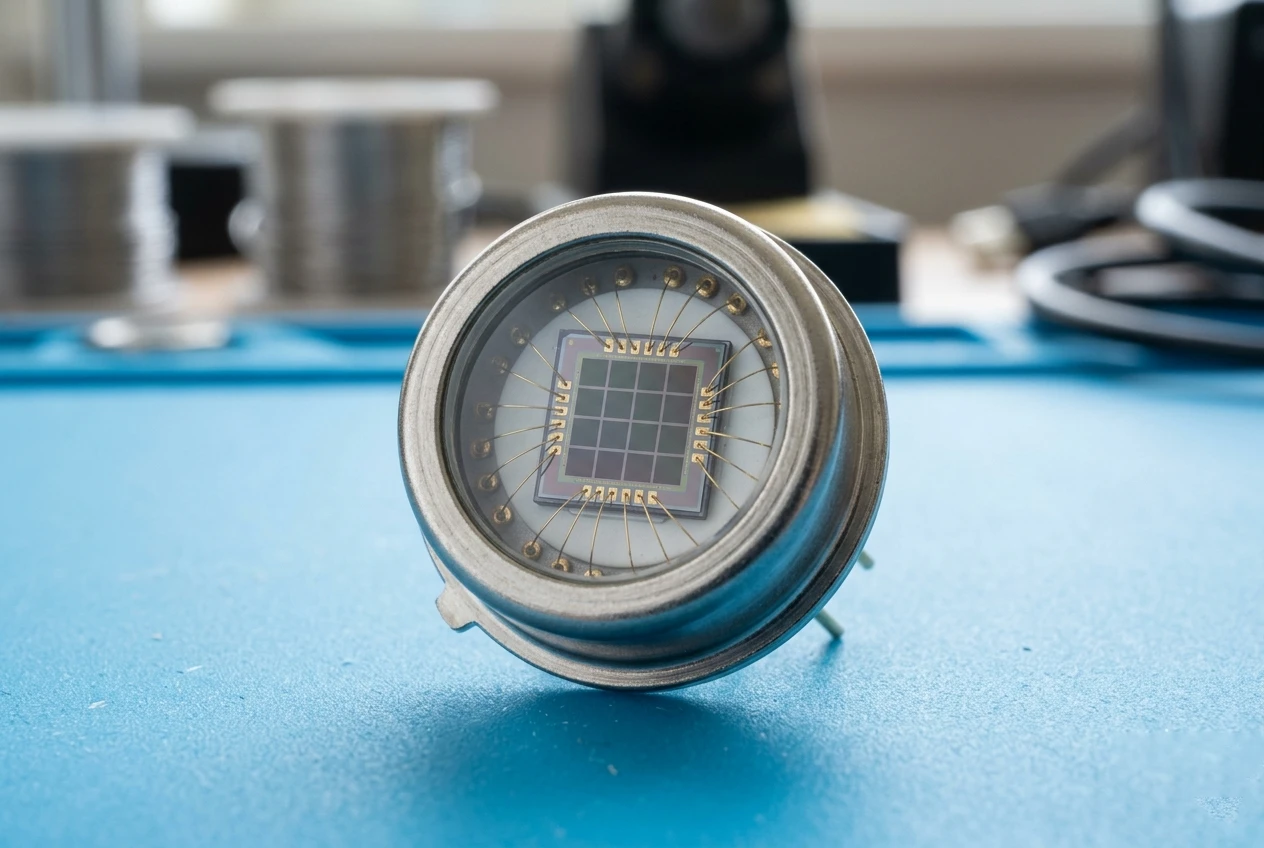
Photodiodes are simple but powerful. They’re just a semiconductor junction (usually silicon) that produces a tiny current proportional to the light intensity shining on it. No amplification built-in, so the output is direct and linear.
I’ve used them a lot in precision stuff, like measuring laser power or in fiber optic receivers. They’re fast – response times in the nanoseconds – and super linear, meaning the output current tracks the light level almost perfectly without distortion.
Common types include PIN photodiodes, which have an intrinsic layer for better speed and sensitivity, and avalanche ones for really low-light detection (though those need high voltage and are noisier).
And a Phototransistor?
Phototransistors take that basic photodiode idea and add transistor amplification. Usually NPN structure, where light hits the base-collector junction, generating a base current that’s then amplified by the transistor’s gain (often 100-1000 or more).
This means you get way more output current from the same light level. Great for low-light situations without needing extra amps.
But there’s a trade-off: they’re slower (microseconds response) and less linear because of that gain variation. Temperature changes can mess with the gain too.
At Bee Photon, we stock some solid options like our Silicon Phototransistor tuned for 800-1100nm IR range – perfect for remote controls or object detection.

Si phototransistor PTCP Series PTCP001-202
Enhance your switching solutions with this 800-1100nm NPN Phototransistor. Perfect for photoelectric switches, it offers high power dissipation up to 90mW. This silicon phototransistor delivers consistent performance in harsh environments from -40°C to +85°C.
Key Differences: Photodiode vs Phototransistor
The difference between photodiode and phototransistor boils down to a few core things. Here’s a quick table to make it clearer – I’ve pulled from real specs like those from Hamamatsu and Thorlabs datasheets.
| Feature | Photodiode | Phototransistor |
|---|---|---|
| Structure | PN or PIN junction | Bipolar transistor (usually NPN) with exposed base |
| Internal Gain | None (or high in avalanche types) | Yes, typically 100-1000+ |
| Sensitivity | Good, but low output current (nA to μA) | Higher effective sensitivity due to gain |
| Response Time | Fast (ns range) | Slower (μs range) |
| Linearity | Excellent | Moderate (gain varies) |
| Noise | Lower dark current | Higher due to amplification |
| Spectral Range (Silicon) | 400-1100nm typical | Similar, peak around 800-900nm |
| Typical Applications | High-speed comms, precise measurement | Switching, low-light detection |
From experience, photodiodes shine (pun intended) when you need accuracy and speed. Phototransistors are my go-to for simpler circuits where you want bang for your buck without extra components.
When to Pick a Photodiode for Your Project
Go with a photodiode if:
- Speed matters – like in optical fiber links or pulse detection. Thorlabs’ FDS series, for example, handle GHz bandwidths easily.
- You need precise, linear measurements – think lab instruments or power meters.
- Low noise is key, especially in faint light scenarios (pair with a good transimpedance amp).
One project I worked on involved detecting short laser pulses – photodiode was the only choice because phototransistors just couldn’t keep up.
Real-world examples: Smoke detectors (often PIN diodes), barcode scanners, medical oximeters.
When a Phototransistor Makes More Sense
Choose a phototransistor when:
- Light levels are low and you want built-in amplification to drive a microcontroller directly.
- Circuit simplicity is priority – no need for op-amps.
- You’re doing on/off switching, like IR beam breaks or remote controls.
I’ve built plenty of object counters using phototransistors – cheap, reliable, and sensitive enough for indoor use.
Applications include: Automatic lights, encoders in printers, security beams.
Our Silicon Phototransistor at Bee Photon is optimized for near-IR (800-1100nm), making it spot-on for those kinds of projects.
Real-Life Scenarios: Which One Wins?
Let’s talk some anonymous cases I’ve seen or built.
In one industrial setup, a client needed to detect position in a conveyor – low speed, dim factory lighting. Phototransistor nailed it with simple resistor pull-up, no extra amp needed.
Another time, for a high-speed data link over short fiber, photodiode was essential – the transitor version smeared the signal too much.
Or think remote controls: Almost always phototransistors because they pick up weak IR signals from across the room without fancy circuitry.
In astronomy gear or spectroscopy, photodiodes rule for their linearity and low noise.

Si PIN photodiode PDCP08 Series PDCP08-511
The PDCP08-511 is a high-performance Black Epoxy PIN Photodiode designed for precision infrared applications. Encased in a special black epoxy resin, this sensor effectively acts as a daylight filter, blocking visible light interference while maximizing sensitivity at 940nm. With a large 2.9×2.9mm active area and low dark current, it ensures reliable signal detection for optical switches and remote control systems, even in noisy ambient light environments.
Pros and Cons Quick Roundup
Photodiodes:
- Pros: Fast, linear, wide bandwidth.
- Cons: Low output, often need amplification.
Phototransistors:
- Pros: High gain, easy to use, sensitive.
- Cons: Slower, nonlinear, temperature sensitive.
How to Decide for Your Specific Project
Ask yourself:
- How fast does it need to respond?
- Do I care about exact light measurement or just detection?
- What’s the light wavelength and intensity?
- Budget and circuit complexity?
If you’re unsure, start with a phototransistor for prototyping – they’re forgiving. Then switch to photodiode if performance demands it.
Check out more on our site at https://photo-detector.com/ for detectors suited to various wavelengths.
FAQ
What’s the main difference between photodiode and phototransistor?
The big one is gain: Photodiodes give direct, small current from light. Phototransistors amplify it internally, so bigger output but slower and less precise.
Which is more sensitive: photodiode or phototransistor?
Phototransistors usually feel more sensitive because of the built-in gain – you get more current from the same light. But for very low noise in faint light, amplified photodiodes can compete.
Can I use a phototransistor for high-speed applications?
Not really the best – they’re limited to maybe hundreds of kHz. Photodiodes go way faster, into GHz for comms.
Are phototransistors better for IR detection?
Yeah, many are tuned for near-IR (like 800-1100nm), and the gain helps with weaker signals. Our Silicon Phototransistor is a good example.
If this helped clear things up, or if you’re working on a project and need advice on the right sensor – maybe even a custom quote – drop us a line at info@photo-detector.com or head to our contact page. We’d love to chat about what’ll work best for you.