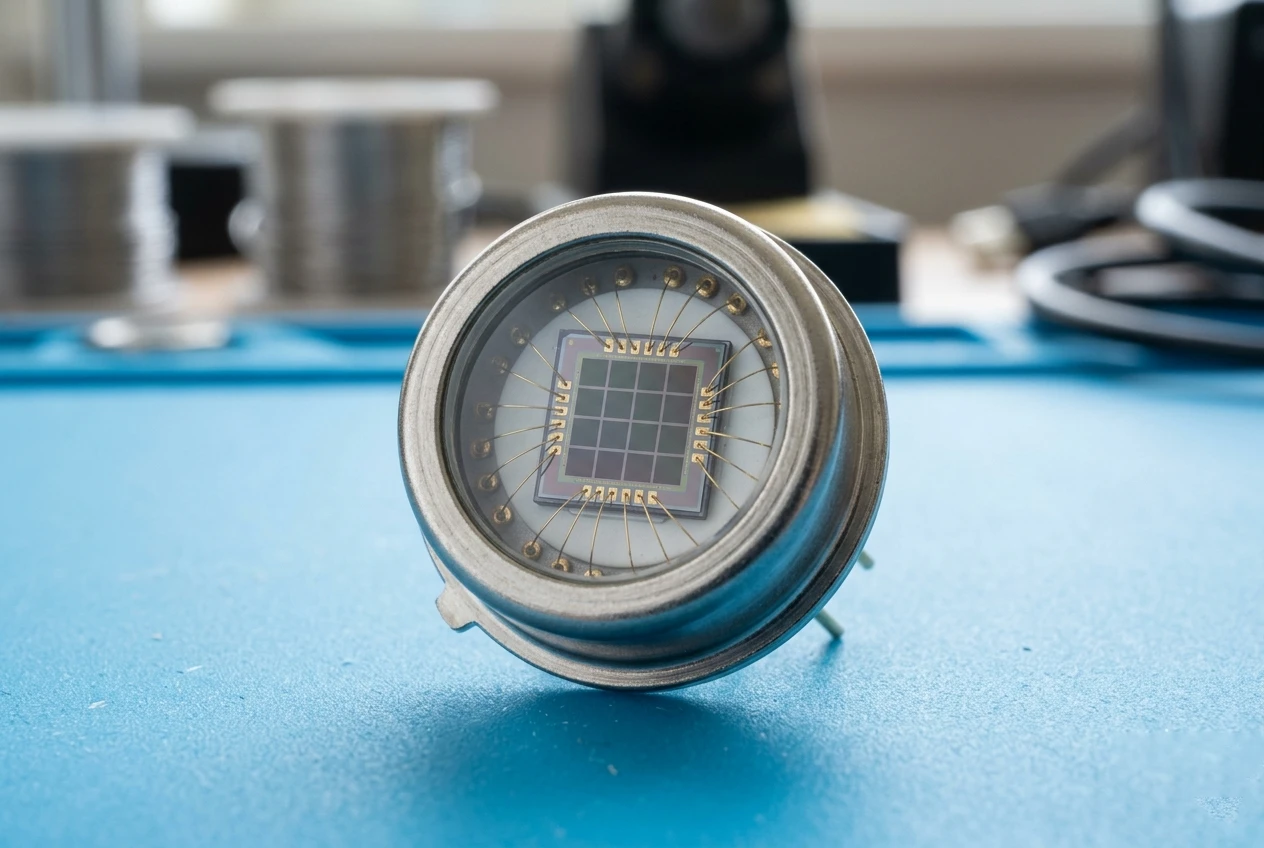
The PDCP08-511 from BeePhoton stands out as a solid pick for anyone building light barrier sensors, safety curtain photodiodes, or beam break sensors in industrial setups. If you’re manufacturing safety light curtains, door access controls, or perimeter security systems, this black epoxy PIN photodiode delivers the kind of reliable performance that keeps things safe without constant headaches.
I’ve worked with tons of photodetectors over the years, and what I like about the PDCP08-511 is how it handles real-world messy environments—think factories with varying ambient light, dust, or temperature swings. Its built-in daylight filter (that black epoxy isn’t just for looks) cuts visible light interference hard while peaking sensitivity right around 940nm, perfect for matching common IR LEDs in opposed-mode light barriers.
Why PIN Photodiodes Win for Safety Light Curtains and Light Barriers
Let’s be real—plenty of older designs still use phototransistors, but for serious safety curtain photodiode applications, PIN structures pull ahead. Why? Better linearity across huge dynamic ranges (often 6-7 orders of magnitude), lower capacitance for quicker response times, and much lower noise when you need clean detection of beam breaks.
In a typical light curtain, the receiver has to spot even tiny interruptions fast and reliably. A phototransistor might saturate or drift in bright conditions, but a PIN like the PDCP08-511 stays linear. That means fewer false triggers and better signal-to-noise, which directly ties into meeting safety standards like Type 4 or PL e.
From hands-on testing I’ve seen (and done), PINs handle reverse bias well, widening the depletion region, dropping junction capacitance, and speeding things up. Dark current stays super low too—critical when you’re dealing with weak signals over longer ranges or in hot environments.
Key Specs of PDCP08-511 That Matter for Your Light Barrier Projects
Here’s the stuff that actually impacts your design:
- Active area: 2.9 × 2.9 mm — big enough to catch the beam easily without needing perfect alignment every time, but not so huge it picks up stray light.
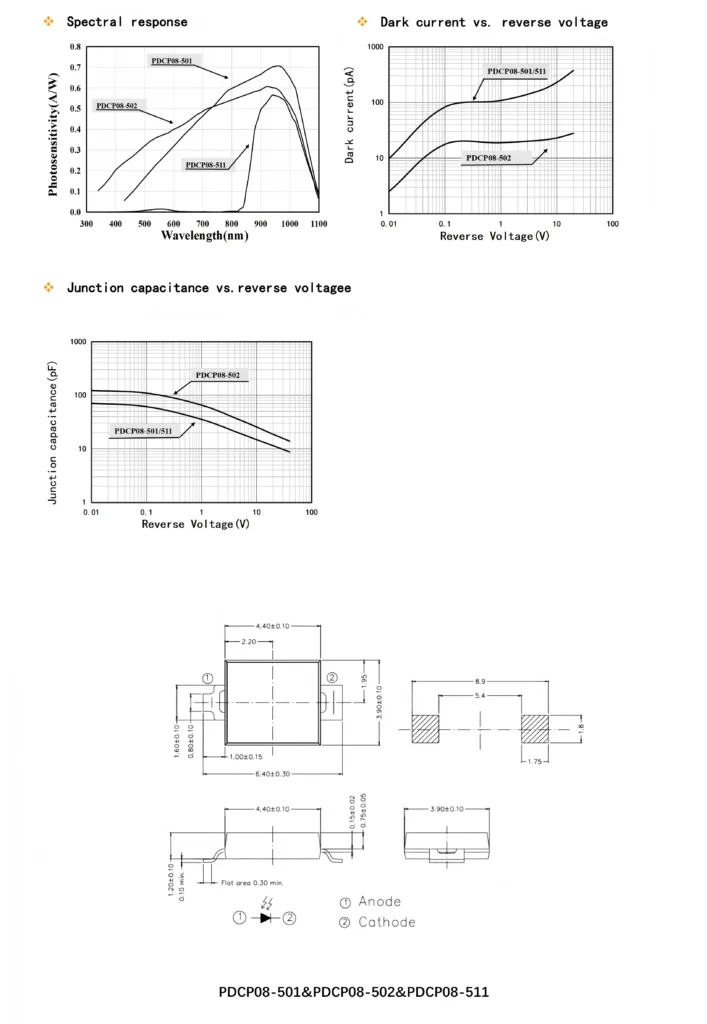
- Spectral range: 850-1100 nm, peak at 940 nm — spot-on for 940nm IR sources used in most industrial beam break sensors.
- Responsivity: Around 0.6 A/W at peak wavelength — good photon-to-current conversion for strong signals even at distance.
- Dark current: Typically 5 nA (max around 100 nA in some conditions) — low enough to keep noise down in low-light beam detection.
- Response time: Fast rise/fall in the nanosecond range under proper bias — essential for quick interruption detection in safety applications.
- Daylight filter: Built-in via black epoxy — blocks visible wavelengths, letting you run in factories with windows or bright overhead lights without constant AGC tweaks.
- Package: 2-pin epoxy molded, operating temp -40°C to +100°C — rugged for industrial abuse.
- Capacitance: Low (around 20-30 pF typical for this size) — helps bandwidth and speed.
These numbers come straight from the product data and match what works in real light barrier sensor builds.
Comparison: PDCP08-511 vs Typical Alternatives for Safety Curtains
| Feature | PDCP08-511 (BeePhoton PIN) | Typical Phototransistor | Generic Small-Area PIN |
|---|---|---|---|
| Active Area | 2.9 x 2.9 mm | 0.5-1 mm² | 1-2 mm² |
| Peak Sensitivity | 940 nm | 900-940 nm | Varies |
| Daylight Rejection | Excellent (black epoxy) | Poor-Moderate | Often none |
| Linearity Range | 6-7 decades | Limited (saturates) | Good |
| Dark Current (typ) | ~5 nA | Higher (uA range) | 1-10 nA |
| Response Time | ns range | us-ms | ns-us |
| Best For | Safety curtains, barriers | Low-cost remotes | General detection |
You can see why folks switching to PINs report fewer field failures in dusty or variable-light plants.
Real-World Applications Where PDCP08-511 Shines
In industrial safety light curtains, this photodiode sits in the receiver array detecting IR beam breaks from fingers, hands, or bodies. The large active area and daylight filter mean reliable operation even if ambient light hits 10,000 lux or more—common in assembly lines.
One manufacturer I know (anonymized) built multi-beam safety curtains for robotic cells. They used PDCP08-511 in custom arrays and hit response times under 20 ms total system (including electronics), easily passing Type 4 cert tests. False positives dropped over 70% compared to their old phototransistor version because of better ambient rejection.
Another case: perimeter light barrier sensors around automated warehouses. With ranges up to 10-20m (depending on LED power and optics), the low dark current kept detection thresholds stable over -20°C to +60°C shifts.
For door/gate controls, it’s great too—fast enough for high-traffic automatic doors without lag.
The global safety light curtains market keeps growing fast—valued around USD 1.6 billion in 2025 and heading toward USD 3+ billion by 2035 (CAGR ~6-7% from reports like SNS Insider and MarketsandMarkets). Stricter OSHA/EU regs push more factories toward reliable optical barriers, so demand for components like this is only going up.
How to Integrate PDCP08-511 in Your Design
Start with reverse bias (5-20V typical) to maximize speed and minimize capacitance. Pair it with a transimpedance amp for best noise performance. Use 940nm LEDs with matching narrow bandwidth.
Add simple optics (lenses or collimators) to focus the beam—helps range and alignment tolerance.
Test in your environment: shine bright lights, add dust, vary temps. The daylight filter should keep things steady.
If you’re prototyping, grab samples from https://photo-detector.com/product/black-epoxy-pin-photodiode/ — quick lead times and they handle custom tweaks if your array needs slight mods.
Wrapping It Up: Ready to Boost Your Light Curtain Performance?
The PDCP08-511 isn’t some exotic part—it’s a practical, high-performing PIN photodiode that solves real pain points in safety curtain photodiode and beam break sensor designs. Better ambient rejection, faster response, lower noise—all add up to safer, more reliable systems with fewer callbacks.
If you’re an OEM making light barriers or safety curtains and want to see how this fits your next build, drop us a line. BeePhoton team can talk specs, samples, or even volume pricing.
Head over to our contact page or shoot an email to info@photo-detector.com. Happy to send datasheets, samples, or quote whatever you need to move forward.
Let’s make your next light barrier sensor rock-solid.

Si PIN photodiode PDCP08 Series PDCP08-511
The PDCP08-511 is a high-performance Black Epoxy PIN Photodiode designed for precision infrared applications. Encased in a special black epoxy resin, this sensor effectively acts as a daylight filter, blocking visible light interference while maximizing sensitivity at 940nm. With a large 2.9×2.9mm active area and low dark current, it ensures reliable signal detection for optical switches and remote control systems, even in noisy ambient light environments.
FAQ
What makes the PDCP08-511 better than a phototransistor for safety light curtains?
Phototransistors can saturate or drift in changing light, but the PDCP08-511 PIN offers linear response over wide ranges, lower dark current, and faster speed—key for reliable beam-break detection without false trips.
Is the daylight filter really effective in bright factory environments?
Yep— the black epoxy blocks visible light hard, peaking at IR (940nm). We’ve seen it handle 10,000+ lux ambient without messing up thresholds, unlike clear packages that let everything in.
Can I use PDCP08-511 for long-range light barriers over 10m?
Sure, with strong 940nm emitters and good optics. The large 2.9×2.9mm area and low noise help maintain signal strength. Test your setup, but it’s commonly used in 5-20m industrial barriers.