
Look, nobody wants to be the engineer responsible for a medical device that fails when it matters most. When a patient’s oxygen levels drop, that reading on the screen needs to be real, and it needs to be instant.
If you are in the business of building medical monitoring components, specifically pulse oximeters, you know the struggle. You’re fighting motion artifacts, low perfusion issues, and ambient light interference. But here’s the thing a lot of people overlook: the heart of that struggle is usually the quality of the SpO2 photodiode you chose during the design phase.
As someone who has spent years analyzing signal chains in medical devices, I can tell you that swapping out a generic sensor for a high-performance SpO2 photodiode is often the cheapest way to fix a “noisy” product.
In this guide, we’re going to strip away the marketing fluff and talk engineering. We’ll look at how to select the right sensor, the math behind the signal-to-noise ratio, and how to make sure your device passes FDA or CE certification without a headache.
The Physics: Why Your Photodetector Choice Makes or Breaks the Device
We all know the basic concept. You shine two lights through a finger (or earlobe, or foot): Red (usually 660nm) and Infrared (940nm). Oxygenated hemoglobin absorbs more IR; deoxygenated hemoglobin absorbs more Red.
The SpO2 photodiode sits on the other side, catching whatever light makes it through.
Sounds simple, right? But here is where it gets messy. The signal you are trying to catch is tiny. It is a small AC component riding on top of a massive DC component (the static absorption from bone, skin, and non-pulsatile blood).
The Math You Can’t Ignore
To calculate the oxygen saturation, your firmware is likely calculating the “Ratio of Ratios” (let’s call it R).
R = (AC_red / DC_red) / (AC_ir / DC_ir)
Where:
- AC is the pulsatile component (the heartbeat).
- DC is the non-pulsatile component.
If your SpO2 photodiode isn’t sensitive enough, or if it has a high dark current, that “AC” value gets buried in noise. When the AC signal is garbage, your R value is wrong. And when R is wrong, the number on the screen scares the nurse for no reason.
Most manufacturers use an empirical calibration equation that looks something like this:
SpO2 = A – B * R
Where A and B are coefficients determined by clinical trials. If your SpO2 photodiode introduces non-linearities, this linear equation falls apart, especially at low saturation levels (below 80%), which is exactly when accuracy is critical.
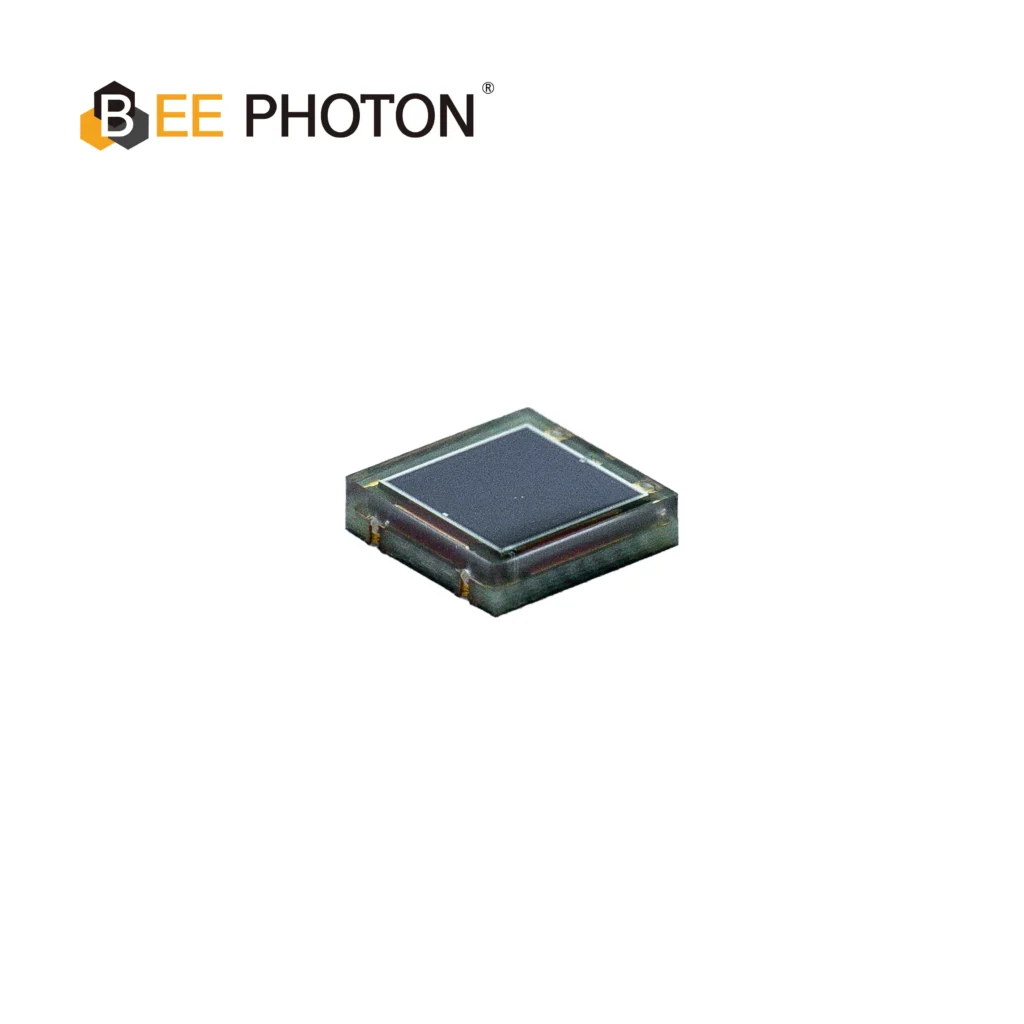
Si PIN Photodiode with UV sensitivity enchanced (320-1060nm) PDCC34-601
Experience our High Quantum Efficiency Photodiode for precise UV-NIR detection. This sensor ensures high responsivity for analytical and medical instruments.Its COB design and enhanced UV sensitivity (320-1060nm) make this Si PIN photodiode ideal for compact, high-performance applications.
Key Parameters for Selecting a SpO2 Photodiode
When you are browsing through catalogs or looking at our Si PIN photodiodes, you can’t just pick the one that fits the footprint. You have to look at the specs that affect the pulse oximetry sensor performance.
Here is my checklist for a medical-grade sensor.
1. Spectral Responsivity
Your photodiode needs to be highly responsive at both 660nm and 940nm. Standard silicon is great at 940nm but can drop off at 660nm. A high-quality SpO2 photodiode is optimized to have a flatter response curve across this specific range. If the responsivity at 660nm is too low, you’ll have to drive your Red LED harder, which kills battery life in portable units.
2. Dark Current (Id)
This is the killer. Dark current is the current the diode produces even when there is no light. In a pulse oximetry sensor, this is pure noise.
- Generic Photodiode: Dark current ~1-5 nA.
- Medical Grade SpO2 Photodiode: Dark current < 0.1 nA.
Low dark current gives you a wider dynamic range. It allows your device to read accurately on patients with darker skin pigmentation or thick fingers where light transmission is very low.
3. Junction Capacitance (Cj)
Capacitance affects speed. While pulse oximetry isn’t “high speed” like fiber optics, a lower capacitance reduces noise when you are switching LEDs on and off rapidly to sample the signals. Lower capacitance allows for cleaner TIA (Transimpedance Amplifier) design.
Technical Comparison: Generic vs. BeePhoton Optimized Sensors
I threw together this table to show you the difference between grabbing a cheap off-the-shelf part and using a dedicated SpO2 photodiode.
| Parameter | Generic Consumer Photodiode | BeePhoton Medical SpO2 Photodiode | Impact on Oximetry |
|---|---|---|---|
| Spectral Range | 400nm – 1100nm (Unbalanced) | 350nm – 1100nm (Optimized for Red/IR) | Better signal balance between Red and IR channels. |
| Dark Current | High (2.0 nA typical) | Ultra-Low (< 0.05 nA) | Critical for reading low perfusion (cold fingers/shock). |
| Active Area | Small (< 1mm^2) | Scalable (Customizable sizes) | Larger area captures more light, improving SNR. |
| Package | Standard Epoxy | Clear/Filtered Medical Epoxy | Biocompatible and reduces ambient light interference. |
A Real World Scenario: The “Drifting Signal” Problem
Let me tell you a quick story (names changed, obviously). We had a client, a mid-sized manufacturer of handheld vitals monitors. They were using a standard photodiode from a massive distributor.
Their problem? Signal Drift.
When the device was turned on, it was accurate. But after 20 minutes of continuous use, the SpO2 readings would drift down by 2-3%. That is huge in a clinical setting.
They thought it was their LEDs heating up and changing wavelength. They spent months redesigning the LED driver.
I chatted with their lead engineer and asked to see the SpO2 photodiode spec sheet. It turns out, the generic diode they used had a massive temperature coefficient for Dark Current. As the device warmed up (from the battery and electronics), the dark current rose, adding a false “absorption” baseline to the signal.
The Fix:
They switched to a BeePhoton high-precision SpO2 photodiode with thermally stable characteristics.
- Result: The drift vanished.
- Cost: The BOM cost increased by maybe $0.15 per unit.
- Savings: They saved thousands on a potential recall and redesign.
This is why selecting the right medical monitoring components matters more than saving pennies on the BOM.

Si PIN Photodiode with UV sensitivity enchanced (320-1060nm) PDCT16-601
Our Borosilicate Window Photodiode ensures superior UV to NIR detection. This photodiode with a durable borosilicate window excels in spectroscopy & medical analysis.
Design Tips for Integrating the SpO2 Photodiode
If you are laying out the PCB right now, keep these tips in mind to get the most out of your SpO2 photodiode.
The TIA Interface
Your SpO2 photodiode generates current, not voltage. You need a Transimpedance Amplifier (TIA) to convert that current to a voltage your ADC can read.
- Keep the trace between the photodiode anode and the TIA inverting input as short as humanly possible. This trace is an antenna for noise (50/60Hz mains hum is your enemy here).
- Use a guard ring around the TIA input if you are dealing with very low currents.
Dealing with Ambient Light
Sunlight and hospital fluorescent lights flickers. A good SpO2 photodiode setup needs optical shielding, but also electrical filtering.
- Ensure your SpO2 photodiode has an integrated daylight filter if possible, or design the housing to block external light.
- Use background subtraction in your firmware: Measure the photodiode current when both LEDs are off, and subtract that value from your Red and IR measurements.
Trends in Medical Monitoring Components
We are seeing a shift. The old “clip on the finger” style is still king for accuracy, but wearables are pushing the boundaries.
Reflectance vs. Transmittance
Classic oximeters are Transmittance (light goes through the tissue).
Smartwatches and patches are Reflectance (light bounces off the bone/tissue).
Reflectance pulse oximetry is much harder. The signal is smaller. This makes the quality of the SpO2 photodiode even more critical. You need higher sensitivity (NEP – Noise Equivalent Power) because you are catching photons that managed to bounce back, not just pass through.
If you are designing a wearable patch or a ring, do not skimp on the sensor. You need the largest active area SpO2 photodiode you can fit in the casing to capture those scattered photons.
Why Sourcing Matters
I’ve seen supply chains collapse because a generic sensor went End-of-Life (EOL) without notice. When you work with a specialized partner like BeePhoton, you aren’t just buying a reel of chips. You are securing a supply chain for critical medical monitoring components.
We understand FDA/MDR documentation requirements. We know that if you change the sensor, you might have to re-validate the device. We aim to get it right the first time.
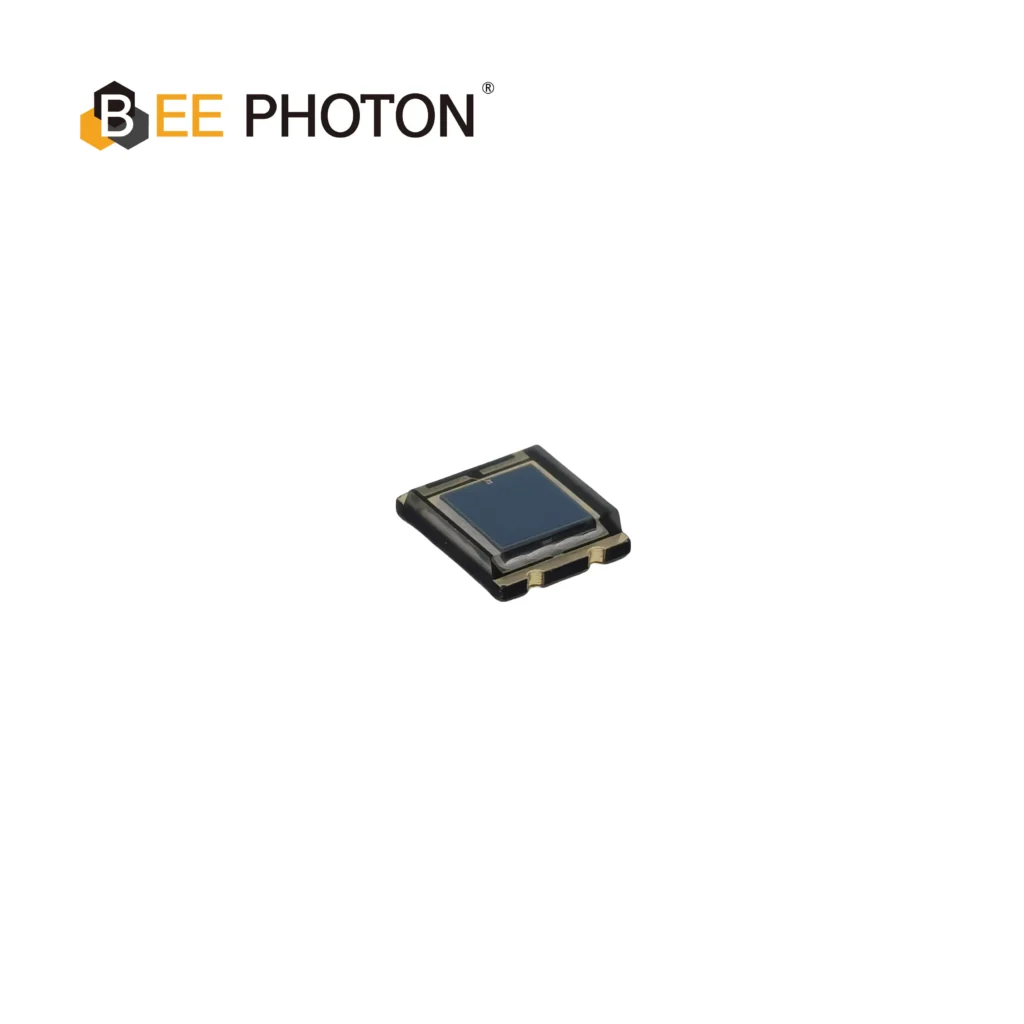
Si PIN Photodiode with NIR sensitivity enchanced (430-1100nm) PDCP08-201
The PDCP08-201 is a high-performance SMD Si PIN Photodiode designed for precision optical communication and medical sensing.[1] Featuring a large 2.9×2.9 mm active area with enhanced NIR sensitivity (0.70 A/W) and ultra-low dark current (20 pA), this SMD Si PIN Photodiode ensures superior signal detection and reliability in a compact surface-mount package.
FAQ: Common Questions from Device Manufacturers
Q: Can I use a standard photodiode for pulse oximetry?
A: Technically, yes, but you will struggle with accuracy. A standard diode usually has higher dark current and isn’t optimized for the 660nm/940nm ratio. A dedicated SpO2 photodiode ensures you meet medical standards (ISO 80601-2-61).
Q: How does active area size affect the SpO2 photodiode performance?
A: A larger active area captures more light, which improves the Signal-to-Noise Ratio (SNR). However, it also increases capacitance. For a finger clip, a larger area (like 5mm to 7mm square) is usually better. For wearables, you balance size with power consumption.
Q: What is the lead time for custom Si PIN photodiodes?
A: This varies, but at BeePhoton, we specialize in helping OEM manufacturers. We can often provide samples quickly for prototyping. Since medical monitoring components require strict quality control, we prioritize stability in our manufacturing line.
Q: Why is my SpO2 reading unstable on patients with low perfusion?
A: This is usually a noise issue. When perfusion is low, the pulsatile signal (AC) is tiny. If your SpO2 photodiode has high dark noise or thermal noise, it drowns out the signal. Switching to a sensor with lower Dark Current (Id) is the most effective hardware fix.
Ready to Upgrade Your Sensor Technology?
Look, the medical device market is crowded. The only way to stand out is by having a device that works instantly and accurately, every single time. You don’t want your sales team making excuses for “noisy signals” during a demo.
At BeePhoton, we engineer the SpO2 photodiode solutions that power top-tier medical devices. Whether you need a standard Si PIN photodiode or a custom array for a new wearable, we have the expertise to help you optimize your optical signal chain.
Don’t let a cheap sensor compromise your expensive device.
- Need a sample? We can ship test units for your engineering team.
- Have a weird form factor? We do custom packaging.
- Just want to talk specs? Our engineers actually like talking about shunt resistance.
Contact us today or send an email directly to info@photo-detector.com. Let’s make sure your next product launch is flawless.
Or, browse our full range of sensors here: Si PIN Photodiodes Product Category.


