
If you’ve been in the medical instrumentation game as long as I have, you know the drill. You’re designing a new fluorescence analyzer or a flow cytometer. The marketing team wants it handheld, procurement wants it cheaper, and engineering—well, we just want it to work without needing a separate power plant.
For decades, the Photomultiplier Tube (PMT) was the undisputed king of low-light detection. And yeah, they are great. But they are also fragile, bulky glass tubes that demand high voltage. In today’s market, where “point-of-care” (POC) is the magic word, sticking a vacuum tube into a portable device is like trying to put a V8 engine in a golf cart. It works, but it’s messy.
This is why more engineers are looking to replace PMT with photodiode technology, specifically solid-state detectors like Si PIN photodiodes. I’m going to walk you through why this shift is happening, the math behind it, and how to actually pull it off without losing the sensitivity your diagnostic equipment needs.
The Elephant in the Room: PMTs Are Aging Tech
Don’t get me wrong, I love a good PMT. The internal gain is fantastic (10^6 is no joke). But let’s be honest about their baggage. They are sensitive to magnetic fields, they break if you look at them wrong, and they require a high-voltage power supply (HVPS) often running anywhere from 600V to 1000V.
When you try to replace PMT with photodiode sensors, you aren’t just swapping a component. You are fundamentally changing the architecture of your medical diagnostic equipment. You are moving from vacuum electronics to solid-state physics.
Here is the reality check:
- Size: PMTs are massive compared to a chip.
- Cost: A good PMT setup costs hundreds of dollars. A photodiode setup? Often a fraction of that.
- Durability: Drop a PMT, it shatters. Drop a photodiode, you just pick it up.
Solid-State Detectors vs. Vacuum Tubes: The Showdown
I’ve seen too many engineers hesitate to make the switch because they are terrified of the Noise Equivalent Power (NEP) specs. They think, “A photodiode has no internal gain; I’ll never see the signal.”
That used to be true. But modern amplifier designs and better silicon purity have changed the game. Let’s look at the raw comparison.
Table 1: The Smackdown – PMT vs. Si PIN Photodiode
| Feature | Photomultiplier Tube (PMT) | Si PIN Photodiode | Winner |
|---|---|---|---|
| Supply Voltage | 500V – 2000V (High Voltage) | 5V – 15V (Low Voltage) | Photodiode |
| Quantum Efficiency (QE) | 10% – 25% (Typical photocathode) | 80% – 90% (Silicon) | Photodiode |
| Internal Gain | Yes (10^5 to 10^7) | No (Unity gain, 1) | PMT |
| Magnetic Field Sensitivity | High (Needs shielding) | None | Photodiode |
| Response Time | Ultra-fast (<1 ns) | Fast (ns to µs) | Tie (Application dependent) |
| Cost | $$$ High | $ Low | Photodiode |
| Robustness | Fragile (Glass) | Rugged (Solid State) | Photodiode |
As you can see, if you want to replace PMT with photodiode solutions, you gain massive advantages in QE and ruggedness. The only thing you lose is internal gain. But guess what? We have Transimpedance Amplifiers (TIAs) for that.
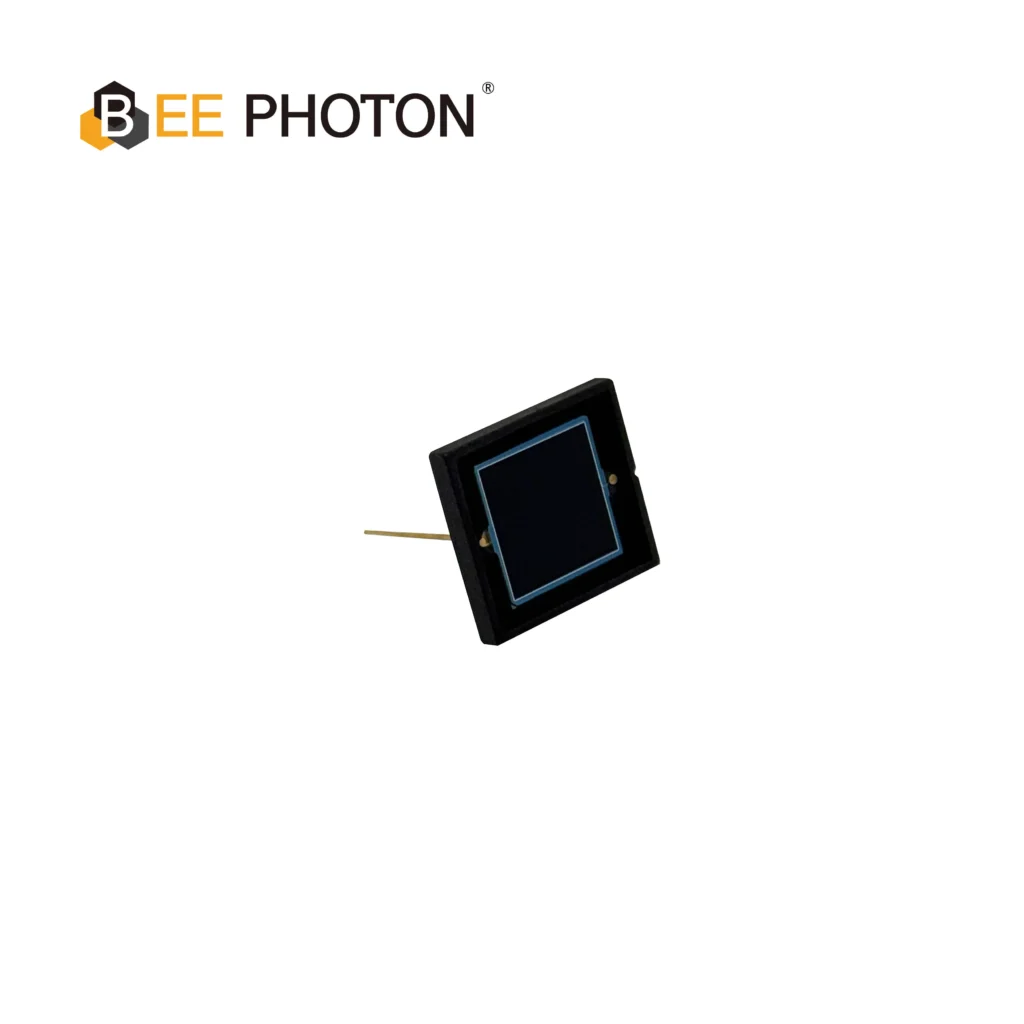
Si PIN Photodiode with UV sensitivity enchanced (190-1100nm) PDCD100-F01
Experience superior UV detection with Bee Photon’s Ultraviolet (UV) Sensitive Photodiode.Our Si PIN photodiode ensures high sensitivity and reliability for analytical instruments.This Ultraviolet (UV) Sensitive Photodiode with a quartz window offers precise measurements from 190nm to 1100nm.
The Physics: Can You Actually Replace PMT with Photodiode?
Okay, let’s get into the weeds a bit. I promise to keep the math painless, but we need to talk formulas if we want to be taken seriously.
The biggest argument against switching is Signal-to-Noise Ratio (SNR).
For a PMT, the signal is virtually noise-free until the anode because the multiplication happens in a vacuum. For a photodiode, you are fighting thermal noise (Johnson noise) in the resistor and the dark current of the diode itself.
However, Silicon has a secret weapon: Quantum Efficiency (QE).
A typical bialkali PMT might have a QE of 20% at 400nm. A generic Si PIN photodiode like the ones we make at BeePhoton often hits 80% or higher across a broad spectrum. This means for every 100 photons hitting the detector, the PMT sees 20, but the photodiode sees 80. You start with 4x more signal current before amplification.
The Signal Formula
When you design to replace PMT with photodiode, you calculate your photocurrent (Ip) like this:
Ip = P_opt * R_lambda
Where:
Ipis the photocurrent (Amps).P_optis the optical power incident on the chip (Watts).R_lambdais the responsivity (Amps/Watt).
Responsivity is derived from QE:
R_lambda = (QE * q * lambda) / (h * c)
(Where q is electron charge, lambda is wavelength, h is Planck’s constant, c is speed of light).
Because R_lambda is so much better in silicon for visible and NIR light, you have a stronger base signal. The challenge is the noise floor.
Fighting the Noise
To successfully replace PMT with photodiode, you have to manage the Noise Equivalent Power (NEP).
NEP = Noise_Current / Responsivity
If you use a high-quality Si PIN diode with low Dark Current (Id), your shot noise is minimized.
Shot Noise_current = sqrt( 2 * q * Id * B )
Where B is your bandwidth.
Here is the kicker that many datasheets don’t tell you: In many clinical chemistry applications, the light levels aren’t actually “single photon” levels. They are low, but not that low. In these “middle-ground” ranges, a PMT is overkill. You are paying for gain you don’t need, and dealing with shot noise from the background light anyway. A photodiode with a low-noise JFET op-amp can match the performance for 10% of the cost.
Real-World Scenarios: When to Make the Switch
I’ve consulted on plenty of projects where the engineering lead was stubborn. They loved their tubes. But eventually, the market forces them to change. Here is where it makes the most sense to replace PMT with photodiode modules.
1. Point-of-Care (POC) Analyzers
Imagine a blood analyzer that needs to sit in an ambulance. You cannot have a device that requires 1000V and breaks if the ambulance hits a pothole. Solid-state detectors are mandatory here. By using a compact Si PIN photodiode, you reduce the optical bench size by half.
2. Portable Fluorescence Detectors
Fluorescence usually screams “PMT” because the signals are weak. However, if you are looking at standard fluorophores (like FITC or GFP) and you have a decent excitation source (like a modern LED or Laser Diode), the emission is often strong enough for a PIN diode, especially if you use a large active area to capture more light.
3. Flow Cytometry (Side Scatter & Forward Scatter)
While the fluorescence channels in high-end cytometers might still use PMTs or APDs (Avalanche Photodiodes), the Forward Scatter (FSC) and Side Scatter (SSC) channels are almost always better served by standard photodiodes. They deal with stronger signals where PMTs might actually saturate or get damaged.
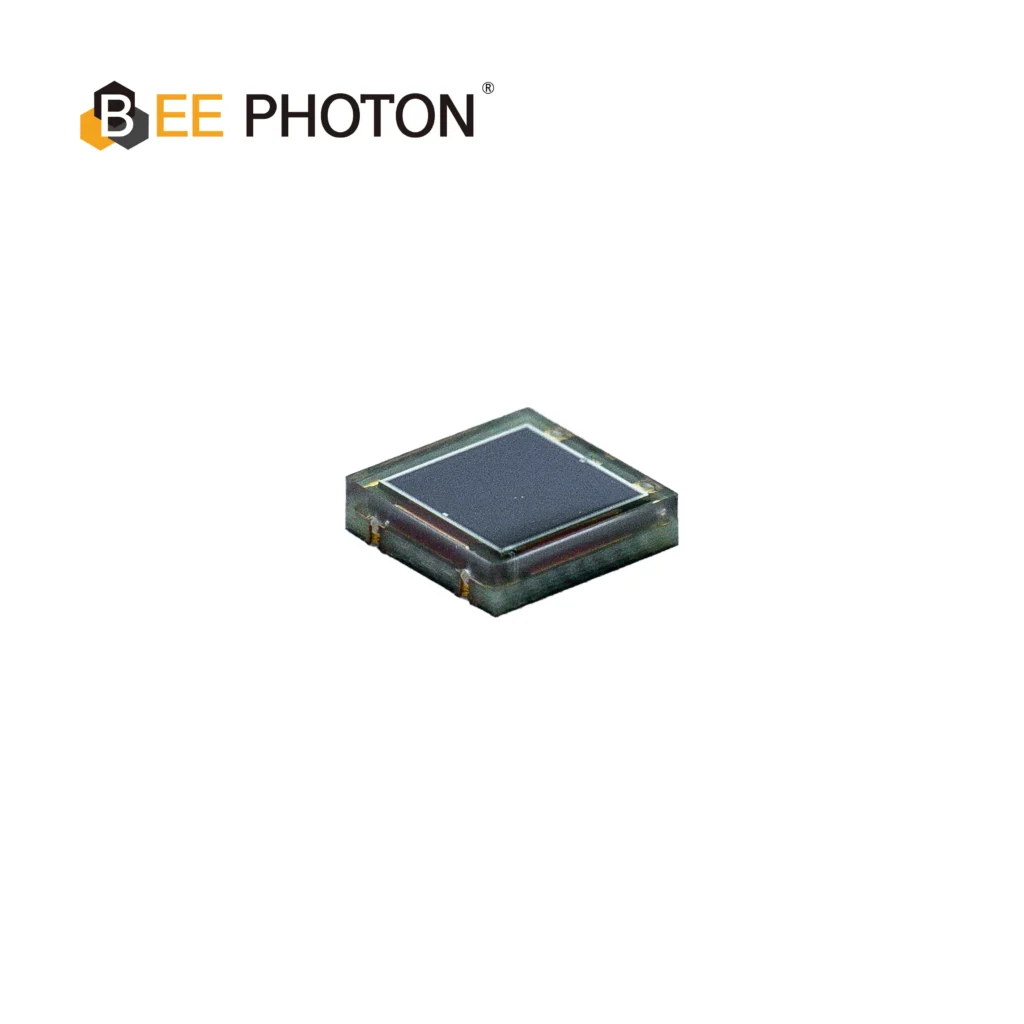
Si PIN Photodiode with UV sensitivity enchanced (320-1060nm) PDCC34-601
Experience our High Quantum Efficiency Photodiode for precise UV-NIR detection. This sensor ensures high responsivity for analytical and medical instruments.Its COB design and enhanced UV sensitivity (320-1060nm) make this Si PIN photodiode ideal for compact, high-performance applications.
Case Study: The “Mini-Lab” Project
Let me share a quick story (names changed to protect the innocent/NDA). A client came to us at BeePhoton wanting to shrink a desktop immunoassay analyzer. The thing was the size of a microwave.
Their goal: Make it the size of a toaster.
Their problem: The PMT assembly took up 30% of the internal volume because of the shielding and the power supply brick.
The Solution:
We helped them replace PMT with photodiode sensors from our Si PIN series.
We chose a sensor with a large active area to maximize light collection (since they couldn’t focus the light perfectly in the smaller box).
The Result:
- Volume Reduction: The detector module size dropped by 85%.
- Cost Savings: The BOM (Bill of Materials) for the detector channel went from $180 (PMT + HVPS) to $25 (Photodiode + OpAmp).
- Performance: The CV (Coefficient of Variation) on their test results changed from 2.1% to 2.3%. A negligible difference for a massive gain in portability.
They successfully launched the product last year, and it’s crushing it in urgent care clinics.
Integrating BeePhoton Si PIN Photodiodes
If you are thinking, “Okay, I’m sold, but which diode do I use?”—this is where BeePhoton comes in.
We specialize in high-performance solid-state detectors. Our Si PIN photodiodes are specifically designed for medical diagnostic equipment where low noise is non-negotiable.
When you replace PMT with photodiode components using our tech, you get:
- Low Dark Current: Crucial for keeping that noise floor down.
- High Spectral Sensitivity: Particularly in the 400nm – 1100nm range, covering almost all standard diagnostic reagents.
- Fast Response: Good enough for pulse detection in cell counting.
You can check out our full range here: Si PIN Photodiodes Category.
Common Pitfalls When You Switch
It’s not all sunshine and rainbows. If you just desolder a PMT and slap in a diode, you will fail.
- Impedance Mismatch: PMTs are current sources with high output impedance. Photodiodes need a Transimpedance Amplifier (TIA) close to the sensor. If you run long cables from a photodiode to your amp, your signal will be swamped by noise. Keep the amp close!
- Capacitance: Large area photodiodes have higher junction capacitance. This slows down your bandwidth. If you need speed, don’t pick a massive detector unless you know how to compensate for it in the circuit.
- Light Leaks: PMTs are usually in light-tight housings. Photodiodes are often exposed. You need to design your mechanics to shield ambient light strictly.
A Controversial Opinion? Maybe.
There are still old-school professors who insist that “Real physics requires vacuum tubes.” To them I say: Look at your smartphone camera. It’s a CMOS sensor (solid state). It captures images in low light that film cameras could only dream of. The same evolution is happening in medical diagnostic equipment.
Holding onto PMTs for routine diagnostics is often just laziness or fear of redesigning the analog front end. Don’t be that engineer. Be the one who innovates.
Cost Analysis: Saving More Than Just Pennies
When you replace PMT with photodiode, the savings compound.
- Component Cost: Immediate 5x-10x reduction.
- Power Supply: Eliminating the HVPS saves another $50-$100 per unit.
- Compliance: Low voltage devices are easier to certify (UL/CE standards are stricter for high voltage).
- Warranty: Solid-state detectors essentially never wear out. PMTs have a half-life. Your service calls drop.
Wrapping It Up
The transition from vacuum tubes to solid-state is inevitable. It happened in radios, it happened in TVs, and it is happening in medical diagnostic equipment.
If you are looking to optimize for cost and volume, you need to replace PMT with photodiode technology. The Si PIN photodiodes offer a rugged, low-cost, and high-performance alternative that fits the modern demand for portable healthcare.
At BeePhoton, we help companies make this transition every day. We know the specs, we know the pitfalls, and we have the chips you need.
Ready to modernize your device?
Don’t guess at the specs. Let’s talk about your optical path.
Contact BeePhoton Today or drop us an email at info@photo-detector.com. We can review your current setup and suggest the perfect Si PIN replacement.
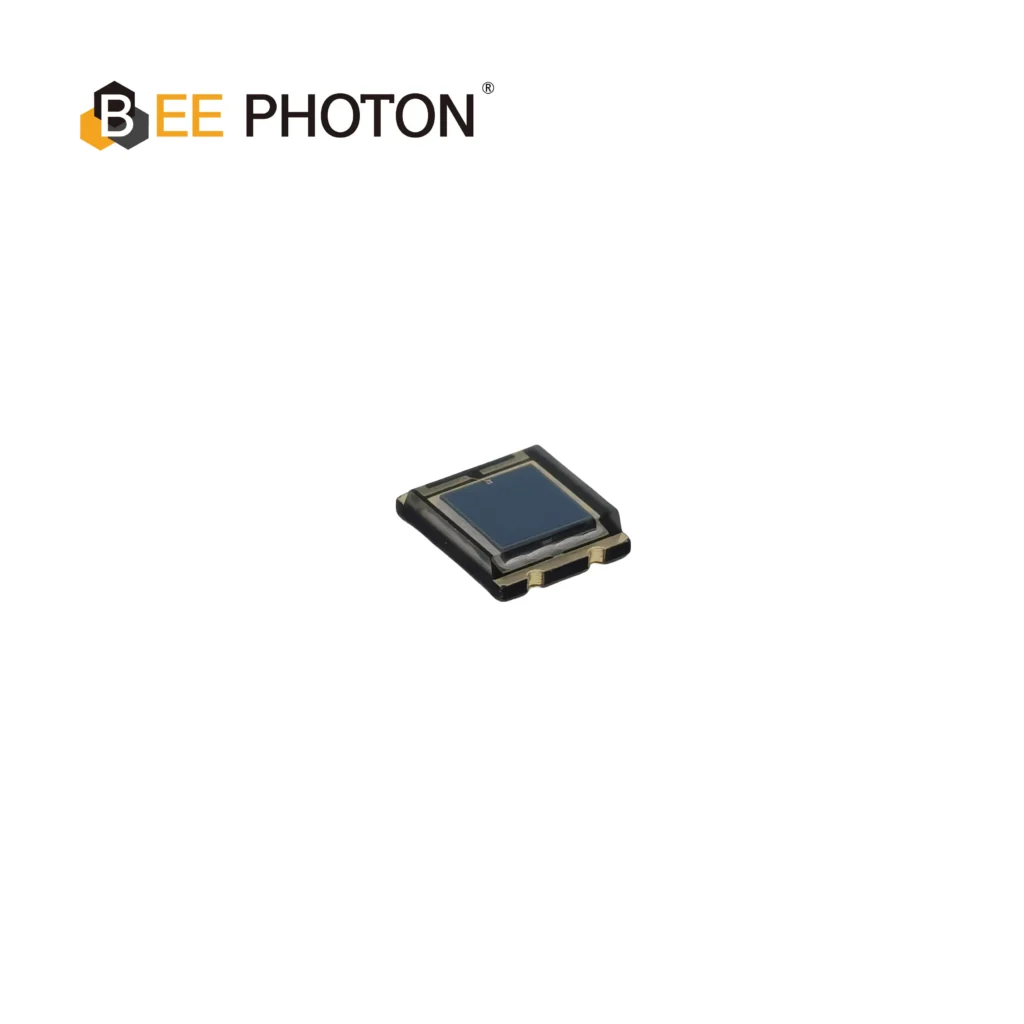
Si PIN Photodiode with NIR sensitivity enchanced (430-1100nm) PDCP08-201
The PDCP08-201 is a high-performance SMD Si PIN Photodiode designed for precision optical communication and medical sensing.[1] Featuring a large 2.9×2.9 mm active area with enhanced NIR sensitivity (0.70 A/W) and ultra-low dark current (20 pA), this SMD Si PIN Photodiode ensures superior signal detection and reliability in a compact surface-mount package.
FAQ: Questions We Get All The Time
Q1: Can I really replace PMT with photodiode for chemiluminescence?
A: It depends on the intensity. For ultra-low, single-photon counting chemiluminescence, a PMT or an APD (Avalanche Photodiode) is still preferred. However, for “flash” chemiluminescence or standard enhanced assays used in many clinical analyzers, a high-quality Si PIN photodiode with a low-noise amplifier works perfectly fine and saves a ton of space.
Q2: What is the main disadvantage when I replace PMT with photodiode?
A: The main disadvantage is the lack of internal gain. You must design a very clean, low-noise amplifier circuit (TIA) to boost the signal. If your electronics design is sloppy, the noise will kill your signal. However, with good design, this is easily manageable.
Q3: Do Si PIN photodiodes degrade over time like PMTs?
A: Generally, no. PMTs have a photocathode that degrades with usage and exposure to high light levels. Solid-state detectors like Si PIN diodes are extremely stable over time. Unless you subject them to extreme radiation or heat, they will likely outlast the device itself.
Q4: Is it difficult to customize the active area of a photodiode?
A: Not at all. Unlike PMTs which come in standard glass shapes, Si PIN photodiodes are manufactured on wafers. We can offer various active area sizes to match your specific light spot size, optimizing the SNR for your specific medical diagnostic equipment.


