Si ha estado diseñando o resolviendo problemas en codificadores ópticos rotativos o lineales durante algún tiempo, probablemente recordará cuando el infrarrojo (IR) era el rey indiscutible de las fuentes de luz. Durante décadas, los emisores IR estándar de 850 nm u 880 nm cumplieron su función a la perfección. Eran económicos, los detectores de silicio se adaptaban bien a sus longitudes de onda y nadie necesitaba realmente una precisión submicrométrica para el control básico de motores industriales.
Pero los tiempos han cambiado. Hoy en día, la automatización industrial, la robótica y la fabricación de semiconductores exigen una precisión extrema. Estamos hablando de resoluciones que superan los 20 bits o requieren mediciones lineales submicrométricas. Cuando se intenta exprimir ese nivel de rendimiento de un emisor de infrarrojos de la vieja escuela, se choca contra un muro físico.
Ese muro se llama difracción.
Para superar esta limitación, los principales fabricantes de codificadores han ido desplazando discretamente sus diseños de alta gama hacia longitudes de onda más cortas, utilizando específicamente una LED azul para codificadores. Entre las diversas opciones, la longitud de onda de 465 nm ha surgido como el punto óptimo para los codificadores ópticos avanzados. Analicemos por qué se está produciendo este cambio, la física pura que hay detrás y por qué una fuente de luz azul de 465 nm ya no es solo una actualización opcional, sino una necesidad absoluta para el control de movimiento moderno.
La física de la precisión: la longitud de onda y el límite de difracción
Para entender por qué un LED azul para codificadores es tan crítico que tenemos que hablar de cómo lee realmente la posición un codificador óptico.
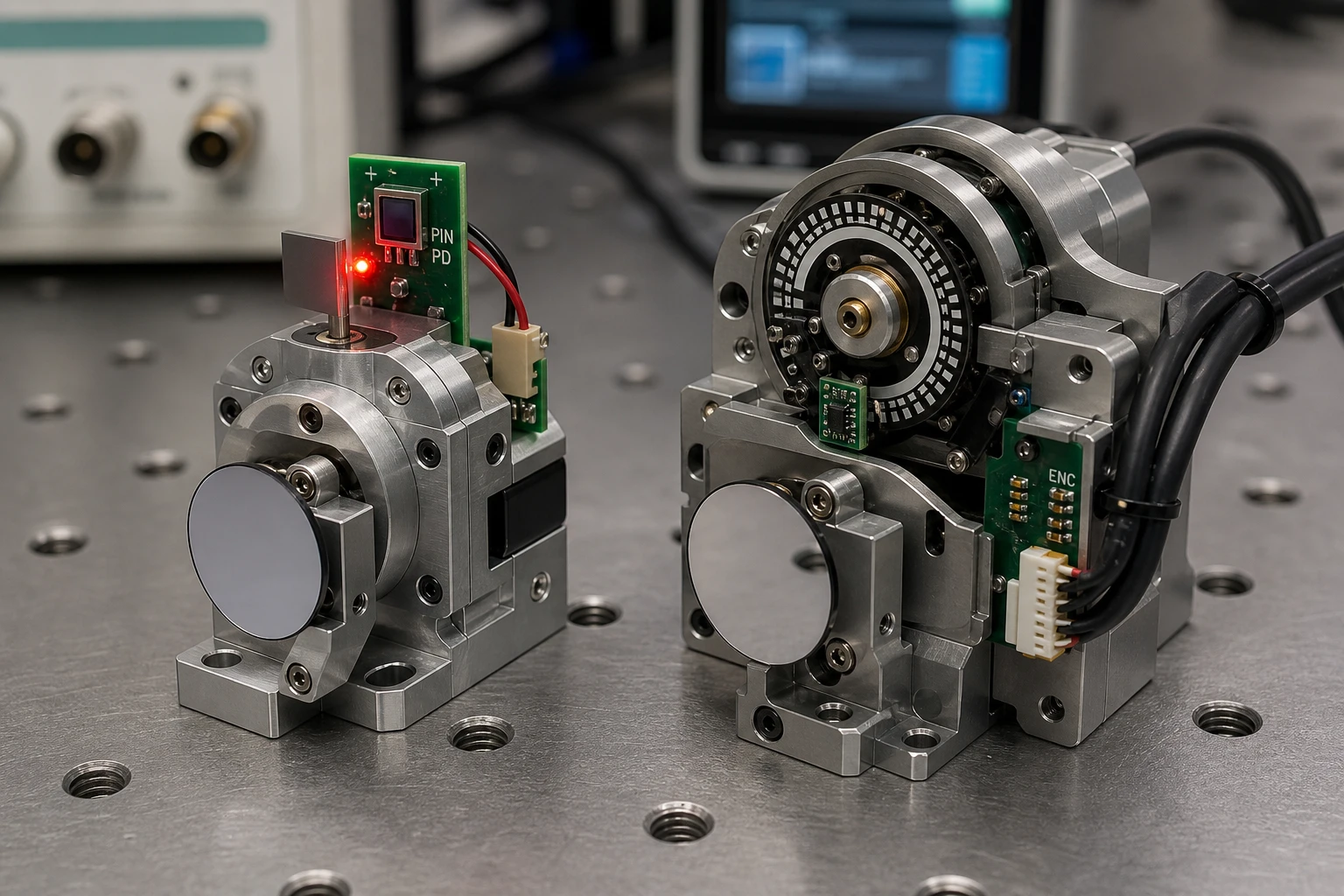
Ya sea que esté diseñando un sistema transmisivo o reflectante, básicamente está proyectando luz a través de o sobre una rejilla de paso fino (el disco de código) hacia un conjunto de fotodetectores. El fotodetector mide el patrón de luz resultante y lo traduce en señales eléctricas sinusoidales, que luego se interpolan para calcular la posición.
¿El problema? A la luz no le gusta viajar en líneas perfectamente rectas cuando pasa a través de pequeños huecos. Se curva. Esta curvatura se conoce como difracción.
La dispersión angular de esta luz difractada puede estimarse mediante una relación física sencilla:
theta = lambda / w
Dónde:
thetaes el ángulo de difracción (la dispersión del haz de luz)lambdaes la longitud de onda de la fuente de luzwes el ancho de la rendija de la rejilla en su disco codificador
Si observa detenidamente esta fórmula, notará que el ángulo de difracción theta es directamente proporcional a la longitud de onda lambda.
Cuando se utiliza una fuente de luz infrarroja con una longitud de onda de 850 nm, la luz se dispersa significativamente al pasar a través de las estrechas rendijas de una rejilla de alta resolución. Esto hace que los patrones claros y oscuros del sensor se desdibujen entre sí. La señal eléctrica resultante pierde su contraste, aparece el ruido y la precisión de la interpolación desaparece por completo.
Ahora, veamos qué sucede cuando sustituimos eso por una de 465 nm LED azul para codificadores:
- Longitud de onda infrarroja:
lambda= 850 nm - Longitud de onda del LED azul:
lambda= 465 nm - Reducción de la difracción: Aproximadamente 45 %
Al reducir la longitud de onda de 850 nm a 465 nm, el ángulo de difracción se reduce casi a la mitad. El haz de luz permanece mucho más concentrado y nítido mientras viaja desde el disco de código hasta el sensor. Esto significa que el sensor recibe un patrón óptico de alta definición y alto contraste.
A continuación se presenta una comparación rápida de cómo la longitud de onda afecta a las diferentes fuentes de luz utilizadas en los codificadores:
| Parámetro | Infrarrojo tradicional (IR) | LED rojo estándar | LED azul de 465 nm |
|---|---|---|---|
| Longitud de onda típica | 850 nm | 640 nm | 465 nm |
| Dispersión de difracción relativa | 100 % (Referencia) | ~75% | ~55 % (Reducción del 45 %) |
| Contraste de señal (modulación) | Bajo en pasos finos | Moderado | Muy alta |
| Resolución física máxima | Limitada (requiere discos grandes) | Medio | Excelente (permite pasos ultrafinos) |
| Aplicación común | Codificadores industriales heredados | Codificadores de consumo de bajo costo | Codificadores compactos de ultraprecisión |
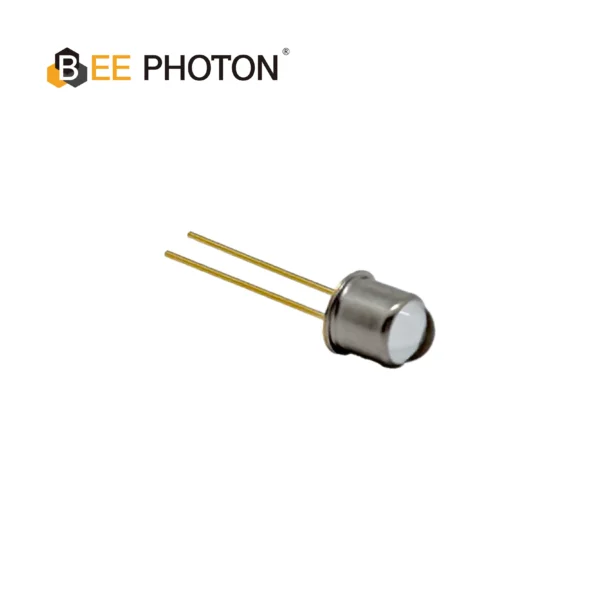
LED azul E465-4-201L4
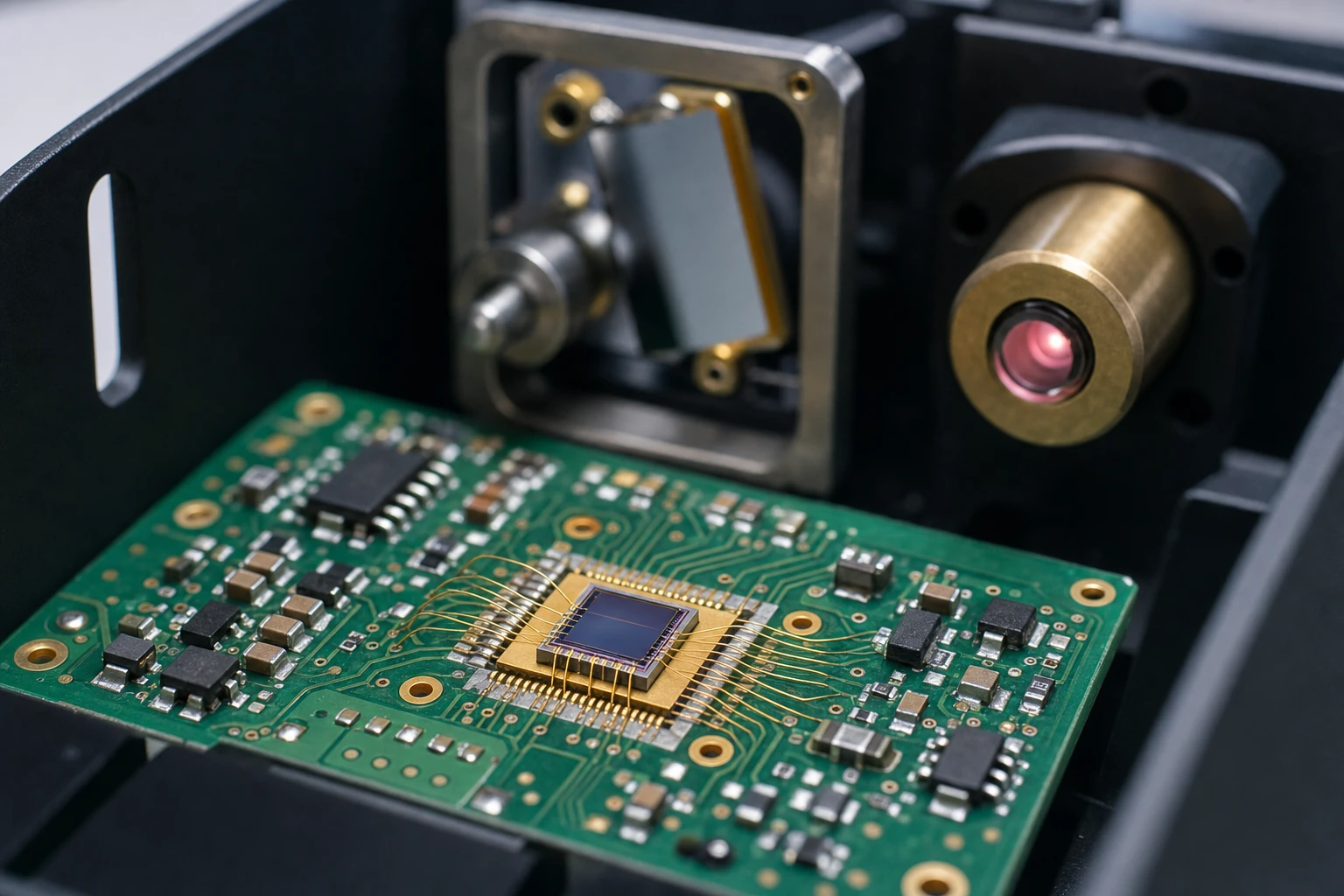
En E465-4-201L4 es un sistema de alto rendimiento LED azul de 465 nm diseñada específicamente para aplicaciones industriales de precisión que requieren una salida de luz focalizada. Proporciona una alta luminosidad con un rango de longitud de onda de 460-470 nm estrictamente controlado. LED azul de 465 nm es un componente esencial para los interruptores ópticos y los codificadores rotatorios.
Por qué un LED azul de 465 nm para codificadores supone un cambio radical en la resolución
Cuando hablamos de actualizar a un LED azul para codificadores, el beneficio inmediato en el mundo real es un salto drástico en la resolución y precisión sin aumentar el tamaño físico del codificador.
Si está limitado al uso de luz infrarroja, la única forma de obtener una mayor resolución es aumentar el tamaño del disco de código (lo que aumenta el ancho de la ranura w en relación con la longitud de onda) o depender en gran medida de la interpolación de señal basada en software. Ninguna de las dos opciones es ideal. Los discos grandes no caben en carcasas de motor ajustadas, y la interpolación de software excesiva es increíblemente sensible al ruido eléctrico, al desplazamiento de la señal y a la inestabilidad mecánica (jitter).
Al integrar un de 465 nm LED azul para codificadores, resuelve este problema a nivel de hardware.
Debido a que la difracción es mucho menor, se pueden diseñar discos de código con líneas de rejilla increíblemente estrechas. No es raro que los codificadores absolutos e incrementales modernos que utilizan luz azul alcancen pasos de línea inferiores a 20 micras. Las señales de seno y coseno resultantes son notablemente limpias, lo que permite que los circuitos integrados (IC) de interpolación posteriores resuelvan fácilmente posiciones de hasta 20 bits o más.
IR tradicional (850 nm):  [Luz] ---> \ Desenfoque por difracción / ---> Patrón de sensor borroso
LED azul de 465 nm:         [Luz] ---> | Haz nítido |   ---> Patrón de sensor definido
Otra gran ventaja de un LED azul para codificadores es la reducción del jitter de la señal. El jitter es básicamente el ruido de fase en la salida del codificador. En sistemas servo de alta velocidad, el jitter se traduce directamente en rizado de velocidad y calor en el motor. Dado que el patrón de luz azul en la matriz de fotodetectores tiene bordes mucho más nítidos, las transiciones son increíblemente limpias. Esto minimiza el jitter de la señal, proporcionando al controlador del motor una señal de retroalimentación estable y altamente confiable incluso a altas velocidades de rotación.
Experiencia en el mundo real: cuando la interpolación de software falla, el hardware salva el día
Hace un par de años, trabajamos con un equipo de ingeniería que estaba diseñando una articulación robótica compacta. Utilizaban una fuente de luz IR estándar de 850 nm e intentaban lograr una resolución absoluta de 18 bits en un disco de código de 30 mm de diámetro.
En teoría, sus cálculos funcionaban. Planeaban usar un convertidor analógico-digital (ADC) de 8 bits para interpolar sus señales analógicas de seno/coseno. Pero en la realidad, el codificador era un desastre. La relación señal-ruido (SNR) era pésima porque la luz de 850 nm se difractaba tanto a través de las diminutas líneas de la rejilla que el sensor apenas podía distinguir entre los picos y los valles. No importa cuánto filtrado hicieran en el firmware, no podían obtener una lectura estable. El brazo robótico seguía moviéndose espasmódicamente en reposo.
La solución fue sencilla: sustituyeron el emisor IR por uno de alta calidad LED azul para codificadores. Específicamente, utilizaron un diodo de 465 nm y 4 mW encapsulado junto con una pequeña lente colimadora.
Los resultados fueron inmediatos. El contraste de la señal aumentó en más del 60 %, el nivel de ruido disminuyó y las señales analógicas puras se convirtieron en sinusoides hermosas y limpias. No tuvieron que cambiar su complejo código de filtrado DSP porque el hardware finalmente estaba entregando una señal limpia. El brazo dejó de vibrar y el sistema alcanzó fácilmente la resolución objetivo de 18 bits.
Esta es la razón por la cual los compradores B2B y los diseñadores de sistemas se están alejando activamente de la tecnología infrarroja. Si no cuenta con señales físicas limpias en el sensor, ninguna cantidad de software inteligente podrá salvar su diseño.
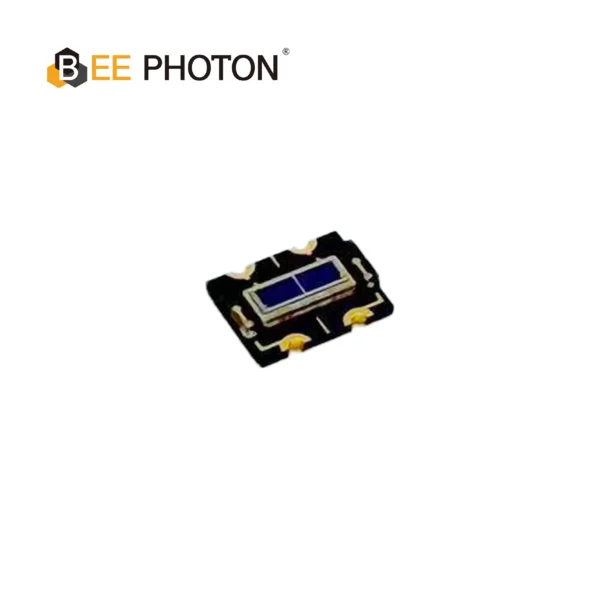
Matriz de fotodiodos PIN de Si PDCA02-601
La serie PDCA de Bee Photon es un producto de ingeniería de precisión Fotodiodo PIN doble diseñado para la detección industrial de gama alta. A diferencia de los detectores estándar de un solo elemento, este dispositivo basado en silicio presenta una estructura de matriz segmentada (PD A y PD B), lo que lo convierte en la solución perfecta para la detección diferencial y interruptores ópticos con supresión de fondo. Con una amplia respuesta espectral de 350 nm a 1060 nm, garantiza un rendimiento versátil en las longitudes de onda del visible y el infrarrojo cercano.
Parámetros de diseño cruciales: potencia, alineación y vida útil
Elegir el correcto LED azul para codificadores es algo más que simplemente escoger cualquier diodo azul al azar del mercado. Si está diseñando un emisor de luz de codificador óptico, debe equilibrar cuidadosamente tres factores críticos: la potencia de salida, la alineación óptica y la vida útil térmica.
1. Potencia óptica y el punto óptimo
Si bien una mayor potencia puede parecer una forma fácil de obtener más señal, sobrecargar el emisor es una receta para el desastre. Genera un exceso de calor y reduce drásticamente la vida útil del diodo.
Para la mayoría de los codificadores rotativos y lineales avanzados, una diodo de 465 nm y 4 mW salida se considera el punto óptimo industrial. Una salida óptica de 4 mW proporciona una densidad de fotones más que suficiente para saturar los modernos sensores CMOS de matriz en fase sin consumir una corriente excesiva ni crear puntos térmicos.
2. Colimación y divergencia del haz
Un LED emite luz de forma natural en un patrón amplio en forma de cúpula. Si permite que esta luz no colimada incida en su disco de código, obtendrá distorsiones espaciales masivas.
Para evitar esto, los conjuntos de alto rendimiento emisor de luz de codificador óptico integran una lente de microcolimación. Esta lente da forma a la salida en un haz casi paralelo con un ángulo de divergencia de menos de 1,5 a 2 grados. Cuanto más estrecho y paralelo sea el haz, menor será la sensibilidad de alineación de su sistema, lo que facilitará mucho el montaje de fabricación.
3. Gestión térmica y vida útil
Seamos honestos: se espera que los codificadores industriales funcionen las 24 horas del día, los 7 días de la semana, durante una década o más sin fallos. Los LED se degradan con el tiempo y su salida de luz disminuye (un proceso llamado envejecimiento). Este envejecimiento se ve fuertemente acelerado por la temperatura.
Al implementar un LED azul para codificadores, debe asegurarse de que el circuito de accionamiento esté optimizado para una corriente baja (a menudo de 10 mA a 20 mA) y que el diseño de la PCB tenga una disipación térmica adecuada. Hacer funcionar un producto premium fuente de luz azul industrial a una corriente conservadora garantiza una vida útil de más de 100.000 horas, igualando o incluso superando a los emisores IR tradicionales.
Comparación de fuentes de luz: azul de 465 nm frente a violeta de 405 nm
Some designers ask, “If shorter wavelengths are better, why not go all the way down to a 405nm violet or UV light source?”
Es una pregunta válida. Matemáticamente, los 405 nm reducirían la difracción incluso más que los 465 nm. Sin embargo, en el mundo real de la ingeniería industrial, los 405 nm introducen una serie de problemas graves que los hacen muy poco prácticos para los diseños de codificadores a largo plazo.
Aquí se explica por qué los 465 nm siguen siendo el estándar absoluto para una alta fiabilidad LED azul para codificadores:
- Sensibilidad del fotodetector: Los fototransistores y las matrices de fotodiodos estándar basados en silicio tienen una respuesta espectral que disminuye drásticamente a medida que se avanza hacia el espectro violeta y ultravioleta. A 465 nm, los detectores de silicio conservan una eficiencia cuántica muy respetable, lo que permite hacer funcionar el emisor a menor potencia. A 405 nm, es necesario aplicar mucha más corriente al LED para obtener el mismo nivel de señal del detector.
- Degradación óptica: La luz violeta y ultravioleta son altamente energéticas. Con el tiempo, la exposición constante a la luz de 405 nm degradará y amarilleará las lentes colimadoras de plástico, los adhesivos y los discos de código de vidrio o plástico transmisivos utilizados en su codificador. Esto provoca una degradación permanente de la señal. La longitud de onda de 465 nm es lo suficientemente suave como para evitar este envejecimiento óptico.
- Coste y disponibilidad de los componentes: La longitud de onda de 465 nm cuenta con el amplio respaldo de fabricantes de optoelectrónica de primera calidad, lo que garantiza una cadena de suministro estable y rentable para componentes emisor de luz de codificador óptico críticos.
Cómo realizar con éxito la transición de los LED infrarrojos a los azules
Si actualmente utiliza una fuente de luz infrarroja y está evaluando si realizar la actualización a un LED azul para codificadores, aquí tiene una lista de verificación paso a paso para mantener a su equipo de ingeniería en el camino correcto:
- Evalúe su fotodetector: Compruebe la curva de sensibilidad espectral de su CI receptor o matriz de fotodiodos. Asegúrese de que tenga una respuesta suficiente en el rango de 460 nm a 470 nm. La mayoría de los sensores de matriz en fase modernos están totalmente optimizados para ello, pero los detectores antiguos podrían necesitar una actualización.
- Revise el diseño de la rejilla: Si mantiene su antigua rejilla de paso ancho, un LED azul para codificadores seguirá ofreciéndole un ligero aumento en el contraste de la señal y reducirá la sensibilidad a la alineación. No obstante, para aprovechar realmente las ventajas, debería considerar reducir el paso de la rejilla para maximizar la resolución física.
- Compruebe la óptica: No se limite a colocar un LED azul sin protección en una carcasa diseñada para un emisor IR con lente. Asegúrese de que su emisor de luz de codificador óptico utilice una lente colimadora optimizada para longitudes de onda azules visibles para evitar la aberración cromática.
- Asóciese con un proveedor especializado: Diseñar ensamblajes ópticos personalizados es una tarea difícil. Trabajar con un especialista experimentado en optoelectrónica como BeePhoton puede ahorrarle meses de prueba y error. Ellos pueden proporcionar módulos de fuente de luz azul totalmente integrados, prealineados y probados, adaptados a sus limitaciones mecánicas específicas.
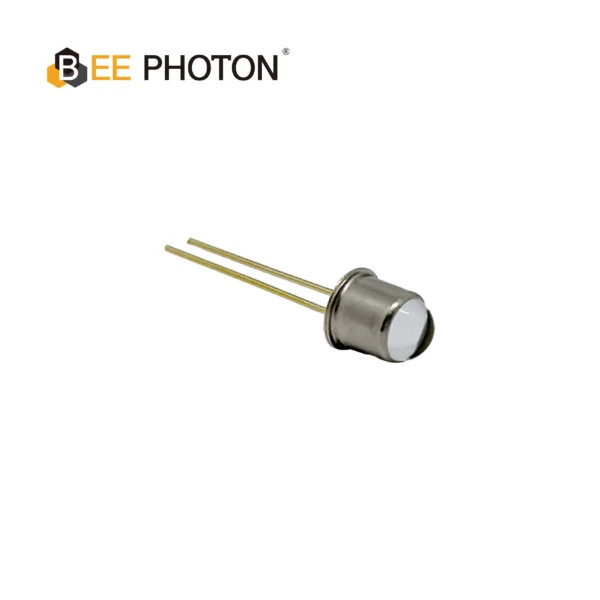
LED rojo E628-10-201L4
LED rojo de 625 nm de alto rendimiento para aplicaciones ópticas de precisión
En E628-10-201L4 de Bee Photon es una LED rojo de 625 nm diseñada para ofrecer una gran luminosidad y una fiabilidad excepcional en aplicaciones industriales exigentes. Diseñada con un ángulo de emisión estrecho de 4 grados, esta Emisor LED rojo de alta potencia proporciona una salida de luz focalizada, lo que la convierte en la solución perfecta para tareas de detección y señalización óptica de precisión en las que la exactitud es primordial.
Preguntas más frecuentes (FAQ)
¿Puedo integrar un LED azul en mi diseño actual de codificador óptico por infrarrojos?
Generally, you cannot just do a direct drop-in swap without checking two things: your sensor’s spectral sensitivity and your lens optics. While most modern silicon photodetectors can easily detect a LED azul para codificadores, es posible que los detectores más antiguos hayan sido filtrados para responder únicamente al infrarrojo. Además, las lentes colimadoras estándar diseñadas para IR podrían no enfocar la luz azul correctamente debido a la aberración cromática, por lo que se recomienda encarecidamente realizar un ligero ajuste en la lente o actualizar a un emisor de luz de codificador óptico dedicado es altamente recomendable.
¿Por qué se elige 465 nm en lugar de 405 nm o el verde de 525 nm?
La longitud de onda de 465 nm es el compromiso físico ideal. Bajar a 405 nm (violeta/UV cercano) reduce la difracción ligeramente más, pero acelera la degradación óptica de las lentes y los discos de código, además de presentar una baja sensibilidad en los detectores de silicio. Por otro lado, la luz verde de 525 nm tiene una longitud de onda mayor, lo que no ofrece los mismos beneficios de reducción de difracción que una de 465 nm. LED azul para codificadores.
¿Cuál es la vida útil típica de una fuente de luz de diodo de 465 nm y 4 mW?
Cuando se opera con corrientes conservadoras y estándar de la industria (normalmente entre 10 mA y 20 mA), una fuente de luz de alta calidad de diodo de 465 nm y 4 mW alcanza fácilmente una vida útil operativa superior a las 100.000 horas. Esto representa más de 11 años de funcionamiento industrial continuo las 24 horas, los 7 días de la semana. Un diseño térmico de PCB adecuado es clave para evitar el envejecimiento prematuro.
¿La luz azul ayuda en los codificadores reflectantes o es solo para los transmisivos?
A LED azul para codificadores es increíblemente beneficioso tanto para las tecnologías transmisivas como para las reflectivas. En los codificadores reflectivos, la luz debe rebotar en un patrón reflectante sobre un disco de acero o vidrio. Las longitudes de onda más cortas reducen la diafonía óptica y la dispersión durante esta reflexión, lo que da como resultado un contraste de señal mucho más nítido y una salida más estable, incluso si la separación entre el sensor y el disco varía ligeramente.
Lleve sus diseños de control de movimiento al siguiente nivel
¿Está listo para actualizar su diseño de codificador de próxima generación? Nuestro equipo de ingeniería en BeePhoton se especializa en el diseño y la fabricación de alto rendimiento de fuente de luz azul industrial opciones, matrices de fotodiodos y paquetes optoelectrónicos personalizados.
Ya sea que necesite un diodo de 465 nm y 4 mW emisor colimado estándar o un ensamblaje óptico multicanal completamente personalizado, estamos aquí para ayudarle a resolver sus desafíos de diseño más complejos.
¡Póngase en contacto con nosotros hoy mismo! Puede consultar nuestra línea completa de emisores especializados en nuestro catálogo de fuentes de luz industriales, o póngase en contacto con nuestro equipo de ingeniería directamente en info@photo-detector.com para solicitar fichas técnicas, pedir muestras o una cotización personalizada para su proyecto. Trabajemos juntos para que su próximo diseño sea increíblemente preciso.