If you are reading this, you’re probably neck-deep in a schematic for a new AAU (Active Antenna Unit) or trying to figure out why your Bit Error Rate (BER) is acting up in the optical fronthaul.
I’ve been there. The shift from 4G LTE to 5G NR isn’t just a frequency bump; it’s a complete architectural nightmare for hardware integration. We are talking about massive MIMO and eCPRI protocols that demand data rates we used to only worry about in core networks. And at the heart of this physical layer beast? The humble, yet critical, photodetector.
Today, I’m going to skip the marketing fluff. We are going to talk about High-Speed Photodiodes, specifically why off-the-shelf parts often fail in 5G applications, and how to choose the right 5G base station components without blowing your BOM cost.
The Reality of 5G Fronthaul: Speed Kills (If You Aren’t Ready)
When we moved from CPRI to eCPRI, the bandwidth requirement per channel jumped from roughly 10 Gbps to 25 Gbps (and now pushing 50 Gbps in some deployments).
Here is the thing: A standard photodiode that performed beautifully in a 4G remote radio head (RRH) will choke in a 5G environment. I remember consulting on a project in 2020 where an integrator tried to reuse legacy 10G PIN diodes for a 25G application by trying to overdrive the TIA (Transimpedance Amplifier).
It was a disaster. The inter-symbol interference (ISI) was off the charts.
For optical fronthaul sensors, you need detectors that balance three opposing forces:
- Speed (Bandwidth)
- Sensitivity (Responsivity)
- Cost (Because volume matters)
If you are looking for specific parts, you might want to check out our Si PIN photodiodes, which are often the workhorses for these short-reach applications.

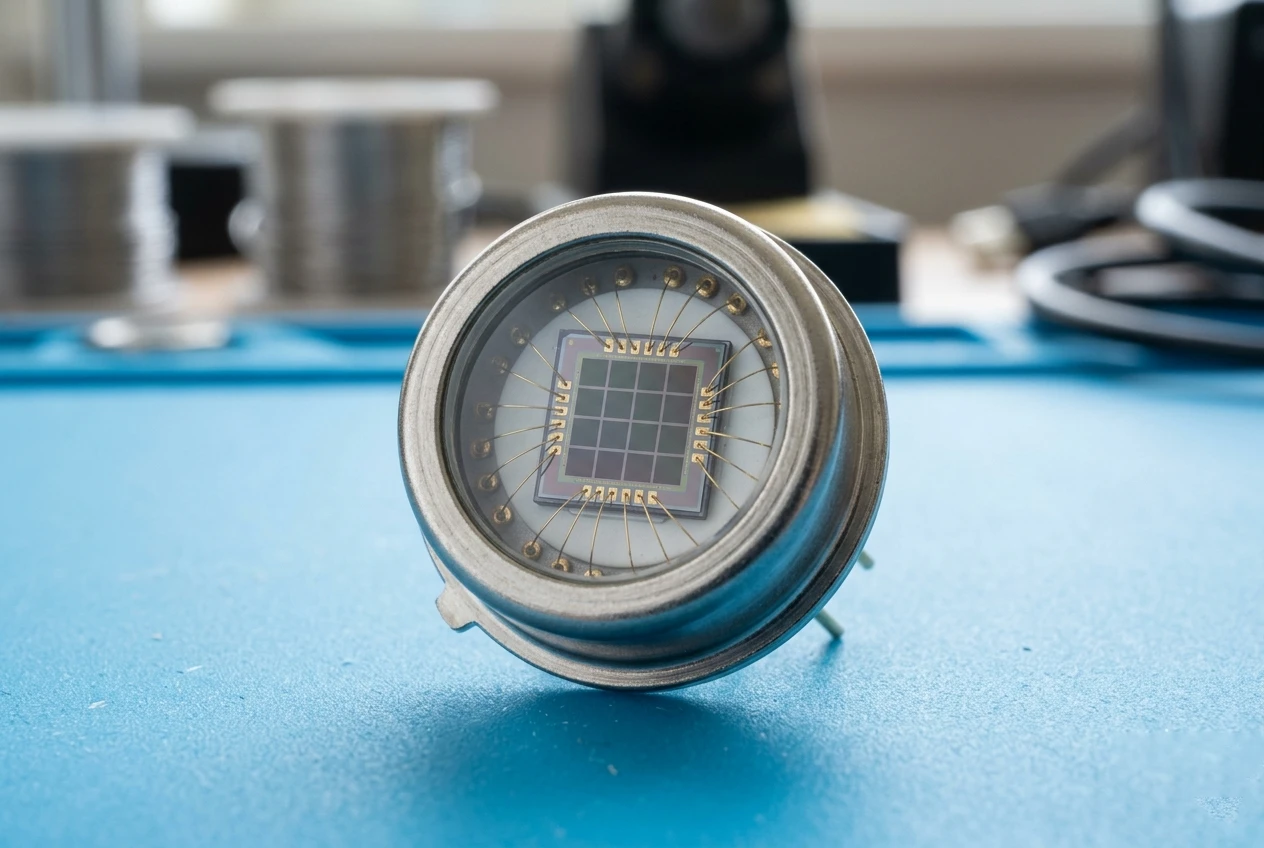
Si PIN Photodiode Array Dual PD PDCA02-101
The High Reliability Si PIN Photodiode Array (Model: PDCA02-101) is a premium dual-element detector designed for precision optical sensing. Featuring a compact 9.2×4.0×2.0 mm package and distinct photosensitive areas, this sensor delivers superior stability and low dark current for demanding industrial and medical applications.
Understanding the Physics (Without the Headache)
You don’t need a PhD in physics to select a diode, but you do need to understand what limits your speed. In high-speed PIN diode structures, the bandwidth (BW) is usually limited by two things: the transit time of carriers and the RC time constant.
For 5G applications, we are usually looking at the junction capacitance (Cj) like a hawk.
The RC Limit
The formula that dictates your life is essentially:
f_3dB = 1 / (2 * pi * R_load * C_j)
- f_3dB: The frequency where the response drops by 3dB.
- R_load: Your load resistance (usually 50 ohms).
- C_j: The junction capacitance.
To get higher speeds, you need lower capacitance. This usually means a smaller active area. But wait—if you make the active area too small, coupling light from the fiber becomes a nightmare of alignment tolerances. It’s a trade-off.
At BeePhoton, we’ve spent years optimizing this specific ratio. We found that for 25Gbps applications, keeping the capacitance under 0.15 pF is usually the sweet spot for easy packaging vs. performance.
PIN vs. APD: What Do You Actually Need?
I see this debate all the time in engineering meetings. “Should we use an Avalanche Photodiode (APD) for better sensitivity?”
Frankly, for most 5G fronthaul links (which are typically under 10km, and often just hundreds of meters), APDs are overkill. They require high bias voltages (often 40V+), complex temperature compensation circuits, and they are noisy.
For 850nm or 1310nm short-reach links, a well-engineered high-speed PIN diode is superior because:
- Linearity: They handle high optical power better (important when the AAU is close to the DU).
- Voltage: They run on low bias (usually 3V or 5V), simplifying your power supply design.
- Cost: significantly cheaper than APDs.
Comparison: 5G Base Station Requirements
I put together this table based on typical specs we see from Tier 1 integrators. This might help you align your requirements.
| Feature | Legacy 4G (LTE) | 5G Fronthaul (SFP28) | BeePhoton Recommendation |
|---|---|---|---|
| Data Rate | 1.25G – 10 Gbps | 25 Gbps (eCPRI) | High-Speed Si/InGaAs PIN |
| Wavelength | 1310nm / 1550nm | 850nm (SR) / 1310nm (LR) | Multi-mode optimized for SR |
| Rise Time | ~ 50 ps | < 15 ps | < 12 ps for margin |
| Responsivity | 0.85 A/W | > 0.6 A/W (at high freq) | High linearity focus |
| Bias Voltage | 3.3V | 2V – 3.3V | Low voltage operation |

Si PIN Photodiode with UV sensitivity enchanced (190-1100nm) PDCT25-F01
Our Si PIN Diode with Wide Dynamic Range ensures precise measurement of varying light intensities. Ideal for power meters, it offers excellent linearity across the 190-1100nm spectrum. A reliable Si PIN diode for consistent performance.
Technical Nuances That Bite You in the Rear
Let’s get into the weeds a bit. These are the things datasheets don’t always tell you, but you need to know.
1. The Packaging Parasitics
You can have the fastest chip in the world, but if you wire-bond it poorly, you’ve just built a low-pass filter. The inductance of the bond wire kills your high-frequency response.
When we design our modules at BeePhoton, we use flip-chip bonding or extremely short gold wire bonds to minimize inductance. If you are buying bare die to package yourself, keep those wires short!
2. Dark Current & Noise
In 5G base stations, heat is the enemy. AAUs sit on rooftops baking in the sun. As temperature rises, Dark Current ($I_d$) increases exponentially.
If your dark current is too high at 85°C, your noise floor rises, and your receiver sensitivity tanks.
Pro Tip: Always ask for the dark current data at 85°C, not just room temperature (25°C). We test all our optical fronthaul sensors at elevated temps to ensure they don’t drift out of spec in the field.
3. Saturation Power
5G networks are dense. Sometimes the optical signal coming in is strong. If your photodiode saturates easily, you get pulse width distortion. A good high-speed PIN needs to remain linear up to at least +3dBm or higher for these applications.
A Real-World Scenario (Anonymized)
We worked with a client—let’s call them “ComNet Solutions”—who was building a 25G bi-directional transceiver for the Asian market. They were seeing random link failures during high-traffic testing.
They initially blamed the laser driver. After we stepped in and hooked up a high-bandwidth oscilloscope, we saw the eye diagram on the receiver side was closing shut.
The culprit?
They were using a generic PIN diode with a capacitance of 0.3 pF. It was cheap, sure. But at 25Gbps, the RC time constant was smoothing out the “1”s and “0”s until they looked like sine waves.
The Fix:
We swapped it for a BeePhoton low-capacitance Si PIN (optimized for 850nm VCSEL links).
- Capacitance dropped to 0.12 pF.
- Rise time improved from 45ps to 14ps.
- The eye diagram opened up wide.
The project passed certification two weeks later. Sometimes, spending an extra few cents on the component saves you thousands in redesign costs.
How to Select the Right Part for Your Board
If you are browsing our Si PIN photodiodes section, keep this checklist in mind:
- Wavelength Match: Are you using Multi-mode fiber (850nm) or Single-mode (1310/1550nm)? Si is great for 850nm. You need InGaAs for the longer waves.
- Active Area Size: Don’t just go for the biggest area for easy alignment. For 25G, you usually need diameters < 40 microns.
- Integration: Do you need a bare die, a TO-can, or a pigtailed module? For base stations, TOSA/ROSA assemblies are standard, but custom pigtails allow for flexible board placement.

Si PIN Photodiode with UV sensitivity enchanced (320-1060nm) PDCC34-601
Experience our High Quantum Efficiency Photodiode for precise UV-NIR detection. This sensor ensures high responsivity for analytical and medical instruments.Its COB design and enhanced UV sensitivity (320-1060nm) make this Si PIN photodiode ideal for compact, high-performance applications.
Why BeePhoton?
Look, I know there are big giants in the industry. But here is why engineers like working with us. We don’t just send you a datasheet and wish you luck.
We understand the specific thermal and electronic constraints of 5G base station components. We test our stuff. We break our stuff so you don’t have to. Whether you need a standard part or a custom array for a massive MIMO setup, we speak your language.
Plus, we’re pretty fast on the email replies. No waiting three weeks for a “maybe.”
Frequently Asked Questions (FAQ)
Q1: Can I use a 10G photodiode for 25G applications if I use a better equalizer?
Answer: Generally, no. While a Continuous Time Linear Equalizer (CTLE) can compensate for some rolloff, a 10G diode usually has too much capacitance. You’ll be fighting physics, and your Signal-to-Noise Ratio (SNR) will likely be too poor to meet 5G BER standards.
Q2: What is the typical lifespan of these photodiodes in an outdoor base station?
Answer: This is a big concern. Reliable high-speed PIN diodes should pass Telcordia GR-468 reliability standards. We design ours to last 15-20 years, assuming the junction temperature stays within rated limits (usually under 100°C).
Q3: Si PIN vs. InGaAs for 850nm applications?
Answer: Silicon (Si) is actually quite good at 850nm and is much cheaper than Indium Gallium Arsenide (InGaAs). However, if you need extreme speeds (>50 Gbps), InGaAs might offer a slight edge in transit time, but for standard 25G fronthaul, Si is the cost-effective winner.
Q4: How does bias voltage affect the speed?
Answer: Increasing reverse bias reduces the junction capacitance (up to a point) and sweeps carriers out of the depletion region faster. However, go too high and you risk breakdown. We usually recommend a sweet spot between 2V and 5V for our high-speed series.
Let’s Solve Your Bandwidth Problem
5G isn’t waiting around, and neither should your engineering team. If you are struggling with receiver sensitivity or just need a second pair of eyes on your optical front-end design, reach out to us.
We have helped dozens of integrators streamline their optical fronthaul sensors, and we can do the same for you.
Ready to upgrade?
- Check out our products: https://photo-detector.com/
- Drop us a line for a custom quote or datasheet: info@photo-detector.com
- Need technical advice? Visit our Contact Page.
Don’t let a slow diode be the bottleneck in your high-speed network. Let’s build something fast.