I’ve spent the last twelve years helping factories and automation integrators sort out their optical sensing headaches. More times than I can count, the whole problem came down to the 850nm NIR LED they picked. Not because it was broken, but because it wasn’t the right tool for the job.
If you’re an engineer trying to keep optical switches triggering cleanly in dusty, hot, or vibration-heavy environments, this article is written for you. No fluffy theory. Just the stuff that actually matters when you have to bet your production line on an infrared emitter for optical switch.
Why 850nm NIR LED Dominates Industrial Sensing
Most people default to 850nm because silicon photodetectors respond extremely well at this wavelength. It’s far enough into the near-infrared that it’s basically invisible to the human eye, yet not so deep that you lose a ton of efficiency.
From what I’ve seen on factory floors, 850nm NIR LED also punches through moderate dust and oil mist better than visible red LEDs while still giving you fast rise and fall times. That’s critical when your optical switch needs to catch objects moving at 5–10 meters per second.
But here’s the part most datasheets won’t tell you: not all 850nm NIR LEDs are created equal. The difference between a cheap one and a properly engineered high radiance IR diode can mean the difference between 99.9% uptime and constant false triggers.
The Five Parameters That Actually Matter
When I audit a customer’s optical switch design, I only care about five things. Everything else is secondary.
Radiant Intensity (How Much Punch It Really Has)
This is the big one. Look for radiant intensity in mW/sr, not just total optical power.
In real industrial applications, I rarely accept anything under 50mW/sr at 100mA drive current. Our own NIR LED E850-180-201L4 measures 180mW/sr typical, which gives us breathing room when the lens gets dirty or the distance stretches.
Quick rule of thumb I use:
Required intensity (mW/sr) = (Detector sensitivity threshold × distance²) / Lens efficiency
Don’t worry about memorizing the formula. Just remember that every time you double the distance, you need four times the intensity to keep the same signal strength.
Viewing Angle – Don’t Guess This One
This is where most people go wrong.
- 15–30 degrees: Long distance, clean environments, precise positioning
- 40–60 degrees: Most common sweet spot for industrial optical switches
- 90+ degrees: Only if you need to flood an area with infrared emitter for optical switch coverage
I once had a customer using 120-degree 850nm NIR LEDs for a through-beam switch across 8 meters. The signal was so weak that birds flying through the beam would trigger the switch. We swapped to a 30-degree high radiance IR diode and the problem disappeared overnight.
Wavelength Tolerance and Temperature Drift
850nm is great until the temperature swings. Many cheap LEDs drift 0.3nm/°C. In a steel plant that goes from 5°C at night to 55°C during operation, that drift can push you right out of your detector’s peak sensitivity band.
Look for parts with tight binning (±10nm or better) and good thermal management. The industrial sensor lighting you deploy has to work the same at -20°C as it does at 70°C.
Package and Mechanical Robustness
This is the part nobody talks about until their LED fails six months in.
Industrial environments eat components. I strongly prefer LEDs with:
- Metal can or robust epoxy packages
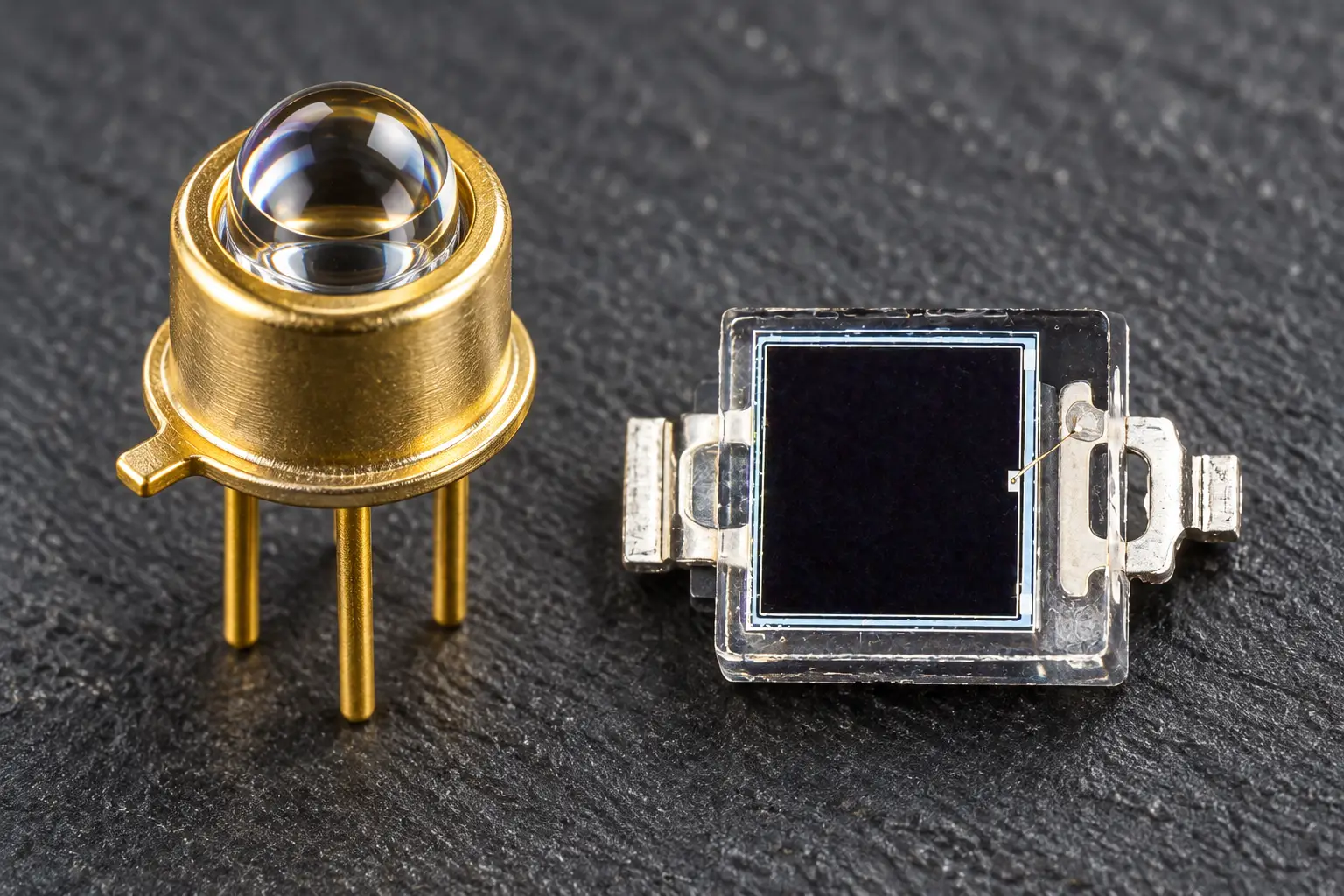
- Flat lenses that don’t collect dust as easily as domed ones
- Gold wire bonding (not aluminum) for long-term reliability
Forward Voltage and Current Requirements
Make sure your driver circuit can actually deliver the current without overheating the LED. Most of the 850nm NIR LEDs I recommend run comfortably at 100–150mA continuous, but you need proper heatsinking above 80mA.
Here’s a quick comparison table I give to clients:
| Parameter | Budget Option | Industrial Grade | Our E850 Series | What It Means for You |
|---|---|---|---|---|
| Radiant Intensity | 15–30 mW/sr | 80–120 mW/sr | 160–200 mW/sr | Detection distance & dirt tolerance |
| Viewing Angle | 60–90° | 30–50° | 20–40° | Precision vs coverage |
| Temp Range (operating) | -20 to +60°C | -40 to +85°C | -40 to +105°C | Reliability in real factories |
| Wavelength Tolerance | ±25nm | ±15nm | ±10nm | Consistent trigger points |
| Expected Lifetime | 15,000 hrs | 50,000+ hrs | 70,000+ hrs | How often you’ll replace it |
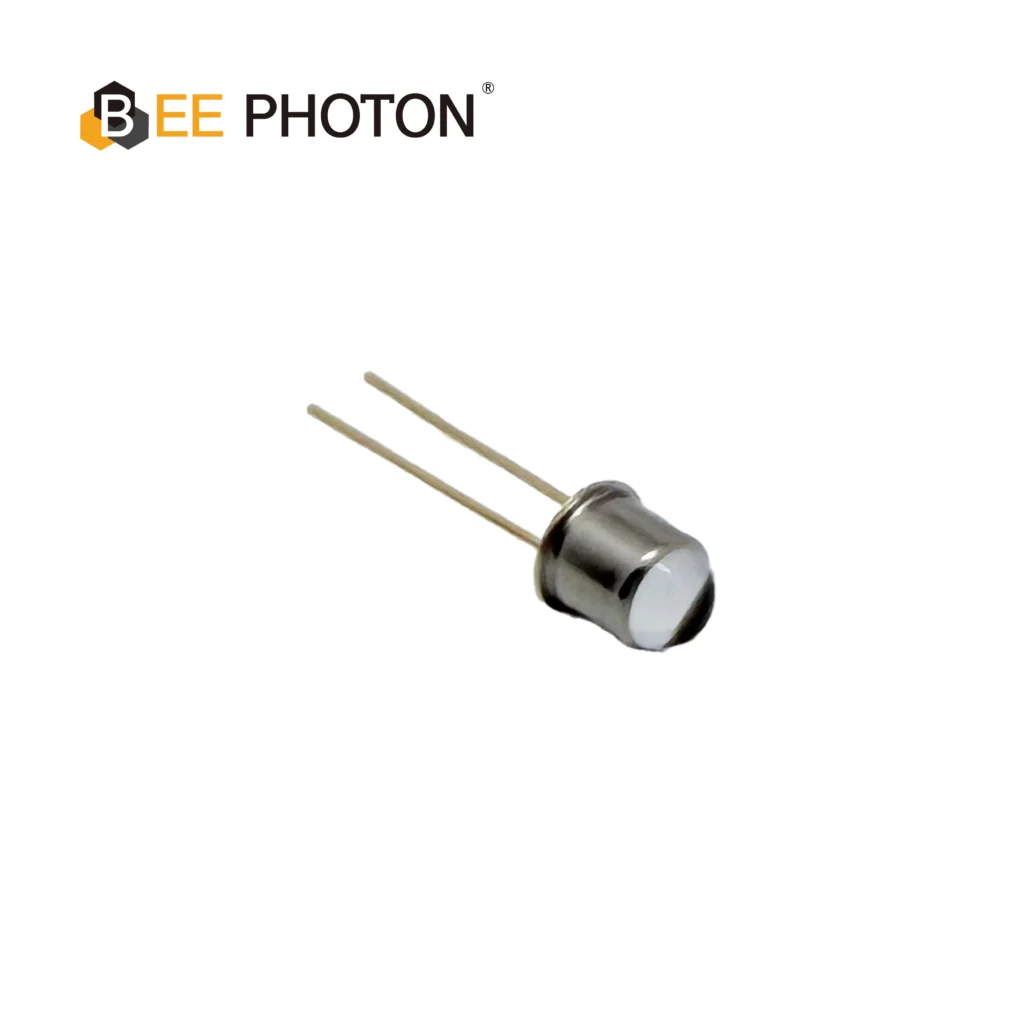
NIR LED E850-180-201L4
The E850-180-201L4 is a high-performance 850nm NIR LED engineered for precision industrial sensing. Manufactured by Bee Photon, this infrared emitter is designed to deliver high luminosity and exceptional stability, making it the ideal light source for demanding automation environments.
Matching Your 850nm NIR LED to the Application
Different optical switch types need different solutions.
Through-beam switches usually want narrow beam, high radiance 850nm NIR LED. You need every milliwatt to punch through steam, dust, or long distances.
Diffuse reflective switches are trickier. Too narrow a beam and you miss small targets. Too wide and you get false triggers from background objects. I usually recommend 40–50 degree 850nm NIR LED with moderate intensity for these.
Retro-reflective switches sit somewhere in the middle. The reflector helps so you can get away with slightly less intensity, but temperature stability becomes more important because the signal is so clean that even small drifts show up as instability.
Real-World Lessons from the Field
Last year we worked with a logistics company sorting packages at 3m/s. Their old infrared emitter for optical switch kept missing black plastic crates because the surface absorbed too much of the 850nm light. We switched them to a higher power 850nm NIR LED with better wavelength centering and added a small adjustment to the receiver threshold. False negative rate dropped from 4.2% to 0.07%.
Another client in food processing had condensation issues. The domed lenses on their cheap LEDs would fog up and kill the signal every time the temperature changed. We moved them to our flat-lens light source series and the problem basically vanished.
These aren’t lab examples. These are real production lines that run 20 hours a day.
How to Test Before You Buy
Don’t trust the datasheet alone. Here’s my standard test protocol:
- Drive the 850nm NIR LED at your intended current and measure actual radiant intensity at operating temperature.
- Cycle it from minimum to maximum temperature while monitoring wavelength shift.
- Spray it with fine dust or oil mist (whatever your environment throws at it) and see how fast the signal degrades.
- Check rise/fall time with an oscilloscope — anything over 50ns starts limiting your maximum switching speed.
If a supplier won’t give you samples to run these tests, that’s a red flag.
Common Mistakes Even Smart Engineers Make
- Buying based on total power (mW) instead of radiant intensity (mW/sr)
- Ignoring the temperature coefficient of the LED
- Using wide-angle LEDs for long-distance applications
- Forgetting that lens contamination will cut your intensity dramatically
- Choosing the cheapest 850nm NIR LED that “technically meets spec”
The last one bites people the hardest. That $0.12 LED might look fine on paper but will cost you thousands in downtime.
What We’ve Learned Building Our Own 850nm NIR LEDs
At BeePhoton, we make both photodetectors and the light sources that drive them. This gives us a unique view — we see exactly how the 850nm NIR LED and the detector interact in real applications.
That’s why our E850 series uses gold wire, tight wavelength binning, and packages designed for industrial sensor lighting rather than consumer remote controls. The difference shows up in the field.
Ready to Get This Right?
Stop guessing which 850nm NIR LED will work in your application.
The right choice isn’t about finding the “best” LED on the market. It’s about finding the one that matches your optical switch, environment, and reliability requirements.
If you want help narrowing it down, our team actually enjoys these conversations. Drop us a message on the contact us page, tell us your distance, speed, environment, and target size. We’ll tell you straight whether our 850nm NIR LED makes sense or if something else in our light source range would be better.
Or just email me directly at info@photo-detector.com. I answer technical questions from engineers pretty much every week.

NIR LED E850-25-001-L20
The E850-25-001-L20 is a high-performance 855nm NIR LED designed for demanding industrial applications. Manufactured by Bee Photon, this infrared emitter features a narrow 20-degree emission angle, delivering high radiant intensity of 25mW/sr tailored for precision sensing. Its robust design ensures high reliability and consistent output over a wide operating temperature range.
FAQ
Q1: Is 850nm NIR LED better than 940nm for industrial optical switches?
Usually yes. Silicon detectors have much higher response at 850nm, which gives you better signal-to-noise ratio. 940nm is useful when you need to avoid visible light even more strictly or when sunlight interference is extreme, but for most factory automation, 850nm NIR LED wins.
Q2: How long should a good industrial 850nm NIR LED actually last?
In proper conditions with good thermal design, 50,000 to 70,000 hours is realistic. We’ve seen our E850 series still running strong after five years in 24/7 packaging lines. The cheap ones? Sometimes they fade after 8–12 months.
Q3: Can I drive my 850nm NIR LED harder to get more distance?
Yes, but only up to a point. Most of our industrial-grade parts can handle 150–200mA with proper heatsinking. Beyond that you start killing lifetime fast. Better to choose a higher radiance IR diode than to overdrive a weak one.
Q4: What’s the biggest mistake you see with industrial sensor lighting?
Treating the LED as just another component instead of the heart of the detection system. The 850nm NIR LED, the optical path, the detector, and the signal processing all have to work together. Optimize only one piece and you’ll usually create problems somewhere else.