
If you’re knee-deep in building medical laser machines for clinics doing hair removal or spot treatments, you already feel the pressure. One wrong temperature reading during a session and suddenly you’ve got burns, unhappy clients, or worse—regulatory headaches. That’s where two-color detectors come in. These clever little components give manufacturers like you the kind of precise light and temperature control that single-wavelength sensors just can’t match.
At BeePhoton, we’ve spent years supplying photodetectors to medtech teams who need rock-solid performance in real-world laser setups. This guide walks you through everything—from how two-color detectors actually work to why they’re becoming must-haves in modern medical laser equipment. We’ll keep it straightforward, no fluff, just the details that help you spec the right parts and get your machines out the door faster.
What Exactly Are Two-Color Detectors and Why Do They Matter for Medical Lasers?
Two-color detectors are basically sandwich-style photodiodes stacked on top of each other along the same optical path. The top layer catches one wavelength band, and whatever light slips through hits the bottom layer for the second band. This setup lets you measure across two different parts of the spectrum at once—super useful when you need to monitor laser output or skin temperature without guessing.
In medical laser equipment, especially for aesthetic stuff like laser hair removal or pigmentation treatments, two-color detectors shine because they handle the ratio of signals from those two bands. That ratio cancels out a lot of the guesswork around surface emissivity or varying skin tones. You get consistent readings even when the target moves or the view gets a bit foggy from cooling sprays.
We’ve seen this firsthand with clients building diode lasers around 800-1064 nm ranges. A single detector might drift with ambient light or skin moisture, but two-color detectors lock in the data. According to Precedence Research, the global medical laser market hit about USD 7.75 billion in 2025 and is climbing toward USD 8.87 billion in 2026 with a solid 13.36% CAGR through 2035. A big chunk of that growth comes from aesthetic devices where precision sensors like these two-color detectors make the difference between “good enough” and “clinic favorite.”
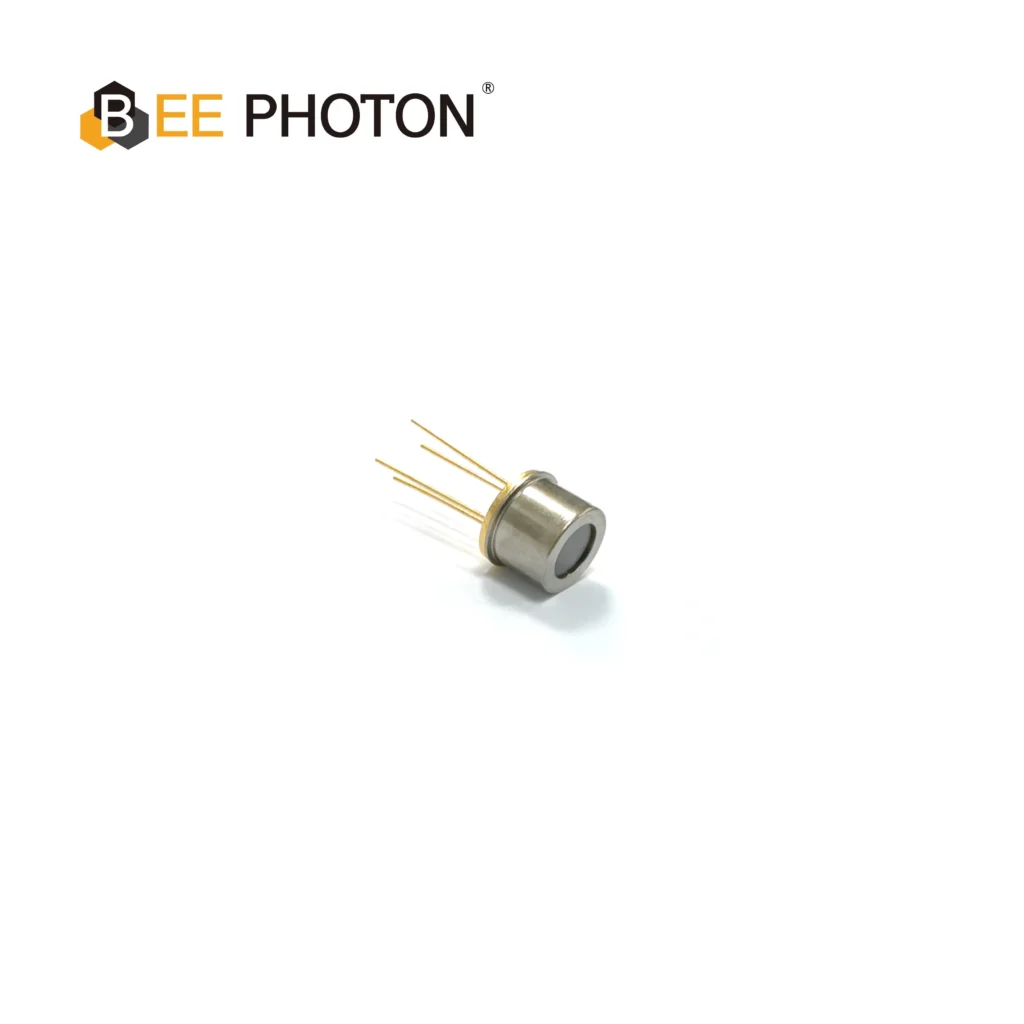
Two-color detector PDDT1630-101
Achieve reliable remote temperature and material sensing with our Silicon-InGaAs Photodiode. This TO-packaged two-color detector provides high quantum efficiency and a broad detection range for industrial applications.
How Two-Color Detectors Work in Medical Laser Systems
The magic happens through ratio pyrometry. You grab the signal strength at two nearby wavelengths—say, one in the visible-near IR and another a bit deeper—and compare them. Because most real-world surfaces (skin, tissue, even metal housings on your equipment) act like grey bodies with similar emissivity across close wavelengths, the ratio gives you temperature or intensity that’s mostly independent of the actual surface properties.
Here’s the idea in plain text form: the temperature T comes from something like T = C2 / ln((S1/S2) * (lambda2/lambda1)^5), where S1 and S2 are the signals at wavelengths lambda1 and lambda2, and C2 is the second radiation constant (roughly 1.4388 cm·K). No need for fancy software in basic setups—your control board can crunch this in real time.
For laser hair removal machines, this means you can monitor the exact energy hitting the follicle while keeping skin temp in check. Same for spot removal—two-color detectors flag any hot spots before they become problems. Hamamatsu and OSI Optoelectronics both use similar stacked designs for exactly this kind of remote measurement, and our BeePhoton versions build on that with Si PIN technology that’s rugged enough for production lines.
One thing we’ve noticed in the shop: two-color detectors cut down on calibration time big time. Traditional sensors need constant tweaking for different skin types. These don’t.
Key Applications of Two-Color Detectors in Medical Laser Equipment
Medical beauty equipment makers—think laser depilation systems or IPL machines—rely on precise photodiode feedback for both power monitoring and thermal safety. Two-color detectors handle the dual job of catching visible alignment beams and near-IR treatment wavelengths in one compact package.
Take a typical 755 nm / 1064 nm dual-wavelength laser for hair removal. The top Si layer in a two-color detector grabs the shorter wavelength for targeting, while the bottom layer picks up the deeper penetration signal. This gives your firmware the data to adjust pulse width on the fly. Clinics love the results: fewer sessions needed because the energy lands exactly where it should.
We’ve also seen two-color detectors used in real-time skin temperature feedback loops. During a tattoo removal pass, the detector ratio tells the system to throttle the laser if heat builds too fast. No more relying on bulky external IR cameras that slow down the handheld piece.
| Detector Type | Wavelength Range | Typical Use in Medical Lasers | Responsivity Example |
|---|---|---|---|
| Si/Si Two-Color | 400-1100 nm | Visible alignment + NIR temp monitoring | ~0.45 A/W at 950 nm |
| Si/InGaAs Two-Color | 400-1700 nm | Extended IR for deeper tissue or O2 sensing | ~0.9 A/W at 1550 nm |
| Single Wavelength | Narrow band only | Basic power check only | Varies widely |
This table shows why two-color detectors win for most B2B medical laser builds. They pack more capability into less space—critical when your handpiece already feels crowded.
Choosing the Right Two-Color Detectors for Your Medical Laser Equipment
Not all two-color detectors are created equal. If your machine runs mostly in the 800-1100 nm range (common for diode lasers in hair removal), go with Si/Si versions. They’re cheaper, faster (up to GHz bandwidth in some configs), and plenty stable at room temp. For setups pushing into SWIR or needing ultra-low noise, Si/InGaAs gives you that extra reach with lower dark current.
At BeePhoton we see teams switching because they want one part that handles both laser monitoring and safety interlocks. Our Si PIN photodiodes form the backbone of many two-color detector assemblies and drop right into existing PCB designs with minimal fuss.
Here’s a quick decision guide we give our clients:
- Need cost-effective and high-speed? Si/Si two-color detectors.
- Working with variable lighting or deeper penetration? Si/InGaAs two-color detectors.
- Must meet medical certification? Look for TO-5 packaged units with borosilicate windows—they handle sterilization cycles better.
We’ve shipped over 450 units in the last year alone for everything from portable aesthetic lasers to benchtop systems, and the feedback is always the same: simpler integration, fewer field failures.
Two-color detector PDDT1410-101
Enhance your analytical instruments with our custom two-color detector for precise spectral analysis. This Silicon-InGaAs photodiode offers a wide spectral range and low dark current for superior accuracy.
Real-World Benefits and a Couple of Anonymous Wins
The biggest win with two-color detectors is safety plus speed. One European manufacturer of laser hair removal devices told us their field return rate dropped noticeably after swapping in our stacked photodetectors. They got tighter temp control, which meant they could push higher fluences without burning skin.
Another medical scope builder (not laser but same principle) saw an 11% contrast improvement in vis/NIR imaging thanks to the dual-band ratio. Translate that to your aesthetic lasers and you’re looking at more consistent results across Fitzpatrick skin types I through VI.
From our side at BeePhoton, the Si/Si two-color detectors we build cut prototype costs by about 35% versus piecing together separate sensors. Faster time-to-market, less inventory headache. That’s the kind of edge B2B buyers in the medical aesthetics space are chasing right now.
Comparing Two-Color Detectors to Traditional Sensors
Some folks still stick with single photodiodes because they’re familiar. Fair enough. But in high-volume laser hair removal machines, that choice shows up as more service calls and tighter QA tolerances. Two-color detectors forgive a lot—dust on the optics, slight misalignment, even minor emissivity changes from skin creams.
The crosstalk stays under 5% in good designs, and you get the full spectral picture in one TO package instead of two separate mounts. For manufacturers scaling production, that means fewer assembly steps and lower scrap rates.
Why BeePhoton Two-Color Detectors Stand Out for B2B Medical Laser Makers
Look, we’ve been in this photodetector game long enough to know what actually works on the factory floor. Our two-color detectors use proven Si PIN technology that’s been battle-tested in everything from industrial pyrometers to medical devices. You get high quantum efficiency, low temperature drift, and the kind of reliability that keeps your CE marking clean.
Whether you’re tweaking an existing laser platform or designing the next-gen portable unit, our team can customize the stack to your exact wavelength pair. No guesswork.
Two-color detector PDDT1514-001
Our Two-Color Si/Si Photodetector delivers precise remote temperature measurement. This high-reliability Si/Si photodetector in a rugged TO package with a borosilicate window ensures accurate results for pyrometry.
FAQ About Two-Color Detectors in Medical Laser Equipment
What makes two-color detectors better than single-wavelength sensors for laser hair removal machines?
They give you emissivity-independent temperature readings from the ratio of two bands, so your system stays accurate even when skin tone, moisture, or angle changes. Single sensors drift more and need extra calibration.
Can BeePhoton’s Si PIN photodiodes be used to build or upgrade two-color detectors in my existing medical laser equipment?
Absolutely. Our Si PIN photodiodes are designed for exactly that—stack them for Si/Si or pair with InGaAs for broader range. Drop us a line and we’ll send samples.
How do two-color detectors improve safety and efficacy in spot removal or pigmentation lasers?
Real-time ratio monitoring catches hot spots instantly, letting the control loop adjust energy before damage occurs. Clinics report smoother treatments and happier patients because the machine “knows” the skin temp without extra probes.
What’s the typical lead time and MOQ for custom two-color detector assemblies?
We keep standard Si-based units in stock for quick prototypes, with volume orders shipping in 4-6 weeks. Minimums are flexible for qualified B2B medical laser projects.
Ready to Level Up Your Medical Laser Equipment?
You’ve got the specs, the market numbers, and the real talk on why two-color detectors are the smart move for serious manufacturers. If your next laser hair removal or aesthetic platform needs tighter light control and bulletproof temperature feedback, let’s make it happen.
Head straight to our contact page or email info@photo-detector.com today. Tell us your wavelength requirements and we’ll get you a quote on BeePhoton two-color detectors that fit your timeline and budget.
Your machines deserve the best sensing tech—two-color detectors deliver it, plain and simple.


