I’ve spent a good decade looking at failed meter designs, and let me tell you, it’s rarely the big stuff that breaks. It’s almost always the optical port. You’ve got a smart meter sitting on a wall in a dusty basement or under the scorching sun in Dubai, and suddenly, the utility guy can’t get a reading. Why? Because the PIN photodiode for smart meter communication was either an afterthought or just plain wrong for the job.
If you’re an engineer at a grid company or a meter manufacturer, you know that the infrared (IR) interface is the “handshake” between the meter and the world. In this guide, I’m going to skip the textbook fluff and get into the weeds of how to choose and implement Si PIN photodiodes that actually survive the real world. At BeePhoton, we’ve seen what works, and honestly, a lot of the standard advice out there is just too generic.
The Reality of IEC 62056-21 and IR Communication
Most of us are working within the IEC 62056-21 standard (formerly IEC 1107). It’s the bread and butter of local meter reading. It defines how the optical probe sticks to the meter and how data flows over that 940nm (usually) light beam.
But here is the thing—standards tell you what to do, not how to make it bulletproof. When you are designing the optical port, you are fighting three enemies:
- Ambient Light Interference: Sunlight or fluorescent bulbs trying to drown out your signal.
- Temperature Shifting: Components drifting when the meter gets hot.
- Speed Requirements: Ensuring the rise and fall times don’t smear your data bits.
Using a generic phototransistor might save you a few cents, but for a professional-grade smart meter, a PIN photodiode is the only way to go. Why? Speed and linearity.
The “Not-So-Boring” Physics: Why PIN Diodes Win
I promise I won’t turn this into a physics lecture, but we need to talk about the “I” in PIN. That Intrinsic layer is the secret sauce.
In a standard PN junction, the depletion region is tiny. In a PIN photodiode, that thick intrinsic layer allows for a much larger volume to capture photons. This means lower capacitance (which equals more speed) and better sensitivity.
The Math You Actually Need
When you’re calculating the performance of your PIN photodiode for smart meter designs, you’ll likely look at the Photocurrent (Ip). It’s pretty simple:
Ip = R x P_in
Where:
- Ip is the photocurrent produced (Amps).
- R is the Responsivity (Amps per Watt, A/W).
- P_in is the incident optical power (Watts).
For a typical 940nm IR system, you’re looking for an R value around 0.55 to 0.65 A/W. If your supplier isn’t giving you a clear curve on this, run.
Another big one is the Bandwidth (f_3dB). If your baud rate is high, you need to make sure your RC time constant doesn’t kill you:
f_3dB = 1 / (2 x pi x R_L x C_j)
- pi is approx 3.14159.
- R_L is your load resistor.
- C_j is the junction capacitance.
At BeePhoton, we often suggest keeping C_j as low as possible (under 10pF for high-speed stuff) so you have plenty of “headroom” for your circuit.

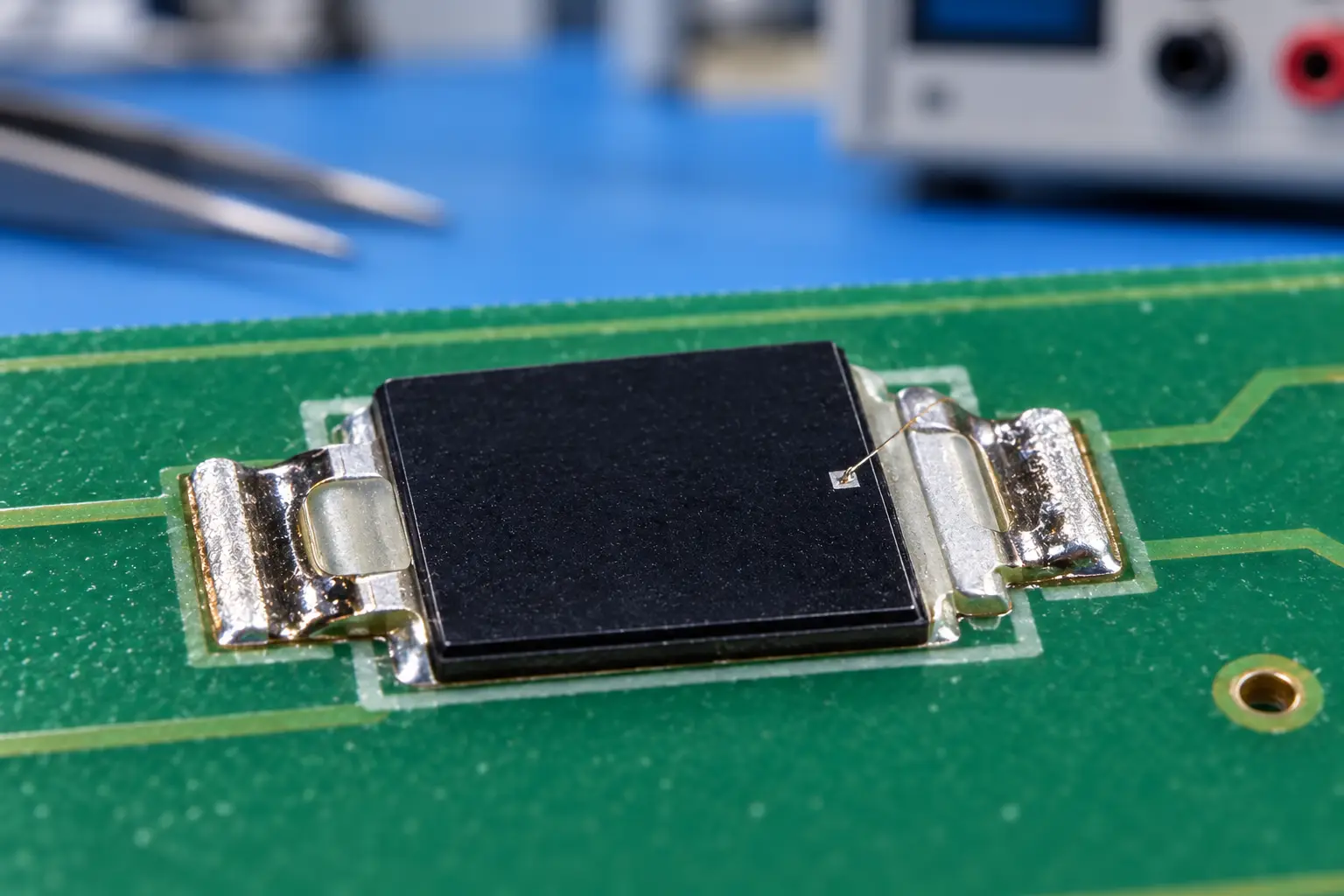
Si PIN Photodiode with low dark current (350-1060nm) PDCC34-001
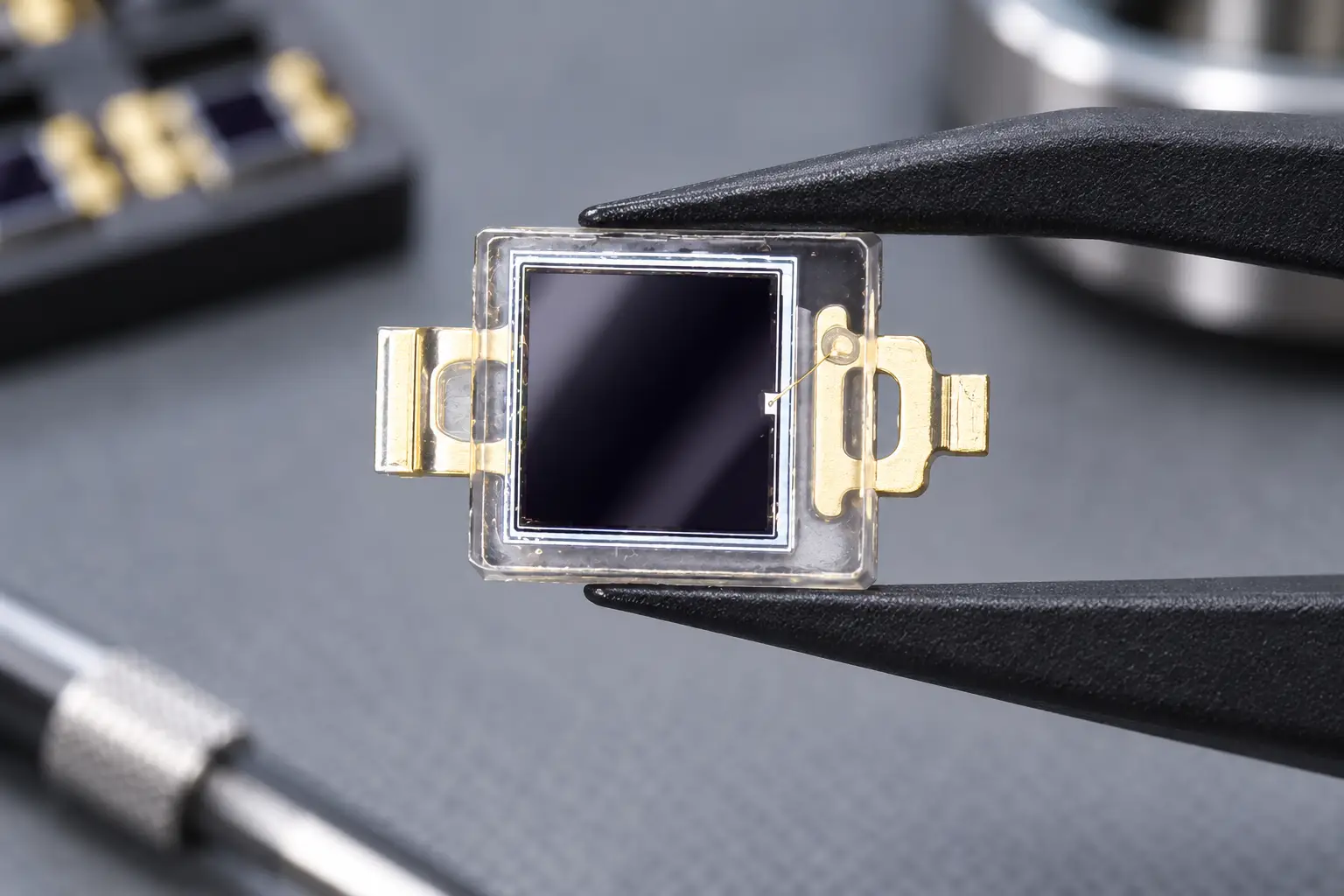
Bee Photon offers a compact COB Si PIN Photodiode with wide spectral response (350-1060nm). This Chip-on-Board photodiode features low dark current, ideal for integrated and space-constrained applications.
Designing the Optical Port: A Practical Comparison
I’ve put together this table because I’m tired of seeing people compare apples to oranges when they pick components.
| Feature | Low-Cost Phototransistor | Professional PIN Photodiode | BeePhoton BP-Series |
|---|---|---|---|
| Response Speed | Slow (ms range) | Very Fast (ns range) | Sub-10ns |
| Linearity | Poor (saturates easily) | Excellent | Optimized for 850-950nm |
| Temp Stability | Bad (drifts a lot) | Stable | High-Temp Grade Available |
| Cost | Lowest | Moderate | Competitive Factory Direct |
| Main Use Case | Toy remotes, basic sensors | Smart Grids, Industrial Comms | DLMS/COSEM Smart Meters |
Honestly, if you are building meters for a national grid, using a phototransistor is just asking for a massive recall in five years. The drift alone will kill your signal-to-noise ratio.
Dealing with the “Sunlight Problem”
One of the most common complaints I get from field engineers is: “The meter works in the lab, but it fails in the field at 2 PM.”
That’s the sun for you. Sunlight is a massive source of IR noise. To fight this, you need a two-prong approach:
- Optical Filtering: Your PIN photodiode for smart meter should have a daylight filter (that black-looking epoxy) that cuts off everything below 700nm or 800nm.
- Transimpedance Amplifier (TIA) Design: You need a circuit that can handle a high DC offset (from the sun) while still amplifying the tiny AC signal (your data).
I’ve seen some “clever” designs try to do this with software, but trust me, fix it in the hardware first. If the photodiode is saturated, no amount of code will save you.
Why We Built BeePhoton the Way We Did
When we started BeePhoton, we noticed a gap. You had the giant Japanese or US manufacturers who didn’t care about a “small” 50,000-unit meter run, and then you had the “no-name” vendors where the specs changed every Tuesday.
We focused on the IR communication diode niche because smart metering is critical infrastructure. We make sure our silicon is consistent. If you buy a batch in 2024 and another in 2026, the spectral response curve is going to be identical. That matters when you’re calibrating millions of units.
A Quick “Case Study” (No Names, Just Facts)
We had a client in Eastern Europe who was experiencing a 15% failure rate in their smart gas meters. They were using a cheap IR diode. It turned out that as the humidity rose, the packaging on their old diodes was delaminating, causing a shift in the refractive index.
We swapped them over to our hermetically sealed (or high-grade resin) Si PIN series. They didn’t even have to change their PCB layout—just a drop-in replacement. Failure rate dropped to near zero. Sometimes, “expensive” components are actually the cheapest way to go when you factor in the cost of a truck roll to fix a broken meter.
Technical Deep Dive: Responsivity and Quantum Efficiency
If you really want to impress your boss, don’t just talk about “sensitivity.” Talk about Quantum Efficiency (QE).
QE = R x ( (h x c) / (q x lambda) )
- h = Planck’s constant (6.626 x 10^-34 J s)
- c = Speed of light (3 x 10^8 m/s)
- q = Electron charge (1.6 x 10^-19 C)
- lambda = Wavelength (e.g., 940 x 10^-9 m)
In plain English, QE is the percentage of photons hitting the diode that actually turn into electrons. For a high-quality PIN photodiode for smart meter, you want this number to be as high as possible—usually above 80% at the peak wavelength.

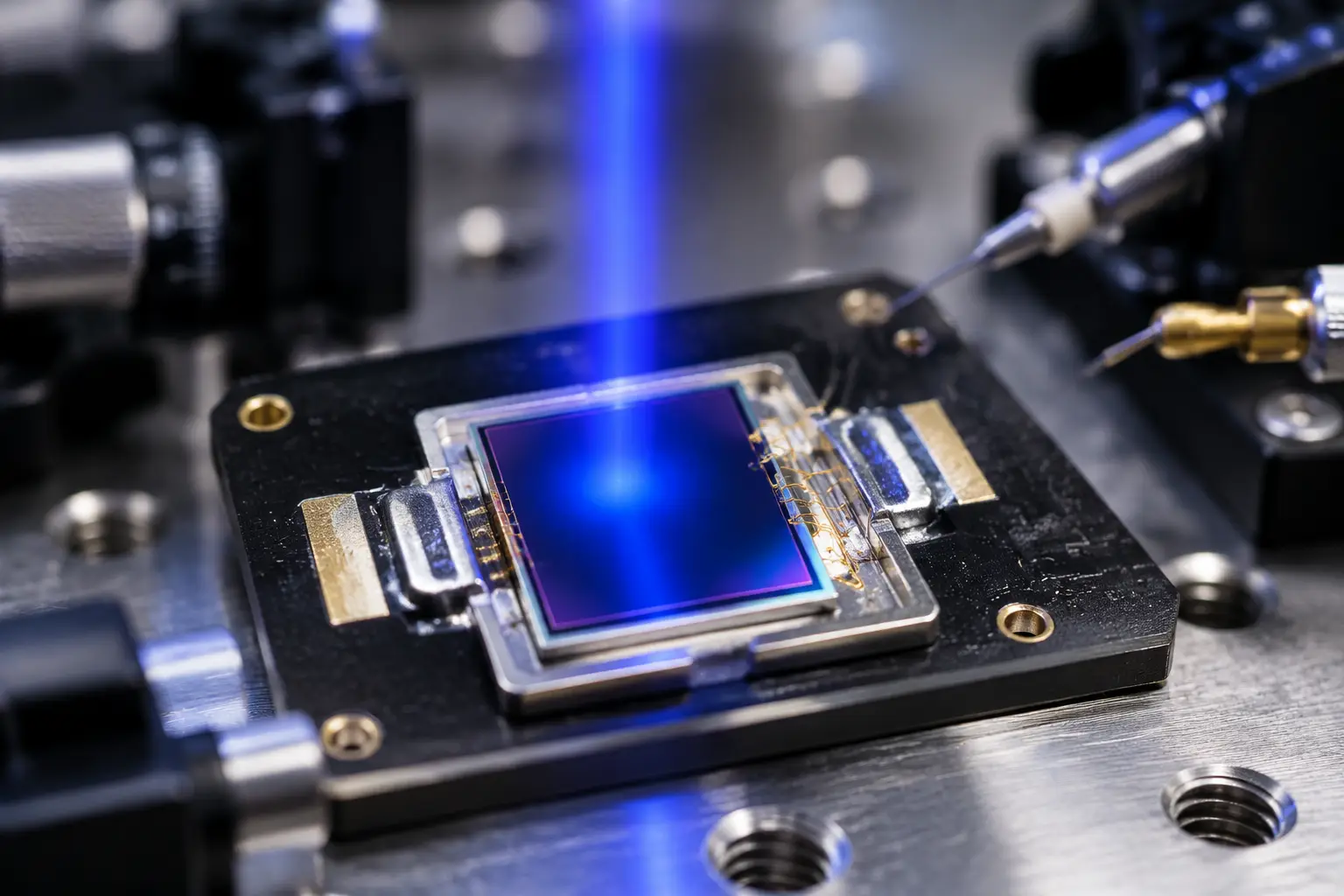
Si PIN Photodiode with low dark current (350-1060nm) PDCT14-001
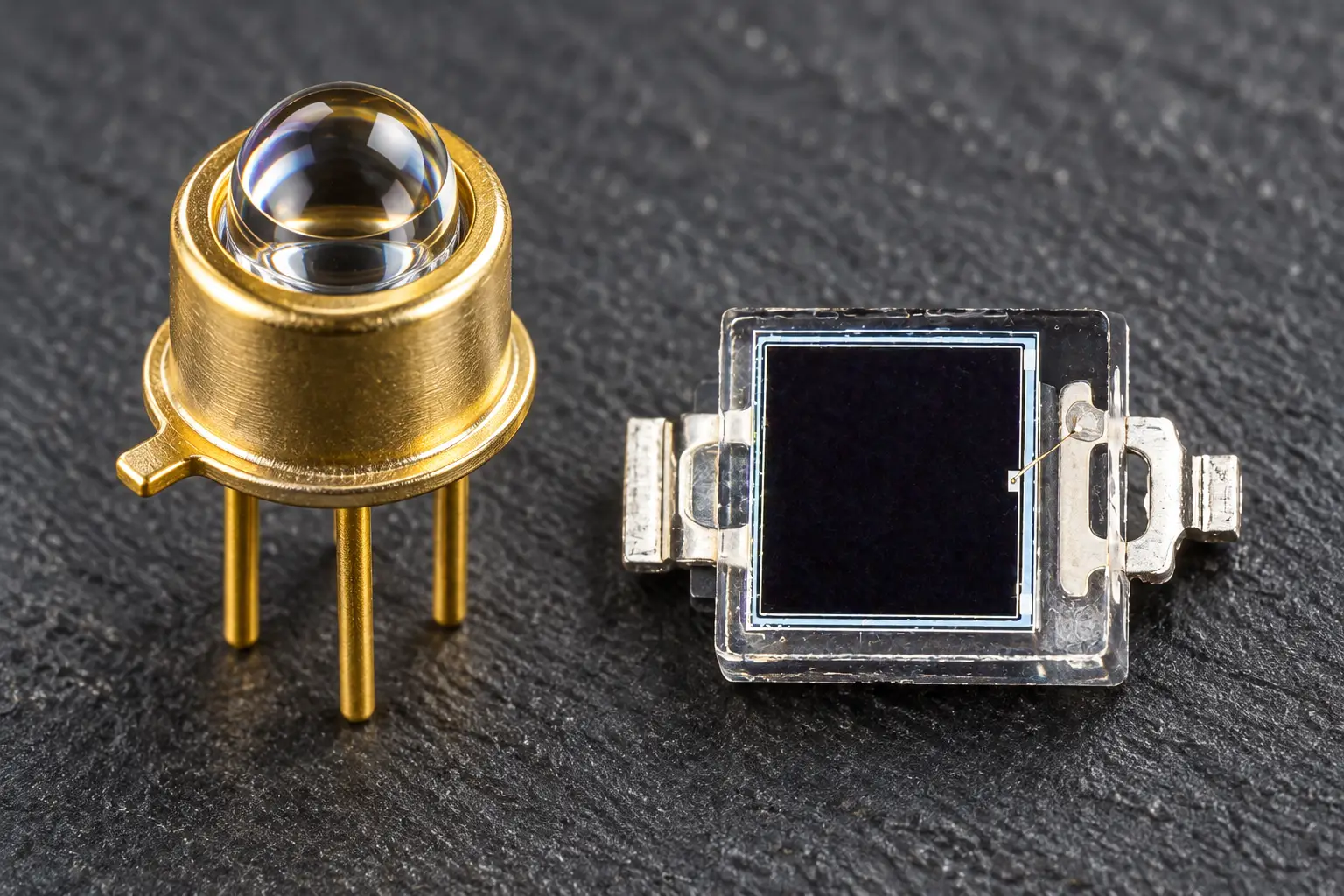
Enhance your optical measurement equipment with our TO-packaged Si PIN photodiode. It features ultra-low dark current, high consistency, and a borosilicate window for durability. This high-performance Si PIN photodiode is optimized for demanding applications.
How to Integrate BeePhoton Diodes into Your Workflow
If you’re currently in the middle of a design cycle, don’t wait until the prototype stage to test your IR port.
- Check the footprint: Most of our PIN diodes come in standard through-hole (like 5mm or 3mm) or SMD packages (1206, etc.).
- Bias Voltage: PIN diodes like a little reverse bias to minimize capacitance. Even 3.3V or 5V is enough to “speed up” the diode for most DLMS/COSEM baud rates.
- Alignment: The IEC standard defines the mechanical alignment. Make sure your mounting bracket holds the photodiode and the IR LED in the exact center of the optical window.
If you are stuck, you can always contact our engineers directly. We don’t just sell parts; we help with the circuit design too.
Common Mistakes to Avoid
I’ve made plenty of mistakes in my career, so you don’t have to. Here are the big ones for smart meter ports:
- Ignoring Dark Current: As the meter gets hot, the “Dark Current” (the current that flows even when there’s no light) increases. If your threshold is too tight, the meter might think it’s receiving data when it’s just “sweating.”
- Poor Soldering: IR diodes are sensitive to heat. If your assembly line is too aggressive with the reflow oven, you can degrade the silicon.
- Plastic Windows: Using the wrong type of plastic for the meter’s outer case. Some plastics look clear to us but are “brick walls” to 940nm IR light. Always test the transmission of your casing.
The Future of Smart Metering Ports
We’re starting to see higher baud rates—moving from 9600 up to much higher speeds for firmware updates over the air (or over the port). This is where the PIN photodiode for smart meter really shines. Phototransistors just can’t keep up with the 115.2 kbps speeds some utilities are now demanding.
Also, with the rise of “smart cities,” these meters are expected to last 15 to 20 years. That requires a level of component aging stability that only high-quality silicon can provide.
Wrapping Things Up
Look, choosing a PIN photodiode for smart meter isn’t the most glamorous part of engineering, but it’s the difference between a product that works and a product that generates a mountain of customer complaints. At BeePhoton, we take this stuff seriously because we know you’re building the backbone of the energy grid.
If you want to look at the specific specs of our latest silicon, head over to our Si PIN photodiodes page. We’ve got the datasheets ready for you.
And hey, if you’ve got a weird design requirement—maybe a super small footprint or a specific spectral peak—just shoot us an email. We’re usually pretty quick to respond.
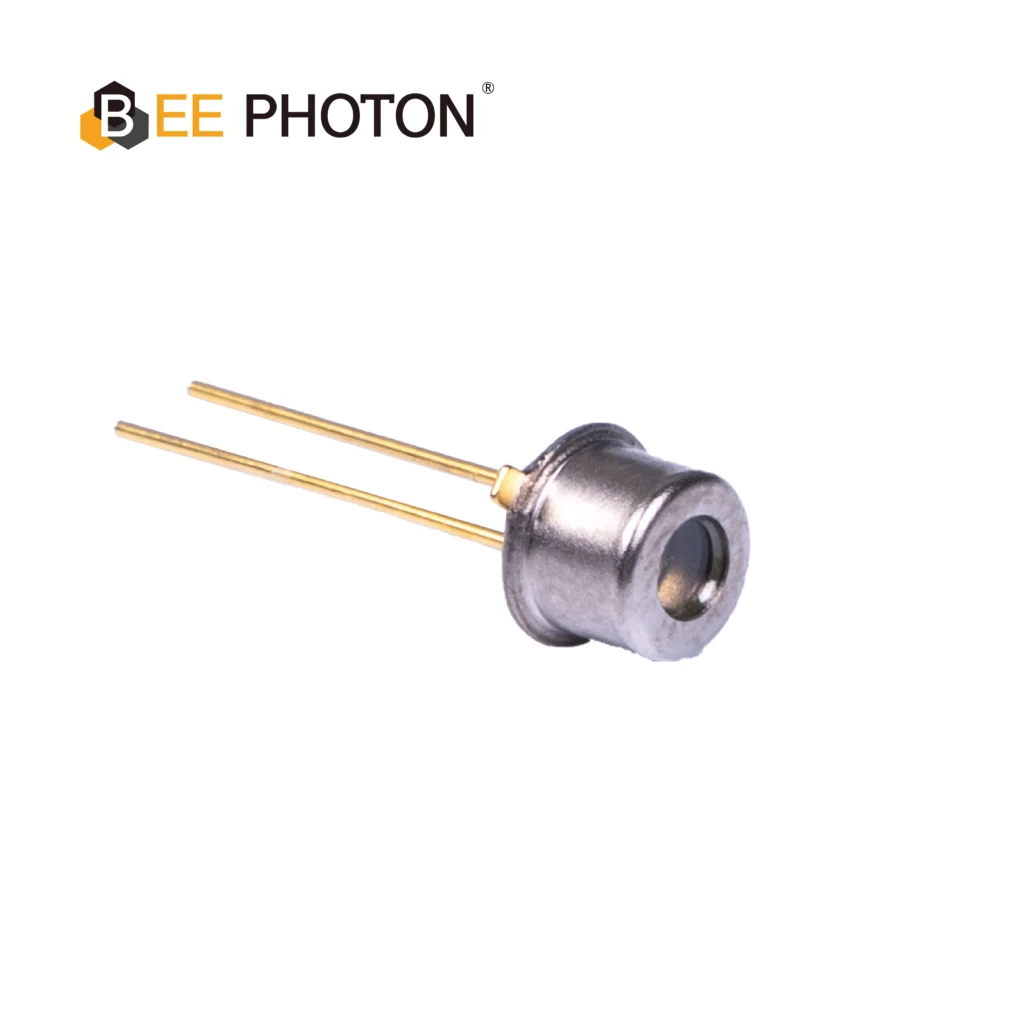
Si PIN Photodiode with low dark current (350-1060nm) PDCT01-201
Experience superior signal clarity with our Si PIN photodiode, engineered for ultra-low dark current and high stability. This photodiode ensures precise laser detection and optical measurements. Our low dark current Si PIN photodiode offers exceptional performance.
FAQ: Everything You Wanted to Ask (But Were Too Busy to Search)
Q1: Can I use an 850nm PIN photodiode for a 940nm system?
Generally, yes. Silicon PIN photodiodes have a fairly broad spectral response. However, the responsivity might be slightly lower at 940nm than at its peak. It’s always best to check the curve in our datasheet. For smart meters, we usually optimize for the 880nm-950nm range to cover all bases.
Q2: What’s the advantage of an SMD PIN photodiode over through-hole for meters?
It’s mostly about your assembly process. SMD is great for high-volume automated pick-and-place. However, through-hole (3mm/5mm) can sometimes be easier to align mechanically with the meter’s outer casing. We offer both, so it’s really down to your mechanical design.
Q3: How do I reduce the noise from indoor LED lighting?
This is a big one. Many modern LED lights flicker at high frequencies that can mimic data. Using a PIN photodiode with a built-in IR filter is step one. Step two is using a band-pass filter in your receiver electronics to only let through the frequencies relevant to your baud rate.
Q4: Is there a minimum order quantity (MOQ) for BeePhoton parts?
We’re pretty flexible. We work with both small-scale specialized manufacturers and massive grid suppliers. Just drop us a line at info@photo-detector.com and we can talk about your specific project needs.
Ready to Upgrade Your Meter Design?
Don’t let a cheap component be the weak link in your smart grid infrastructure. Our team at BeePhoton is ready to provide you with the high-performance IR communication diodes you need to meet IEC standards and exceed customer expectations.
- Browse our catalog: Si PIN Photodiodes
- Request a Quote: Contact BeePhoton
- Direct Inquiry: info@photo-detector.com
Let’s build a more reliable grid together. Reach out today for a technical consultation or to request samples for your next prototype.