If you are tasked with keeping the lights on at a power grid or managing the floodgates at a massive hydro dam, you already know that standard security equipment is basically useless out there. I’ve spent a lot of time crawling around substations in the dead of winter and checking perimeter setups near dam spillways, and I’ll tell you firsthand: the elements will destroy your equipment if you aren’t careful.
We are talking about real critical infrastructure security. You can’t just slap a waterproof sticker on a commercial detector and expect it to survive a decade of thermal shocks, electromagnetic interference, and 100% humidity. You need actual harsh environment sensors.
Getting detector reliability right in these places isn’t just about avoiding a few false alarms. A false positive in a major substation security system can trigger automated lockdowns, roll out expensive emergency response teams, and completely mess up your operations. So, we need to talk about what actually makes harsh environment sensors work, and why most of the stuff you buy off the shelf is going to fail on you when you need it most.
The Big Lie About “Rugged” Security Sensors
I’m just going to say it: most IP67 or IP68 ratings on spec sheets for commercial security sensors are borderline fiction when applied to critical infrastructure.
Sure, a plastic-packaged photodiode might pass a lab test where they dunk it in a tank of water for 30 minutes. That’s great for a consumer smartphone. But what happens when that same plastic package sits on a concrete dam face for five years?
You get moisture ingress. Plastic and epoxy resins are not completely impermeable to water vapor over long periods. When you are deploying harsh environment sensors at a hydro facility, the humidity is relentless. The temperature drops at night, and that moisture vapor condenses right onto the silicon chip inside the sensor. Next thing you know, you’ve got a short circuit or the optical window fogs up from the inside. Your security perimeter is now totally blind, and you definitly don’t want to find out about it during a real intrusion event.
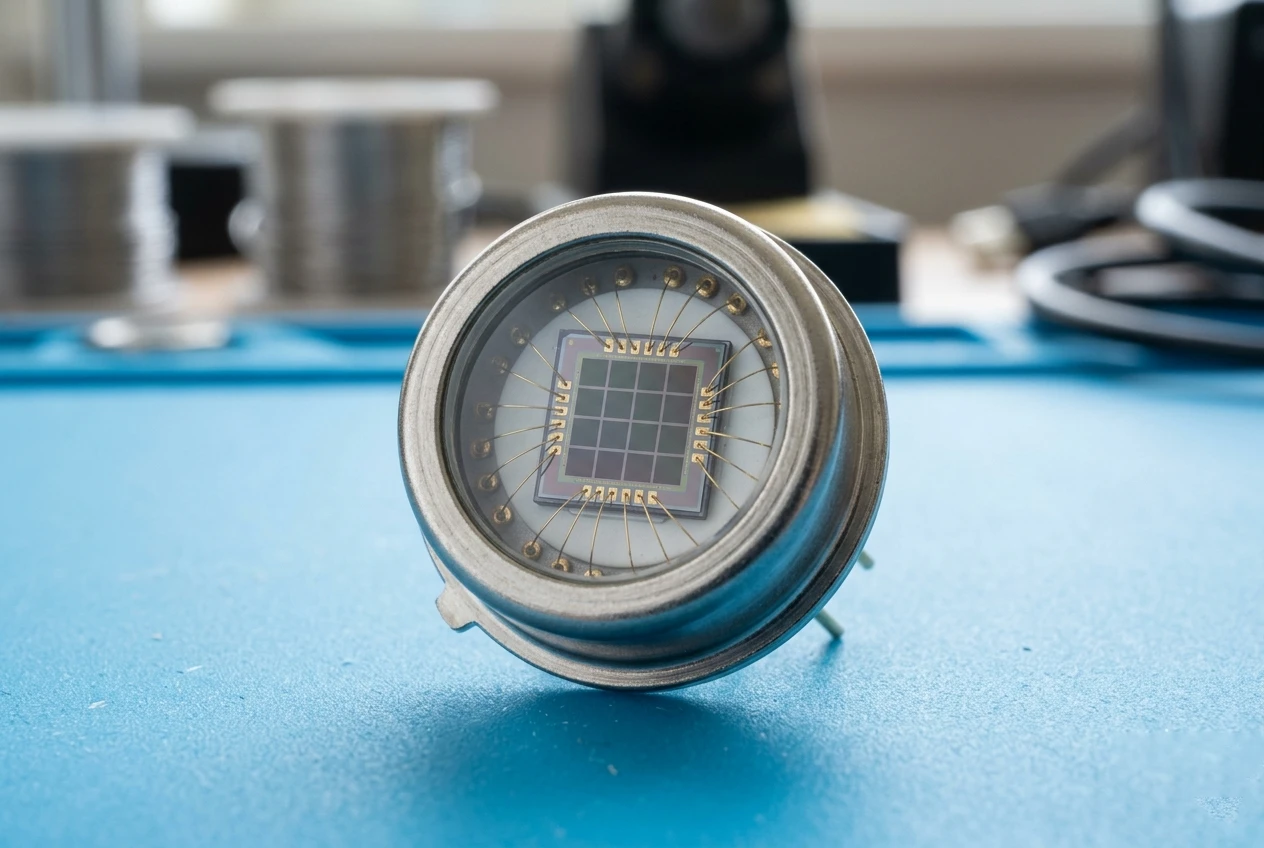
If you want true detector reliability, you have to look past the marketing fluff. Real harsh environment sensors use hermetically sealed metal packages. We’re talking glass-to-metal seals where the window is literally melted into a metal cap, like a TO-39 or TO-8 package. That is the only way to stop moisture vapor long-term.

Si PIN Photodiode with UV sensitivity enchanced (190-1100nm) PDCD100-F01
Experience superior UV detection with Bee Photon’s Ultraviolet (UV) Sensitive Photodiode.Our Si PIN photodiode ensures high sensitivity and reliability for analytical instruments.This Ultraviolet (UV) Sensitive Photodiode with a quartz window offers precise measurements from 190nm to 1100nm.
Why Your Sensors Are Frying in the Summer Sun
Let’s talk about the physics of why your alarms are tripping at 3 PM in July. When you put security systems out in a power grid substation, they bake in the sun. The metal enclosures can easily hit 80°C or even 85°C.
Inside your typical infrared beam detector or fiber optic intrusion system, there is a silicon detector. The problem with silicon at high temperatures is something called dark current. Dark current is the background electrical noise the detector produces even when it’s pitch black.
Here is the general rule of thumb for standard silicon detectors:
I_dark(T) = I_dark(25°C) * 2^((T – 25) / 10)
This formula basically says that for every 10 degrees Celsius the temperature goes up, the dark current doubles.
Let’s say you buy some cheap harsh environment sensors that have a baseline dark current of 5 nanoamps (nA) at room temperature (25°C). That sounds fine. But put it in a substation enclosure hitting 85°C.
That is a 60-degree jump.
60 divided by 10 is 6.
2 to the power of 6 is 64.
So your 5 nA dark current multiplies by 64. You are now sitting at 320 nA of background noise.
If your system’s alarm threshold is set to trip at a 300 nA shift, your system just triggered a full-blown perimeter breach alarm because the sun came out. This is exactly why building harsh environment sensors requires high-end, low-dark-current photonics right at the component level. You can’t fix bad physics with software updates.
Power Grids and the EMI Nightmare
Another massive headache I see all the time is Electromagnetic Interference (EMI). Substations have massive transformers, high-voltage lines, and insane magnetic fields. If you use cheap, unshielded harsh environment sensors, those magnetic fields will induce stray currents right into the detector’s leads.
I remember a specific case we handled for a midwest utility company. They had a perimeter laser tripwire system using basic plastic photodiodes. Every time a specific 500kV breaker would actuate, the transient electromagnetic pulse would induce a voltage spike in their security loop. They spent months thinking animals were crossing the beam.
We had them swap out the receivers for properly shielded Si PIN photodiodes from BeePhoton. We used hermetic TO-can packages where the metal cap acts as a Faraday cage. We grounded the casing, and the false alarms stopped immediately. That’s the difference between buying random parts and investing in real harsh environment sensors. You have to isolate the silicon from the electrical chaos around it.
What Actually Makes Si PIN Photodiodes So Good?
When we build harsh environment sensors, we don’t just use any basic PN junction. We use Si PIN photodiodes. The “I” stands for an intrinsic layer between the P and N doped regions.
Why does this matter for critical infrastructure security? Two reasons: speed and sensitivity.
Because of that thick intrinsic layer, the depletion region is wider. This means it captures more photons (better sensitivity when there’s heavy fog at your dam), and it lowers the capacitance of the junction. Lower capacitance means the detector responds incredibly fast. If you are running a pulsed laser security fence, you need that speed to separate the actual laser pulses from random background sunlight.
We focus heavily on this at BeePhoton. Our harsh environment sensors are designed specifically so that the intrinsic region is optimized for near-infrared wavelengths (like 850nm or 905nm), which are totally invisible to the human eye but punch right through rain and mist.
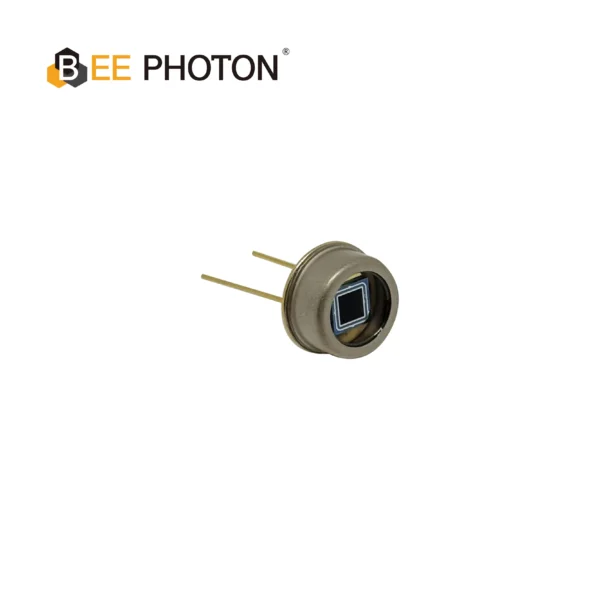
Si PIN Photodiode with UV sensitivity enchanced (190-1100nm) PDCT06-F01
Achieve rapid signal capture with our Fast Rise Time Si PIN Photodiode. Optimized for optical comms and pulse detection with low capacitance and high reliability. Get the performance of a fast Si PIN photodiode today.
The Real Cost of Replacing “Cheap” Sensors
People always ask me why they should pay more upfront for specialized harsh environment sensors. It usually comes down to simple math.
Let’s say a standard outdoor sensor costs you $50, and a military-grade hermetic one costs $150. If you are securing a hydro dam, you might need 200 of them. That’s a $20,000 difference. A procurement guy in an office will always want the cheaper one.
But think about the installation. Hiring a crew to scale the concrete face of a dam, run conduit, and wire these things up is going to cost you $100,000 in labor alone.
Fast forward three years. The cheap sensors start experiencing wire bond fatigue because of the constant vibration from the water turbines. Or the plastic degrades under UV light and water gets in. Now you have a 10% failure rate across your perimeter. You have to hire that crew again to replace them. And you’ll keep doing it.
When you use real harsh environment sensors, your Mean Time Between Failures (MTBF) shoots through the roof.
Here is the standard reliability equation B2B engineers use:
Failure Rate (λ) = Number of Failures / Total Operating Hours
MTBF = 1 / λ
In a properly built hermetic sensor, the MTBF is often calculated in millions of hours. In a plastic one exposed to a dam’s enviroment, you are lucky to get 30,000 hours before degradation starts. Buying the right harsh environment sensors upfront is just common sense risk management.
Let’s Compare the Specs
If you are a systems integrator trying to build out a platform for critical infrastructure, here is a quick cheat sheet on what to look for. You can see why standard stuff just doesn’t hold up compared to true harsh environment sensors.
| Feature | Standard Security Sensor | True Harsh Environment Sensors | Why it matters for Infrastructure |
|---|---|---|---|
| Packaging | Molded Plastic / Epoxy | Kovar Metal TO-Can (Hermetic) | Stops water vapor from corroding the chip in dams. |
| Window | Plastic lens | Glass-to-metal sealed window | Doesn’t degrade or cloud up under heavy UV exposure. |
| Temp Range | -10°C to +60°C | -40°C to +105°C (or higher) | Prevents thermal runaway in grid substations during summer. |
| Dark Current | High (fluctuates wildly) | Ultra-low (controlled processing) | Keeps the noise floor down so you don’t get false alarms. |
| EMI Immunity | None (acts like an antenna) | Grounded metal case | Blocks massive electromagnetic noise from power transformers. |
Designing for Extreme Vibration at Dams
I want to touch on something that rarely gets talked about: vibration. When millions of gallons of water rush through penstocks and hit the turbines, the entire structure of the dam hums. It’s a low-frequency, relentless vibration.
Standard circuit boards inside cheap security cameras or optical links use basic solder joints. Over time, that constant shaking causes micro-fractures in the solder. Suddenly, the signal drops out.
Inside our high-end harsh environment sensors, the tiny gold wires connecting the silicon chip to the output pins are bonded using specialized ultrasonic welding techniques. The chips are die-attached with advanced epoxies that absorb mechanical shock rather than transferring it to the silicon. If you are managing detector reliability at a hydroelectric plant, this invisible mechanical strength is exactly what you are paying for.

Si PIN Photodiode with UV sensitivity enchanced (320-1060nm) PDCC34-601
Experience our High Quantum Efficiency Photodiode for precise UV-NIR detection. This sensor ensures high responsivity for analytical and medical instruments.Its COB design and enhanced UV sensitivity (320-1060nm) make this Si PIN photodiode ideal for compact, high-performance applications.
Signal to Noise: The Ultimate Battle
At the end of the day, all harsh environment sensors are just fighting a war against noise. You want to see the signal (the intruder crossing the perimeter) and ignore the noise (the sun, the heat, the electromagnetic spikes).
The formula for Signal-to-Noise Ratio (SNR) in these optical systems looks roughly like this:
SNR = I_signal / SQRT( Shot_Noise^2 + Thermal_Noise^2 + Amplifier_Noise^2 )
When you deploy bad sensors, your Thermal_Noise skyrockets because of the dark current issue we talked about earlier. Your Amplifier_Noise goes nuts because it’s picking up EMI from the power lines. The denominator of that equation gets huge, and your SNR drops to zero.
By using hermetically sealed, low-capacitance Si PIN photodiodes built specifically as harsh environment sensors, you crush those noise variables. Your SNR stays high, your alarms stay accurate, and your security team stops ignoring alerts because of “the boy who cried wolf” syndrome.
It’s Time to Upgrade Your Perimeter
Look, relying on consumer-grade tech to protect the power grid or a major water supply is just a bad move. The stakes are too high. You need components that are engineered from the bare silicon up to handle the absolute worst conditions on earth.
Whether you are dealing with blinding snowstorms, 100% humidity, or the massive magnetic fields of a 500kV transformer, your perimeter security needs to be rock solid.
Don’t wait for your current system to blind itself or trigger another midnight false alarm. It is time to integrate genuine harsh environment sensors into your hardware.
We build these exact components. Our team at BeePhoton knows the physics, we know the environments, and we know exactly how to keep your detector reliability exactly where it needs to be.
Stop guessing with your infrastructure security. Contact us today. Tell us about the nightmare environment you are trying to secure, and we’ll help you spec out the exact Si PIN photodiodes you need. You can also drop our engineering team a direct line at info@photo-detector.com. Let’s fix your perimeter for good.

Si PIN Photodiode with low dark current (350-1060nm) PDCC100-001
Looking for a custom Si PIN photodiode? Bee Photon provides OEM solutions with low dark current and a 350-1060nm range. We partner with B2B clients to develop photodiodes tailored to your specific needs.
Frequently Asked Questions (FAQ)
Q: Can’t I just put a standard sensor inside a heavy-duty waterproof box?
Honestly, no. That is a really common mistake. Even if you put a cheap sensor in a thick aluminum box, the air inside that box has moisture. When the temperature drops, that moisture condenses on the plastic lens of the cheap sensor. Also, a separate box doesn’t solve the thermal noise problem; it often makes it worse by trapping heat like a tiny oven, destroying your detector reliability. You need harsh environment sensors that are sealed at the component level.
Q: Why are Si PIN photodiodes better than standard photodiodes for harsh environment sensors?
It comes down to response time and noise management. The “Intrinsic” layer in Si PIN photodiodes makes the depletion region thicker. This drastically lowers the capacitance of the device, making it fast enough to catch ultra-short laser pulses in perimeter security setups. Plus, the way we manufacture them at BeePhoton ensures a much lower dark current, which is critical when the sensor bakes in the sun at a power substation.
Q: How do you know if a sensor is truly rated for critical infrastructure?
Look at the package material and the operating temperature range. If the data sheet says it uses a plastic or epoxy lens, throw it out. True harsh environment sensors will specify “hermetically sealed”, usually indicating a Kovar metal TO-can with a glass window. The temperature spec should comfortably handle -40°C to +85°C (or higher) without the dark current spiking so high that it trips your alarm thresholds. If you aren’t sure, reach out to our team at info@photo-detector.com and we can review the specs with you.
Q: What makes EMI such a big deal for power grid security?
Power grids and substations generate massive electromagnetic fields. If your security sensors use unshielded electronics, those magnetic fields induce random electrical currents into the detector wires. The system interprets those spikes as an actual security breach. Harsh environment sensors combat this by using grounded metal housings (like a Faraday cage) right at the silicon level to block that interference completely.