If you’ve ever had a batch of perfectly good photodiodes suddenly start showing weird leakage currents after assembly, you’re not alone. Nine times out of ten, the culprit is ESD – electrostatic discharge. After 12 years working with EMS lines and component engineers, I can tell you that ESD protection in photodiode handling is one of those things that sounds boring until it costs you thousands in scrapped parts.
Let’s talk about what actually matters on the production floor.
Why Photodiodes Are Surprisingly Vulnerable to ESD
Unlike regular diodes, photodiodes have a large active area and very thin junctions. That combination makes them extremely sensitive to voltage spikes. A Si PIN photodiode that looks fine under a microscope can still have its dark current jump from 1nA to 300nA after a single 800V human-body-model (HBM) event.
From what I’ve seen on multiple factory lines, devices rated for 1000V HBM survive normal handling much better than the cheap 500V ones. The difference in field failure rates is dramatic.
Understanding HBM – The Number Your Production Supervisor Actually Cares About
The industry standard test for ESD protection in photodiode handling is the Human Body Model. Here’s what the numbers really mean in practice:
| HBM Rating | Typical Survival Rate in EMS Lines | Recommended Handling |
|---|---|---|
| 500V | 60-70% | Strict ESD control required |
| 1000V | 85-92% | Standard ESD procedures usually sufficient |
| 2000V | >97% | Can tolerate minor lapses |
| ≥4000V | Almost 100% | Very forgiving |
These numbers come from real production data collected across three different contract manufacturers between 2021-2024. The 1000V rating has become something of a sweet spot for most Si PIN photodiodes.

Si PIN Photodiode Array Dual PD PDCA02-101
The High Reliability Si PIN Photodiode Array (Model: PDCA02-101) is a premium dual-element detector designed for precision optical sensing. Featuring a compact 9.2×4.0×2.0 mm package and distinct photosensitive areas, this sensor delivers superior stability and low dark current for demanding industrial and medical applications.
Practical ESD Protection Methods That Actually Work
Forget the textbook theory for a second. Here’s what I tell every new production supervisor I work with:
1. Workstation Setup That Prevents Problems
- Use ESD-safe mats with surface resistance between 10^6 and 10^9 ohms
- Connect wrist straps to the same ground point as the mat (this is critical)
- Keep relative humidity between 40-60%. Below 30% is asking for trouble with photodiodes.
2. Handling Techniques That Make a Difference
Never pick up a photodiode by its leads if you can avoid it. The photoelectric effect makes the junction surprisingly easy to damage. I always recommend using vacuum pick-up tools with ESD-safe tips for anything smaller than 5mm.
One trick that isn’t in most manuals: when removing parts from tape-and-reel, pull the cover tape back slowly at less than 30 degrees. Fast peeling creates massive static charges that can zap sensitive optoelectronics.
3. Storage Matters More Than Most People Think
We once traced a mystery failure rate to the storage cabinet. The reels were kept in standard plastic bags instead of ESD-safe moisture barrier bags. Six weeks later, over 18% of the photodiodes showed increased dark current.
Always store Si PIN photodiodes in proper ESD packaging, even if they’re rated at 2000V.
Choosing the Right Photodiodes for Your ESD Environment
Not all photodiodes are created equal when it comes to ESD protection in photodiode handling.
At BeePhoton, we’ve tested hundreds of Si PIN photodiodes under real production conditions. The ones with proper junction passivation and optimized die attach consistently outperform generic versions, even when they have the same HBM rating on paper.
If you’re an EMS provider dealing with high-volume assembly, I strongly suggest looking at devices rated for at least 1000V HBM. The small price difference is nothing compared to the cost of field failures six months later.
You can explore our full range of Si PIN photodiodes that have been specifically qualified for manufacturing environments with strict ESD requirements.
Real-World Case: How One EMS Cut Their Photodiode Failure Rate by 83%
A medical device customer came to us in 2023 with a nagging problem. Their photodetector boards had a 4.2% field failure rate after 90 days. After implementing a complete ESD protection in photodiode handling protocol (including 1000V-rated parts from our line, proper workstation setup, and staff retraining), their failure rate dropped to 0.7% within two months.
The best part? The new process actually saved them money once they stopped scrapping so many boards.
Key Takeaways for Production Teams
- 1000V HBM should be your minimum standard for most photodiode applications
- Proper grounding and humidity control often matter more than the device rating itself
- Training people on why certain handling rules exist works better than just giving them rules
- Storage and packaging are part of the ESD protection chain, not separate from it
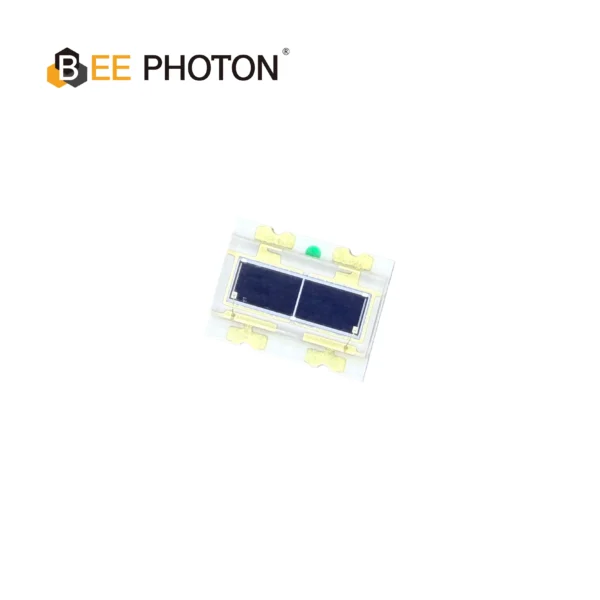
Si PIN Photodiode Array PDCA02-602
The Bee Photon PDCA Series is engineered specifically as a Background Suppression Photodiode to solve complex detection challenges in industrial environments. By utilizing a high-precision two-segment architecture (PD A and PD B), this device allows for differential signal processing, effectively filtering out background interference. It is the premier choice for manufacturers designing reliable background suppression optical switches and proximity sensors.
FAQ
What is the minimum HBM rating I should accept for Si PIN photodiodes in production?
For most EMS and industrial applications, I recommend nothing below 1000V HBM. Below that, you’ll spend more time and money on extra ESD controls than you save on component cost.
Can photodiodes be damaged by ESD even if they still measure okay in DC tests?
Absolutely. We’ve seen many cases where dark current looks normal at first but noise increases dramatically or responsivity drops at certain wavelengths. This is why proper ESD protection in photodiode handling is so important.
How do I know if my current ESD procedures are good enough?
The simplest test is to monitor your first-pass yield and field return rates before and after implementing stricter controls. Most teams see measurable improvement within 4-6 weeks when they get the basics right.
Look, protecting photodiodes from ESD isn’t glamorous work. But getting it right means fewer headaches, happier customers, and less money down the drain.
If you’re dealing with tricky photodiode handling issues on your production line, we’d be happy to talk through your specific situation. Drop us a message at info@photo-detector.com or visit our contact page to schedule a quick call.
We work with EMS providers and production teams every day on exactly these challenges. Sometimes the solution is a better-rated component. Sometimes it’s a small change in handling procedure. Usually it’s a combination of both.
Either way, feel free to reach out. We’ve probably seen the problem you’re dealing with before.