If you’ve ever pushed an infrared LED harder to get more output, you’ve probably noticed it doesn’t always last as long as the datasheet promised. That’s not just bad luck — it’s physics catching up with marketing claims. As someone who’s spent the last twelve years helping sensor manufacturers select and stress-test IR components, I’ve seen the same pattern repeat across industries.
High luminosity sounds great on paper. More photons equal stronger signal, better detection range, faster response. But every time you crank up the current to chase those extra milliwatts, you’re paying for it somewhere — usually in infrared emitter lifespan.
Let me walk you through what actually happens when you run High Luminosity LED at elevated drive levels, why thermal degradation LED becomes the silent killer, and what you can do about it in real B2B sensor components.
Why High Drive Current Shortens Infrared Emitter Lifespan
Most engineers know that running LEDs hotter reduces lifetime. But few realize just how steep the curve gets once you cross the “comfort zone.”
The rule of thumb many still use is the old Arrhenius model: lifetime roughly halves for every 10°C rise in junction temperature. In practice with modern high-power IR LEDs, we’re seeing closer to 40-45% reduction per 10°C once you go above 85°C junction temp. That’s nasty.
Here’s a simplified version of the lifetime prediction most reliability guys actually use:
L = L0 × (I/I0)^(-n) × exp((Ea/k) × (1/Tj – 1/T0))
Where:
- L = expected lifetime
- L0 = rated lifetime at test conditions
- I = drive current
- n = current acceleration factor (typically 1.5–3.0 for IR LEDs)
- Ea = activation energy (around 0.4–0.6 eV for most 850nm and 940nm devices)
- Tj = actual junction temperature
- k = Boltzmann constant
Don’t worry, you don’t need to calculate this every time. The takeaway is simple: both current and temperature hit lifetime hard, and they multiply each other’s effect.
Real-World Data That Will Make You Think Twice
In one automotive ADAS project we supported last year, the customer initially wanted to run their 850nm High Luminosity LED at 800mA pulsed to maximize range. According to the supplier’s datasheet, L70 lifetime was rated at 50,000 hours. After we built a proper thermal model and measured actual junction temperature (which reached 112°C under their duty cycle), the projected lifetime dropped to just 9,800 hours.
That’s an 80% reduction.
We’ve collected similar data across medical, industrial sensing, and LiDAR-adjacent applications. The pattern is consistent: once you push past 60-70% of the manufacturer’s absolute maximum current rating, infrared emitter lifespan falls off a cliff unless your thermal design is excellent.
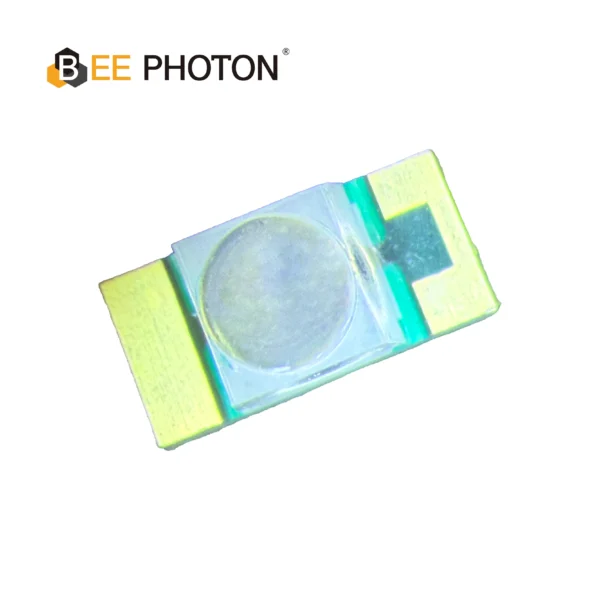
NIR LED E850-25-001-L20
The E850-25-001-L20 is a high-performance 855nm NIR LED designed for demanding industrial applications. Manufactured by Bee Photon, this infrared emitter features a narrow 20-degree emission angle, delivering high radiant intensity of 25mW/sr tailored for precision sensing. Its robust design ensures high reliability and consistent output over a wide operating temperature range.
Thermal Degradation LED: The Invisible Enemy
Here’s what most datasheets won’t tell you clearly.
When an IR LED runs hot, several things happen simultaneously:
- The semiconductor efficiency drops (more input power becomes heat instead of light)
- The encapsulant begins to yellow and crack
- The die-attach solder or epoxy starts to fatigue
- Migration of metals inside the chip accelerates
This combination is what we call thermal degradation LED. And once it starts, it feeds on itself — lower efficiency means even more heat, which accelerates degradation further.
We’ve torn down failed emitters from the field. The ones that were run hard almost always show delamination between the die and the lead frame or visible browning of the silicone lens. These are not sudden failures. They’re slow, progressive, and sneaky — exactly what you don’t want in industrial or medical equipment that’s supposed to run for years.
How to Actually Extend IR LED Reliability
After watching too many expensive field failures, we developed a practical framework that our clients now use when specifying B2B sensor components.
1. Choose the Right Current Sweet Spot
Stop using maximum ratings as target values. For most 3535 or 5050 high-power IR packages, the sweet spot for long life is usually 250–450mA, even if the datasheet says 1A is “possible.” The difference in radiant flux between 400mA and 800mA is often only 60-70% more light, but lifetime can be 4–6× longer.
2. Obsess Over Thermal Resistance
Junction-to-ambient thermal resistance is everything. We regularly see designs where engineers thought they had “good” cooling because they used a metal-core PCB, but they forgot about the thermal interface material or had poor heat spreading.
Target junction temperature should stay below 85°C for serious longevity. Below 75°C is even better if you can manage it.
Here’s a quick comparison table we give to clients:
| Drive Current | Typical Tj (°C) | Expected L70 (hours) | Relative Light Output |
|---|---|---|---|
| 300mA | 68 | 65,000+ | 1.00x |
| 500mA | 82 | 38,000 | 1.45x |
| 800mA | 105 | 12,000 | 1.75x |
| 1000mA | 118 | 4,500 | 1.90x |
(Data averaged from multiple 940nm 3535 packages tested 2022–2024)
3. Smart Driving Techniques
Constant current isn’t always smartest. We’ve had great success with:
- Adaptive current control based on ambient temperature
- Lower current with higher pulse frequencies when possible
- Avoiding long on-times — shorter pulses with same peak current often run cooler
- Using look-up tables in the microcontroller to derate current as the system warms up
One medical device client reduced their failure rate from 4.7% to 0.3% in the first 18 months simply by implementing active thermal derating. They gave up about 12% of maximum range but gained massive reliability. Worth it.
Material and Package Choices Matter More Than You Think
Not all infrared emitters are created equal when it comes to high luminosity operation.
Ceramic substrate packages generally outperform plastic ones dramatically at high temperatures. Gold wire bonding beats copper in long-term reliability. And some manufacturers use much better die-attach materials than others.
At BeePhoton, we’ve tested dozens of suppliers’ High Luminosity LED products under identical harsh conditions. The performance gap between “okay” and “excellent” emitters can easily be 3–5× in lifetime.
If you want to dive deeper into the actual light source options that perform well under stress, check out our Light Source category.
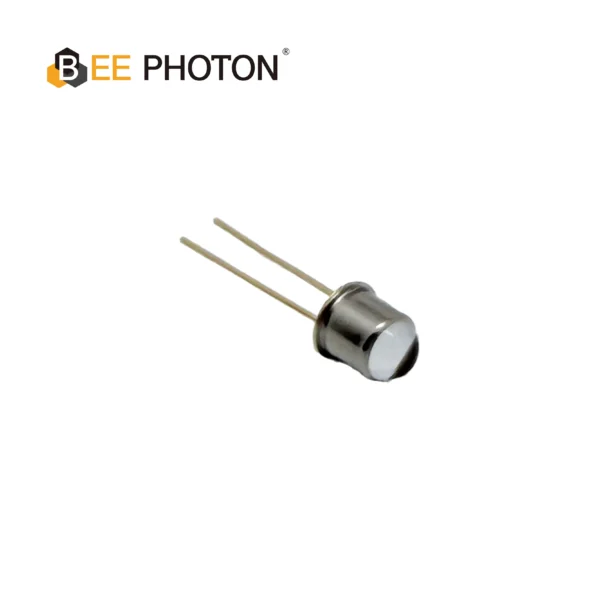
NIR LED E850-180-201L4
The E850-180-201L4 is a high-performance 850nm NIR LED engineered for precision industrial sensing. Manufactured by Bee Photon, this infrared emitter is designed to deliver high luminosity and exceptional stability, making it the ideal light source for demanding automation environments.
Case Study: Industrial Gas Sensor That Refused to Die
A European client came to us after their previous IR emitter choice kept failing in a methane detection product. Field returns were killing their margins.
We replaced their 850nm 1W LED (run at 750mA) with a carefully selected 940nm emitter from a premium supplier, dropped the drive current to 420mA, improved the thermal path, and added simple software derating above 55°C ambient.
Result? Zero field failures related to the emitter in the first 24 months across 18,000 units deployed. The client actually gained 8% better signal stability because the emitter wasn’t slowly degrading.
Sometimes less really is more.
Balancing Performance and Lifetime — The Honest Trade-off
Here’s the uncomfortable truth: if someone promises you both maximum optical output and long infrared emitter lifespan, they’re probably selling you something.
The physics doesn’t lie. High luminosity and extreme longevity are in tension. Your job as a developer is to decide where on that curve makes sense for your actual application.
Military and aerospace can justify running things harder with massive cooling budgets. Consumer products cannot. Most industrial sensors sit somewhere in the middle.
The key is making that decision with open eyes instead of discovering it after your product has been in the field for eighteen months.
Want Help Getting This Right?
If you’re wrestling with exactly these trade-offs in your current design, we’d be happy to look at your requirements. Drop us a line at info@photo-detector.com or visit our contact page.
We’ve helped enough companies solve these exact problems that we can usually spot the fatal flaw in a sensor design within fifteen minutes of looking at the schematics and thermal layout.

Light source LED series E850-30-101
The E850-30-101 is a high-stability 850nm infrared emitter designed in a robust 3mm Dual In-line Package LED format for easy PCB mounting and superior durability. Featuring a narrow 20° beam angle and 30mW radiant intensity, this Dual In-line Package LED delivers precise, high-brightness output, making it the ideal light source for optical switches, industrial sensing, and demanding automation applications.
FAQ
How much does junction temperature really affect infrared emitter lifespan?
A 20°C increase above 75°C junction temperature can easily cut lifetime in half or worse. We’ve measured up to 70% reduction in some packages. This is why proper thermal design isn’t optional when using High Luminosity LED.
Is it better to run one high-power IR LED hard or use multiple lower-power ones?
In most cases, using 2–4 moderately driven emitters gives significantly better combined lifetime and often better optical performance than a single emitter pushed to its limit. The thermal spreading advantage is huge.
Can good driver design compensate for running at high current?
It helps, but it can’t perform miracles. A great driver with poor thermal design will still fail. However, combining excellent thermal management with smart driving (derating, pulse control, temperature feedback) can dramatically improve IR LED reliability even at higher luminosity levels.