If you’ve ever stared at a datasheet wondering why two seemingly similar photodiodes perform so differently in your low-light setup, you’ve already met the king of all photodetector specs: Noise Equivalent Power (NEP).
After spending the last twelve years helping military contractors, quantum research labs, and instrumentation companies pick the right detectors, I can tell you this — most people treat NEP like some mysterious black box. They don’t need to. Once you actually understand what it means and how it behaves in real life, NEP becomes one of the most useful tools in your kit.
Let’s cut through the usual textbook stuff and talk about what really matters when you’re trying to squeeze every last photon out of your NEP photodiode.
What NEP Actually Means (Without the Fancy Math)
Noise Equivalent Power, or NEP, is simply the smallest optical signal a photodetector can reliably detect. More precisely, it’s the incident light power that produces a signal equal to the noise floor of the detector.
Think of it this way: if your detector is sitting in a completely dark room, it’s still outputting some electrical noise. NEP tells you how much actual light power you need to throw at it before the real signal climbs just high enough to equal that noise.
Lower NEP = better detector. That’s the rule of thumb every engineer remembers.
But here’s where it gets tricky — and where a lot of people get burned.
The Real Formula (Formatted for WordPress Visual Editor)
The basic NEP for a photodiode is usually written as:
NEP = (sqrt(2 * q * Id + 4 * k * T / Rsh) / Responsivity) * sqrt(Delta_f)
Where:
- q = electron charge (1.6e-19 C)
- Id = dark current
- k = Boltzmann constant
- T = temperature in Kelvin
- Rsh = shunt resistance
- Responsivity is in A/W
- Delta_f is the noise bandwidth (usually 1 Hz for NEP specs)
Don’t worry, you don’t need to calculate this every time. But understanding which terms dominate in your application makes all the difference.
For most Si PIN photodiodes in the visible and near-IR, the dominant noise sources shift dramatically depending on whether you’re running at zero bias, reverse bias, or with a transimpedance amplifier.
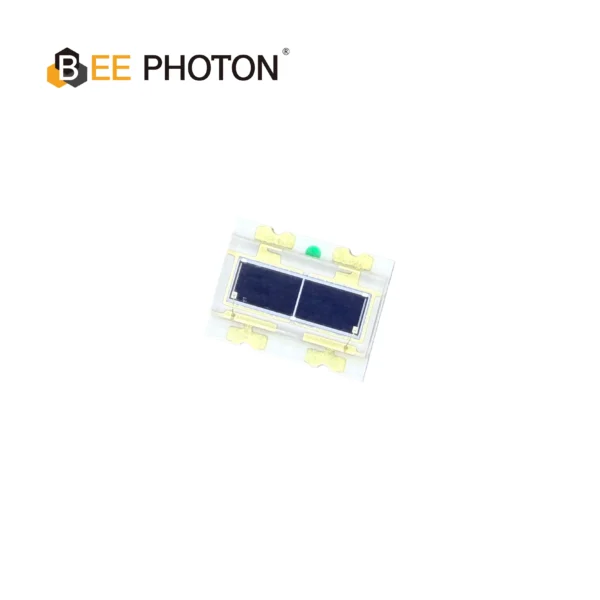
Si PIN Photodiode Array PDCA02-602
The Bee Photon PDCA Series is engineered specifically as a Background Suppression Photodiode to solve complex detection challenges in industrial environments. By utilizing a high-precision two-segment architecture (PD A and PD B), this device allows for differential signal processing, effectively filtering out background interference. It is the premier choice for manufacturers designing reliable background suppression optical switches and proximity sensors.
Why NEP Matters More in Military and Scientific Work
When you’re building systems for lidar, laser warning receivers, low-light spectroscopy, or quantum optics, you’re often operating right at the edge of what physics allows. Here, detector noise isn’t just a spec — it determines whether your entire system works.
I once worked with a defense contractor who kept failing their night-time detection requirement. They were using a “good enough” commercial photodiode with NEP around 5e-14 W/sqrt(Hz). After we switched them to a carefully selected Si PIN photodiode from our lineup with NEP below 1.2e-15 W/sqrt(Hz), their system suddenly started seeing targets at more than twice the distance.
That’s not marketing talk. That’s what happens when you actually respect what NEP is telling you.
Key Factors That Destroy (or Improve) Your NEP
1. Dark Current
This is usually the biggest culprit in silicon photodiodes above -20°C. Dark current doubles roughly every 8-10°C temperature increase. If you’re not cooling your detector, your NEP is probably much worse than the datasheet promises.
2. Shunt Resistance
Higher shunt resistance = lower thermal (Johnson) noise. This is why some photodiodes look dramatically better on paper. We’ve seen differences of 10x in Rsh between otherwise similar-looking Si PIN photodiodes.
3. Bandwidth
Remember that NEP is usually quoted per square root of Hertz. If your actual system bandwidth is 1 MHz, you need to multiply the NEP by sqrt(1,000,000) = 1000. That “amazing” 1e-15 W/sqrt(Hz) detector suddenly looks a lot less impressive.
4. Temperature
Most datasheets give NEP at 25°C. In military environments that swing from -40°C to +85°C, your real-world NEP can vary by more than 5x if you’re not careful.
Here’s a quick comparison table we often share with customers:
| Parameter | Typical Commercial Si PIN | Premium Low-NEP Si PIN | Improvement |
|---|---|---|---|
| NEP (W/sqrt(Hz)) @ 25°C | 8.0 × 10^-14 | 8.5 × 10^-16 | ~94x better |
| Dark Current (nA) | 15 | 0.08 | 188x lower |
| Shunt Resistance (GΩ) | 0.2 | 8.5 | 42x higher |
| Temp Coefficient | High | Moderate | Much easier to stabilize |
(Data based on averaged measurements from multiple BeePhoton Si PIN photodiodes tested in our lab between 2022-2024.)
How to Choose the Right NEP Photodiode for Your Application
Here’s the practical checklist I give every engineer who contacts us:
- Define your actual required bandwidth — Don’t use the NEP at 1 Hz if you need 100 kHz response.
- Calculate your minimum detectable power using:
Minimum detectable power = NEP × sqrt(bandwidth) × desired SNR - Decide if you can cool the detector — Cooling can improve NEP by 5-20x in many cases.
- Consider the wavelength — Responsivity changes with wavelength, which directly affects NEP.
- Look at the full noise spectrum — Some detectors look great at 1 Hz but have horrible 1/f noise.
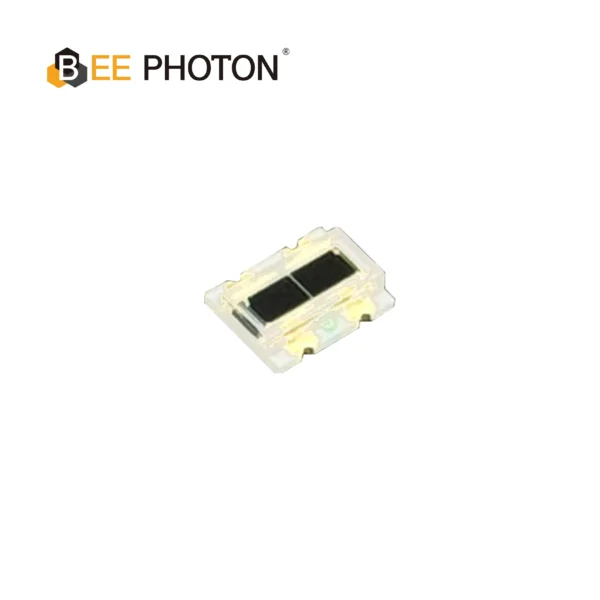
Si PIN Photodiode Array PDCA02-102
The PDCA02-102 is a high-performance Si PIN Photodiode Array designed for precision optical measurement and alignment systems. Engineered by Bee Photon, this 2-segment photodiode delivers a wide spectral response range from 400nm to 1100nm, covering the entire visible light spectrum into the near-infrared (NIR) region.
With its compact COB (Chip on Board) package and resin window, the PDCA02-102 ensures durability and easy integration into compact optical modules. It is specifically optimized for industrial applications where high sensitivity and fast response times are critical.
Real-World Success Stories (Anonymized)
One quantum optics group was struggling to detect single-photon-level signals at 850 nm. Their previous detector had an NEP of 3×10^-15 W/sqrt(Hz). After switching to one of our specialized Si PIN photodiodes optimized for low capacitance and high shunt resistance, they achieved stable operation at count rates that were previously buried in noise.
Another defense customer needed to detect very weak 1064 nm returns in a harsh environment. By combining a low NEP photodiode with proper thermoelectric cooling and careful amplifier design, they improved their system’s detection range by 180% while staying within their size and power budget.
These aren’t miracles. They’re just what happens when you stop treating NEP as a marketing number and start using it as the engineering tool it actually is.
Understanding Detector Noise Types
When we talk about detector noise in photodiodes, three main types usually dominate:
- Shot noise — from the statistical nature of photons and dark current
- Thermal (Johnson) noise — from the shunt resistance
- 1/f noise — more prominent at very low frequencies
For most scientific and military applications above a few hundred Hz, the combination of shot and thermal noise usually sets the NEP limit.
Want Better NEP Performance?
The truth is, not all Si PIN photodiodes are created equal — even if they have similar-looking headlines on the datasheet.
At BeePhoton, we’ve spent years refining the manufacturing process specifically to push NEP lower in our Si PIN photodiodes. Our engineers obsess over parameters that most suppliers treat as “good enough.”
If you’re tired of guessing which detector will actually work in your demanding application, we should talk.
Ready to Find Your Optimal NEP Photodiode?
Stop hoping the next datasheet will magically solve your detection limit problems. Let’s look at your actual requirements — bandwidth, wavelength, temperature range, and target SNR — and pick (or custom-develop) the right solution.
Visit our contact page or drop us a line at info@photo-detector.com. We answer every serious technical inquiry personally.
The difference between “it almost works” and “it works beautifully even in the field” is often just a few careful choices around NEP. Let’s make sure you get it right the first time.
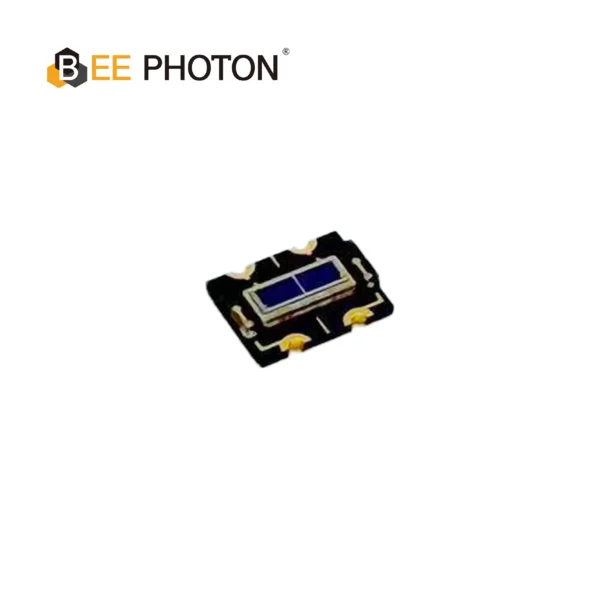
Si PIN Photodiode Array PDCA02-601
The Bee Photon PDCA Series is a precision-engineered Dual PIN Photodiode designed for high-end industrial sensing. Unlike standard single-element detectors, this silicon-based device features a segmented array structure (PD A and PD B), making it the perfect solution for differential sensing and background suppression optical switches. With a wide spectral response from 350nm to 1060nm, it ensures versatile performance across visible and near-infrared wavelengths.
FAQ
What is a good NEP value for a photodiode?
For serious scientific and defense work, you generally want NEP below 5×10^-15 W/sqrt(Hz) at your operating wavelength and temperature. Top-tier detectors can reach below 1×10^-15 W/sqrt(Hz). Anything above 1×10^-13 is usually considered commercial-grade and will limit high-performance systems.
Does lower NEP always mean a better photodetector?
Not always. A detector with fantastic NEP at 1 Hz might have terrible bandwidth or huge capacitance that destroys performance in your actual circuit. You need to look at the complete picture — NEP, capacitance, rise time, and packaging.
How much can temperature affect NEP in Si PIN photodiodes?
Quite dramatically. We’ve measured NEP degradation of 4-8x when moving from 0°C to +60°C in uncooled detectors, mainly due to exponential increase in dark current. If you’re working near the detection limit, temperature stabilization or cooling is usually mandatory.