When you’re trying to squeeze every last drop of precision out of a rotary or linear encoder, choosing the right optical encoder light source is probably the most critical decision you will make. Honestly, many hardware designers spend weeks obsessing over the photodiode array layout or the grating pitch of the glass disc, only to realize too late that their chosen optical encoder light source is completely bottlenecking the system.
If you’ve ever looked at an oscilloscope and seen a fuzzy, degraded sine wave coming off your photoreceiver, you know exactly what I’m talking about. A sloppy beam of light ruins signal clarity faster than you can say “crosstalk.” That’s where selecting a high-precision optical encoder light source with a tight 4-degree beam angle changes the game.
In this guide, we’ll look closely at why your choice of optical encoder light source dictates the upper limit of resolution. We will explore the optical physics, do some quick math on light scattering, and explain how to pick the right optical encoder light source so your sensors can deliver the sub-micron accuracy your customers demand.
The Core Challenge: Light Scattering in Optical Encoders
Why does beam angle even matter so much? To answer that, we have to look at how transmissive and reflective encoders work. In a typical setup, your optical encoder light source projects light through a rotating code wheel (often made of glass, metal, or plastic) with fine slits. On the other side, a photodetector array receives this light and converts the optical patterns into electrical signals.
As encoder manufacturers push for higher resolution—think 2500 Lines Per Inch (LPI) or even higher—the physical slits on the disc must become incredibly narrow. If you use a generic, wide-angle LED as your optical encoder light source, the light spreads out like a flashlight in the fog. This divergence causes the light passing through one slit to spill over into the adjacent slits. In the optics world, we call this optical crosstalk or signal blur.
When you use a poorly matched optical encoder light source, the photodiode array receives a muddy, low-contrast pattern instead of sharp, distinct shadows. Your digital interpolation circuits start guessing, which leads to phase errors, jitter, and ultimately, a loss of positioning accuracy. Compared to standard wide-angle LEDs, an optimized optical encoder light source like a 4 degree beam angle LED makes a massive difference.
What is a 4-Degree Narrow Beam LED?
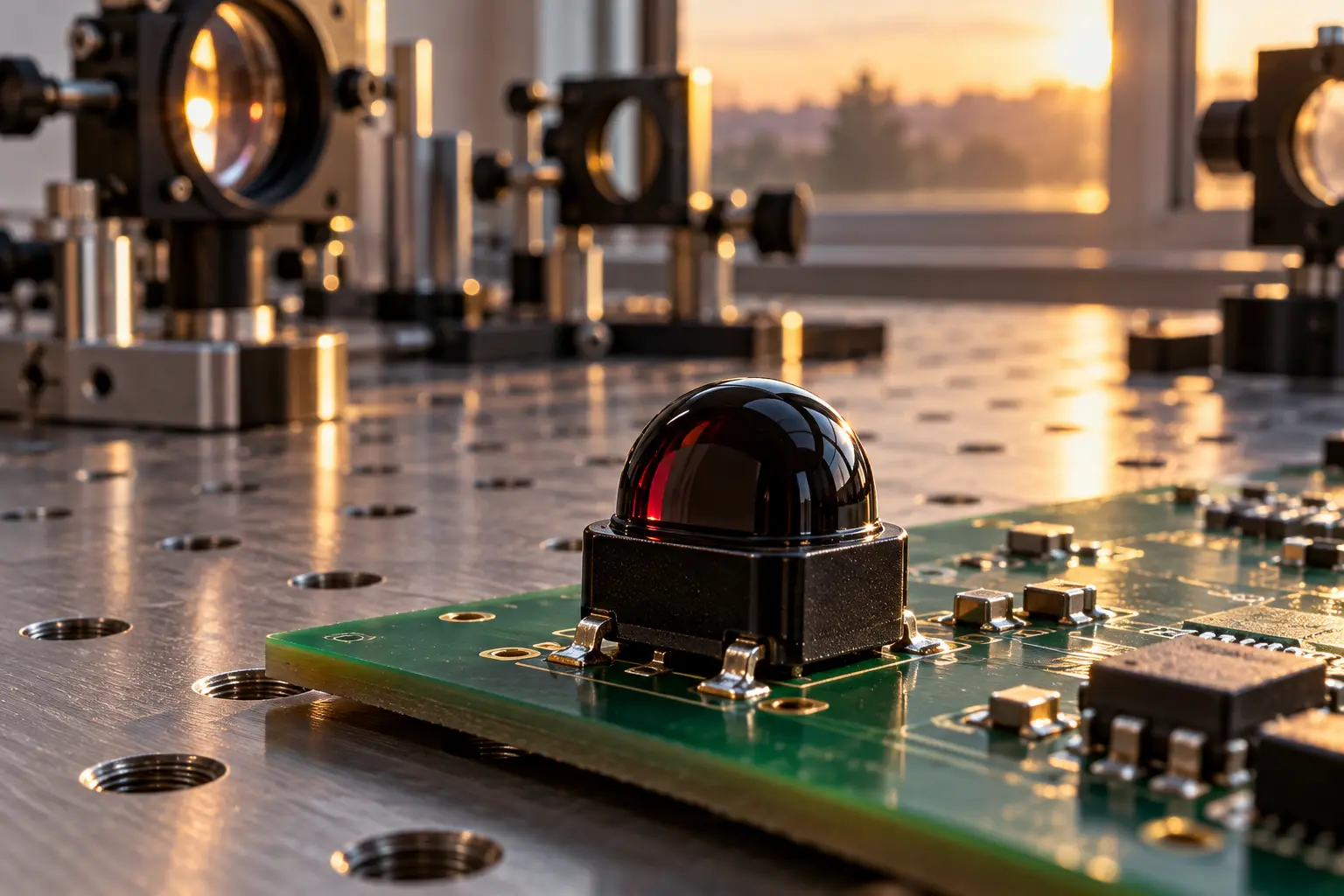
To combat light scattering, many engineers are turning to a specialized LED for high-resolution encoders. Specifically, a 4 degree beam angle LED behaves more like a semiconductor laser than a traditional LED, but without the high cost, temperature sensitivity, or eye-safety headaches of a laser diode.
A focused beam LED diode with a 4-degree beam angle utilizes specialized micro-dome packaging or point source emitter technology. Instead of spreading light across a 30-degree or 60-degree cone, the internal optics shape the light into a highly collimated, parallel beam.
When this specialized optical encoder light source fires, the rays remain almost parallel over the critical distance between the light source, the code disc, and the detector. By keeping the beam tightly focused, you virtually eliminate the spatial dispersion that causes crosstalk. This allows your photodiode array to capture clean, high-contrast transitions even when the grating pitch is extremely tight.
Let’s do some simple math to illustrate this. If you are designing with a typical air gap (the physical distance between your optical encoder light source and the photodetector array), you can calculate the physical blur circle on the detector.

NIR LED E850-25-001-L20
The E850-25-001-L20 is a high-performance 855nm NIR LED designed for demanding industrial applications. Manufactured by Bee Photon, this infrared emitter features a narrow 20-degree emission angle, delivering high radiant intensity of 25mW/sr tailored for precision sensing. Its robust design ensures high reliability and consistent output over a wide operating temperature range.
The Math Behind Beam Divergence and Signal Blur
To keep things simple and avoid complex LaTeX formatting that might break your WordPress editor, let’s write out the basic formula for beam spread using standard text symbols.
Let w be the diameter of the light spot on the detector, w0 be the initial emitting aperture size of your optical encoder light source, z be the distance or air gap from the LED lens to the detector, and theta be the full beam divergence angle of the LED.
The formula for the light spot diameter w on your detector can be expressed as:
w = w0 + 2 * z * tan(theta / 2)
Let’s run a quick calculation comparing a standard LED to a specialized optical encoder light source from BeePhoton.
Assume we have an air gap z of exactly 1.5 millimeters, which is pretty standard in compact industrial motor drives. Let’s assume the initial emitter aperture w0 is 150 micrometers (which is 0.15 mm).
Case A: A standard 30-degree LED used as an optical encoder light source.
Here, theta is 30 degrees, so theta / 2 is 15 degrees.tan(15 degrees) = 0.2679w = 0.15 + 2 * 1.5 * 0.2679w = 0.15 + 0.8037w = 0.9537 mm
The light beam from this standard optical encoder light source has expanded from 0.15 mm to almost 1 millimeter by the time it reaches the detector. If your encoder disk has slits that are only 20 micrometers wide, this massive, diverging spot of light will wash out multiple slits at the same time, rendering high-resolution feedback impossible.
Case B: A specialized 4-degree optical encoder light source.
Here, theta is 4 degrees, so theta / 2 is 2 degrees.tan(2 degrees) = 0.0349w = 0.15 + 2 * 1.5 * 0.0349w = 0.15 + 0.1047w = 0.2547 mm
Look at that difference. With a 4 degree beam angle LED, the light spot is only 0.25 mm wide—almost four times smaller than the standard LED. The light rays are practically parallel. This ensures that the shadow cast by the code disc onto your photoreceiver is incredibly sharp, enabling you to use much tighter slit spacing on your code wheel. This is why a precise optical encoder light source is required if you want to push your encoder’s resolution into the thousands of Counts Per Revolution (CPR).
Why a 4-Degree Beam Angle is the Sweet Spot
You might wonder: “Why not go even tighter? Why not use a 1-degree beam or a laser?” Well, there are a few practical reasons why a 4-degree optical encoder light source is considered the sweet spot by most B2B sensor design engineers.
First, as you try to shrink the beam angle below 4 degrees using standard optical lenses, the alignment tolerances become insanely unforgiving. A 1-degree beam requires extremely precise mechanical placement during manufacturing. If your pick-and-place machine is off by just a fraction of a millimeter, or if the encoder housing expands slightly due to motor heat, your light beam will miss the photodiode array entirely. A 4 degree beam angle LED gives you the perfect balance of tight collimation and realistic assembly tolerances.
Second, laser diodes are often overkill. While a laser provides a highly coherent, parallel beam, it also introduces optical noise like laser speckle. Plus, lasers are notoriously sensitive to high temperatures—a common issue inside hot industrial servo motors. An LED-based optical encoder light source is much more thermally stable and has a significantly longer operational lifetime, often exceeding 100,000 hours of continuous operation.
If you look at the specialized options in our light source product category, you’ll find that these narrow-beam devices is engineered specifically to handle the rugged environments of industrial automation while maintaining a tight, reliable beam shape over their entire lifespan.
Direct Technical Comparison of Light Sources
To help you visualize the trade-offs, let’s compare different types of optical encoder light source options side-by-side. As a hardware developer or procurement manager, you have to weigh performance against cost and reliability.
Here is a simple comparison table outlining how a specialized 4-degree optical encoder light source stacks up against standard LEDs and laser diodes:
| Parameter | Standard LED | 4-Degree Narrow Beam LED | Laser Diode (VCSEL) |
|---|---|---|---|
| Beam Angle (Divergence) | 30 to 60 degrees | ~4 degrees (highly collimated) | < 1 to 2 degrees |
| Crosstalk Risk | High (frequent signal overlap) | Extremely Low | Minimal |
| Mechanical Alignment Tolerance | High (very forgiving) | Moderate (highly manageable) | Very Low (unforgiving) |
| Thermal Sensitivity | Low | Low | High (requires compensation) |
| Lifespan (MTBF) | High (>100,000 hrs) | High (>100,000 hrs) | Moderate (20,000 to 50,000 hrs) |
| System Cost | Very Low | Low to Moderate | High |
| Best Application | Low-res indicators, basic switches | High-resolution optical encoders | Interferential / ultra-precision |
As you can see from this breakdown under the column of optical encoder light source lifespan, thermal sensitivity, and overall alignment tolerance, a specialized optical encoder light source like a focused beam LED diode offers the reliability of a standard LED, while matching the optical performance of a laser diode for most high-resolution rotary and linear encoder designs.
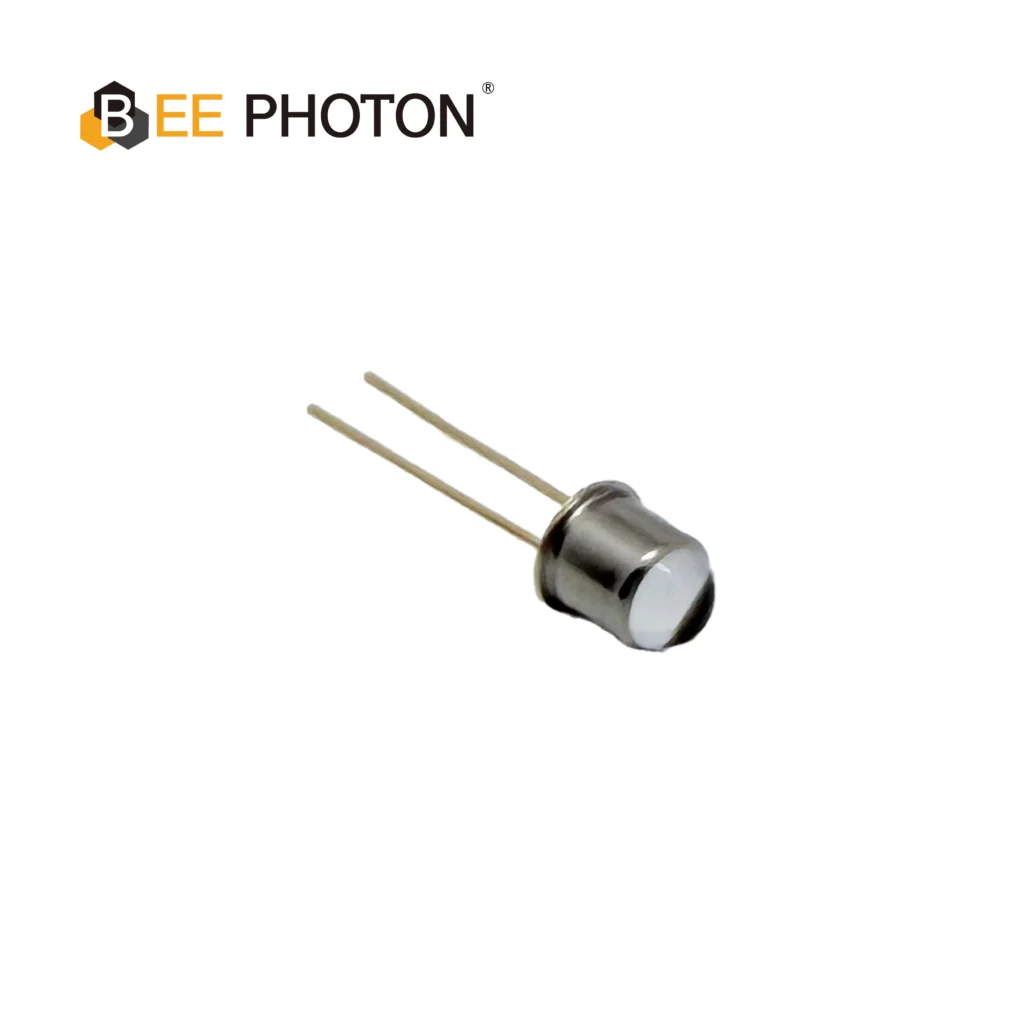
NIR LED E850-180-201L4
The E850-180-201L4 is a high-performance 850nm NIR LED engineered for precision industrial sensing. Manufactured by Bee Photon, this infrared emitter is designed to deliver high luminosity and exceptional stability, making it the ideal light source for demanding automation environments.
Real-World Engineering Success Story
Let’s talk about a real scenario we encountered. We worked with a manufacturer of high-precision robotic joints who was trying to upgrade their absolute rotary encoders from 12-bit to 18-bit resolution. They kept getting strange signal distortion whenever the ambient temperature inside the robotic arm climbed past 50 degrees Celsius.
Initially, they were using a generic point-source LED as their optical encoder light source. While it worked okay on the lab bench at room temperature, the wider beam divergence and thermal drift of the generic optical encoder light source caused the output signal contrast to drop by over 30%. This drop triggered position-reporting errors, which caused the robotic arm to jitter during precise micro-positioning tasks.
Our engineering team suggested swapping their generic emitter with a high-reliability, custom-lens 4-degree optical encoder light source from BeePhoton. Because the 4-degree narrow beam LED kept the light highly parallel, the signal contrast remained sharp and stable even as the operating temperature shifted. The new optical encoder light source instantly solved the crosstalk between the fine absolute tracks on the glass disc. The manufacturer successfully achieved their 18-bit resolution target without changing their photodetector layout or redesigning their entire housing. That’s the power of selecting the right optical encoder light source for the job.
How to Select the Ideal Optical Encoder Light Source
When you’re sourcing an optical encoder light source for a B2B product line, you can’t just pick any random part off a distributor’s shelf. You need to keep several key specifications in mind:
1. Wavelength Matching
Your optical encoder light source must align perfectly with the peak sensitivity of your photodiode or photo IC. Typically, infrared wavelengths around 850 nm or 870 nm are ideal because silicon photodetectors have excellent quantum efficiency in this range. For ultra-fine resolutions, some engineers opt for visible blue or green wavelengths to minimize diffraction limits.
2. Optical Output Power (Intensity)
The optical encoder light source needs to provide enough radiant intensity so that the photodiode array can generate a strong signal, but not so much that it saturates the receiver. A highly efficient focused beam LED diode ensures you get maximum light concentration on the active sensor area without needing to draw high drive currents.
3. Packaging and Lens Quality
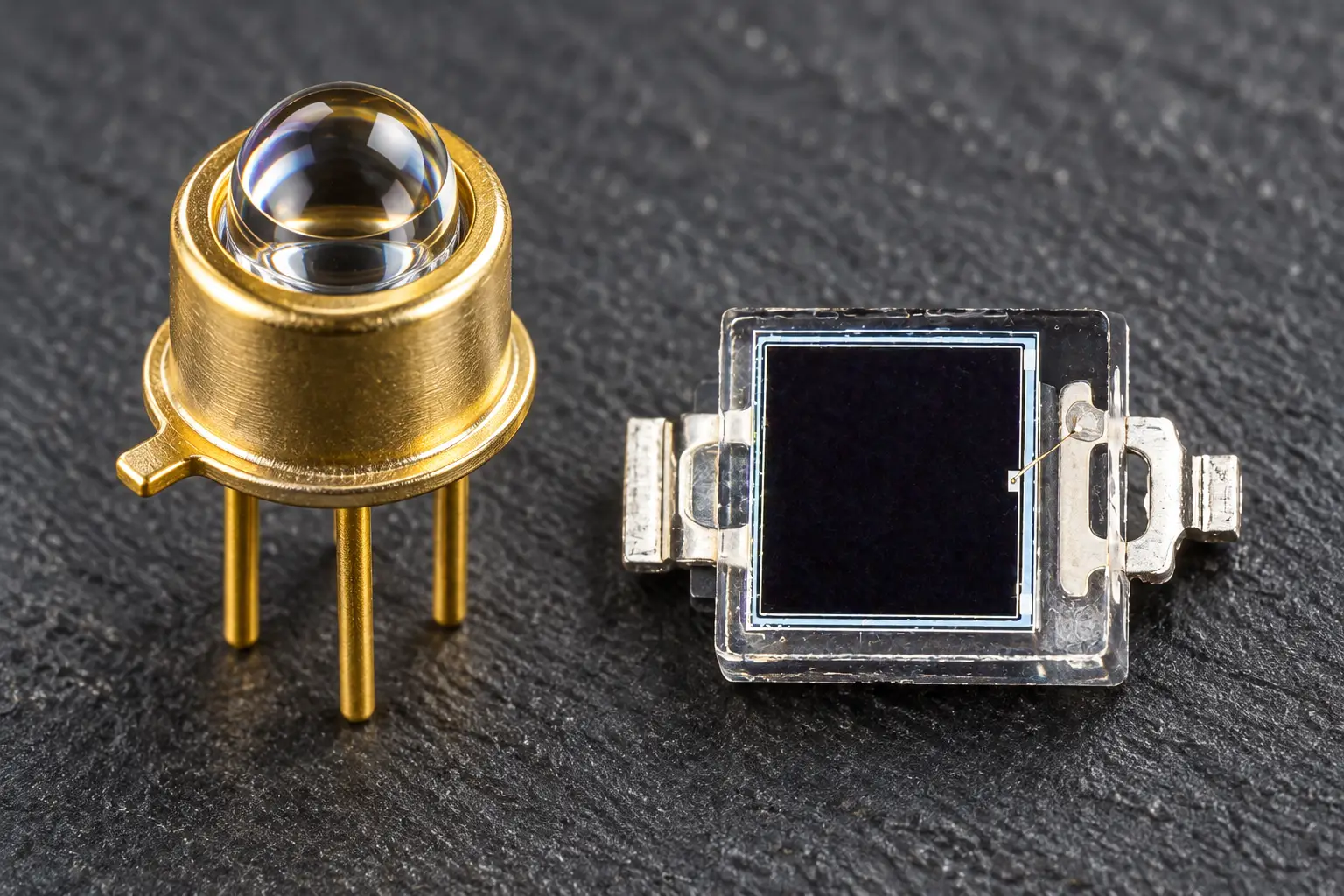
The physical package of your optical encoder light source dictates how it mounts to your PCB. Metal-can packages (like TO-18 or TO-46) with hermetically sealed glass dome lenses offer incredible optical clarity and physical protection in harsh industrial environments. For ultra-compact designs, specialized surface-mount (SMD) packages with integrated micro-lenses are also popular.
By focusing on these parameters, you ensures that your selected optical encoder light source matches both the physical and electrical constraints of your encoder assembly, paving the way for a smooth manufacturing process.
If you are currently evaluating your options, you can check out our wide variety of industrial-grade emitters on the BeePhoton light source product category page. We’ve worked hard to optimize these components specifically for demanding motion control applications.

Si PIN Photodiode Array PDCA02-102
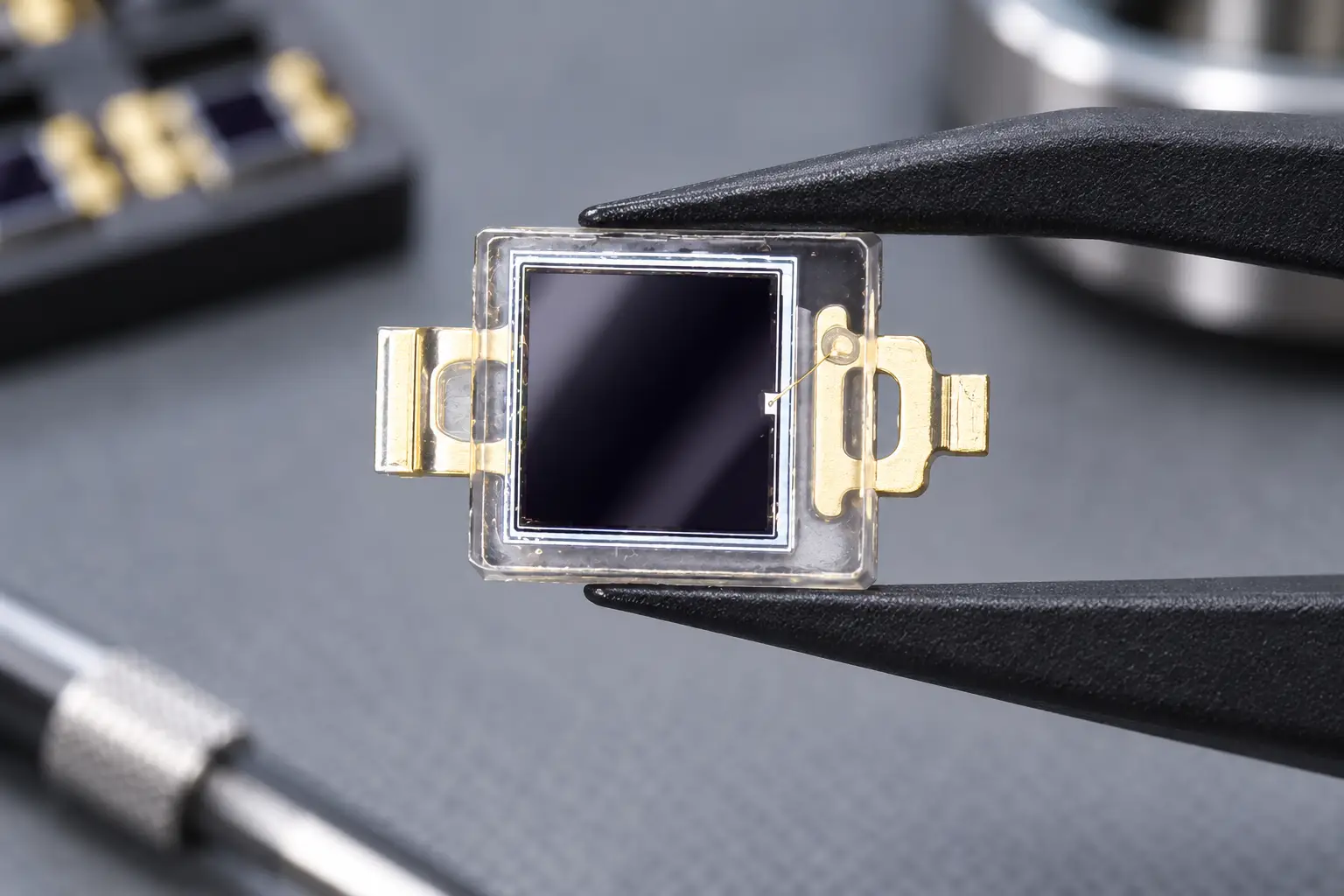
The PDCA02-102 is a high-performance Si PIN Photodiode Array designed for precision optical measurement and alignment systems. Engineered by Bee Photon, this 2-segment photodiode delivers a wide spectral response range from 400nm to 1100nm, covering the entire visible light spectrum into the near-infrared (NIR) region.
With its compact COB (Chip on Board) package and resin window, the PDCA02-102 ensures durability and easy integration into compact optical modules. It is specifically optimized for industrial applications where high sensitivity and fast response times are critical.
FAQ: Common Optical Encoder Light Source Questions
Q1: Can I replace my existing, wider-angle emitter with a 4-degree optical encoder light source without changing my PCB design?
In many cases, yes! If your current optical encoder light source uses a standard package size like TO-46 or TO-18, you can usually find a 4-degree focused beam LED diode that shares the exact same footprint. However, because the light is much more focused, you might need to adjust your LED drive current (forward current) to make sure you aren’t saturating your photodetector array. We always recommend doing a quick spin in the lab to tune the signal levels.
Q2: How does temperature affect the performance of a 4-degree optical encoder light source?
All LEDs experience some degree of light output degradation as temperature rises. However, high-quality B2B-grade LEDs are designed with advanced semiconductor materials that minimize this thermal drift. When you use a 4-degree optical encoder light source, the highly collimated beam ensures that even if the absolute light output drops slightly at high temperatures, the sharp contrast of the light-to-dark transitions on your photodetector remains intact, preventing signal loss.
Q3: Is a point-source LED the same thing as a 4-degree optical encoder light source?
Not exactly, though they are closely related. A point source emitter (PSE) has a tiny, well-defined physical aperture (often 25 to 150 microns) which makes the light look like a single, perfect point. A 4 degree beam angle LED refers to the narrow divergence of the light beam, which is achieved by shaping the light with a high-precision dome lens. Many top-tier encoders combine these technologies, using a point-source die inside a hermetic dome package to create the ultimate highly collimated optical encoder light source.
Ready to Upgrade Your Optical Encoder?
Are you tired of dealing with sloppy signal contrast, high crosstalk, and erratic encoder feedback at high temperatures?
If you are designing the next generation of high-resolution robotic joints, CNC machine spindles, or medical scanning devices, you cannot afford to compromise on your light emitter. A generic LED simply won’t cut it when you are pushing for sub-micron precision.
At BeePhoton, we specialize in manufacturing rugged, highly collimated LED for high-resolution encoders designed to drop directly into your high-precision motion control systems. Our 4-degree narrow beam emitters provide the near-parallel light path you need to eliminate signal blur, reduce positioning errors, and keep your sensors operating smoothly under harsh industrial conditions.
Don’t let a weak link in your optical path compromise your entire device’s accuracy. Upgrade your design with a premium optical encoder light source today. To discuss your specific project requirements, request detailed datasheets, or get a custom quote, please contact our engineering team or email us directly at info@photo-detector.com. Let’s work together to make your optical sensors as precise and reliable as they can possibly be!