If you design industrial equipment that has to keep working reliably from -40 °C all the way up to 100 °C, you already know that photodiodes can be a headache when the temperature swings wildly. One of the biggest troublemakers is the temperature coefficient of dark current.
I’ve spent the last twelve years helping companies pick the right Si PIN photodiodes for harsh environments, and I can tell you this: ignoring the temp coefficient of dark current is one of the fastest ways to watch your signal-to-noise ratio fall apart.
Let’s talk about what it actually means, why it matters so much in real industrial applications, and how to deal with it without losing your mind.
What Is Dark Current Anyway?
Dark current is the small electrical current that flows through a photodiode even when no light is hitting it. Think of it as the photodiode’s “leakage” when it’s supposed to be asleep.
In most silicon PIN photodiodes, this current is tiny at room temperature — often in the picoamp or low nanoamp range. But here’s the thing: it doesn’t stay tiny when things get hot.
Why Temperature Coefficient of Dark Current Matters in Industrial Design
The temperature coefficient of dark current tells you how fast that leakage current grows as temperature rises. For silicon photodiodes, dark current typically doubles roughly every 8–10 °C. That’s not a gentle slope — that’s exponential growth.
When your equipment needs to operate across a -40 °C to 100 °C range, this exponential behavior becomes a serious design constraint. At 100 °C, your dark current can easily be 200–500 times higher than at 25 °C. That directly eats into your dynamic range and makes weak optical signals much harder to detect.
I once worked with a client building pipeline inspection robots. Their original photodiode looked perfect on paper at 25 °C. At 85 °C inside the pipe, the dark current shot up so high they couldn’t see the return signal anymore. We had to completely redesign the optical front-end.
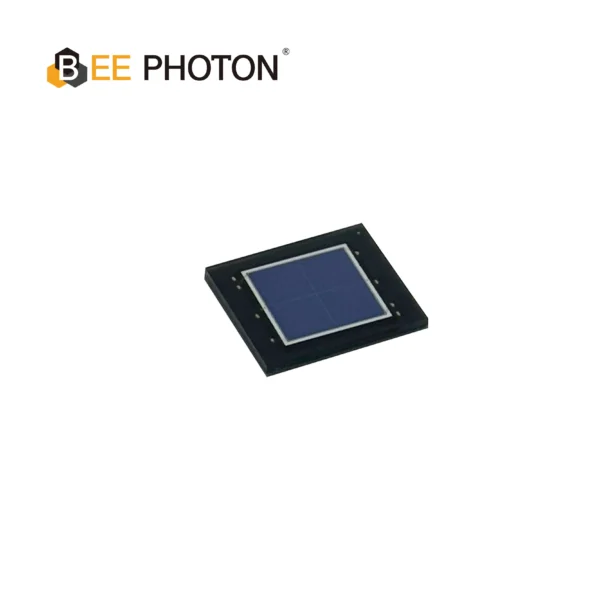
Si PIN Photodiode Array Four-quadrant PD PDCA04-102
Looking for a high-performance B2B Si PIN Photodiode Array for precision sensing? The PDCA04-102 is a premium four-quadrant detector designed for industrial OEM applications. Featuring a robust 16.5×14.5mm package with four large 5×5mm photosensitive elements, this array delivers exceptional consistency and sensitivity for position detection and laser alignment systems. Partner with Bee Photon for reliable bulk manufacturing and custom solutions.
How Dark Current Changes with Temperature (The Math Made Simple)
Instead of throwing scary LaTeX at you, here’s the practical relationship most engineers actually use:
Id(T) ≈ Id(T0) × 2^((T – T0)/ΔT)
Where:
- Id(T) = dark current at temperature T
- Id(T0) = dark current at reference temperature (usually 25 °C)
- ΔT = temperature coefficient in °C (typically 8–10 °C for silicon)
For many BeePhoton Si PIN photodiodes, we see a doubling every ~9 °C. Let me show you what that actually looks like in real numbers:
| Temperature (°C) | Multiplication Factor | Dark Current Example (if 1 nA at 25°C) |
|---|---|---|
| -40 | 0.006 | 6 pA |
| 25 | 1.0 | 1.0 nA |
| 60 | 13.0 | 13 nA |
| 85 | 58.0 | 58 nA |
| 100 | 150+ | 150+ nA |
You can see why thermal management or compensation becomes critical above 60 °C.
Temp Coefficient Photodiode vs Thermal Noise — Don’t Mix Them Up
A lot of designers I talk to confuse the temperature coefficient of dark current with thermal (Johnson) noise. They’re related but not the same.
Thermal noise comes from the random motion of electrons in the resistance and increases with the square root of temperature. Dark current, on the other hand, is a leakage current that increases exponentially with temperature.
In many industrial applications between -40 °C and 100 °C, the dark current shot noise actually dominates over thermal noise once you pass about 50–60 °C. That’s why understanding the temp coefficient of dark current is usually more important than worrying about thermal noise in these temperature ranges.
Id vs Temp: What Real Curves Look Like
When you look at Id vs Temp plots from different manufacturers, you’ll notice two things:
- The curves are nearly straight lines on a logarithmic scale (which confirms the exponential behavior).
- Different photodiode structures show very different slopes.
At BeePhoton, we’ve spent years optimizing our silicon PIN photodiodes specifically for flatter Id vs Temp curves in industrial temperature ranges. Some of our high-temperature series show significantly lower temperature coefficients than standard catalog parts.
Practical Ways to Handle Temperature Coefficient of Dark Current
Here’s what actually works in the field:
1. Choose the Right Photodiode from the Start
Not all Si PIN photodiodes behave the same. Look specifically for parts rated for extended temperature with documented low temp coefficient of dark current. Our Si PIN photodiodes category includes several families designed for exactly this kind of industrial abuse.
2. Active Temperature Compensation
Some of the more sophisticated systems I’ve helped design use a temperature sensor near the photodiode to dynamically adjust the bias voltage or subtraction current. It’s more complex but can give you nearly flat response across -40 to 85 °C.
3. Cooling Where Possible
In some industrial enclosures, even simple passive cooling or heat sinking can drop the photodiode temperature by 15–20 °C, which cuts dark current by a factor of 4 or more. Sometimes the cheapest fix is keeping the detector cooler.
4. Accept It and Design Around It
In many cases, the cleanest approach is to simply measure at the highest expected temperature and make sure your signal is still strong enough. I’ve seen plenty of successful designs that just live with higher dark current but use much stronger light sources or better modulation techniques.
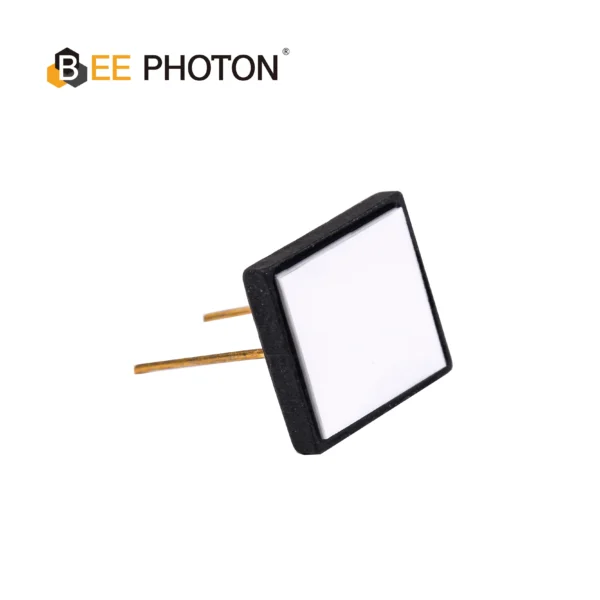
Si PIN Photodiode with scintillantor PDCD34-102
Bee Photon’s Si PIN photodiodes with scintillator deliver superior X-ray and gamma-ray detection.Our GOS scintillator photodiode ensures high light output and minimal afterglow for precise imaging.
Real-World Success Story (Anonymous Industrial Client)
One of our clients builds laser-based distance sensors for steel mills where ambient temperatures regularly hit 90 °C. Their first attempt using standard photodiodes failed qualification because the measurement uncertainty became too large at high temperatures.
After switching to one of our specialized low dark current Si PIN photodiodes and adding a simple software compensation curve based on the known temperature coefficient of dark current, they passed qualification with margin. The system has now been running in multiple mills for over three years with zero temperature-related field failures.
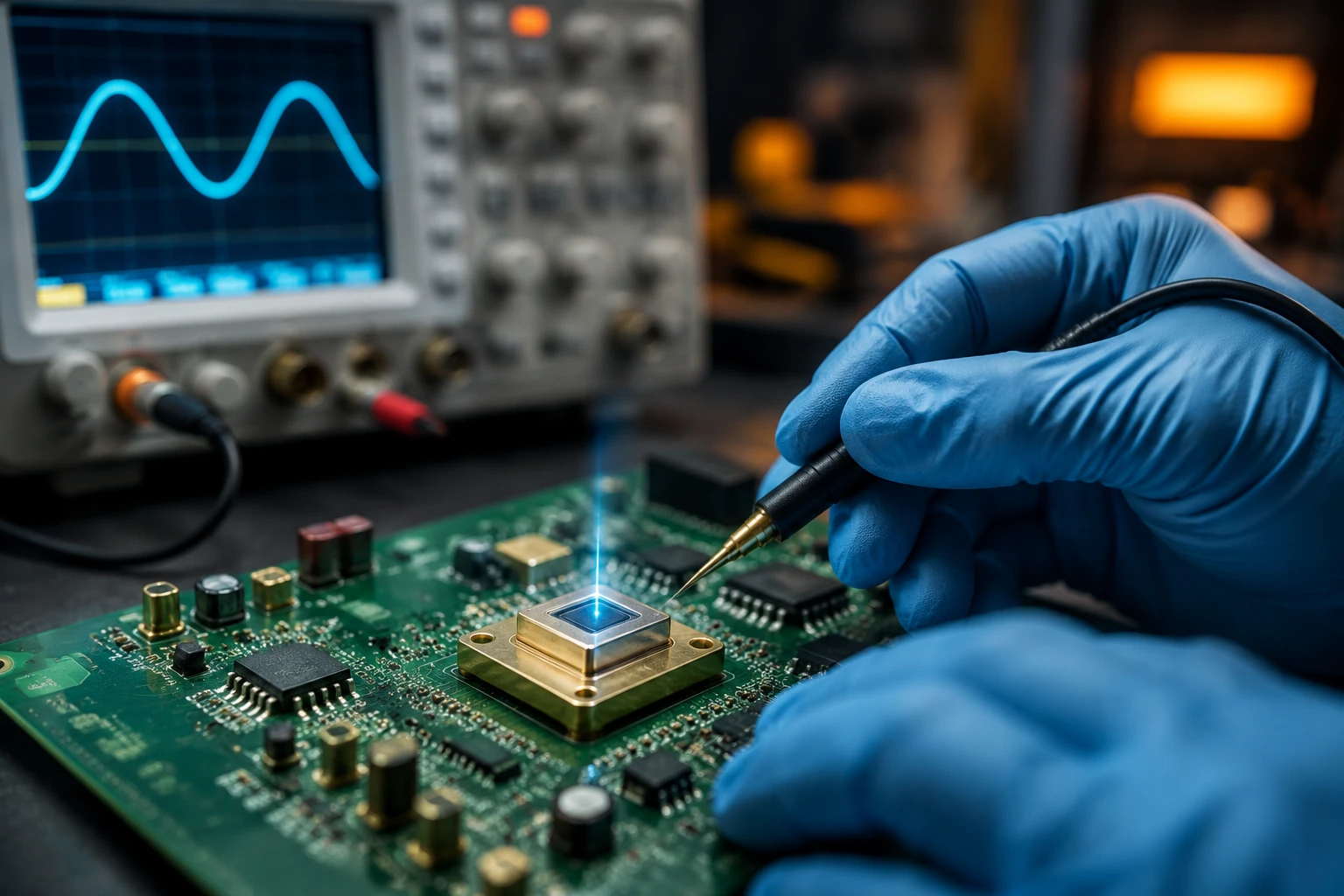
How to Measure Temperature Coefficient of Dark Current Yourself
If you want to characterize parts yourself (which I highly recommend), here’s the practical method:
- Use a temperature-controlled chamber or good Peltier setup
- Measure dark current at 10 °C intervals from -40 °C to 100 °C
- Keep the photodiode in complete darkness (use proper shielding)
- Wait for thermal equilibrium at each step (this is where most people rush it)
- Plot on semi-log scale
You’ll quickly see if you’re dealing with a well-behaved part or one that will bite you at high temperatures.
Choosing Photodiodes with Better Temp Coefficient Performance
When comparing datasheets, look beyond the room temperature dark current spec. The real question is: what will the dark current be at my maximum operating temperature?
At BeePhoton we publish dark current values at both 25 °C and 85 °C for most of our industrial-grade photodiodes because we know that’s what our customers actually care about.
Wrapping Up
The temperature coefficient of dark current isn’t some obscure parameter you can safely ignore. For anyone designing equipment that must operate reliably across wide temperature ranges, it’s one of the fundamental limitations you have to design around.
Get this part right and your photodetection system will stay stable. Get it wrong and you’ll be chasing temperature-dependent drift for months.
If you’re currently wrestling with temperature-dependent performance in your photodiodes, we’d be happy to look at your requirements. Drop us a line through our contact page or email info@photo-detector.com. We’ve helped quite a few industrial designers solve exactly this problem.
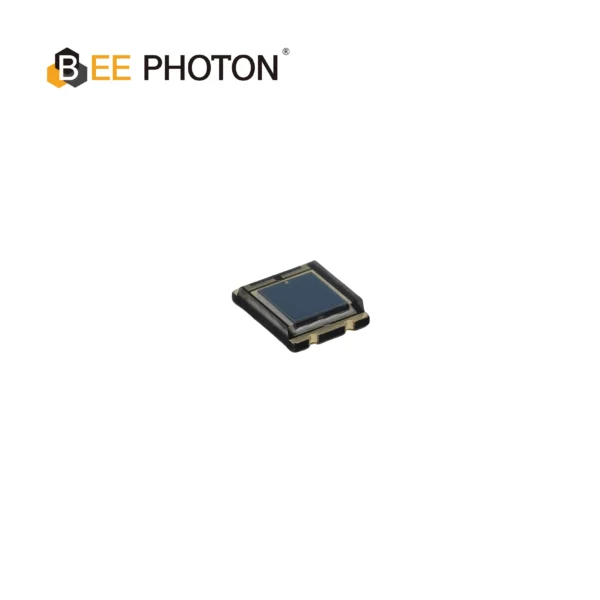
Si PIN Photodiode with NIR sensitivity enchanced (430-1100nm) PDCP08-201
The PDCP08-201 is a high-performance SMD Si PIN Photodiode designed for precision optical communication and medical sensing.[1] Featuring a large 2.9×2.9 mm active area with enhanced NIR sensitivity (0.70 A/W) and ultra-low dark current (20 pA), this SMD Si PIN Photodiode ensures superior signal detection and reliability in a compact surface-mount package.
FAQ
What is a typical temperature coefficient of dark current for silicon PIN photodiodes?
Most standard silicon PIN photodiodes show dark current doubling approximately every 8–10 °C. Some specialized industrial versions from BeePhoton achieve better performance, especially in the 60–100 °C range.
Does thermal noise or dark current dominate at high temperatures?
In most industrial applications between 50 °C and 100 °C, the shot noise from the increased dark current becomes the dominant noise source, making the temperature coefficient of dark current more critical than thermal (Johnson) noise.
Can I compensate for high temperature coefficient of dark current in software?
Yes, many systems successfully use temperature compensation curves in firmware. However, this works best when you start with photodiodes that have repeatable and well-documented Id vs Temp behavior.